The Third Eye of Shiva Myth Meaning & Symbolism
The myth of Shiva's Third Eye, a blazing eye of wisdom on his forehead, which opens to incinerate illusion and restore cosmic order through purifying fire.
The Tale of The Third Eye of Shiva
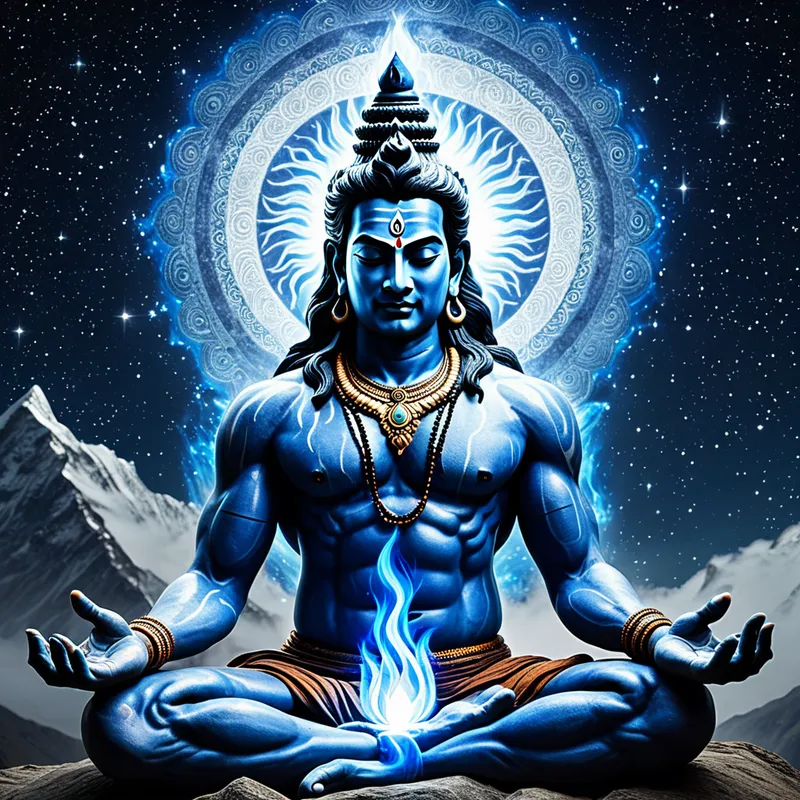
In the beginningless time, when the worlds were young and the rhythms of creation and dissolution beat like a slow, cosmic heart, there was a silence. It was not an empty silence, but a profound, potent stillness that dwelled in the high, icy fastnesses of [Mount Kailash](/myths/mount-kailash “Myth from Hindu culture.”/). Here, wrapped in the skin of a tiger, his body pale as moonlit ash, sat [Shiva](/myths/shiva “Myth from Hindu culture.”/), the great ascetic. His eyes were closed, turned inward upon the infinite universe within. He was the still axis of the turning world, immersed in [samadhi](/myths/samadhi “Myth from Buddhist culture.”/) so deep that the roots of the mountains grew from his stillness, and the stars were but reflections of his [inner light](/myths/inner-light “Myth from Buddhist culture.”/).
But in the celestial realms, a crisis brewed. A demon, Taraka, had plunged the heavens into chaos. His boon made him invulnerable to all but a son born of Shiva. Yet Shiva, the eternal yogi, had withdrawn from all worldly attachment, his heart frozen in the ice of perfect renunciation. There was no consort, no prospect of a child. Desperation filled the courts of the gods.
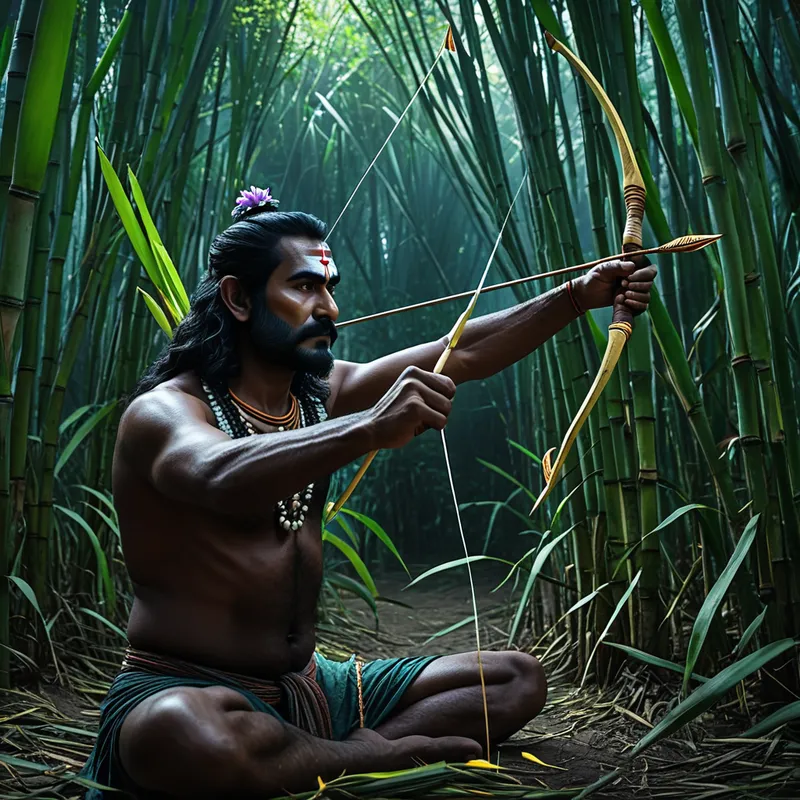
Their hope rested on [Lakshmi](/myths/lakshmi “Myth from Hindu culture.”/), who whispered of a solution. There was another, Rati, whose very essence was the antidote to ascetic withdrawal. And she had a husband: Kama, the beautiful, mischievous god of desire. Armed with his bow of sugarcane and arrows tipped with intoxicating flowers, Kama was dispatched to the silent slopes of Kailash.
The air, once crisp with the scent of pine and snow, grew heavy with the perfume of [jasmine](/myths/jasmine “Myth from Persian culture.”/) and mango blossom. Bees drowsed. The very stones seemed to yearn. Kama, hidden among the deodar trees, drew his bow. He aimed not at flesh, but at the fortress of Shiva’s consciousness. He let fly.
The arrow, named Unmadana – the Maddening One – streaked through the sacred silence. It found its mark. In the fathomless depths of his meditation, Shiva felt a tremor. A forgotten warmth, a memory of spring, a pull towards form and beauty stirred. His inward-gazing eyes trembled. And in that moment, his gaze fell upon Uma, the daughter of the mountain, who had been performing fierce austerities nearby to win him as her lord.
The universe held its breath. The delicate balance was shattered. The stirring of desire in the master of renunciation was a cosmic paradox. And from that paradox, a fury was born—not of pettiness, but of a divine principle violated. Shiva’s closed eyes snapped open. [The third eye](/myths/the-third-eye “Myth from Hindu culture.”/), the vertical eye of wisdom that rests upon the forehead, the eye that sees not [the world of forms](/myths/the-world-of-forms “Myth from Platonic culture.”/) but the blazing truth of reality, burst open.
It was not a look, but a conflagration. A pillar of searing, blue-white flame erupted from his brow. It was pure consciousness made fire, the light of absolute knowledge that consumes all illusion. The beam found Kama. There was no scream, only a silent, instantaneous reduction to ashes. The god of form, attachment, and sensory allure was vaporized by the formless, detached fire of supreme awareness. The perfumed air cleared. The unsettling warmth vanished, replaced by the original, sacred cold. Order—a terrible, devastating order—was restored. The [Third Eye](/myths/third-eye “Myth from Hindu culture.”/) had spoken, and its language was annihilation.
Cultural Origins & Context
This potent narrative is woven into the vast tapestry of the Itihasas and Puranas, particularly the Shiva Purana and Kumarasambhava by the poet Kalidasa. It was not merely a story of divine conflict but a foundational teaching tool, passed down by sages (rishis) and storytellers (kathakars) to illustrate the core tenets of Shaivism. Its societal function was multifaceted: it explained the nature of Shiva as both terrifying ascetic (Bhairava) and potential householder, validated the path of yogic renunciation, and served as a cautionary tale about the power of divine will over even the most fundamental human (and divine) impulses. The myth established the Third Eye not as a mere physical feature, but as the ultimate instrument of cosmic correction.
Symbolic Architecture
The Third Eye is the central [symbol](/symbols/symbol “Symbol: A symbol can represent an idea, concept, or belief, serving as a powerful tool for communication and understanding.”/), representing a mode of [perception](/symbols/perception “Symbol: The process of becoming aware of something through the senses. In dreams, it often represents how one interprets reality or internal states.”/) beyond the dualistic senses. The two physical eyes see duality—good and evil, [beauty](/symbols/beauty “Symbol: This symbol embodies aesthetics, harmony, and the appreciation of life’s finer qualities.”/) and ugliness, attraction and repulsion. The Third Eye sees unity, the underlying [reality](/symbols/reality “Symbol: Reality signifies the state of existence and perception, often reflecting one’s understanding of truth and life experiences.”/) (Brahman), and the [truth](/symbols/truth “Symbol: Truth represents authenticity, honesty, and the quest for knowledge beyond mere appearances.”/) of all forms as transient.
The opening of the Third Eye is not an act of seeing, but of incinerating. It destroys the veil (maya) so that reality, in its nakedness, may be.
[Kama](/symbols/kama “Symbol: A ritual sickle or curved blade used in Hindu and Buddhist traditions, symbolizing the cutting of attachments and spiritual liberation.”/) represents kama (desire) itself—the binding, attractive force that fuels the cycle of [birth](/symbols/birth “Symbol: Birth symbolizes new beginnings, transformation, and the potential for growth and development.”/) and [rebirth](/symbols/rebirth “Symbol: A profound transformation where old aspects of self or life die, making way for new beginnings, growth, and renewal.”/) ([samsara](/myths/samsara “Myth from Buddhist culture.”/)). He is not “evil,” but a necessary, creative [energy](/symbols/energy “Symbol: Energy symbolizes vitality, motivation, and the drive that fuels actions and ambitions.”/) that becomes destructive when it disturbs the [equilibrium](/symbols/equilibrium “Symbol: A state of balance, stability, or harmony between opposing forces, often representing inner peace or external order.”/) required for liberation ([moksha](/myths/moksha “Myth from Hindu culture.”/)). Shiva’s [incineration](/symbols/incineration “Symbol: Complete destruction by fire, often representing purification, sacrifice, or irreversible transformation in spiritual and mythological contexts.”/) of [Kama](/symbols/kama “Symbol: A ritual sickle or curved blade used in Hindu and Buddhist traditions, symbolizing the cutting of attachments and spiritual liberation.”/) symbolizes the yogi’s ultimate transcendence of all sensory attachment. Yet, the myth’s [resolution](/symbols/resolution “Symbol: In arts and music, resolution refers to the movement from dissonance to consonance, creating a sense of completion, release, or finality in a composition.”/) is not an end. Rati’s lament moves Shiva, who later restores [Kama](/symbols/kama “Symbol: A ritual sickle or curved blade used in Hindu and Buddhist traditions, symbolizing the cutting of attachments and spiritual liberation.”/) as Ananga, “the bodiless one.” This reveals a deeper truth: desire, when stripped of its addictive, form-bound power (made bodiless), becomes pure, creative [energy](/symbols/energy “Symbol: Energy symbolizes vitality, motivation, and the drive that fuels actions and ambitions.”/) in service of [consciousness](/symbols/consciousness “Symbol: Consciousness represents the state of awareness and perception, encompassing thoughts, feelings, and experiences.”/), not its master.
The Dreamer’s Resonance
When this myth pattern stirs in the modern dreamer, it often signals a profound psychological crisis point. To dream of a burning forehead, a piercing light from within the skull, or the sudden, ash-fall destruction of a cherished obsession or relationship, is to encounter the [psyche](/myths/psyche “Myth from Greek culture.”/)’s own “Shiva principle.”
Somatically, this may manifest as tension headaches, a feeling of pressure at the brow, or intense, purifying fevers. Psychologically, the dreamer is undergoing a necessary, often violent, deconstruction. The “Kama” being burned could be an outworn identity, a compulsive pattern, a cherished illusion about oneself or another. The Third Eye in the dream is [the Self](/myths/the-self “Myth from Jungian culture.”/)’s ruthless compassion, activating to burn away what [the ego](/myths/the-ego “Myth from Jungian culture.”/) clings to, no matter how beautiful or seemingly essential, because it blocks the path to a more authentic existence. It is the psyche’s radical surgery.
Alchemical Translation
The alchemical journey modeled here is the transmutation of identificatio (identification with desires and forms) into liberatio (liberated consciousness). For the individual, the “meditation on Kailash” is the hard-won stage of introspection and withdrawal from external validation. The “arrow of Kama” is the seductive pull of old habits, the lure of falling back into comfortable patterns of thought, relationship, or addiction.
The individuation crisis occurs when the seduction of the known meets the silent, terrifying pull of the true Self. One must be incinerated for the other to live.
Opening the “Third Eye” is the conscious, willful act of choosing truth over comfort. It is the moment one says, “This pattern, though familiar, is killing my spirit,” and allows a purifying inner fire to destroy it. This is not a cold act, but one of immense, transformative heat. The “ash” left behind is the vibhuti (sacred ash) of the old self, which the newly aligned individual wears as a testament to what has been sacrificed and transcended. The restored “bodiless Kama” is the redeemed energy of passion and creativity, now free to serve the individual’s deepest purpose, no longer as a blind master, but as a willing instrument of the awakened Self. The myth thus maps the passage from being enslaved by desire to wielding desire’s energy in the service of one’s own cosmic destiny.
Associated Symbols
Explore related symbols from the CaleaDream lexicon: