The Thing Myth Meaning & Symbolism
The sacred assembly where gods and mortals gather to speak law into being, forging order from chaos through the power of collective voice and sacrifice.
The Tale of The Thing
Hear now of the first sound that was not wind or wave, not the growl of beast or the crack of frost. It was the sound of a word spoken into the silence of [the world](/myths/the-world “Myth from Tarot culture.”/). It was the sound of Law.
In the dawning of ages, when the worlds were still young and raw, the gods themselves walked in uncertainty. Odin had drunk from the well of fate, but its visions were a tangled skein. The mighty Thor could break mountains, but could not mend a broken oath. Chaos was not just the [Jotunn](/myths/jotunn “Myth from Norse culture.”/) at the gates; it was in the very spaces between them, in disputes with no resolution, in grievances that festered like wounds.
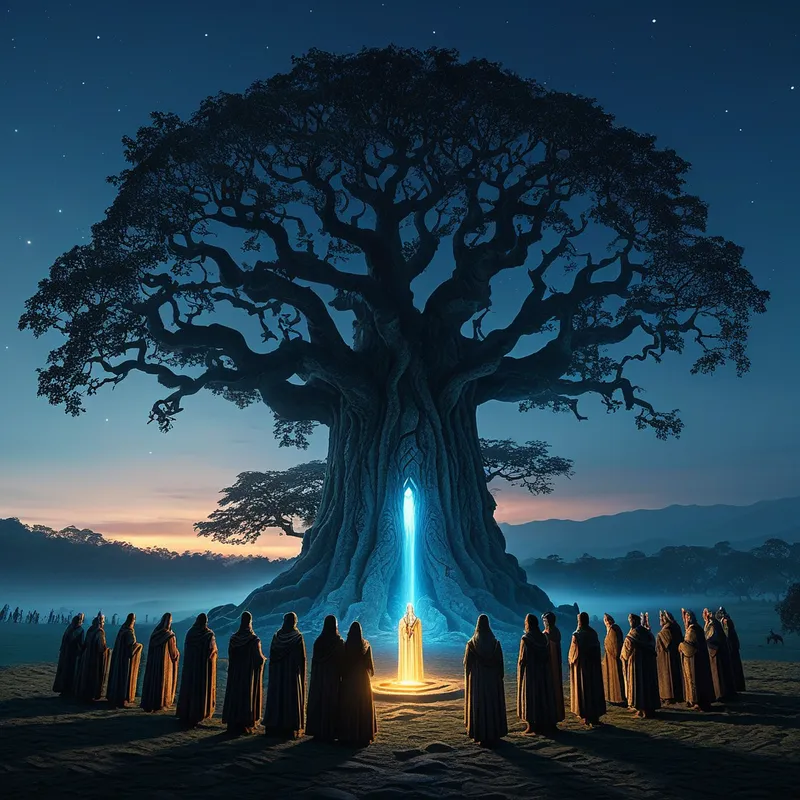
So the Allfather called a gathering. Not in the golden halls of [Valhalla](/myths/valhalla “Myth from Germanic culture.”/), but in a place between and of all. They chose a plain, open and vast, beneath the reaching branches of the [Yggdrasil](/myths/yggdrasil “Myth from Global/Universal culture.”/) itself. To this place came the Æsir and the Vanir, their ancient war still a quiet scar. The [light elves](/myths/light-elves “Myth from Norse culture.”/) came, their forms shimmering like mist in morning light. Even [the dwarves](/myths/the-dwarves “Myth from Norse culture.”/), from their stone roots, sent their voices. And from [Midgard](/myths/midgard “Myth from Norse culture.”/), the chosen representatives of humankind crossed the trembling bridge to stand in the presence of the divine.
This was the [Thing](/myths/thing “Myth from Norse culture.”/). No roof but [the sky](/myths/the-sky “Myth from Persian culture.”/). No walls but [the horizon](/myths/the-horizon “Myth from Various culture.”/). In the center was a great stone, the lögberg, cold and immutable. The air was thick with the scent of damp earth and distant pine, charged with the breath of hundreds.
One by one, they stepped forward. Not with weapons, but with words. A god accused a neighbor of moving a boundary stone. An elf spoke of a stolen song. A human chief, his voice trembling yet clear, laid out a blood-feud that had consumed three generations. Each speaker held a staff, the symbol of their right to be heard. The crowd listened, a living, breathing entity. There were no shouts, only the profound weight of attention.
Then came the judgment. Not from Odin alone, but from the collective. Voices rose in agreement or dissent, weaving a tapestry of consensus. The verdicts were not mere punishments; they were reparations, resolutions, sentences designed to restore balance, not merely inflict pain. Silver was weighed for a life. Oaths were sworn on the sacred ring. A feud was ended with a marriage pact. With each resolution, spoken aloud and ratified by the assembly’s murmur, something happened in the world. The chaotic strands of fate tightened into a recognizable pattern. A new force entered the cosmos: [Justice](/myths/justice “Myth from Tarot culture.”/). Not as a divine decree from on high, but as a living thing, born from the soil of debate and watered by the collective will.
The assembly closed not with a feast, but with a solemn silence. [The law](/myths/the-law “Myth from Biblical culture.”/) had been spoken. It now existed, as real as the stone at their feet or the tree above their heads. They had not received order; they had created it. And they would return, season after season, to tend to it, for they knew that without the Thing, the world would slide back into the silent, lawless dark.

Cultural Origins & Context
The Thing was not merely a mythological concept but the bedrock of Germanic and Norse societal structure. These were the regional and national assemblies where free people—farmers, warriors, chiefs—gathered to settle disputes, try cases, elect leaders, and decide matters of war and peace. The mythologizing of the Thing reflects its sacred, foundational role.
It was a profoundly liminal space, both physically and legally. Often held at neutral, ancient sites marked by boundary stones or [sacred groves](/myths/sacred-groves “Myth from Celtic culture.”/), it was a time-out-of-time. The gathering was under the protection of the gods, particularly Tyr, the one-handed god who sacrificed his hand to bind the wolf [Fenrir](/myths/fenrir “Myth from Norse culture.”/), embodying the cost of upholding law. The law-speaker, who recited the laws from memory, was a revered figure, a living conduit of tradition. The myth served to sanctify this human institution, projecting its origins onto the divine plane, thereby granting it immutable authority and cosmic significance. It taught that order is not inherent but forged, and that every individual voice was a thread in the fabric of society.
Symbolic Architecture
At its core, the myth of the Thing is a master [symbol](/symbols/symbol “Symbol: A symbol can represent an idea, concept, or belief, serving as a powerful tool for communication and understanding.”/) for the [emergence](/symbols/emergence “Symbol: A process of coming into being, rising from obscurity, or breaking through a barrier, often representing birth, transformation, or revelation.”/) of [consciousness](/symbols/consciousness “Symbol: Consciousness represents the state of awareness and perception, encompassing thoughts, feelings, and experiences.”/) from the unconscious, of differentiated order from primal unity.
The circle around the law-rock is the psyche drawing a boundary around a point of awareness, creating a sacred space where the inner chaos can be named and addressed.
The open plain beneath Yggdrasil represents the totality of the [psyche](/myths/psyche “Myth from Greek culture.”/)—[the Self](/myths/the-self “Myth from Jungian culture.”/). All aspects, from the lofty spiritual aspirations (the gods and elves) to the instinctual and chthonic forces (implied, but held at bay by [the law](/symbols/the-law “Symbol: Represents external rules, societal order, moral boundaries, and the tension between personal freedom and collective structure.”/)), to the everyday ego (the humans), have a right to attend. The lögberg is the central, immutable principle of objective [truth](/symbols/truth “Symbol: Truth represents authenticity, honesty, and the quest for knowledge beyond mere appearances.”/) or the core Self around which the [personality](/symbols/personality “Symbol: Personality in dreams often symbolizes the traits and characteristics of the dreamer, reflecting how they perceive themselves and how they believe they are perceived by others.”/) must organize. The act of speaking one’s [case](/symbols/case “Symbol: A case often signifies containment, protection of personal matters, and the need for organization in one’s life.”/) is the act of bringing a complex, unconscious conflict—a [resentment](/symbols/resentment “Symbol: A deep-seated emotional bitterness from perceived unfairness or injury, often festering silently and poisoning relationships.”/), a [guilt](/symbols/guilt “Symbol: A painful emotional state arising from a perceived violation of moral or social standards, often tied to actions or inactions.”/), a desire—into the clear light of conscious examination. The collective judgment is the integrative function of the [psyche](/myths/psyche “Myth from Greek culture.”/), weighing different inner values and impulses to arrive at a ruling that serves the whole being, not just one compulsive part.
The [absence](/symbols/absence “Symbol: The state of something missing, void, or not present. Often signifies loss, potential, or existential questioning.”/) of a single, tyrannical judge is crucial. Order is not imposed by a kingly ego (Odin); it is a negotiated settlement between the various archetypal forces within.

The Dreamer’s Resonance
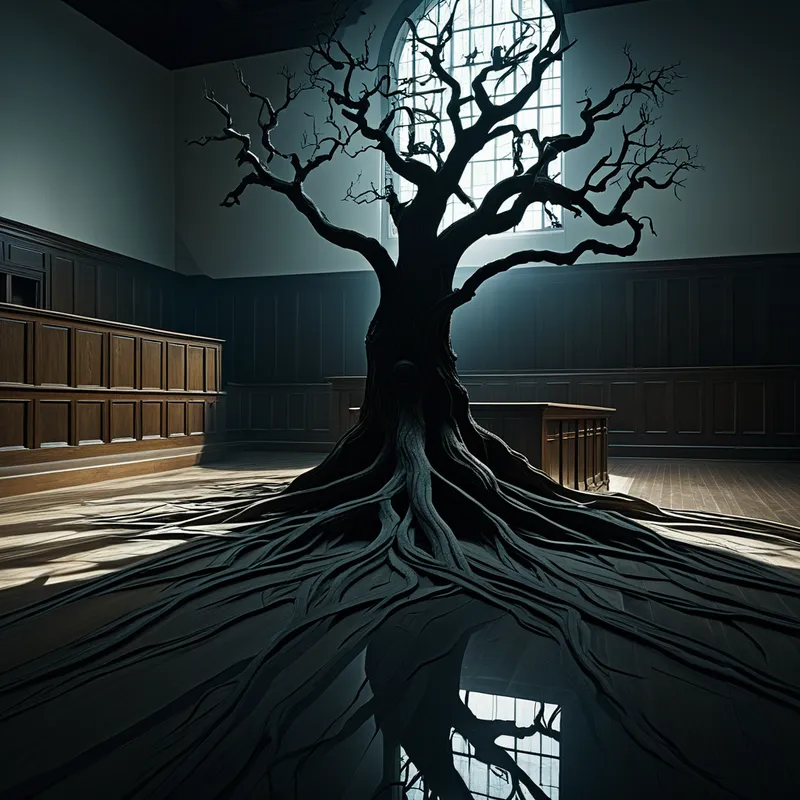
When the pattern of the Thing stirs in modern dreams, it signals a profound internal process of self-regulation and justice. The dreamer may find themselves in a vast, solemn gathering, perhaps in an unfamiliar council chamber, a town hall meeting, or directly on an ancient plain. They may be called to speak, to bear witness, or to listen.
Somatically, this can feel like a pressure in the chest or throat—the weight of a truth that needs utterance. Psychologically, it is the Self organizing a “court case” against a neglected or tyrannical aspect of the personality. Perhaps the inner Critic is on trial for its harshness, or the Pleasure-seeking impulse is being called to account for its consequences. The dream is staging an internal assembly to adjudicate a conflict that has caused psychic civil war. The resolution in the dream—whether a verdict is reached, an oath sworn, or a compensation paid—maps directly onto the psychic energy that will be freed or redirected in waking life. A dream of a successful, solemn Thing often precedes a period of significant inner peace and decisive action.
Alchemical Translation
The alchemical process mirrored in the Thing is coagulatio: the bringing together of disparate elements to form a new, solid, and lasting substance. [The prima materia](/myths/the-prima-materia “Myth from Alchemical culture.”/) is the chaotic, conflicting drives of the unexamined life. The vas or vessel is the sacred, bounded circle of the assembly—the consciously held space of introspection and therapy.
Individuation is not about becoming a solitary king in your own skull, but about convening a just and representative parliament of the soul.
The modern individual undergoes this transmutation by consciously “holding court” within. This is the practice of active imagination, of journaling where one lets different inner voices speak their case, of therapy where hidden grievances are brought to the lögberg of compassionate attention. The “law” that is spoken into being is not a rigid set of rules, but a personal ethos—a living, breathing code of integrity that arises from listening deeply to all parts of oneself and forging compromises that serve the totality.
The sacrifice is the comfort of one-sidedness. We must sacrifice the tyranny of letting one complex (like ambition or fear) rule unchallenged. Like the gods who gave up absolute autonomy to gain collective security and order, we give up psychic autocracy to gain authentic Self-governance. The [triumph](/myths/triumph “Myth from Roman culture.”/) is not conquest, but constitution. We do not slay our inner giants; we invite them to the assembly, give them a voice under law, and in doing so, transform their chaotic power into a foundational pillar of a more whole and conscious life.
Associated Symbols
Explore related symbols from the CaleaDream lexicon: