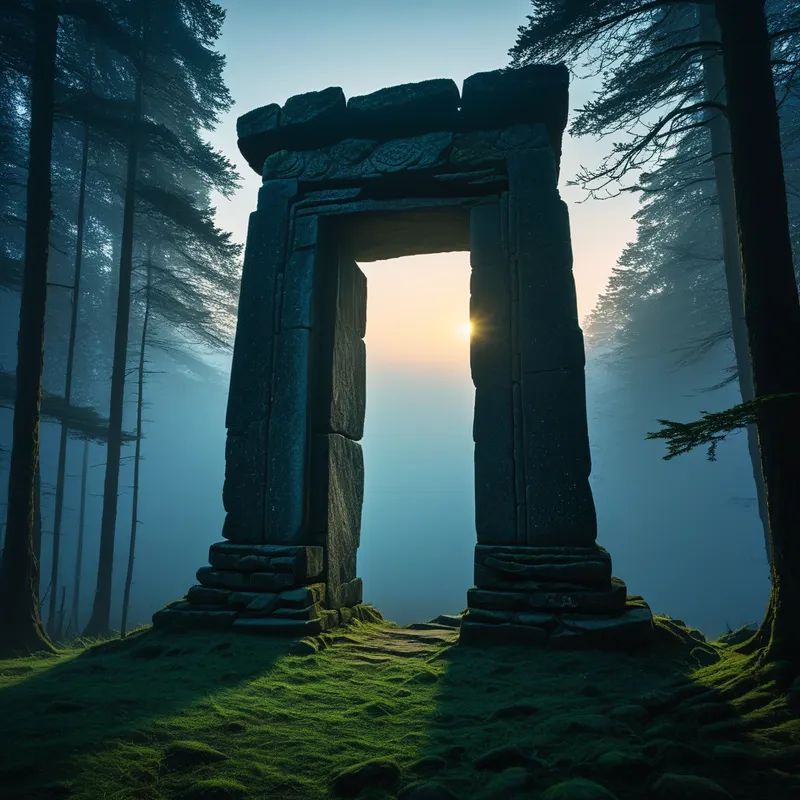
The Thin Places Myth Meaning & Symbolism
A myth of sacred thresholds where the mortal world and the Otherworld touch, revealing the permeable nature of reality and the self.
The Tale of The Thin Places
Listen. There are places in the land where the world holds its breath.
Not in the great forts of kings, nor in the roaring heart of the forest, but in the quiet corners. Where a spring bubbles from black earth, cold as a forgotten promise. Where three streams meet in a murmuring confluence. Where a single, lichen-crusted stone stands sentinel on a wind-scoured hill, older than memory. Here, the Caul of Manannán grows thin. It is not torn, but worn soft, like cloth loved to transparency.
In such a place, a seeker might come—not a warrior seeking glory, but a soul heavy with questions the waking world cannot answer. Let us say her name was Fídelma. She comes at the hinge-time, the eite, when day bleeds into night. The air is not still, but listening. The light does not fade; it changes quality, becoming a liquid gold that reveals more than it conceals.
As she places her palm upon the cold stone, the world does not vanish. It doubles. The rustle of oak leaves is joined by a faint, silver chiming. The scent of damp soil deepens, carrying the perfume of flowers that do not bloom in any earthly meadow. She sees the hill she stands upon, yes, but she also sees through it—to another hill, greener, under a timeless twilight. Figures move there, graceful and deliberate, their forms shimmering like heat-haze. This is Tír na nÓg, the Land of the Young, not as a distant kingdom, but as a layer pressed close against her own.
There is no violent rupture, only a profound permeability. A figure from that side may approach the threshold—a Bean Sídhe perhaps, her eyes holding the depth of ancient wells. She might offer a cup from which a single sip promises wisdom, or a perilous truth. The conflict is not of swords, but of will and longing. Does Fídelma step across, risking the dissolution of her mortal self in that radiant eternity? Or does she receive the vision and return, her soul imprinted with a knowledge that will forever separate her from the mundane?
The resolution is in the return. The veil settles, the double vision fades, leaving only the stone, the spring, the hill. But they are changed, and so is she. The place is now marked in her spirit, a nemeton of memory. She carries the thin place within her, a quiet seam in her soul where otherness whispers. She does not speak of it plainly, for such truths are worn, not told. But in her poetry, in the knowing silence of her gaze, the echo of that twilight threshold remains, a testament that the walls of the world are made of breath, not stone.

Cultural Origins & Context
The concept of the Thin Place is not a single, codified myth with a canonical plot, but a pervasive and foundational understanding woven through the Celtic worldview. It emerges from a culture that perceived the landscape as inherently animate and sacred—a doctrine known as dinnseanchas. Every river, mound, and grove had its story and its resident spirit. This animism logically led to the perception of certain nodes within this living tapestry as points of heightened potency.
These beliefs were curated and transmitted by the Druids and later, the fili. They did not speak of “supernatural” events, but of a nuanced ecology of reality with multiple, interpenetrating layers. Stories of encounters at fords, wells, and burial mounds served a societal function beyond entertainment. They were cognitive maps, instructing the community on the boundaries of the known world and the protocols for engaging with the numinous. They reinforced taboos, explained local phenomena, and provided a framework for understanding visionary experiences, dreams, and the mysteries of death. The Thin Place was a geographical anchor for a metaphysical truth: that the world of the living and the Tuatha Dé Danann were in constant, if subtle, relation.
Symbolic Architecture
At its core, the Thin Place is the archetypal symbol of the Liminal. It represents the threshold itself as a state of being, not merely a boundary to be crossed. It is the crack where light gets in, the seam where opposites meet and dialogue becomes possible.
The Thin Place is not a destination, but a condition of perception—the moment the soul realizes it is standing in a doorway.
Psychologically, it symbolizes the permeable boundary between the conscious ego and the vast, autonomous realm of the unconscious. The familiar landscape is the conscious personality—ordered, known, daylight. The glimpsed Otherworld is the unconscious—teeming with archetypal figures, eternal patterns, and both creative and destructive potentials. The figure who approaches from the other side (the Bean Sídhe, the guide, the challenger) is an emissary from this deeper self, a personified complex or archetype seeking recognition. The offered “cup” represents the intoxicating, often dangerous, knowledge or energy that integration with this unconscious content promises. To drink fully without preparation is to be overwhelmed—to lose oneself in psychosis or inflation. The myth advocates for a respectful, bounded engagement: to behold, to receive a message, and to return to the day-world transformed but intact.
The Dreamer’s Resonance
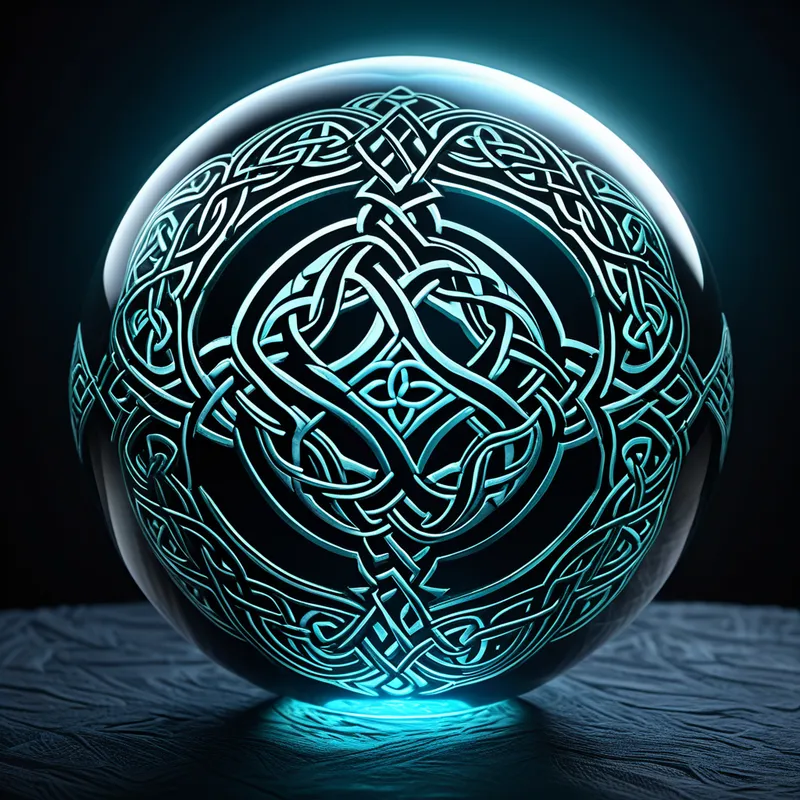
When the pattern of the Thin Place manifests in modern dreams, it rarely appears as a literal Celtic landscape. Instead, the dreamer encounters liminal architecture: an elevator that opens onto a vast, unknown floor; a familiar house with a previously unnoticed room; a mirror that reflects a different self; a door within a dream that leads to another, deeper dream.
These dreams signal a psychological process of threshold-crossing. Somatically, the dreamer may report a feeling of vibrational energy, a pulling sensation, or a profound stillness upon waking. Psychologically, they indicate that a previously solid boundary within the psyche is becoming permeable. This could be the barrier between a held identity and a repressed aspect of the self (the Shadow), between a current life stage and an emerging one, or between intellectual knowing and intuitive, embodied wisdom. The dream is an announcement: a sacred, often disorienting, dialogue with a deeper layer of the self has been initiated. The critical task for the dreamer is not to force their way through the door, but to learn to stand at its threshold, to listen to what whispers from the other side, and to discern what, if anything, to bring back.
Alchemical Translation
The alchemical journey of individuation is a long pilgrimage through inner landscapes, and the Thin Place is its essential, recurring station. It models the process of psychic transmutation not as a violent conquest, but as a sacred encounter at a threshold.
The first step is the nigredo, the recognition of the threshold itself—a feeling of being stuck between worlds, of profound disorientation and longing. This is Fídelma’s restless seeking. The approach to the thin place is the albedo, a purification of intention, where the noise of the persona falls away, leaving the soul exposed and receptive. The moment of double vision—the seeing of both worlds—is the critical coniunctio oppositorum, the conjunction of opposites. Here, the conscious mind and the unconscious contents do not battle, but briefly coexist in the same perceptual field.
The goal is not to live in the Otherworld, but to allow its light to irrigate the mortal world. Individuation is the art of becoming a Thin Place.
The return to the ordinary world is the rubedo, the reddening. It is the integration of the vision into the fabric of daily life. The seeker does not become a denizen of the unconscious, but a wiser inhabitant of consciousness, one who knows the walls are thin. The transformed hill or well in the tale symbolizes the transformed psyche: the same, yet fundamentally altered, now a permanent site of inner pilgrimage. The modern individual engaged in this work learns to identify their own inner thin places—in meditation, in creative flow, in deep relationship, in moments of crisis—and to approach them not with fear, but with the reverence of an ancient seeker at a sacred spring, knowing that here, the very substance of the self can be rewoven.
Associated Symbols
Explore related symbols from the CaleaDream lexicon: