The Theater of Dionysus in anc Myth Meaning & Symbolism
A myth of the god Dionysus descending to build a sacred stage where primal chaos meets human form, birthing the transformative power of theater.
The Tale of The Theater of Dionysus in anc
Listen. Before the marble was quarried, before the first chisel sang against stone, there was only the wild hill. It was a place of thorns and whispering pines, of foxes and forgotten gods. The wind did not blow there; it sang, a low, maddening tune through the rocks. This was the hill of Chaos, a place where form dissolved and the raw stuff of life churned unseen.
Then He came. Not with a procession, but with a silence so profound it was a sound of its own. Dionysus walked up the slope, his feet bare and dark with earth. He was not the smiling youth of the vineyards here. His eyes held the depth of the grape’s crushing, the madness of the ferment. In one hand, he held a thyrsus, a fennel stalk crowned with a pine cone, dripping with unseen honey. In the other, he carried nothing but the weight of a promise.
He stopped at the hillside’s heart and drove his thyrsus into the ground. The earth did not accept it; it drank it. A tremor ran through the hill. From the point of impact, vines exploded—not the tame vines of the vineyard, but savage, seeking tendrils of ivy and grape, lashing at the air, curling around the ankles of the watching spirits. The pines groaned and bent into strange arcs.
Dionysus raised his arms. “Here,” his voice was not a shout, but the rumble of a distant landslide, the gurgle of new wine. “Here, the unseen shall be seen. The silent shall find a voice. The one shall become many, and the many shall remember they are one.”
He did not command slaves to build. He called the very essence of the place. The wild vines wove themselves into the shapes of men and women, figures of leaf and shadow. These were the first Chorus. They moved not with human grace, but with the rustling, collective motion of a forest in a gale. They began to hum, a dissonant, beautiful drone that vibrated in the chest.
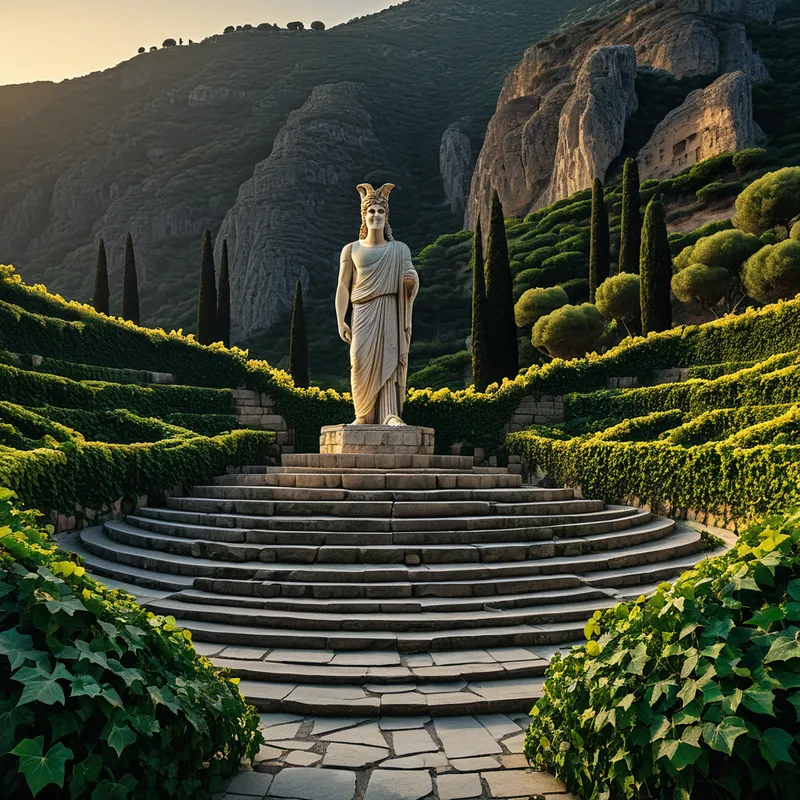
And the hill itself began to change. The chaotic slope remembered an order it had never known. Under the god’s gaze, the earth sculpted itself—a semicircle of stone benches rising in tiers, cradling a flat, circular space: the Orchestra. Behind it, a low platform emerged from the rock: the Skene. It was not built; it was released, like a form held captive within the marble.
As the last stone settled, a profound silence fell. The vine-people stood still. Dionysus walked into the center of the orchestra. He looked not at the empty seats, but through them, into the heart of the coming crowd. He took from his own brow a wreath of ivy and cast it upon the stone. Where it landed, a single, pure spring bubbled up—water that tasted of memory and forgetting.
“This is the Theatron,” he whispered. “The place of seeing. Here, you will witness what you fear to be. Here, the mask will tell the truth the face cannot bear.”
And with that, the first shadow fell across the orchestra—not the shadow of a cloud, but the shadow of a story yet untold, waiting for a mortal to step into the light and wear it.
Cultural Origins & Context
The myth of the Theater’s divine foundation is not a single story from a singular text, but a collective understanding woven into the fabric of ancient Greek religious practice. It emerges from the Dionysian Festivals themselves. The theater was not mere entertainment; it was a teletē, a rite of the god. The myth was “told” each year in the ritual actions: the procession of the god’s statue from his temple to the theater, the sacrifices at his altar in the orchestra, the choral hymns (dithyrambs) that were the direct precursors to tragedy.
The myth’s societal function was profound and dual. On one level, it was an act of civic and cosmic ordering. It narrated the taming of the wild, chthonic power of Dionysus—the god of irrationality—into an institution that served the polis. The theater became the sanctioned container for the very chaos that could destroy society if left unchecked. On another level, it was a myth of integration. By placing the theater under Dionysus’s patronage, the Greeks acknowledged that the health of the city depended on periodically confronting the irrational, the tragic, the ecstatic, and the comic—all within a sacred, bounded space and time.
Symbolic Architecture
The Theater is not merely a building in this myth; it is a living model of the psyche. Dionysus represents the raw, undifferentiated libido of the unconscious—the swirling chaos of instinct, emotion, and primal memory. The hill of Chaos is the unconscious itself, in its natural, untamed state.
The god does not destroy the wild hill; he compels it to remember a shape it never knew it possessed.
The act of creation is an act of revelation, not imposition. The Theatron symbolizes consciousness—the capacity to see, to witness. The Orchestra is the stage of the personal and collective complex, where the patterned movements (the Chorus) of our shared human dilemmas play out. The Skene represents the persona—the façade, the “scene” behind which we prepare to present ourselves, but which also contains hidden doors for sudden revelations (deus ex machina).
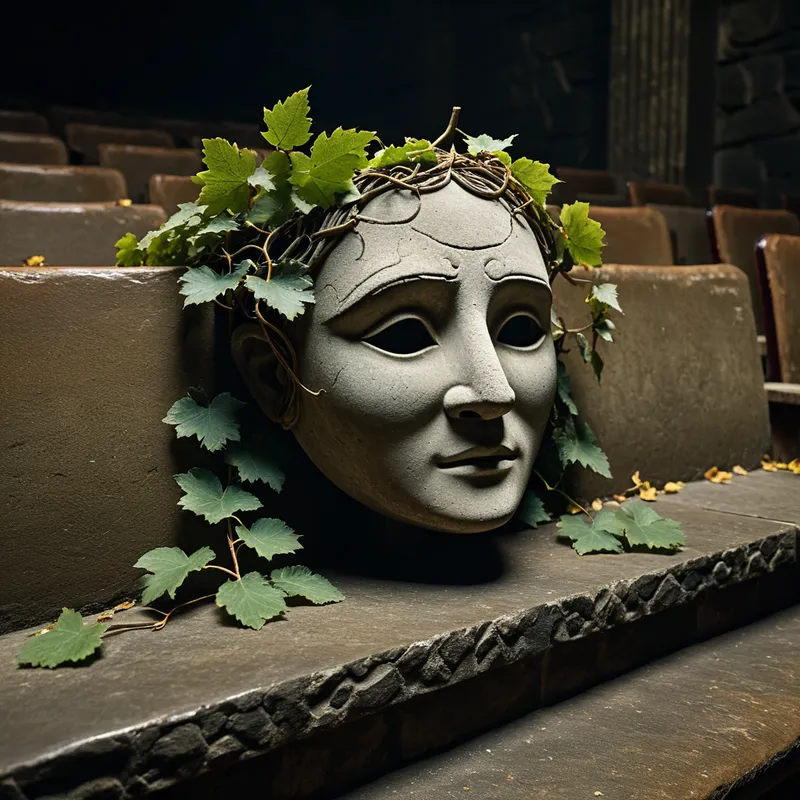
The mask is the central artifact. It is the paradox: by hiding the individual face, it reveals the universal archetype. In psychological terms, donning the mask allows the ego to temporarily identify with a content of the unconscious—a hero, a victim, a tyrant—without being completely consumed by it. It is a vessel for controlled possession.
The Dreamer’s Resonance
When this myth stirs in the modern dreamer, it often manifests as dreams of unexpected stages, forgotten amphitheaters, or being compelled to perform without a script. To dream of standing in a vast, empty theater suggests a confrontation with the Self—the audience is the totality of one’s psyche, waiting to witness what the ego will enact. A dream of being part of a chanting, moving Chorus points to the emergence of a powerful complex or group dynamic within the dreamer’s life, where individual identity feels subsumed by a collective rhythm or emotion.
The somatic experience is key. There is often a feeling of profound ambivalence: awe mixed with dread, the thrill of the spotlight coupled with the terror of exposure. This is the Dionysian duality. The dream is initiating a process where some chaotic, unconscious content—a repressed grief, a wild creativity, a furious rage—is seeking not to destroy the dreamer, but to find its form. It is asking for an orchestra in which to dance, a story in which to be contained, so that it may be seen, integrated, and its energy transformed.
Alchemical Translation
The myth models the alchemical process of coniunctio oppositorum—the sacred marriage of chaos and order, unconscious and conscious, divine madness and human structure. The individual’s journey of individuation mirrors the god’s act.
First, there is the nigredo: the recognition of the inner “wild hill,” the chaotic, suffering, or fermenting state of the psyche. This is the raw material. Then, the albedo: the calling forth of the structuring principle, the ego’s willingness to provide a “stage”—perhaps through therapy, art, ritual, or deep reflection—for this material to appear. This is not an act of suppression, but of sacred invitation.
The transformation occurs in the liminal space between the orchestra and the seats, between the performance and the witness.
The rubedo, the reddening, is the moment of catharsis—the tragic recognition, the comic release, the ecstatic connection. It is the spring that bubbles up where the god’s wreath fell: a new source of life and meaning born from the confrontation. The ego, having temporarily identified with the archetypal content (worn the mask), returns to itself, but changed. It is no longer simply the actor or the audience, but the custodian of the entire Theater—the conscious steward of a now more inclusive and dynamic Self.
Thus, the myth endures not as a relic, but as a blueprint. It tells us that our deepest chaos contains the seed of our most sacred order, and that to become whole, we must first provide a stage for the parts of us we have yet to see.
Associated Symbols
Explore related symbols from the CaleaDream lexicon: