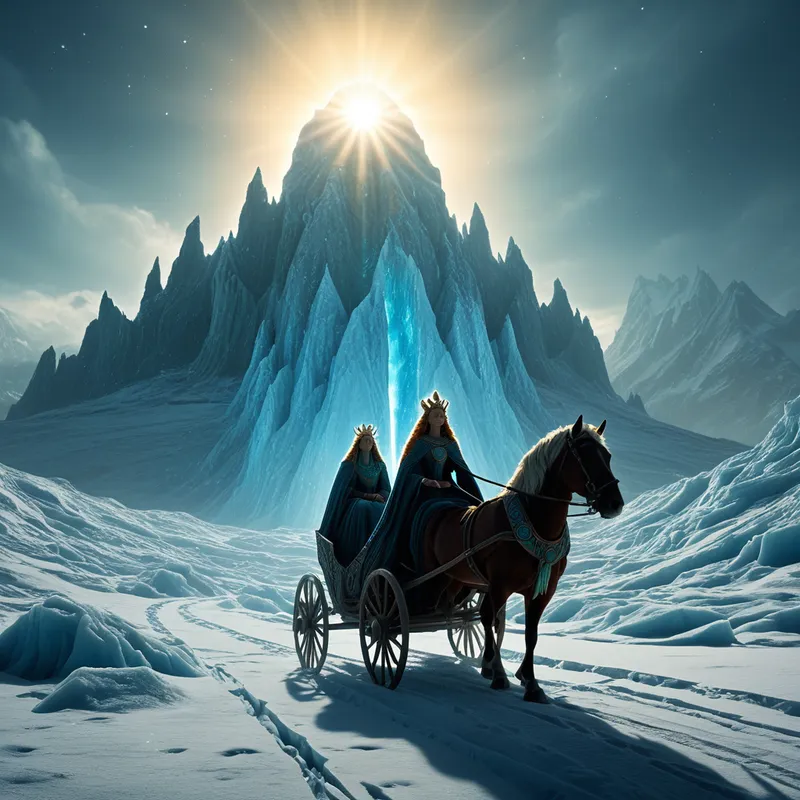
The Thaw of Fimbulwinter Myth Meaning & Symbolism
A myth of the great winter's end, where the world dies in ice and is reborn from the survivors, heralding a new and verdant age.
The Tale of The Thaw of Fimbulwinter
Hear now of the great silence, the time when the breath of [the world](/myths/the-world “Myth from Tarot culture.”/) grew still. It began not with a storm, but with a sigh—the sigh of the wolf, [Fenrir](/myths/fenrir “Myth from Norse culture.”/), straining at his bonds. The sun, our fair Sol, grew pale and wan, her chariot tracing a weaker path across the heavens. Then came the snows, not of gentle winter, but of a world grown weary. This was [Fimbulwinter](/myths/fimbulwinter “Myth from Norse culture.”/), three winters back-to-back, with no summer to breathe life between them.
The winds from the north were knives of frost. The rivers, the mighty veins of [the earth](/myths/the-earth “Myth from Hindu culture.”/), turned to stone. The seas themselves groaned and locked into plains of grinding ice. In this endless twilight, the old laws frayed. Kin turned on kin for a crust of frozen bread. The very bonds of fellowship, the sacred frith, shattered like ice underfoot. The great tree, [Yggdrasil](/myths/yggdrasil “Myth from Global/Universal culture.”/), trembled in the cold, its leaves falling not in autumn, but in a perpetual, silent death.
This was the prelude to the final battle, the doom of gods and giants. And when that storm of swords and fury was spent—when Odin had fallen and Thor lay still, when fire had scoured the earth and the stars had gone out—the silence returned. A deeper silence. The silence of a corpse.
For an age, or perhaps a heartbeat, the world was a tomb of ice and ash. No bird cried. No stream whispered. Only the groan of glaciers and the sigh of a dead wind.
Then, a change. A subtle warmth, like the memory of a forgotten kiss, touched the eastern horizon. The charred sky began, imperceptibly, to lighten. The corpse of the sun, Sunna reborn, found her strength. She did not blaze, not yet, but she persisted. Her light, feeble but unwavering, began to lick at the edges of the eternal frost.
And in the heart of the world, in the hidden hollow of Yggdrasil known as Hoddmímis holt, something stirred. Two figures, covered in the rime of ages, blinked in the new light. Their names were Lif and Lifthrasir. They had slept through the fury, sustained by [the dew](/myths/the-dew “Myth from Alchemical culture.”/) of [the world tree](/myths/the-world-tree “Myth from Celtic culture.”/). Now, they emerged. Their breath, once faint clouds, grew steady. They looked upon a world washed clean—barren, yes, but silent of strife. The ice was retreating, revealing black, rich earth. And on [the wind](/myths/the-wind “Myth from Various culture.”/), now soft from the south, came a scent they had never known, yet their bones remembered: the scent of green, growing things.
The thaw was not a victory shout; it was a slow, profound exhalation. The world was not rebuilt by gods, but by the patience of the sun and the resilience of a single seed, held safe in the deepest dark. A new age, Gimlé, was not given. It was whispered, and it was answered by those who remembered how to listen for the drip, drip, drip of melting ice.

Cultural Origins & Context
This narrative of the great winter and its thaw is not a standalone tale but the crucial coda to the cycle of [Ragnarok](/myths/ragnarok “Myth from Norse culture.”/). Our primary sources are the Old Norse poems of the Völuspá and the Hávamál, as preserved in the 13th-century Poetic Edda, and the later prose account by Snorri Sturluson in his Prose Edda.
These stories were not mere entertainment. They were the cosmological framework for a people intimately acquainted with harsh winters, existential threat, and the cyclical nature of life and death. The myth was likely told in hall and hearth during the darkest months, a ritualized remembering that the deepest winter does have an end, even if that end follows a catastrophic breaking of the old world. The function was profound: it provided a narrative of hope that was not naive, but hard-won. It taught that survival and renewal are possible, but they require foresight (like hiding in the [world tree](/myths/world-tree “Myth from Global culture.”/)), endurance, and the fundamental, fertile pairing of life forces (Lif and Lifthrasir). It was a myth for the long game, assuring that even after total destruction, the potential for life persists.
Symbolic Architecture
At its core, the [Thaw](/symbols/thaw “Symbol: A transition from frozen rigidity to fluid movement, representing release, renewal, and the gradual return of life after stagnation.”/) of [Fimbulwinter](/symbols/fimbulwinter “Symbol: Fimbulwinter represents a cataclysmic winter preceding the end of the world, embodying themes of destruction, transformation, and renewal.”/) is a master [symbol](/symbols/symbol “Symbol: A symbol can represent an idea, concept, or belief, serving as a powerful tool for communication and understanding.”/) of the necessary [death](/symbols/death “Symbol: Symbolizes transformation, endings, and new beginnings; often associated with fear of the unknown.”/) that precedes authentic renewal. It is not a gentle transition, but a catastrophic collapse of an old, unsustainable order—be it cosmic, societal, or psychological.
The ice does not merely melt; it must first have frozen solid. The new world is not a repair of the old, but a germination from its essential, hidden seed.
Fimbulwinter symbolizes the psychic [winter](/symbols/winter “Symbol: Winter symbolizes a time of reflection, introspection, and dormancy, often representing challenges or a period of transformation.”/), a [period](/symbols/period “Symbol: Periods in dreams can symbolize cyclical patterns, renewal, and the associated emotions of loss or change throughout life.”/) of absolute stagnation, depression, or existential [crisis](/symbols/crisis “Symbol: A crisis symbolizes turmoil, urgent challenges, and the need for immediate resolution or change.”/) where all warmth, [connection](/symbols/connection “Symbol: Connection symbolizes relationships, communication, and bonds among individuals.”/), and growth seem irrevocably lost. It is the “dark [night](/symbols/night “Symbol: Night often symbolizes the unconscious, mystery, and the unknown, representing the realm of dreams and intuition.”/) of the [soul](/symbols/soul “Symbol: The soul represents the essence of a person, encompassing their spirit, identity, and connection to the universe.”/)” on a cultural or personal scale. The collapse of frith represents the [disintegration](/symbols/disintegration “Symbol: A symbol of breakdown, loss of form, or fragmentation, often reflecting anxiety about personal identity, control, or stability.”/) of our internalized values and ego structures; everything we relied upon fails.
Yggdrasil, the enduring [axis](/symbols/axis “Symbol: A central line or principle around which things revolve, representing stability, orientation, and the fundamental structure of reality or consciousness.”/) mundi, is the symbolic representation of [the Self](/myths/the-self “Myth from Jungian culture.”/)—the central, organizing principle of the [psyche](/myths/psyche “Myth from Greek culture.”/) that survives all personal Ragnaroks. Hoddmímis holt is the innermost sanctuary of [the Self](/myths/the-self “Myth from Jungian culture.”/), the deep unconscious where the most vital potentials for [life](/symbols/life “Symbol: The symbol of ‘Life’ represents a journey of growth, interconnectedness, and existential meaning, encompassing both the joys and challenges that define human experience.”/) are protected, even when the conscious mind is frozen in winter. Lif and Lifthrasir are not heroic actors but preserved potentials—the archetypal masculine and feminine principles, or simply the raw, undifferentiated spark of life-[consciousness](/symbols/consciousness “Symbol: Consciousness represents the state of awareness and perception, encompassing thoughts, feelings, and experiences.”/), waiting for the conditions to be right to emerge and begin the work of world-building anew.
The Dreamer’s Resonance
When this myth stirs in the modern dreamer, it often manifests not as a Viking epic, but through the symbolism of profound personal winter. One may dream of being trapped in a house besieged by endless snow, of a familiar landscape rendered alien and frozen, or of watching a beloved garden die under a layer of permafrost. The somatic feeling is one of piercing cold, numbness, and immobility.
Psychologically, this dream pattern signals that the individual is in, or is approaching, a necessary phase of psychic death. The old adaptations, career paths, relationships, or self-concepts have run their course and are now freezing the soul. The dream is not a prophecy of doom, but an unconscious mapping of the process. The appearance of a hidden, protected space in the dream—a deep cellar, a secret room, a hollow tree—is the psyche’s representation of Hoddmímis holt. The dreamer’s task is not to fight the winter, but to find that inner sanctuary and trust in the latent life preserved there. The eventual thaw in the dream, often signaled by a single drop of [water](/myths/water “Myth from Chinese culture.”/), a faint warmth, or a tiny green shoot, marks the beginning of an almost imperceptible but irreversible movement toward renewal.
Alchemical Translation
In the alchemical process of individuation—the journey toward psychological wholeness—the Thaw of Fimbulwinter models the stage of mortificatio and [solutio](/myths/solutio “Myth from Alchemical culture.”/) (death and dissolution) followed by the miraculous albedo (whitening) and citrinitas (yellowing, dawn). The old, leaden identity (the corrupt, strife-ridden old world) must be utterly dissolved in the acid of crisis and frozen in the isolation of winter. This is a painful, non-negotiable death.
The alchemist does not save the king from death; they allow him to die so the new, golden king can be born from his essence.
The modern individual’s “Ragnarok” might be a burnout, a devastating loss, a midlife crisis, or a shattering of core beliefs. The “thaw” is not a return to normal, but the slow, often unconscious, reorganization of the personality around the deeper, more resilient core of the Self (Yggdrasil). We emerge not as improved versions of our old selves, but as something new—Lif and Lifthrasir stepping onto fresh, unsullied earth. Our task becomes one of patient cultivation, building a life (Gimlé) informed by the lessons of the winter but not bound by its scars. We learn to draw sustenance not from the external validation of the old order, but from the morning dew of a new, self-authored beginning. The myth ultimately teaches that within every ending, especially the most catastrophic, is held—in secret, in the deep wood of the soul—the seed of a beginning beyond our imagining.
Associated Symbols
Explore related symbols from the CaleaDream lexicon: