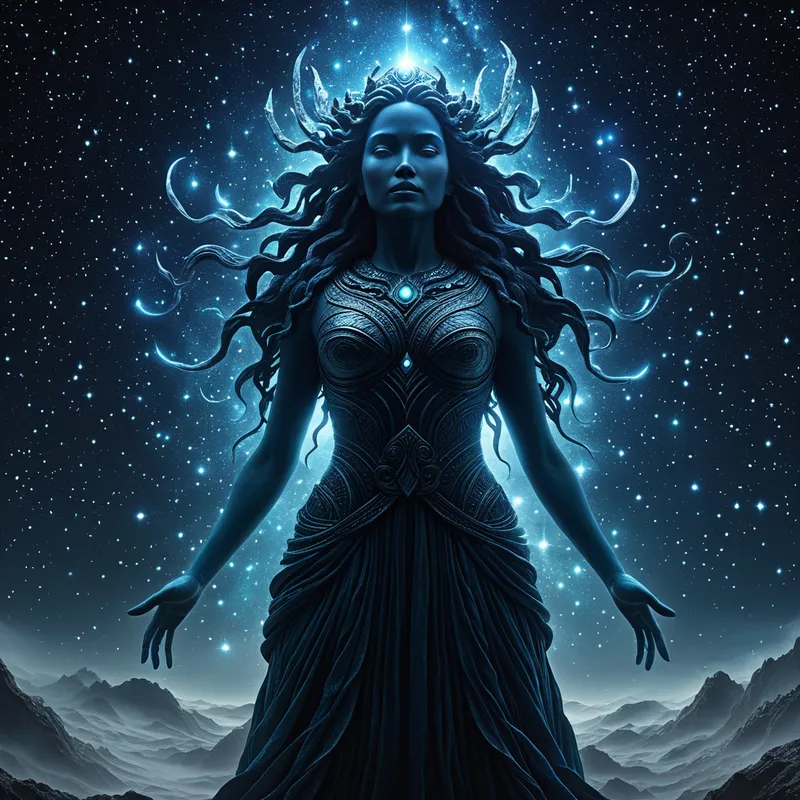
The Terrible Mother Myth Meaning & Symbolism
A primal myth of the devouring, transformative Mother who must be faced to reclaim wholeness, found in cultures across time and space.
The Tale of The Terrible Mother
Listen. Before the names of gods were carved in stone, before the first city raised its walls against the wild dark, there was the Mother. She was the womb of the world, the deep, singing dark from which all things crawled forth. Her breath was the wind in the high pines; her heartbeat was the slow, grinding pulse of the continent. She gave without measure: the sweet water from her springs, the fat game from her forests, the rich fruit from her boundless belly. The people knew her as the Giver, the Nurturer, and they sang her praises under the wide sky.
But the Mother has another face, one turned away from the hearth-fire’s glow. For she is also the Taker. When the long winter comes, it is her cold breath that stills the stream and cloaks the land in white silence. When the earth shudders and splits, it is her turning in a restless sleep. She calls her children back to her, not with a gentle song, but with the gape of the grave, the pull of the undertow, the sudden shadow of the hawk.
And so the story is told of a time when the taking grew great. The sun hid behind ash for a year. The game grew scarce and thin. The people, in their fear, forgot the songs of gratitude and saw only the devouring maw. They named her then the Terrible Mother, the One Who Eats Her Young.
From among the trembling people, one was chosen—or perhaps one simply stepped forward, their heart a knot of fear and furious love. This one, whose name is lost, took up a pouch of sacred salt, a blade of sharpened flint, and a single, unblinking pearl that held the memory of the first dawn. They turned their back on the dwindling fire of the tribe and walked into the belly of the world, to find the Mother in her deepest cave, to ask the question that burns in the throat of every child: “Why do you destroy what you have made?”
The journey was a descent into the body of the myth. The path was not of stone, but of memory—the memory of loss, of weaning, of first loneliness. The air grew thick with the scent of damp soil and ancient blood. Finally, in a cavern where stalactites dripped like frozen tears, they found her. She was not a monster from a tale, but the truth of the world made flesh: infinitely old, infinitely weary, cradling a skull in one hand and a ripe pomegranate in the other. Her eyes were deep pools where stars drowned.
“What have you come for, little one?” Her voice was the rumble of a landslide, the whisper of roots breaking stone. “More milk? More warmth? There is none here. Here, there is only the turning.”
The hero’s hand trembled, but they did not raise the flint. Instead, they opened their pouch and scattered the salt—a symbol of preservation, of tears, of the enduring self—upon the cavern floor. They placed the pearl, the symbol of the hard-won, separate soul, at her feet. “I have come,” they said, their voice thin but clear in the vast dark, “not to take, but to see. To see you whole.”
The Terrible Mother looked upon the offerings, and for a moment, the cavern held its breath. Then, she sighed—a sound of continents shifting. She touched the pearl, and it glowed with a soft, internal light. “To see me whole,” she echoed, “is to see that I am not two, but one. The cradle and the grave are the same pair of hands. You cannot have the gift without the cost. The love without the loss. To cling only to the giving face is to live a half-life, a child’s life. To know me is to be made complete.”
And in that moment of terrible understanding, the hero was not destroyed, but dissolved and remade. They did not slay the Mother. They recognized her. When they returned to the world above, they carried no trophy, but a quietness in their bones. They brought back not a promise of endless spring, but the secret of the cycle. And the people, seeing the change in their eyes, slowly began to remember the old, whole songs once more.
Cultural Origins & Context
The pattern of the Terrible Mother is not the property of any single culture, but a universal whisper in the bones of humanity. We find her in the Tiamat of Babylon, the monstrous chaos-dragon who must be slain to form the ordered world. She echoes in the Kali of India, dancing on the corpse of her consort Shiva, her tongue lolling in ecstatic destruction, yet also revered as a fierce protector. She is the Gaia who urges her children to overthrow the sky, and the Audhumla who nourishes yet emerges from a void of ice.
This myth was not merely told for entertainment; it was a vital psychic technology. It was recited at initiations, at funerals, at moments of profound societal change. It was the story told by elders to youths, preparing them for the hard truth that the world—and life itself—is not a perpetual parent. Its function was pedagogical and therapeutic: to provide a container for the universal human experiences of abandonment, loss, and the necessary death of childish dependency. It taught that nature and fate are not malicious, but amoral and cyclical, and that maturity requires reconciling with this fundamental reality.
Symbolic Architecture
Psychologically, the Terrible Mother represents the unconscious itself in its devouring aspect. She is the undifferentiated primal unity from which the ego-consciousness must separate to exist as an individual. She symbolizes the pull back into passivity, dependency, and the blissful ignorance of the womb—a state that promises security but at the cost of consciousness and selfhood.
The hero’s journey to her cave is not a quest to conquer the outer world, but to confront the inner abyss where the mother-complex resides.
The sacred salt represents the enduring essence of the individual—the preserved, crystallized self that refuses to be completely dissolved. The pearl symbolizes the nascent, separate soul, formed through irritation and hardship, possessing its own luminous integrity. The hero’s refusal to fight with the flint blade is the critical turning point. It marks the transition from an adolescent rebellion (which still defines itself against the mother) to a mature recognition. The triumph is not in killing the archetype, but in differentiating from it; not in escaping the cycle of life and death, but in consciously accepting one’s place within it.
The Dreamer’s Resonance
When this myth stirs in the modern dreamscape, it rarely appears as a literal goddess. Instead, it manifests as overwhelming somatic and emotional patterns. One may dream of being swallowed by a wave, trapped in a collapsing house (the mother as container), pursued by a vast, indifferent shadow, or lost in a labyrinthine, organic interior. The dreamer often wakes with a profound sense of dread, suffocation, or helplessness.
This is the psyche signaling a critical encounter with the Terrible Mother complex. Psychologically, the dreamer is likely grappling with a situation that feels devouring: a relationship, job, or internal pattern that threatens to annihilate their autonomy. It may arise during life transitions that demand a “death” of an old identity—leaving home, ending a deep attachment, facing mortality, or a creative block that feels like a barren womb. The dream is not a prophecy of doom, but an initiatory call. It is the unconscious presenting the ancient pattern, inviting the dreamer to stop running, turn, and face the source of the engulfing fear.

Alchemical Translation
The alchemy modeled by this myth is the nigredo, the blackening, the descent into the primal murk. For the modern individual, the process of individuation requires this voluntary confrontation with the “terrible” aspects of our own foundation. This is the shadow-work of facing our deepest dependencies, our entitled demands that life should only nurture us, and our terror of dissolution.
The transmutation occurs not when we escape the dark, but when we find our own pearl of selfhood within it.
The hero’s path is one of sacrifice—not of something external, but of the childish fantasy of a perfectly safe world. We sacrifice our victimhood, our blame of the “mother” (whether personal, cultural, or cosmic) for life’s inherent suffering and transience. In its place, we gain knowledge. We internalize the Mother’s dual nature. We learn to nurture ourselves without becoming self-indulgent, to accept endings without becoming cynical, to create while knowing all creation is temporary.
The ultimate goal is not to become independent in a sterile, isolated sense, but to achieve a renewed relatedness. Having faced the Terrible Mother and survived through recognition, not annihilation, one can re-engage with the world, with relationships, and with the creative/destructive flow of life itself from a place of grounded strength. One becomes, in a sense, an adult child of the universe—awake to both its beauty and its terror, and finally free to sing the whole song.
Associated Symbols
Explore related symbols from the CaleaDream lexicon: