The Terra Nullius Doctrine Myth Meaning & Symbolism
A mythic tale of a land declared empty by divine decree, and the long, silent struggle of the land's true, unseen spirit to be recognized.
The Tale of The Terra Nullius Doctrine
Listen. Before the first footfall, before the first flag was planted, there was a word. It was not spoken by [the wind](/myths/the-wind “Myth from Various culture.”/) in the trees, nor sung by the rivers to the stones. It was a word born in a distant chamber of parchment and ink, a word that traveled across the wine-dark sea wrapped in the silence of profound assumption.
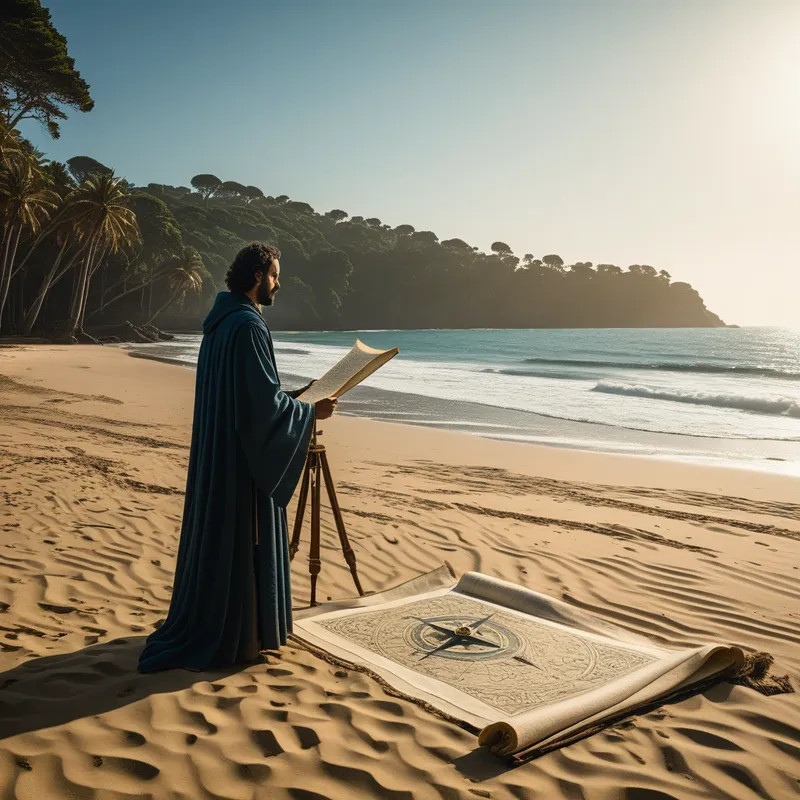
They came, the Bearers of the Blank Page. Their eyes were instruments, their minds filled with charts of places they had never been. They stood upon the shore, feeling the hum of [the earth](/myths/the-earth “Myth from Hindu culture.”/) through their boots, smelling the riot of green life, hearing [the chorus](/myths/the-chorus “Myth from Theater culture.”/) of unseen creatures. And they pronounced their decree.
“This place,” they declared, their voices cutting through the thick air, “is Terra Nullius. It is empty. It is void. It awaits our story.”
The land itself seemed to hold its breath. The ancient spirits of the place—the Genii Loci—watched from within the bark of the ironwood trees, from the depths of the waterholes, from the patterns of the stars only they could read. They were not gone. They were unseen. To the Bearers, a bustling village was a scattering of huts without history. A songline etched across [the desert](/myths/the-desert “Myth from Biblical culture.”/) was a track of animal prints. A face, rich with the wisdom of millennia, was a blank space upon which to project a fantasy.
The conflict was not of clashing swords, but of clashing realities. The Bearers built their world upon the blank page, drawing straight lines over curved hills, building houses of angles where the spirit paths ran in spirals. They planted seeds from across [the sea](/myths/the-sea “Myth from Greek culture.”/) and called the new shoots “civilization,” while dismissing the deep-rooted yams as weeds of a non-existent garden.
The rising action was a long, slow suffocation—not of people, at first, but of meaning. Stories were outlawed as superstition. Names of places were replaced with foreign syllables. The land was parceled, sold, and bounded by fences that cut through the dreaming tracks. The Genii Loci did not fight with weapons. They fought with persistence. They whispered in dreams, causing unease. They allowed the foreign seeds to fail in drought, and let the straight roads crack under the pressure of the living earth. They were the constant, quiet “something” that contradicted the official story of “nothing.”
The resolution is not yet complete, for this is a living myth. It is the slow, painful cracking of the great lie. It is the moment a child of the Bearers, digging in the earth, finds a stone tool older than any of their recorded kings. It is the shudder of recognition when an old song, sung in a language declared dead, resonates in a stranger’s bones. It is the long, legal, and spiritual struggle to have the page re-inscribed—not with a new story that erases the old, but with the acknowledgment that the page was never blank. The story was always there, written in a language of relationship, waiting to be heard.

Cultural Origins & Context
This is not a myth from a single, ancient tome, but a diffuse, modern mythology woven from the legal, philosophical, and narrative justifications of European colonial expansion from the 15th to the 20th centuries. Its “bards” were explorers’ journals, papal bulls like the Inter Caetera, legal scholars like Francisco de Vitoria and Emer de Vattel, and the maps that labeled vast regions as terra incognita.
Its societal function was foundational and psychic. It provided a moral and legal alibi for displacement and extraction. By mythologizing inhabited lands as “empty,” it transformed invasion into discovery, conquest into settlement, and theft into a divine or civilizing mandate. It was a collective story told to ease the colonial conscience, a profound act of narrative erasure that had devastatingly real consequences. It was passed down not around campfires, but in courtrooms, classrooms, and history books, becoming the unconscious bedrock of settler-colonial identity.
Symbolic Architecture
At its [heart](/symbols/heart “Symbol: The heart symbolizes love, emotion, and the core of one’s existence, representing deep connections with others and self.”/), the myth of Terra Nullius is a supreme act of psychological [projection](/symbols/projection “Symbol: The unconscious act of attributing one’s own internal qualities, emotions, or shadow aspects onto external entities, people, or situations.”/). It externalizes an inner [emptiness](/symbols/emptiness “Symbol: Emptiness signifies a profound sense of void or lack in one’s life, often related to existential fears, loss, or spiritual quest.”/) onto the outer world.
The deepest void is not outside us, but within. We declare the world empty to avoid confronting the hollow spaces in our own souls, the disconnected parts of our own history.
The Bearers of the [Blank Page](/symbols/blank-page “Symbol: The blank page symbolizes potential, the beginning of a new journey, or a fresh start, often associated with creativity and uncertainty.”/) symbolize the conscious ego, armed with its [logos](/myths/logos “Myth from Christian culture.”/) (laws, maps, declarations) but utterly disconnected from the [anima](/symbols/anima “Symbol: The feminine archetype within the male unconscious, representing soul, creativity, and connection to the inner world.”/) mundi—[the world](/myths/the-world “Myth from Tarot culture.”/) [soul](/symbols/soul “Symbol: The soul represents the essence of a person, encompassing their spirit, identity, and connection to the universe.”/). They represent a [consciousness](/symbols/consciousness “Symbol: Consciousness represents the state of awareness and perception, encompassing thoughts, feelings, and experiences.”/) that can only relate to [reality](/symbols/reality “Symbol: Reality signifies the state of existence and perception, often reflecting one’s understanding of truth and life experiences.”/) by first reducing it to concepts it controls. The land, the Genii Loci, symbolize the psychic contents that are disowned: the deep, instinctual, ancestral, and ecological layers of [the Self](/myths/the-self “Myth from Jungian culture.”/). They are the [shadow](/symbols/shadow “Symbol: The ‘shadow’ embodies the unconscious, repressed aspects of the self and often represents fears or hidden emotions.”/), not of evil, but of profound [connection](/symbols/connection “Symbol: Connection symbolizes relationships, communication, and bonds among individuals.”/) and pre-existing meaning.
The central [symbol](/symbols/symbol “Symbol: A symbol can represent an idea, concept, or belief, serving as a powerful tool for communication and understanding.”/) of the blank map or [page](/symbols/page “Symbol: A page often represents knowledge, learning, and the unfolding of a narrative in one’s life.”/) is the ultimate fantasy of [the ego](/myths/the-ego “Myth from Jungian culture.”/): a world without a past, without other subjects, without demands—a pure [canvas](/symbols/canvas “Symbol: A blank surface representing potential, creativity, and the foundation for expression or identity.”/) for its own will. The conflict, therefore, is between [the ego](/myths/the-ego “Myth from Jungian culture.”/)’s fantasy of autonomy and the [psyche](/myths/psyche “Myth from Greek culture.”/)’s reality of profound, pre-existing [relationship](/symbols/relationship “Symbol: A representation of connections we have with others in our lives, often reflecting our emotional state.”/).

The Dreamer’s Resonance
When this mythic pattern stirs in the modern dreamer, it often manifests as dreams of eerie emptiness or fraudulent ownership. You may dream of moving into a beautiful, furnished house only to discover a family living quietly in the attic, who calmly inform you they have always been there. You may dream of giving a presentation only to find your notes are blank pages, or of painting over a magnificent mural, convinced you are creating something new.
Somatically, this can feel like a disconnect between head and heart, a sense of living on top of a history you cannot access. Psychologically, it is the process of confronting one’s own “inner terra nullius”—the aspects of self, memory, or heritage that have been declared “empty” or irrelevant to maintain a simpler, more controlled self-narrative. The anxiety in the dream is the friction of two realities: the story you tell yourself, and the deeper, older truth that persists beneath it.
Alchemical Translation
The alchemical journey modeled here is the reintegration of the disowned. It is the negredo of realizing one’s foundational story is based on a negation. The first, brutal operation is the mortificatio—the death of the myth of the blank slate. This is the painful awakening to complicity, to inherited blindness, to the realization that one’s identity or success is built upon a story that erased others.
Individuation requires the courage to re-inhabit a haunted house—to acknowledge the ghosts in the attic not as threats to be removed, but as lost parts of the structure itself, essential to its integrity.
The slow work of the Genii Loci represents the relentless pressure of the Self, the totality of the psyche, working to correct a conscious imbalance. The alchemical translation is the process of listening. It is turning the instrument of perception away from [projection](/myths/projection “Myth from Alchemical culture.”/) and toward reception. It is learning the language of the land—of one’s own body, of buried family history, of the marginalized voices both within and without.
The ultimate transmutation is not conquest, but covenant. It is moving from a psychology of declaration (“I name this empty”) to a psychology of recognition (“I see you have always been here”). It is the arduous, humble work of redrawing the map to include the sacred sites you were taught to ignore, of rewriting the story so that it is no longer a monologue of the ego, but a difficult, honest conversation with the whole of what is. The gold produced is not ownership, but belonging—a belonging earned through the honest acknowledgment of a shared, complex, and deeply storied reality.
Associated Symbols
Explore related symbols from the CaleaDream lexicon: