The Ten Plagues Myth Meaning & Symbolism
A mythic narrative of divine power confronting earthly tyranny, where ten catastrophic plagues shatter a kingdom to liberate an enslaved people.
The Tale of The Ten Plagues
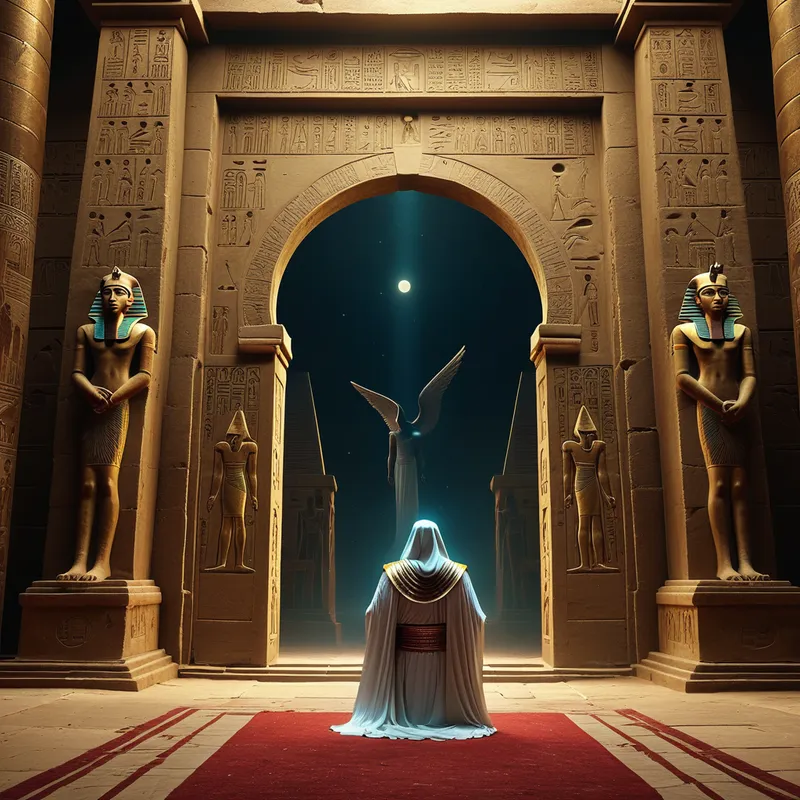
Hear now the tale of a land gripped by stone and sun, a kingdom built on the backs of a broken people. In the black silt of the Nile, a cry had taken root, a groan so deep it shook the foundations of heaven. The god of the slaves, YHWH, had heard. And He sent a voice, a man marked by exile, to the court of the god-king.
Before the throne of gold and arrogance stood Moses, his shepherd’s staff rough against the polished floors. “Thus says the Lord,” the voice echoed, “Let my people go.” Pharaoh, the Son of Ra, laughed, a sound like grinding stone. “Who is this Lord that I should obey him?” The refusal was a seal upon the land.
Then came the turning. The lifeblood of Egypt, the great Nile, did not merely flood; it thickened, it curdled, it became a river of blood. Fish gasped and died, and the people gagged on the metallic stench. Still, Pharaoh’s heart was stone.
From the reeking waters came a crawling, croaking tide. Frogs in their millions, in the beds, the ovens, the kneading bowls, a squelching, living curse. Pharaoh pleaded for respite, promised freedom, but when the frogs died in stinking heaps, his heart hardened again.
The dust of the earth became kinim, a seething cloud upon man and beast. Then came the arov, a ruinous swarm darkening the sky, a plague that spared the land of Goshen where the slaves dwelled. A line was drawn in the sand of creation.
Pestilence struck the livestock in the fields, a sudden, rotting stillness. Then, soot from a furnace, tossed to the sky, became festering boils on the skin of every Egyptian. Hail, such as had never been seen, fire flashing within it, shattered trees and crops and any man or beast caught in the open.
The hail ceased. The promise was broken. And then came the east wind, bearing a living darkness. Locusts, a rustling, devouring blanket that left the earth stripped bare, a wasteland of twigs and despair. A thick, palpable darkness followed—a darkness one could feel, a weight that smothered lamps and courage for three days, while light remained for the children of Israel.
Nine times the land was broken. Nine times the heart of the king was tempered to cruelty. Then came the tenth and final word. At midnight, a silence colder than the desert night passed through the land. From the palace to the hovel, the firstborn of every house that was not marked by the blood of a lamb upon its door was struck. A great cry went up, for there was no house without its dead.
In the terrible stillness of that dawn, the summons came not as a request, but as a command born of grief. “Rise up,” the Egyptians pleaded, “go forth from among my people.” And the people who were no people, the slaves with nothing, rose. They left in haste, their dough unleavened, their pockets filled with the gold and silver of their former masters, driven out by the very hands that had once held the whip.
Cultural Origins & Context
This narrative forms the pivotal core of the Exodus saga, the defining national myth of ancient Israel. It was preserved, refined, and transmitted orally for generations before being codified into the Torah. Its primary function was etiological—to explain the origins of the Passover ritual—and ideological, establishing the identity of the Israelites as a people chosen and liberated by a powerful, covenant-keeping deity in direct opposition to the gods of the dominant superpower, Egypt.
The story served as a potent counter-narrative to Egyptian cosmic order (Ma’at). Where Pharaoh was the guarantor of Ma’at, the plagues systematically dismantle it, showing YHWH’s supremacy over the Egyptian pantheon (the Nile god Hapi, the frog-goddess Heqet, the sun god Ra, etc.). It was told at family gatherings and national festivals not merely as history, but as a sacred reminder: their God was a God of justice who heard the cry of the oppressed and acted with terrifying decisiveness to break the chains of systemic tyranny.
Symbolic Architecture
The plagues are not random punishments but a systematic deconstruction of a world built on a lie. Egypt represents not just a political entity, but a state of psychic imprisonment, a rigid, hierarchical structure of consciousness that denies the soul’s cry for freedom. Pharaoh is the archetypal tyrannical ego, identified completely with power and control, refusing the call of the deeper Self.
The plagues are the language the soul must speak when the ego has become deaf to reason and mercy.
Each plague targets a specific pillar of the oppressive system. The Nile turning to blood attacks the source of life and commerce. The plague on livestock strikes economic wealth. The darkness obliterates the sun-god, the central symbol of Pharaoh’s divine authority. The sequence is an alchemical dissolution, a negredo, where the old, petrified order must be utterly ruined before the new can be born. The final plague, the death of the firstborn, is the ultimate sacrifice of the “first fruit” of that old order—its future, its legacy. The blood on the door is not magic but a symbol of radical differentiation; it marks the boundary between the consciousness that serves the old regime and the consciousness that is prepared for the journey into the unknown wilderness.
The Dreamer’s Resonance
When this myth stirs in the modern psyche, it often manifests in dreams of overwhelming, sequential catastrophe. To dream of water turning foul, of insect infestations, of unnatural darkness, or of a loss akin to the death of a “firstborn” (a prized project, a primary identity, a long-held hope) is to experience the psyche’s own plague cycle.
This is the somatic and psychological process of confronting an internal “Pharaoh”—a domineering complex, an internalized critic, or a life structure (job, relationship, belief system) that has become a prison. The plagues in dreams are the felt-sense of this complex’s infrastructure breaking down. The anxiety, the disgust, the sense of being besieged, are the birth pangs of liberation. The dreamer is not a passive victim but is witnessing, and ultimately participating in, the necessary demolition of a psychic Egypt. The crucial question the dream poses is: What doorpost in my life needs the mark of differentiation? What must I consciously consecrate and protect to be passed over by the destroying angel of my own outdated self?

Alchemical Translation
The journey from slavery to liberation is the quintessential map of individuation. The plagues represent the severe, often chaotic, work of the shadow. One cannot simply walk out of Egypt; the Egypt within must be made uninhabitable.
True freedom is not granted by the oppressor; it is forged in the crucible of the oppressor’s catastrophic defeat.
The process begins with the nigredo—the blackening, the plague series. Each “affliction” is a confrontation with a denied aspect of the Self: the lifeblood turned toxic (repressed emotion), the swarms of irritants (nagging truths), the boils (inflamed shame), the outer darkness (depression, loss of meaning). This is the psyche’s ruthless, divine justice dismantling the ego’s kingdom. The climax is the death of the “firstborn”—the sacrifice of the ego’s most cherished identity, its sense of entitlement and legacy.
Only after this utter dissolution can the albedo, the whitening, begin. This is the Exodus itself—the flight into the wilderness, the liminal space where the new consciousness, marked by the blood of the lamb (symbolizing the sacrifice of the innocent, instinctual self to a higher purpose), is tested and forged into a covenant. The Ten Plagues model the terrifying but essential truth: for the soul to be born, the world it was born into must sometimes end.
Associated Symbols
Explore related symbols from the CaleaDream lexicon: