The Ten Ox-Herding Pictures Myth Meaning & Symbolism
A Zen parable depicting the seeker's journey to tame the wild ox of the mind, find their true nature, and return to the world in service.
The Tale of The Ten Ox-Herding Pictures
Listen. There is a story told in the quiet of the monastery, when the incense smoke curls like a question mark in the air. It is the story of a seeker, and an ox.
In the beginning, there is only a profound and aching sense of loss. The seeker stands at the edge of the wild, human world, feeling a hollow wind where something essential once was. They know, in their bones, that they have misplaced their own true nature. It has wandered off, like a great, powerful, and utterly wild ox, into the trackless mountains of the mind. And so, with a heart full of longing, the seeker steps away from the familiar path and into the wilderness.
The search is arduous. They find only traces—a broken branch here, a hoofprint in the mud there. They hear rumors of its passing in the teachings of old masters, see its shadow in ancient texts. The ox is everywhere and nowhere. Then, one day, deep in the thicket of their own confusion, they catch a glimpse. Just the flick of a tail, the solid, dark bulk of its flank vanishing behind a screen of bamboo. The heart leaps! The chase is truly on.
Now, the seeker pursues with all their might. They hear its bellow in the thunder, see its shape in the clouds. They follow the sound, the scent, the disturbance in the grass. They are getting closer. And then, the moment of encounter. Not a glimpse, but the whole, living, breathing, snorting beast. It is immense, primal, and full of raw, untamed power. It eyes the seeker with a wild intelligence. There is a standoff under the ancient pines.
The struggle is titanic. The ox does not wish to be tamed. It rears, it charges, it seeks to flee back into the formless dark. The seeker must use the rope of discipline and the whip of unwavering attention. It is a battle of wills, a dance of exhaustion and resolve. Slowly, painfully, the ox begins to yield. The seeker, weary to their soul, finally gets a rope around its mighty neck. They begin the long walk home, pulling the great beast behind them. It follows, but its resistance is a constant, heavy pull on the rope.
A transformation begins on the road. The ox is no longer pulled; it walks willingly. The rope hangs loose, still connecting them, but no force is needed. Seeker and ox traverse the landscape as one. They stop by a clear stream to drink, and the seeker looks into the water. They see their own face, and the face of the ox, reflected as one being. A deep, wordless understanding blooms.
At last, they arrive home—but it is not the home they left. It is a simple hut, an empty space of profound peace. The ox is led inside, and the seeker sits down, letting go of the rope entirely. The ox is at rest. The seeker is at rest. All struggle ceases. The ox, the seeker, the hut, the world—all distinctions dissolve into a single, silent, luminous suchness.
When the seeker rises, the ox is gone. Not lost, but fully integrated. The hut is empty. The seeker is empty, in the most full sense of the word. They step outside. There is no trace of the long search, no pride in the capture, no memory of the struggle. Only bare awareness, meeting the morning sun.
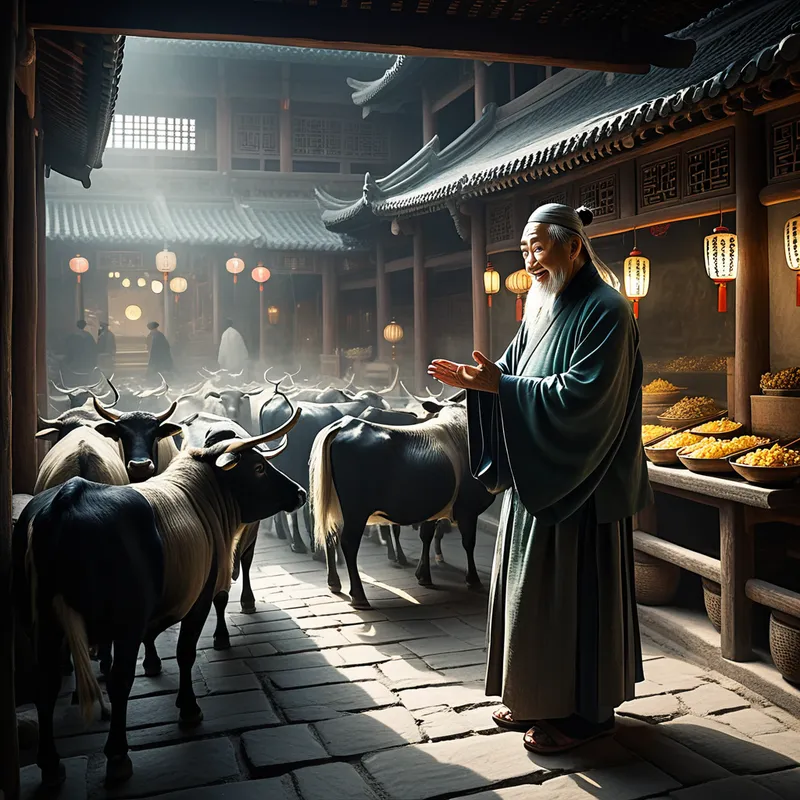
And then, with empty hands and a heart of boundless compassion, the seeker turns and walks back toward the bustling marketplace they once left. They move among the people, hearing the cries of vendors and the laughter of children. They see others searching, struggling, longing. Having found the ox, having become one with it, and having let it go, they now return. Not to preach, but to be. To offer a cup of water, to share a quiet smile. The journey ends where it began, but the world is utterly, completely new.
Cultural Origins & Context
The Zen tradition, with its roots in Chinese Chan Buddhism, has always favored parable and image over doctrinal abstraction. The Ten Ox-Herding Pictures emerged in this milieu, most famously crystallized by the 12th-century Chinese Chan master Kuo-an Shih-yuan. He paired a sequence of poems with images, creating a visual and poetic map of the spiritual journey.
This was not a scripture for the masses but a teaching tool within the monastic community, a “finger pointing at the moon” for advanced students. The images—originally simple ink drawings—and their accompanying verses were copied, studied, and contemplated in meditation halls. They provided a structured yet deeply intuitive framework for understanding the nonlinear process of awakening, from initial seeking to final, enlightened activity in the world. The myth’s power lies in its universal metaphor; the ox, a common beast of burden in agrarian China, became the perfect symbol for the untamed, powerful, and essential nature of the mind.
Symbolic Architecture
The myth is a precise allegory for the process of kensho and its maturation. The ox represents the true self, the Buddha-nature, which is inherently whole and complete but perceived as lost, wild, and separate due to the obscurations of ego, desire, and discursive thought (the “wilderness”).
The search for the ox is the illusion of seeking what was never truly lost. The taming of the ox is the illusion of attaining what was always possessed.
The stages are psychological landmarks. The initial seeking (Stages 1-3) mirrors the intellectual and yearning phase of spiritual practice. Finding the tracks is studying doctrine; seeing the ox is having a first, fleeting insight. The struggle and taming (Stages 4-6) represent the arduous work of meditation and ethical discipline, integrating that insight into one’s daily life and subduing habitual patterns. The homecoming and transcendence (Stages 7-9) depict the fruition: realization, non-duality, and the emptying of even the concept of enlightenment. Finally, the return to the marketplace (Stage 10) embodies the Bodhisattva vow—awakening is not an end, but a beginning of compassionate activity.
The Dreamer’s Resonance
When this myth stirs in the modern dreamer, it signals a profound somatic and psychological process of reclamation. To dream of searching for a lost, powerful animal—be it an ox, a bull, or another great beast—often coincides with a felt sense that a core part of one’s vitality, instinct, or authentic power has been exiled. The dreamer may be in the “track-finding” stage of therapy or self-work, gathering clues from their past.
Dreams of a standoff or struggle with such an animal mirror the conscious ego’s resistance to integrating shadow material or deep, unruly emotions. The rope in the dream may represent a newfound discipline or therapeutic framework that feels both restrictive and necessary. A dream where the animal becomes calm and follows willingly, or where the dreamer and animal merge, points to a significant moment of psychic integration, where a previously autonomous complex is being successfully assimilated into the conscious personality. The final dream of returning to a familiar place, transformed and empty-handed, suggests a readiness to live one’s insights without attachment to the story of the journey itself.
Alchemical Translation
For the modern individual navigating individuation, the Ox-Herding Pictures are a flawless model of psychic transmutation. The “ox” is the totality of the unconscious Self, which the conscious ego (the seeker) initially experiences as alien, powerful, and Other. The entire journey is the individuation process.
The alchemical gold is not found in the final image of the sage, but forged in the fire of the struggle with the ox.
The early stages (1-3) correspond to becoming conscious of the Self’s call, often through symptoms, synchronicities, or a “midlife” yearning. The middle stages (4-7) are the crucible: the ego must engage, struggle with, and ultimately submit to the greater authority of the Self. This is the painful, glorious work of shadow integration, confronting the anima/animus, and dissolving persona identifications. Taming the ox is not about domination, but about establishing a conscious relationship where the ego becomes a servant to the Self.
The transcendent stages (8-9) symbolize the coniunctio oppositorum—the union of opposites. Ego and Self, conscious and unconscious, are experienced as one. This is a state of psychic wholeness. But the alchemy is not complete until Stage 10. Here, the integrated psyche “returns to the marketplace.” The transformed individual brings their hard-won wholeness back into relationship, work, and community. Enlightenment is made practical. The sage in the marketplace is the individual who has completed the great work and now lives it, not as a special state, but as ordinary, compassionate activity. The myth thus maps the full arc: from alienation, through transformative struggle and union, to a grounded, compassionate return, where the treasure found in the deep mountains is spent freely in the dust of the everyday world.
Associated Symbols
Explore related symbols from the CaleaDream lexicon: