The Temple Veil Myth Meaning & Symbolism
At the moment of a god-man's death, the sacred barrier in the Jerusalem Temple tears, opening a new path between humanity and the divine.
The Tale of The Temple Veil
Hear now of the great sundering, the moment [the world](/myths/the-world “Myth from Tarot culture.”/)’s axis shifted in silence and in storm.
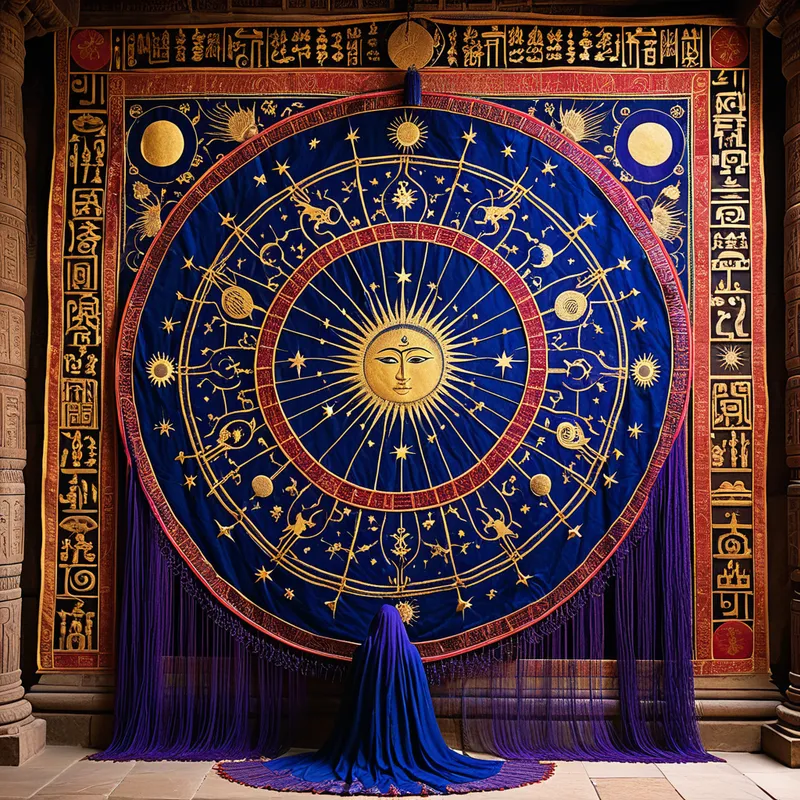
In the heart of the holy city, atop the mountain of Zion, stood [the Temple](/myths/the-temple “Myth from Jewish culture.”/). Its innermost chamber, the Holy of Holies, was a secret held by stone and cloth. Guarding that secret was [the Veil](/myths/the-veil “Myth from Various culture.”/). Woven from threads of sky-blue, royal purple, and the blood of crimson, thicker than a man’s palm, it hung from ceiling to floor, a fortress of fabric. It was the final boundary. Behind it was the Mercy Seat, the unseeable Presence. Before it, once a year, one man—the High Priest—would pass, trembling, with the blood of atonement. The air in that outer court was always thick with the smell of incense and sacrifice, a perpetual prayer for a bridge that could not be built.
On a day when the sun refused to shine, a different sacrifice was made outside the city walls. On a hill of skulls, a teacher from Galilee, hailed by some as king and by others as blasphemer, breathed his last. His final cry was not of defeat, but of completion. As his head bowed, [the earth](/myths/the-earth “Myth from Hindu culture.”/) itself groaned in sympathy. In the city, tombs shook. In the Temple, at the very hour of the evening sacrifice, a sound like the rending of the cosmos echoed from the sanctuary.
The priests tending the altar froze. The sound was not from without, but from within. It was the sound of weaving undone, of a covenant torn not at its edges, but from top to bottom. They rushed to the Holy Place. And there they witnessed the impossible: the Veil, that immovable, impregnable symbol of separation, was split in two. A great, clean rent ran from the highest beam down to the cold stone floor. The secret was exposed. The holy darkness behind it was now a doorway, not by the careful, ritual hand of the priest, but by a violent, gracious act from the other side. The barrier meant to protect humanity from the consuming fire of the Divine had been abolished from the direction of the Divine itself.
Cultural Origins & Context
This story is recorded in the synoptic gospels—Matthew, Mark, and Luke—and is a cornerstone of soteriological and Christological thought. For the early Christian community, comprised largely of Jews, the Temple’s destruction in 70 CE rendered this narrative not just theological, but profoundly psychological and cultural. The physical Temple was gone, but this myth provided a new map of sacred geography.
The story functioned as a cosmic signifier. It was told to demonstrate that the death of [Jesus](/myths/jesus “Myth from Christian culture.”/) was not a tragic end, but a catalytic, cosmological event. It reinterpreted the entire Jewish sacrificial system. No longer was access to God mediated solely through priesthood, lineage, and ritual in a specific location. The tearing of the Veil signified a democratization of the holy, an opening of a “new and living way” (as stated in the Epistle to the Hebrews) directly into the divine presence for all who approached with faith. It was a myth of transition, marking the end of one age of separation and the violent, glorious birth of another age of access.
Symbolic Architecture
The [Veil](/symbols/veil “Symbol: A veil typically symbolizes concealment, protection, and transformation, representing both mystery and femininity across cultures.”/) is the ultimate [symbol](/symbols/symbol “Symbol: A symbol can represent an idea, concept, or belief, serving as a powerful tool for communication and understanding.”/) of the [boundary](/symbols/boundary “Symbol: A conceptual or physical limit defining separation, protection, or identity between entities, spaces, or states of being.”/). It represents every [separation](/symbols/separation “Symbol: A spiritual or mythic division between realms, states of being, or consciousness, often marking a transition or loss of connection.”/) that defines [human](/symbols/human “Symbol: The symbol of a human represents individuality, complexity of emotions, and social relationships.”/) experience: sacred from profane, divine from human, inner from outer, conscious from unconscious, [life](/symbols/life “Symbol: The symbol of ‘Life’ represents a journey of growth, interconnectedness, and existential meaning, encompassing both the joys and challenges that define human experience.”/) from [death](/symbols/death “Symbol: Symbolizes transformation, endings, and new beginnings; often associated with fear of the unknown.”/). It is [the ego](/myths/the-ego “Myth from Jungian culture.”/)’s necessary [fortress](/symbols/fortress “Symbol: A fortress symbolizes security and protection, representing both physical and psychological safety from external threats.”/), protecting the fragile self from the overwhelming totality of the Self.
The Veil is not an obstacle to be conquered, but a mystery to be traversed. Its tearing is not destruction, but revelation.
The [Temple](/symbols/temple “Symbol: A temple often symbolizes spirituality, sanctuary, and a deep connection to the sacred aspects of life.”/) itself is a map of the [psyche](/myths/psyche “Myth from Greek culture.”/). The outer courts represent the [persona](/symbols/persona “Symbol: The social mask or outward identity one presents to the world, often concealing the true self.”/) and conscious life. The Holy Place symbolizes [the personal unconscious](/myths/the-personal-unconscious “Myth from Jungian Psychology culture.”/), where the lamps of [intuition](/symbols/intuition “Symbol: The immediate, non-rational understanding of truth or insight, often described as a ‘gut feeling’ or inner knowing that bypasses conscious reasoning.”/) (the [Menorah](/symbols/menorah “Symbol: A seven-branched candelabrum central to Judaism, symbolizing divine light, wisdom, and the enduring covenant between God and the Jewish people.”/)) burn and the [bread](/symbols/bread “Symbol: Bread symbolizes nourishment, sustenance, and the daily essentials of life, often representing fundamental needs and comfort.”/) of sustenance (the [Table](/symbols/table “Symbol: Tables in dreams often symbolize stability, social interactions, and a platform for discussions, negotiations, or decisions in our waking life.”/) of [Showbread](/myths/showbread “Myth from Biblical culture.”/)) is kept. The Veil is [the threshold](/myths/the-threshold “Myth from Folklore culture.”/) to the [collective unconscious](/symbols/collective-unconscious “Symbol: The Collective Unconscious refers to the part of the unconscious mind shared among beings of the same species, embodying universal experiences and archetypes.”/), [the Holy of Holies](/myths/the-holy-of-holies “Myth from Biblical culture.”/), the [realm](/symbols/realm “Symbol: The symbol of ‘Realm’ often signifies the boundaries of one’s consciousness, experiences, or emotional states, suggesting aspects of reality that are either explored or ignored.”/) of archetypal powers and the central [mystery](/symbols/mystery “Symbol: An enigmatic, unresolved element that invites curiosity and exploration, often representing the unknown or hidden aspects of existence.”/) of [the Self](/myths/the-self “Myth from Jungian culture.”/). The act of tearing, from top to bottom, signifies an intervention from the archetypal [realm](/symbols/realm “Symbol: The symbol of ‘Realm’ often signifies the boundaries of one’s consciousness, experiences, or emotional states, suggesting aspects of reality that are either explored or ignored.”/) into the personal. It is a descent of the transcendent that shatters the ego’s carefully constructed defenses, not to annihilate, but to integrate.
The [hero](/symbols/hero “Symbol: A hero embodies strength, courage, and the ability to overcome significant challenges.”/) of this myth is not the one who dies on the [hill](/symbols/hill “Symbol: A hill represents challenges, progress, or obstacles in life’s journey, often symbolizing effort and perspective.”/), but the [pattern](/symbols/pattern “Symbol: A ‘Pattern’ in dreams often signifies the underlying structure of experiences and thoughts, representing both order and the repetitiveness of life’s situations.”/) enacted: the willing submission of the conscious [personality](/symbols/personality “Symbol: Personality in dreams often symbolizes the traits and characteristics of the dreamer, reflecting how they perceive themselves and how they believe they are perceived by others.”/) (the incarnate Christ) to the transformative power of death, effecting a permanent change in the [structure](/symbols/structure “Symbol: Structure in dreams often symbolizes stability, organization, and the framework of one’s life, reflecting how one perceives their environment and personal life.”/) of [reality](/symbols/reality “Symbol: Reality signifies the state of existence and perception, often reflecting one’s understanding of truth and life experiences.”/) itself. The [hero](/symbols/hero “Symbol: A hero embodies strength, courage, and the ability to overcome significant challenges.”/)’s [journey](/symbols/journey “Symbol: A journey in dreams typically signifies adventure, growth, or a significant life transition.”/) here is [inward](/symbols/inward “Symbol: A journey toward self-awareness, introspection, and the exploration of one’s inner world, thoughts, and unconscious mind.”/), culminating in a sacrifice that opens a [path](/symbols/path “Symbol: The ‘path’ symbolizes a journey, choices, and the direction one’s life is taking, often representing individual growth and exploration.”/) for all.
The Dreamer’s Resonance
When this myth stirs in the modern dreamer, it often manifests as dreams of thresholds, torn barriers, or revealed secrets. One might dream of a wall in their home crumbling to reveal a magnificent, forgotten room. They may dream of a dense fog or curtain suddenly parting. Or, more abstractly, of a profound, somatic sensation of something “ripping” inside the chest or mind.
These dreams signal a critical phase in psychological process: the ego’s defensive structures are being breached by contents of the unconscious too powerful to remain contained. This is not a gentle process. It is often accompanied by life crises—the end of a relationship, a career collapse, a spiritual awakening, or a confrontation with mortality. The “tearing” feels like a loss of control, a sacred violation of one’s inner sanctum. Yet, the direction of the tear (from top to bottom) suggests the process, however painful, is orchestrated by a deeper, guiding intelligence within the psyche—the Self—seeking greater expression. The dreamer is in the grip of a numinous event, where the old covenant between their conscious identity and their inner world is being irrevocably rewritten.
Alchemical Translation
The alchemical opus mirrored in this myth is the [Nigredo](/myths/nigredo “Myth from Alchemical culture.”/), the blackening, the moment of maximum despair and dissolution. The crucifixion is the mortificatio, the killing of the old, literal, separated form. The tearing of the Veil is the first flash of light in that darkness, the promise of the Albedo to come.
For the individual, this models the journey of individuation. We all live behind a personal veil—a complex of beliefs, identities, and traumas that separates our conscious ego from the vast, often terrifying, but ultimately healing power of the unconscious Self. The process of wholeness requires this veil to be torn.
Individuation is not about building a better veil, but about having the courage to stand in the rent, where the winds of the unknown blow through.
This tearing is initiated by a sacrifice. It is the sacrifice of our most cherished illusion: that we are separate, self-sufficient, and in complete control. It is the “death” of the ego’s imperial reign. When we consciously submit to this death—by facing our shadow, enduring a depression, or surrendering a rigid identity—we participate in the myth. We allow the veil of separation to be torn. What is revealed is not an external deity, but the immanent sacredness of our own deepest being, the “[Shekhinah](/myths/shekhinah “Myth from Jewish Mysticism culture.”/) within.” The opened path is not to a distant heaven, but into the core of our own humanity, where the divine and the human are discovered to have never been truly separate at all. The temple is rebuilt not of stone, but of integrated consciousness.
Associated Symbols
Explore related symbols from the CaleaDream lexicon: