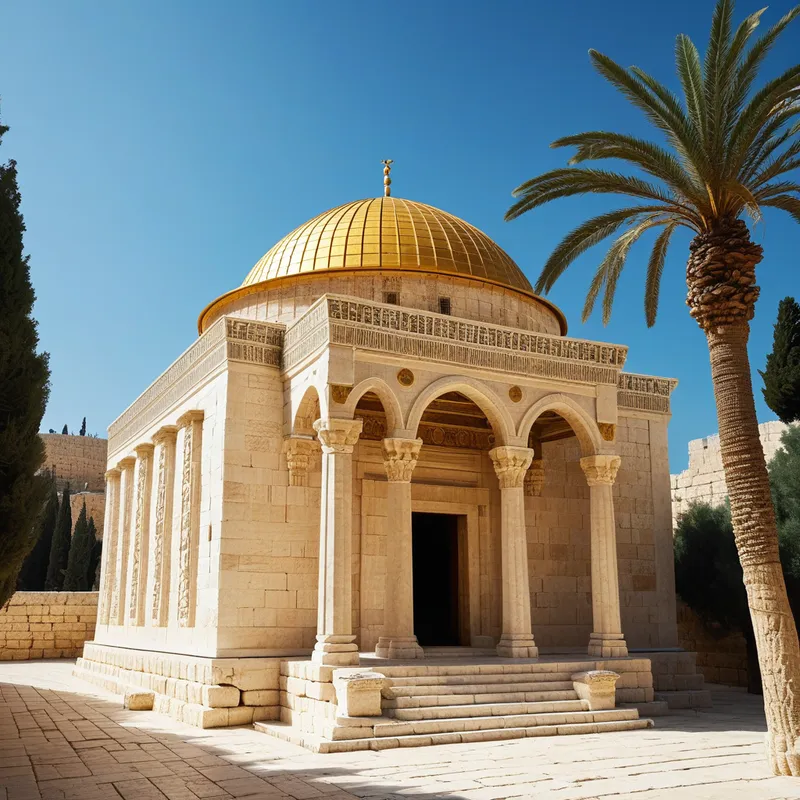
The Temple of Solomon—a divine Myth Meaning & Symbolism
A myth of sacred geometry and divine-human covenant, where a king builds a perfect dwelling for the ineffable, creating a cosmic axis on earth.
The Tale of The Temple of Solomon—a divine
Hear now the tale of the House that was not a house, built by a king who was more than a king. In an age when the earth still remembered the voice of its Maker, Solomon sat upon a throne of ivory and gold, his heart a vessel of a silence so deep it could hear the whisper of foundations laid before the stars were kindled.
The whisper spoke of a dwelling. Not in the high and holy heavens, but here, upon the chosen rock of Moriah, where the breath of the Divine had once stirred the dust to form a man. The command was a paradox: to build a home for the One who fills all things. To contain the uncontainable. To anchor the whirlwind in stone and cedar.
So Solomon, in his wisdom, became a conduit. He called to Hiram of Tyre, and from the forests of Lebanon came logs of fragrant cedar, towering like bronze pillars, sighing with the memory of mountain winds. From the quarries beneath the city came great stones, hewn in silence with tools of copper, each one shaped to perfection so that no hammer’s blow would desecrate the holy ground with clamor. And from the depths of the earth came gold, refined seven times, to be beaten into walls, into cherubim with wings outstretched, into blossoms and chains of light.
For seven years, the mountain was a hive of sacred industry. The sound was not of chaos, but of a profound and ordered hymn—the scrape of saws, the murmur of prayers, the strain of ropes. At the heart of the rising structure, in the deepest gloom, a chamber was prepared. The Holy of Holies, a perfect cube of darkness, waiting. Into this void, the priests bore the ancient Ark of the Covenant, its poles stretching out like silent guardians. When it was set in place, a cloud, thick and palpable as wool, filled the House. The glory had descended. The workmen’s hands fell still; the priests could not stand to minister. The paradox was complete: the infinite had consented to a shadow, the formless had taken a form.
And Solomon stood before the altar, his arms raised to a heavens now mirrored on earth. He spoke not of conquest, but of mystery. “Will God indeed dwell on the earth? Behold, heaven and the highest heaven cannot contain you; how much less this house that I have built!” The Temple stood not as a cage for divinity, but as a divine concession—a single, still point in the turning world where heaven and earth might touch, and the human heart might know where to listen.
Cultural Origins & Context
The mythos of Solomon’s Temple is a foundational pillar in the Abrahamic traditions, primarily chronicled in the Hebrew Bible’s books of Kings and Chronicles. Its transmission is inextricably linked to sacred scripture, priestly liturgy, and royal historiography. It functioned as the ultimate national and spiritual epic for the ancient Kingdom of Israel—a narrative of divine favor, political consolidation under Solomon’s rule, and the fulfillment of a promise made to his father, David.
More than a historical account, it served a profound societal function as the archetypal blueprint for sacred space. It established the template for the cosmos-in-miniature, the axis mundi where the community’s identity, law, and relationship with the divine were centralized and solidified. Its destruction by the Babylonians in 586 BCE transformed the myth from a story about a physical structure into a potent symbol of loss, hope, and spiritual resilience, carried through exile and diaspora. It became a memory of perfection, a vision of restored order, and a metaphor for the human soul itself in later mystical traditions like the Kabbalah.
Symbolic Architecture
The Temple is not merely a building; it is a symbolic map of reality and consciousness. Its very structure is a language.
The Temple is the psyche in stone: the outer courts represent the conscious world of action and community, the inner sanctums the personal unconscious, and the Holy of Holies the irreducible, transcendent core of the Self.
The progressively restrictive access—from the bustling Court of the Gentiles to the silent Holy of Holies entered only once a year by the High Priest—mirrors the journey inward toward the sacred, unknowable center of one’s own being. The perfect, pre-formed stones signify the innate, whole structures of the psyche that must be discovered and assembled, not created from raw chaos. The prohibition of iron tools speaks to the need for a gentle, non-violent approach to inner work; the true Self cannot be forced or hacked into shape.
The central paradox—building a house for a homeless God—encapsulates the human endeavor to conceptualize and relate to the absolute. It represents the necessary, yet ultimately insufficient, containers (our beliefs, rituals, and self-images) we construct to approach the mystery of existence and of our own depths.
The Dreamer’s Resonance
When the Temple of Solomon arises in the modern dreamscape, it seldom appears as a intact, historical relic. More often, the dreamer is building it, searching for its blueprint, or standing in its ruins. To dream of laboring on its construction indicates a active phase of psychic integration. The dreamer is painstakingly assembling the disparate parts of their personality—skills, memories, values—into a coherent, functional whole that can house a greater sense of meaning.
To dream of the Temple in a state of perfect, radiant completion often accompanies a fleeting experience of inner wholeness or spiritual epiphany. Conversely, to dream of its ruined state, its chambers exposed or desecrated, points to a profound feeling of inner fragmentation, a loss of sacred center, or a violation of one’s core values. The Holy of Holies appearing in a dream can be overwhelming; it may present as a blinding light, an impenetrable darkness, or a simple, empty room of terrifying potency. This is the dream ego confronting the naked reality of the Self, an encounter that typically demands preparation and humility.
Alchemical Translation
The myth models the alchemical opus of individuation—the process of becoming an integrated, authentic individual. Solomon, the Ruler, represents the conscious ego tasked with the supreme work: to organize the raw materials of the unconscious (the stones from the deep quarry, the cedars from the chaotic forest) into a temenos, a protected sacred space.
The construction is the transmutation. The base materials of instinct, emotion, and shadow are refined—“hewn in silence”—and elevated into a structure that can contain a higher union.
The finished Temple symbolizes the lapis philosophorum, the philosopher’s stone of the psyche—the achieved state of inner order where the opposites are held in harmony. The divine cloud that fills it signifies the moment of psychic transformation when the ego’s project is surrendered to and inhabited by a greater, transpersonal power. The ego (Solomon) realizes it did not capture God, but built a vessel so pure that God could descend. In psychological terms, the ego aligns itself with the directives of the Self. Thus, the myth guides the modern individual not toward building an impregnable fortress of the personality, but toward constructing a permeable, aligned vessel—a “Temple”—through which the profound and often unsettling energies of the deeper Self can flow into conscious life, bringing wisdom, order, and a connection to the eternal.
Associated Symbols
Explore related symbols from the CaleaDream lexicon: