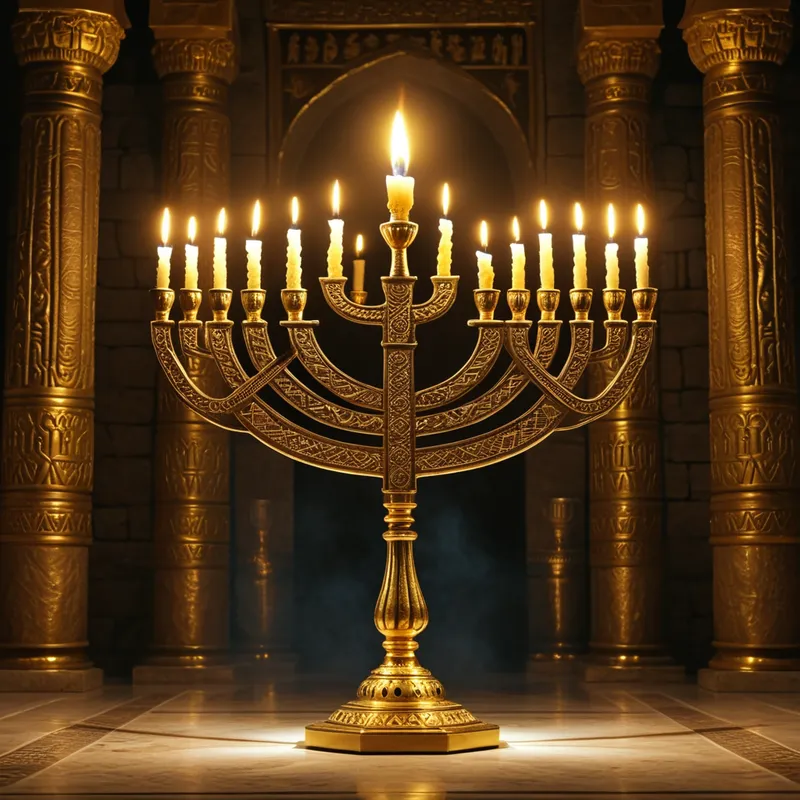
The Temple Menorah Myth Meaning & Symbolism
The myth of the golden lampstand, divinely designed and humanly wrought, whose light was meant to illuminate the holy place and signify an unbroken covenant.
The Tale of The Temple Menorah
In the silence before [the world](/myths/the-world “Myth from Tarot culture.”/) was fully formed, in the place where thought becomes word and word becomes law, a pattern was conceived. It was not born of earth or forged in any mountain’s heart, but was spoken into the blueprint of reality itself. The voice that spoke it was the voice that divided light from darkness, and the pattern was for a vessel of that very light.
The command came to a man named [Moses](/myths/moses “Myth from Biblical culture.”/), on the stark and trembling heights of Sinai. The air was thin, charged with the presence of the unseeable. “See and make,” the voice instructed, “according to the pattern shown to you on the mountain.” And in the inner eye of the prophet, a vision blazed: a single piece of purest gold, beaten, not cast, hammered into being from a talent of fire. From its central stem, six branches would curve—three to the left, three to the right—like the arms of an almond tree reaching for the sun. On each branch, three cups shaped like almond blossoms, with a knob and a flower; on the central stem, four such cups. And at the top of each of the seven branches, a lamp to hold the clear oil of crushed olives.
This was the [Menorah](/myths/menorah “Myth from Judeo-Christian culture.”/). Its light was not for the outer courts, for the noise of [the market](/myths/the-market “Myth from Various culture.”/) or the clamor of daily life. Its destination was the Holy Place, a tent of tapestry and hide, a space heavy with the scent of ketoret and the weight of the promise. Here, in the perpetual twilight, it would stand opposite the table of [showbread](/myths/showbread “Myth from Biblical culture.”/), its face turned toward the center of all things.
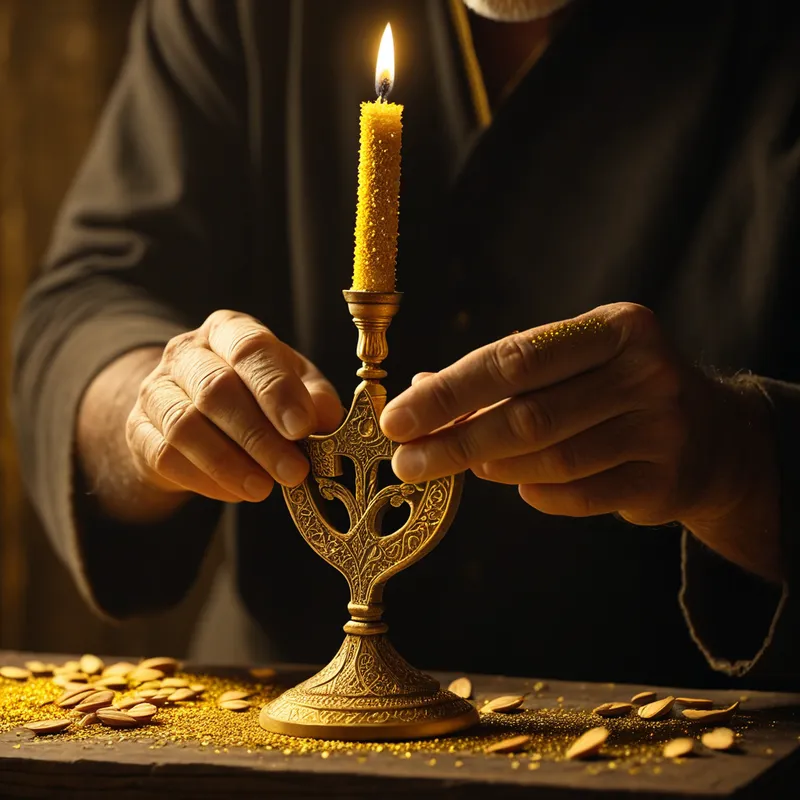
But the vision needed hands. The divine pattern required human skill. The task fell to Bezalel, of the tribe of Judah, and Oholiab, of the tribe of Dan. They took the gold, a substance of the sun, and began the alchemy of obedience. The hammer’s ring was a prayer. Each delicate blossom, beaten from the same mass as the stem, was a testament to unity—the many emerging from, and inseparable from, the one. No solder joined branch to trunk; it was all of a piece, a miracle of transformative craftsmanship.
When it was done, they carried it into the newly raised [Tabernacle](/myths/tabernacle “Myth from Biblical culture.”/). The priests, anointed and trembling, filled its seven lamps with the purest oil and lit the wicks. The flame caught, not with a roar, but with a soft, unwavering sigh. In that moment, the crafted gold became more than an object. Its light reached toward the Holy of Holies, toward the silent, brooding presence behind [the veil](/myths/the-veil “Myth from Various culture.”/). It did not illuminate the darkness so much as hold it at bay, creating a sphere of ordered, peaceful radiance—a tiny, portable dawn in the heart of [the wilderness](/myths/the-wilderness “Myth from Biblical culture.”/). It was a sign: that the pattern from the mountain could live on [the earth](/myths/the-earth “Myth from Hindu culture.”/), that human hands could midwife divine light, and that the covenant, though tested by desert and doubt, was not extinguished. [The Menorah](/myths/the-menorah “Myth from Biblical culture.”/) was lit. The watchful, almond-eyed light of God now burned in the dwelling place of humanity.
Cultural Origins & Context
The mythos of the [Temple Menorah](/myths/temple-menorah “Myth from Jewish culture.”/) is rooted not in a singular narrative of gods and heroes, but in the foundational legal and cultic texts of the Hebrew religion, primarily the books of Exodus, Leviticus, and Numbers. Its origin is sacerdotal, emerging from the priestly tradition whose function was to articulate the precise architecture of the sacred. It was passed down not by bards around a fire, but by priests and scribes, meticulously copied in scrolls that detailed measurements, materials, and rituals.
Its societal function was multifaceted. Practically, it was the sole source of artificial light within the Tabernacle, and later, the permanent Temple in [Jerusalem](/myths/jerusalem “Myth from Biblical culture.”/). Ritually, its tending—the cleaning of the wicks, the replenishing of the oil each evening—was a central, daily duty of the Aaronic priesthood. But its deepest function was symbolic and cosmological. It served as a microcosm of the created order, a tangible link between the divine command (“See and make”) and human execution. It reinforced a theology where holiness was not merely abstract but had a blueprint, a geometry that could be realized in the physical world through disciplined, sanctified craftsmanship. In the chaos of exile and diaspora, the memory of the Menorah, especially after the destruction of the Second Temple, became a potent symbol of national identity, divine presence, and the hope for restoration.
Symbolic Architecture
The [Menorah](/symbols/menorah “Symbol: A seven-branched candelabrum central to Judaism, symbolizing divine light, wisdom, and the enduring covenant between God and the Jewish people.”/) is a dense [forest](/symbols/forest “Symbol: The forest symbolizes a complex domain of the unconscious mind, representing both mystery and potential for personal growth.”/) of symbols. Its primary [material](/symbols/material “Symbol: Material signifies the tangible aspects of life, often representing physical resources, desires, and the physical world’s influence on our existence.”/), gold, represents the highest value, the divine [nature](/symbols/nature “Symbol: Nature symbolizes growth, connectivity, and the primal forces of existence.”/), and purity. That it is “beaten work” signifies that the divine form is not simply imposed but emerges through a process of [effort](/symbols/effort “Symbol: Effort signifies the physical, mental, and emotional energy invested toward achieving goals and personal growth.”/), pressure, and transformation—a [metaphor](/symbols/metaphor “Symbol: A figure of speech where one thing represents another, often revealing hidden connections and deeper truths through symbolic comparison.”/) for the [human](/symbols/human “Symbol: The symbol of a human represents individuality, complexity of emotions, and social relationships.”/) [soul](/symbols/soul “Symbol: The soul represents the essence of a person, encompassing their spirit, identity, and connection to the universe.”/)‘s refinement.
The light is not the sun, but a crafted, tended flame. It speaks of consciousness born of relationship, not of solitary, blinding majesty.
The [number](/symbols/number “Symbol: Numbers in dreams often symbolize meaning, balance, and the quest for understanding in the dreamer’s life, reflecting their mental state or concerns.”/) seven is universally archetypal, representing completeness—the days of creation, [the celestial spheres](/myths/the-celestial-spheres “Myth from Medieval Christian culture.”/). The six branches plus the central stem symbolize the natural world (six) unified and given [direction](/symbols/direction “Symbol: Direction in dreams often relates to life choices, guidance, and the path one is following, emphasizing the importance of navigation in personal journeys.”/) by the spiritual center (one). The almond [motif](/symbols/motif “Symbol: A recurring thematic element, pattern, or design in artistic or musical works, representing underlying ideas or emotional currents.”/) (shaqed in Hebrew) is profoundly resonant; the [almond tree](/symbols/almond-tree “Symbol: The almond tree symbolizes resilience and the duality of creation and destruction, often associated with the nurturing aspects of nature.”/) is the first to [blossom](/symbols/blossom “Symbol: A symbol of new beginnings, growth, and the unfolding of potential, often marking a transition or the start of a journey.”/) in the Israeli spring, a [symbol](/symbols/symbol “Symbol: A symbol can represent an idea, concept, or belief, serving as a powerful tool for communication and understanding.”/) of watchfulness (shoked) and swift fulfillment. The Menorah is thus a [tree](/symbols/tree “Symbol: In dreams, the tree often symbolizes growth, stability, and the interconnectedness of life.”/) of light, an [axis](/symbols/axis “Symbol: A central line or principle around which things revolve, representing stability, orientation, and the fundamental structure of reality or consciousness.”/) mundi rooted in the Holy Place, connecting the earthly [temple](/symbols/temple “Symbol: A temple often symbolizes spirituality, sanctuary, and a deep connection to the sacred aspects of life.”/) to the heavenly [pattern](/symbols/pattern “Symbol: A ‘Pattern’ in dreams often signifies the underlying structure of experiences and thoughts, representing both order and the repetitiveness of life’s situations.”/). Its light, facing the showbread (sustenance) and the inner [veil](/symbols/veil “Symbol: A veil typically symbolizes concealment, protection, and transformation, representing both mystery and femininity across cultures.”/) (the [mystery](/symbols/mystery “Symbol: An enigmatic, unresolved element that invites curiosity and exploration, often representing the unknown or hidden aspects of existence.”/)), represents illuminated [consciousness](/symbols/consciousness “Symbol: Consciousness represents the state of awareness and perception, encompassing thoughts, feelings, and experiences.”/) nourishing the [community](/symbols/community “Symbol: Community in dreams symbolizes connection, support, and the need for belonging.”/) and oriented toward the ultimate [mystery](/symbols/mystery “Symbol: An enigmatic, unresolved element that invites curiosity and exploration, often representing the unknown or hidden aspects of existence.”/) of the divine.
The Dreamer’s Resonance
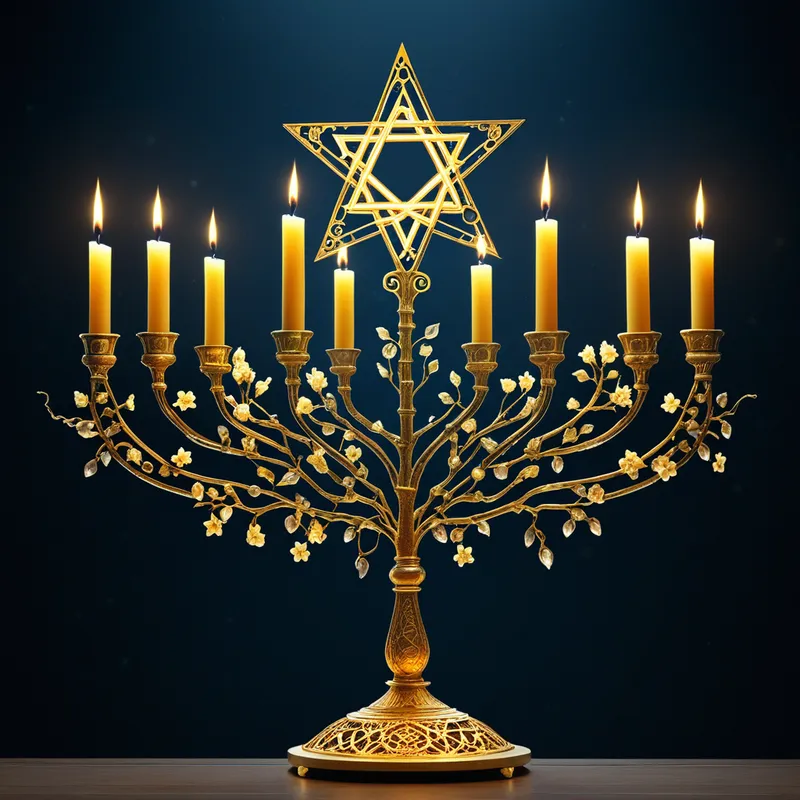
When the Menorah appears in a modern dream, it rarely manifests as a museum artifact. It appears as a psychic structure. To dream of kindling the Menorah suggests the dreamer is attempting to illuminate a dark, inner sanctum—perhaps integrating forgotten aspects of [the self](/myths/the-self “Myth from Jungian culture.”/) or seeking clarity on a spiritual path. The act of lighting it is an act of hope and commitment.
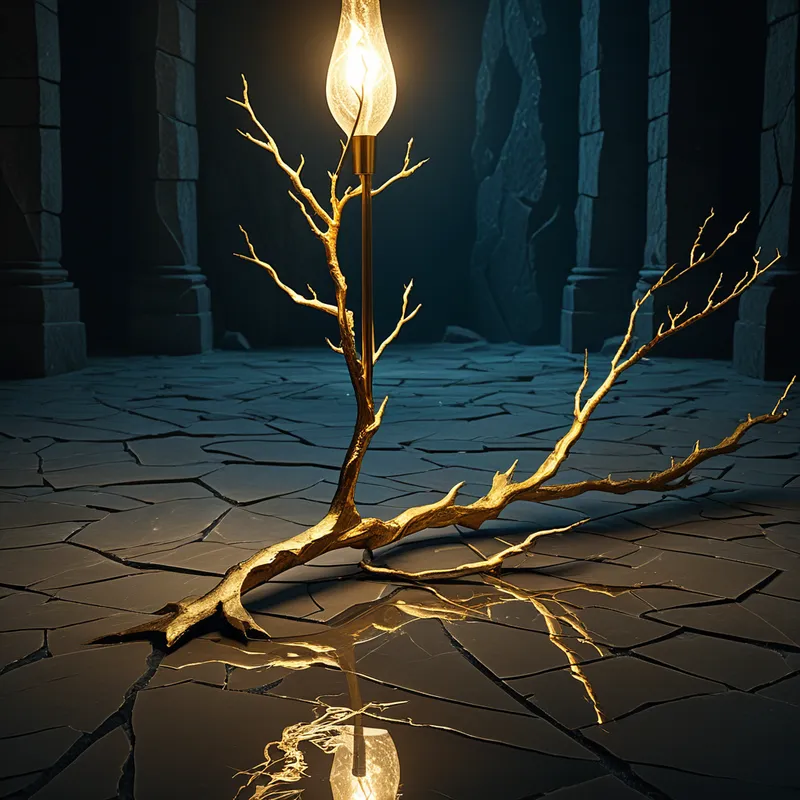
To dream of a broken or unlit Menorah often coincides with feelings of spiritual desolation, a loss of inner guidance, or a sense that one’s creative or intellectual “light” has been extinguished. The somatic feeling here is often one of coldness or hollow dread in the chest.
Dreaming of crafting the Menorah, of being Bezalel at his workbench, signals a powerful process of active individuation. The dream-ego is engaged in the painstaking, beautiful work of forging a unified Self from the raw material of one’s innate talents and experiences. The hammer blows are the challenges of life, shaping the individual into a vessel capable of holding a more conscious, enduring light. The dream suggests the pattern for one’s wholeness exists, and the arduous, sacred work of making it real has begun.
Alchemical Translation
The myth of the Menorah is a masterclass in psychic alchemy. The [prima materia](/myths/prima-materia “Myth from Alchemical culture.”/) is the raw talent of gold—the undifferentiated potential of the [psyche](/myths/psyche “Myth from Greek culture.”/). The divine “pattern shown on the mountain” represents the archetypal image of the Self, the latent, complete blueprint of the individual’s wholeness that exists in the unconscious.
The transmutation occurs not in the vision, but in the beating. The gold must suffer the hammer to become the lampstand.
The “beaten work” is the arduous process of individuation. Every life experience, every conflict, every moment of discipline is a hammer blow that shapes the crude mass toward the intricate, blossoming form. Bezalel, the artisan “filled with the spirit of skill,” represents the conscious ego that has aligned itself with this transcendent purpose. The requirement that it be made of one piece signifies the goal of integration—the intellect, emotion, intuition, and sensation (the branches) are not welded on but are innate, emerging organically from the central stem of the individual’s core being.
Finally, the lighting of the lamps is the opus contra naturam—the work against nature. It is the moment when the crafted psyche becomes functional, illuminating the inner world. This light does not erase shadow; it defines a sacred space within which one can relate to [the shadow](/myths/the-shadow “Myth from Jungian culture.”/), to the “showbread” of one’s nourishing talents, and to the ultimate mystery of the Self ([the Holy of Holies](/myths/the-holy-of-holies “Myth from Biblical culture.”/)). The Menorah myth teaches that enlightenment is not a sudden gift, but the final, glowing result of a lifelong covenant between the human will to create and the divine pattern of wholeness.
Associated Symbols
Explore related symbols from the CaleaDream lexicon: