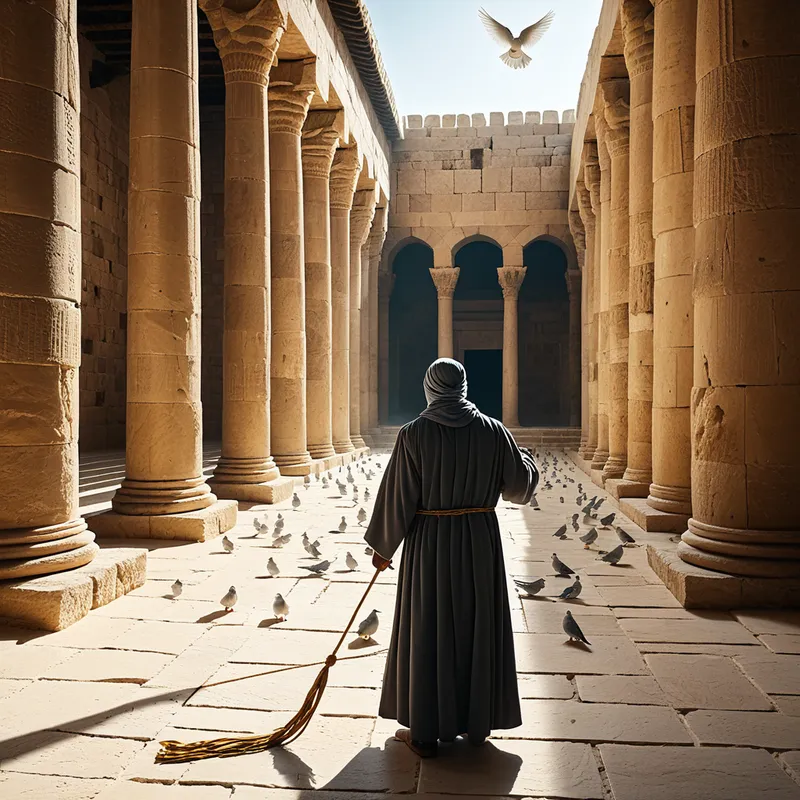
The Temple Cleansing Myth Meaning & Symbolism
A solitary figure enters the sacred marketplace, overturning tables to reclaim the sanctuary's true purpose from the noise of commerce and compromise.
The Tale of The Temple Cleansing
The air in the Temple was thick—not with incense, but with the dust of commerce and the sharp tang of animal fear. It was the time of Passover, and the great outer court, the Court of the Gentiles, meant to be a house of prayer for all nations, had become a roaring marketplace. The clink of coins was the new liturgy. The bleating of sheep and the cooing of doves in cramped cages drowned out whispered psalms. Men haggled over the price of sacrificial purity, their voices rising in profit-driven fervor.
Into this cacophony he came. Not with an army, but alone. A figure from the dust of the road, his gaze sweeping across the scene—the tables of the money-changers, who swapped profane Roman coin for sacred Temple shekels at a usurer’s rate; the pens of animals sold at inflated prices to pilgrims far from home. His stillness was a vortex in the storm of noise.
Then, movement. A terrifying, deliberate grace. He did not shout at first. He acted. His hands, familiar with wood and rope, began to weave cords into a short scourge. The action itself was a silent condemnation. Then, the storm broke. He overturned the first table. A cascade of silver rang like judgment on the stone. Coins, the idols of that place, skittered and spun into the shadows. He moved to the next, and the next, wood crashing, merchants scrambling back with cries of outrage and terror.
“Take these things away!” His voice, when it finally came, cut through the chaos, not with rage, but with a prophetic authority that shook the very pillars. “Stop making my Father’s house a marketplace!” He strode to the dove-sellers, his presence scattering them. He opened the cages, and the birds burst forth in a flurry of wings, a sudden, beautiful chaos of liberation against the stone vaults. The animals destined for the knife were driven out, their confused bleating fading into the city streets.
For a moment, there was a stunned silence, broken only by the settling dust and the distant, now-audible prayers from the inner courts. The sacred space, for a fleeting hour, breathed again. The authorities, emerging from their shock, demanded a sign for this audacious act. He looked at them, the rubble of commerce at his feet, and spoke a riddle of destruction and rebirth that none present could fathom. The deed was done. The Temple, for a moment, was cleansed.
Cultural Origins & Context
This narrative is found in all four Gospels, a rare point of unanimity, though placed at different points in the timeline by the evangelists. Its setting is the Temple in Jerusalem, the absolute center of Jewish religious, national, and economic life in the 1st century. The commerce described was, in one sense, a practical necessity: pilgrims needed approved animals and currency for the required sacrifices. Yet, its location in the Court of the Gentiles—the one place where non-Jews could worship the God of Israel—had effectively turned the threshold of the sacred into a bazaar, excluding the very “nations” it was meant to welcome.
The story functions as a prophetic enactment, a tradition rooted in figures like Jeremiah and Ezekiel. Jesus’s action is not mere reformist zeal; it is a performed parable of judgment and restoration. It directly echoes Zechariah’s vision of a future day when “there shall no longer be a trader in the house of the Lord of hosts.” For the early communities telling this story, it served a dual purpose: it explained the rising tension with religious authorities that led to the crucifixion, and it established their leader as the authoritative interpreter—and ultimate replacement—of the Temple’s sacrificial system. It was a story of revolutionary purity, challenging the comfortable fusion of spiritual power and economic exploitation.
Symbolic Architecture
At its core, the myth is about the violation and reclamation of sacred space. The Temple is not merely a building; it is the symbolic heart, the axis mundi where the divine and human realms connect. The corruption of that space with idolatry of money and systemic exploitation represents a profound psychic sickness: when the inner sanctum of the Self is colonized by the values of the marketplace.
The true sacrilege is not the selling, but the selling within the sanctuary—the failure to maintain a boundary between the transactional world and the holy of holies within.
The figure performing the cleansing embodies the archetypal rebel and the divine mediator. His whip is not an instrument of war, but of discrimination—a symbolic severing of entangled, profaning threads. The overturned tables represent the overthrow of a corrupted system, while the release of the doves (symbols of the Spirit and of innocent sacrifice) signifies the liberation of purity from the machinery of compulsory ritual. The act is one of fierce, non-negotiable differentiation: this is not that. The sacred must be quarantined from the profane, not for elitism, but for its very survival.
The Dreamer’s Resonance
When this myth stirs in the modern unconscious, it often manifests in dreams of chaotic, cluttered, or polluted interior spaces. One may dream of their childhood home filled with noisy strangers conducting business, of their own body housing a bustling, stressful office, or of a beautiful natural sanctuary littered with garbage. The somatic feeling is one of visceral disgust, claustrophobia, and a desperate need for air.
Psychologically, this signals that the ego’s inner “court”—the space where one meets the world and negotiates values—has been overrun. The “money-changers” may represent internalized pressures: the part of you that constantly calculates worth, the voice that commodifies your time and relationships, or the compromise you made that now feels like a betrayal of a core ideal. The dream is an eruption of the Self, the central archetype of wholeness, demanding a cleansing. It is the psyche’s immune response to a soul-sickness born of living out of alignment. The rising emotion—often a clean, sharp anger—is not pathology, but the necessary fuel for the impending, inevitable act of reclamation.
Alchemical Translation
The alchemical journey is one of solve et coagula—dissolve and reconstitute. The Temple Cleansing is the dramatic solve phase applied to the psyche. It is the nigredo, the blackening, where the comfortable, compromised structures must be violently broken down.
Individuation requires not just adding light, but first courageously confronting the shadowed marketplace within—the tables of self-deception where we trade our essence for security.
For the modern individual, this myth models the terrifying, liberating act of psychic revolt. It is the moment you quit the soul-deadening job, end the inauthentic relationship, or silence the internal critic that measures you by external metrics. You make the “whip of cords” from your own disillusionment and overturn the inner tables. You drive out the “sheep”—the herd mentality, the following of empty rituals—and release the “doves”—your own stifled intuition and innocence.
This is not a peaceful, meditative process. It is fiery, disruptive, and will be opposed by the inner “authorities” who benefit from the status quo. But it is the prerequisite for the coagula, the rebuilding. Only after the court is cleared can the true “house of prayer” be established—a quiet, integrated inner space where dialogue with the deeper Self, not commerce with the world, becomes the primary activity. The cleansed temple is the vessel ready to receive the lapis philosophorum, the stone of wholeness. The rebellion is not the end, but the sacred beginning of true interiority.
Associated Symbols
Explore related symbols from the CaleaDream lexicon: