The Tell-Tale Heart Myth Meaning & Symbolism
A tale of a crime, a hidden body, and a heart that beats a confession from beyond the grave, revealing the inescapable voice of the guilty soul.
The Tale of The Tell-Tale Heart
Listen. Listen closely, in the deep of the night, when the world is hushed and the only sound is the blood in your own ears. I will tell you of a man, and of an eye, and of a sound that would not be stilled.
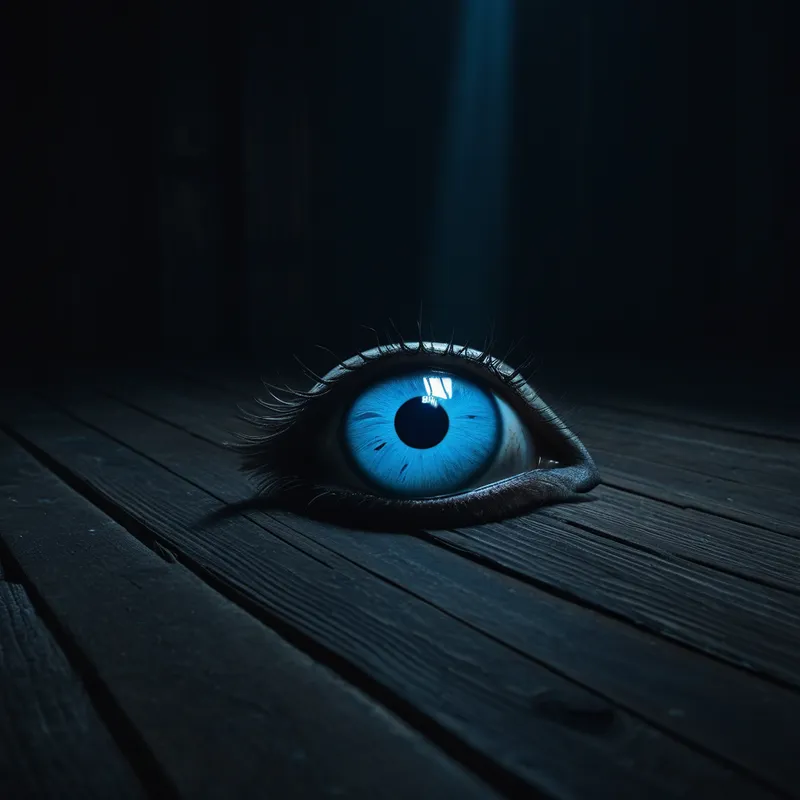
There was a man—let us not speak his name, for names have power—who shared his house with an old man. The old man was not unkind, but he possessed one thing that became an obsession: an eye. A pale blue eye, filmed over, like that of a vulture. To our man, this was no mere eye. It was a curse, a malignant star fixed upon him, seeing through to the corruption he felt in his own soul. He loved the old man, he swore it. But he hated, hated, hated that eye. It became a lodestone for all his unnamed dread, and he resolved it must be destroyed, to still the beating of his own terror.
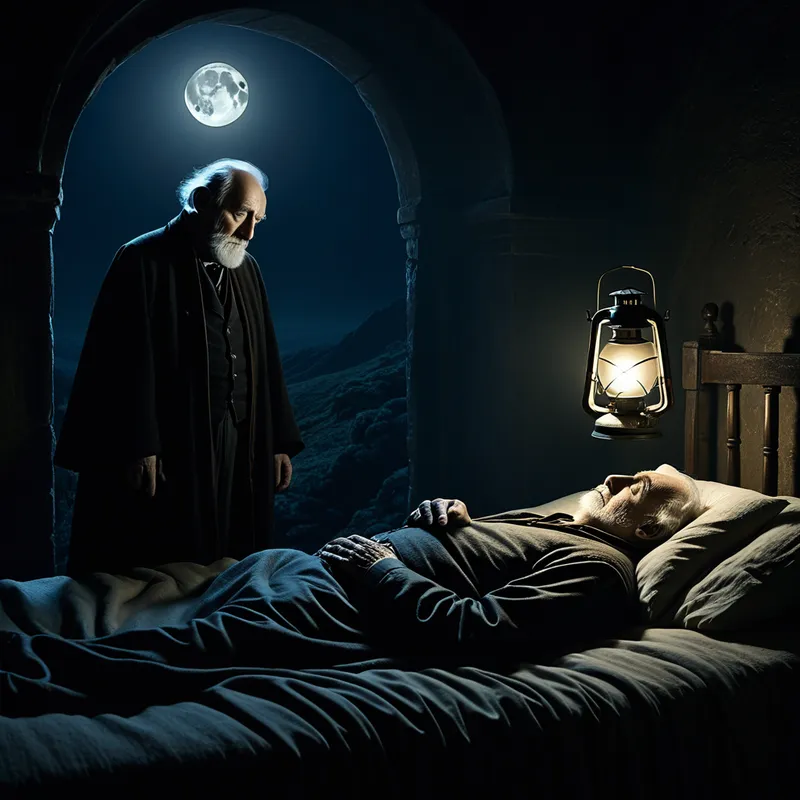
For seven nights, at the midnight hour, he would turn the lock, push open the door so slowly it did not sigh, and thrust his shrouded lantern into the room. A single thin ray, like the finger of a malevolent angel, would creep across the floor until it found the face of the sleeper. And there, closed in sleep, was the hated eye. For seven nights, the eye was shut, and so the deed was stayed, for it was not the old man he wished to end, but the Eye.
On the eighth night, a sound awoke the old man. The man with the lantern stood frozen in the crack of the door. The hour was profound. Then, a groan of mortal terror. The old man knew. He knew the sound of death in his chamber. The lantern ray, trembling now, found its mark. And there it was—wide, wide open—the vast, pale, damning blue eye. The man saw nothing else. He saw only that window. The rage mounted. A low cry, quickly stifled. He dragged the old man to the floor and pulled the heavy bed over him. The sound ceased. The heart was still.
Then began the second labor: concealment. With a craftsman’s care, he dismembered the body and hid the pieces beneath the floorboards of that very chamber, leaving no stain, no clue. He was clever. He was calm. A perfect crime.
But then came the officers. A neighbor had heard a shriek. The man, with flawless audacity, welcomed them, seated them in the chamber of the crime, placed his own chair directly upon the very planks that held his secret. He chatted. He was at ease. Yet, beneath his feet, a sound began. A low, dull, quick sound—like a watch wrapped in cotton. It grew. It was a heartbeat. The sound of the old man’s heart, buried and still, beating, beating, beating from beneath the floor!
His talk became frantic. He raved. The sound swelled into a terrible thunder. It was the sound of his own guilt, made audible to the world. He could bear it no longer. “Villains!” he shrieked at the placid officers. “Dissemble no more! I admit the deed!—tear up the planks!—here, here!—It is the beating of his hideous heart!”
Cultural Origins & Context
This is a tale born not from ancient firesides, but from the flickering gaslight of the 19th century, penned by the master of the macabre, Edgar Allan Poe. Yet, its roots tap directly into the deepest aquifers of oral folklore. It belongs to the genre of the moralizing horror story, a cousin to the cautionary folktale. It was passed not by village bards, but through periodicals like The Pioneer, read aloud in parlors, its chilling conclusion delivering a visceral, collective shudder.
Its societal function was dual. On the surface, it served as pure, thrilling entertainment for a public increasingly fascinated by psychology and the Gothic. On a deeper level, it performed the ancient folkloric duty of reinforcing a social and spiritual law: the law of conscience. In an age of growing urban anonymity and scientific materialism, the story insists on a pre-modern, almost supernatural truth—that a hidden crime does not stay hidden from the universe itself. The heart becomes the invisible witness, and its testimony is inescapable. It is a folklore for the modern, isolated psyche, warning that the most secure prison is the one we build in our own minds.
Symbolic Architecture
The myth’s power lies in its stark, brutal symbolism. The Vulture Eye is not merely a physical defect; it is the Symbol of the Other’s consciousness, a gaze that perceives our shadow. To the narrator, it is the unbearable mirror. He does not kill a man; he attempts to murder a perception, to destroy the external witness to his own internal fragmentation.
The heart buried beneath the floor is the truth buried beneath the persona. It does not decay; it amplifies.
The meticulous concealment represents the ego’s frantic, logical efforts to compartmentalize and hide what it has done—to repress the unacceptable act into the cellar of the unconscious. The floorboards are the fragile barrier between the conscious mind and the seething contents of the shadow. The police are not clever detectives; they are neutral reality, the ordinary world that, by its very indifference and normalcy, becomes the anvil upon which the psyche shatters itself. The heartbeat, then, is the ultimate symbol: the autonomous voice of the Self, the objective psyche, which will not be silenced. It is conscience, yes, but more profoundly, it is the psyche’s imperative toward wholeness, violently insisting that the repressed must return and be acknowledged.

The Dreamer’s Resonance
When this myth patterns a modern dream, the dreamer is in the throes of a profound psychological confrontation. To dream of hiding a terrible thing—a body, an object, a secret room—and then hearing its persistent, accusing sound (a heartbeat, a ticking, a muffled voice) signals that the unconscious is forcing a confession.
Somatically, one may awake with a racing heart, a sense of constriction in the chest, or a literal tinnitus—the body echoing the dream’s sound. Psychologically, this is the process of a complex—a bundle of repressed emotion, memory, and energy—threatening to break containment. The dream-ego (the narrator) has committed an act against the Self (the old man, a wiser, perhaps burdensome part of the psyche) and tried to bury it. The heartbeat is the somatic signature of that buried content, its vital energy refusing to be nullified. The dreamer is being shown, in terrifying clarity, that their current stance of control, cleverness, or denial is unsustainable. The integrity of the psyche demands acknowledgment, even at the cost of the ego’s grand, defensive edifice.

Alchemical Translation
The alchemical process modeled here is not one of gentle sublimation, but of a violent, necessary putrefactio—the stage of blackening and decay that precedes transformation. The narrator attempts to skip this stage. He commits the act (the separatio, the splitting of himself from the offending “eye”) and tries to proceed directly to a false coagulatio, a reintegration based on a lie (the clean room, the calm chat with authority).
The alchemical vessel is not the retort, but the skull of the dreamer. The fire is the heat of a shame that will not cool.
The myth demonstrates that this is impossible. The repressed material must rot, must fester, must generate the psychic pressure (the beating) that will eventually blow the lid off the vessel. The triumphant, if catastrophic, climax of the story is the moment of confessio—the shattering admission. This is the beginning of true alchemy. Only by tearing up the floorboards, by exposing the festering truth to the light of consciousness (represented by the officers, the collective, reality itself), can any integration begin. For the modern individual, the myth is a brutal map. It says: that thing you are so cleverly hiding from yourself, that guilt, that shame, that memory, that neglected talent or love—it is not dead. It is beating. And it will speak, louder and louder, until you finally admit its presence and begin the real, messy work of psychic transmutation. The goal is not to silence the heart, but to listen to what it has always been trying to tell you.
Associated Symbols
Explore related symbols from the CaleaDream lexicon: