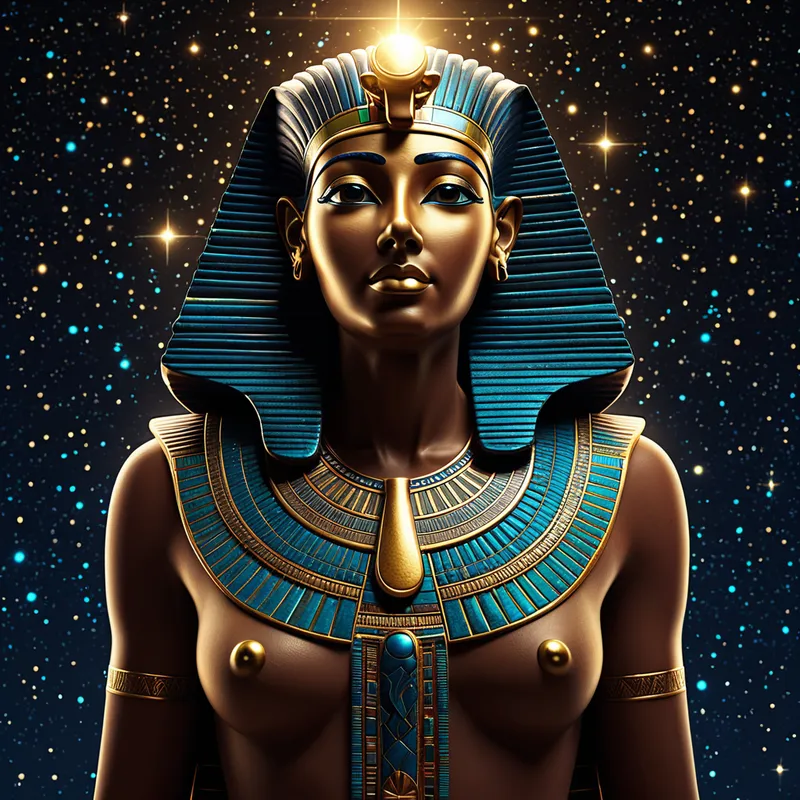
The tears of the Egyptian godd Myth Meaning & Symbolism
A myth of divine sorrow where a god's tears, shed in cosmic loneliness, fall to earth and become the first source of all life and consciousness.
The Tale of The tears of the Egyptian godd
In the time before time, when the universe was a silent, dark egg, there existed only the One. Not a god as we imagine, but a consciousness, a being of pure potential, alone in the absolute. It was the Nun, but it was also the dweller within it. This entity, whom later tongues would call a god, held within itself the blueprints for all that could be: stars, rivers, laughter, sorrow. Yet, in that perfect, solitary containment, a profound ache began to stir—not a pain of injury, but the deep, resonant loneliness of potential unrealized.
For eons that cannot be measured, this being contemplated its own existence. It saw the beauty of its thoughts, the symphony of forms waiting to be born, but with no other to witness, no other to reflect its essence, the beauty turned hollow. The silence, once peaceful, became a vast, echoing chamber. In the heart of this primordial consciousness, a feeling gathered. It was not anger, nor rage. It was a sorrow so pure and so vast that it could find no expression but to overflow.
And so, the god wept.
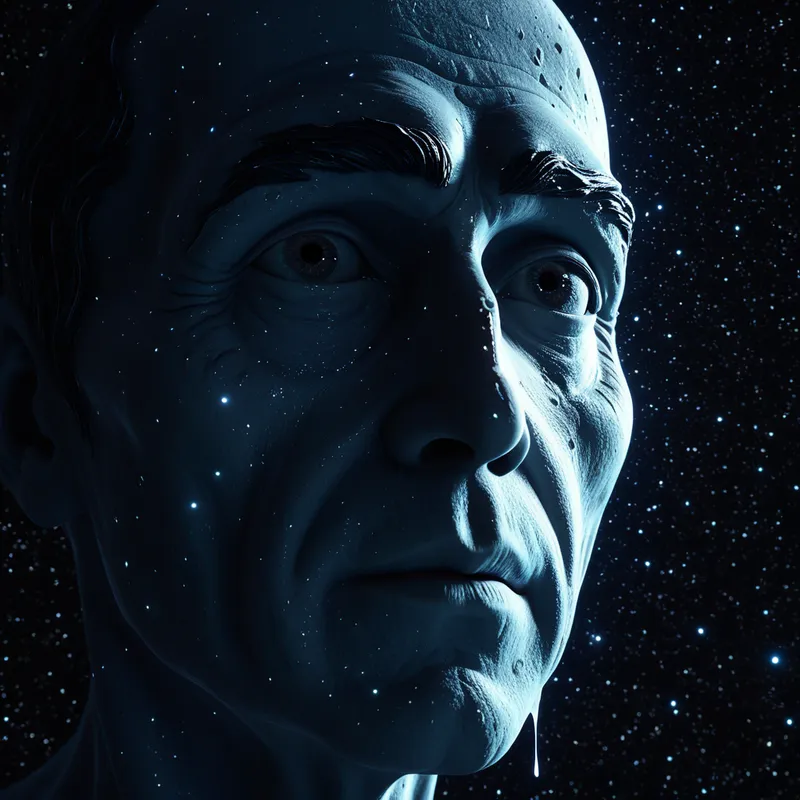
The first tear was not of water, but of condensed starlight and longing. It welled from a place deeper than spirit and fell from a face that was the sky itself. It did not fall to anything, for there was no ground, only the endless dark. It fell through. As it fell, its heat was the first warmth. Its trail was the first comet. The sound of its passage was the first vibration, the first note from which all music would one day descend.
More tears followed, each a unique lament. One tear held the memory of mountains yet unformed; another, the whisper of winds yet to blow. One was heavy with the salt of future oceans, another sparkled with the dry brilliance of desert sands. They fell in a silent, radiant rain, each a seed of a world.
Where they finally came to rest, a gentle mist arose—the Benben stone, but born from sorrow, not command. Upon this misty mound, the tears pooled. From their mingled waters, life stirred. The first reeds pushed toward the light of the god’s own weeping face. The first heartbeat echoed the rhythm of the falling drops. The god, watching, felt its loneliness transform. It was no longer alone, for it had poured itself out, and in that outpouring, had created an Other to behold. Its tears became the Hapi of all existence, the fertile flood from which everything springs.
Cultural Origins & Context
While not a singular, canonical myth from a specific papyrus, the motif of divine tears as agents of creation is a powerful undercurrent in Egyptian theological thought. It synthesizes several profound concepts from the Pyramid Texts and Coffin Texts. The god in this narrative is an amalgam: it carries the solitude of Atum before his act of masturbatory creation, the generative fluid of the gods, and the life-giving principle of the Nile’s inundation, which was seen as the tears of Isis mourning Osiris.
This story likely lived in the oral teachings of priestly philosophers and temple mystics, used not as a public festival tale but as an initiatory explanation for the paradox of creation: why would a perfect, complete being bother to create a flawed, suffering world? The answer embedded here is that creation is not an act of power, but an act of poignant necessity born from a divine emotional reality. It served to sacralize human emotion, particularly grief, framing it not as a weakness but as a potential font of creativity and connection to the divine source.
Symbolic Architecture
The myth’s power lies in its radical symbolism. The tear is the ultimate symbol of emotion made tangible, internal state becoming external reality. It represents the critical moment where feeling can no longer be contained and must manifest in the physical realm.
The first act of creation was not a word, but a sob. The universe began not with a command, but with a confession of unbearable fullness.
Psychologically, the solitary god represents the undifferentiated Self—the psyche before consciousness, containing all archetypes in potential but experiencing none in relation. The “loneliness” is the drive toward individuation, the inherent need of the psyche to know itself through reflection, conflict, and relationship. The tears are the process of projection and manifestation. Every creative act, every piece of art, every forged relationship, begins as an internal pressure—a “tear” of unexpressed emotion or idea that seeks to fall into the world and take form.
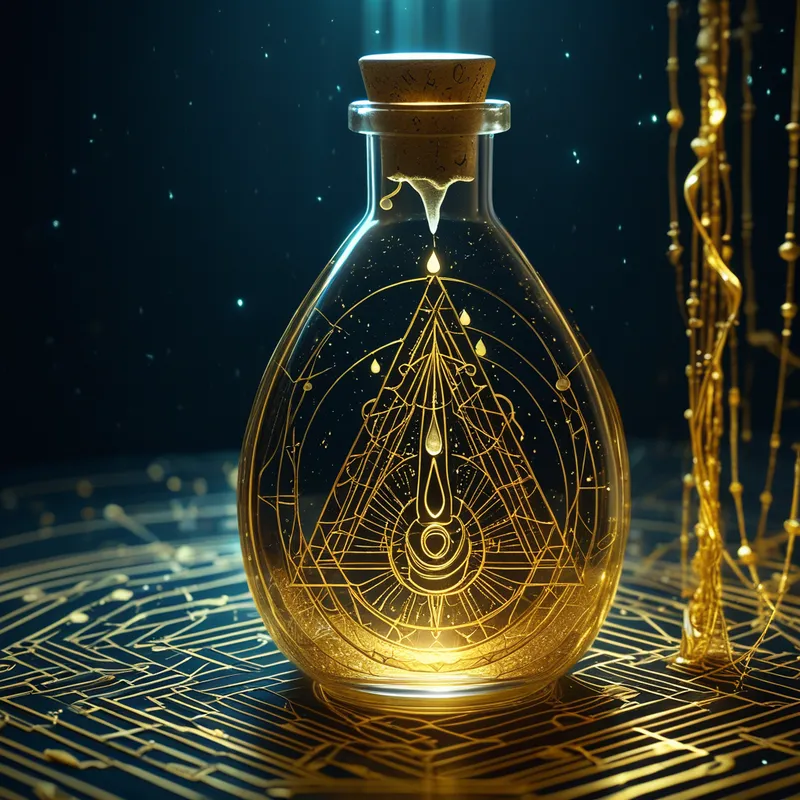
The transformation of tears into life-giving water is the alchemical key. It symbolizes the redemption of suffering. Grief, sadness, and longing are not wasted energies; they are the primal, salty waters from which new growth and consciousness can emerge. The myth tells us that our deepest sorrows carry within them the seeds of our most authentic creations.
The Dreamer’s Resonance
When this myth pattern arises in modern dreams, it often signals a profound somatic and psychological process: the crystallization of deep emotion into a new state of being. A dreamer might find themselves weeping uncontrollably, their tears transforming into objects, landscapes, or living things. They may dream of a vast, lonely figure in space, or simply feel the sensation of a weighty, luminous drop forming within their chest.
This is the psyche working to transmute raw, often unconscious, affective material. The “tear” is the somatic embodiment of a feeling—grief, longing, pent-up creativity—that has reached a critical mass and is seeking release and form. The dream is the stage for this alchemy. The transformation witnessed in the dream (tear-to-plant, tear-to-river) shows the dreamer’s own innate capacity to turn psychic pain into generative power. It is a direct message from the unconscious that the current sorrow is not an end, but a fertile beginning, a call to create from the depths of one’s experience.

Alchemical Translation
For the modern individual on the path of individuation, this myth models the process of psychic transmutation with exquisite clarity. The journey begins in the “Nun” of our own unconscious solitude, where we hold unlived potentials. The suffering of unexpressed life—the loneliness of the god—is not a flaw, but the necessary friction that ignites the transformative process.
Individuation requires the courage to weep your own world into being. The salt of your tears is the catalyst for your unique creation.
The “alchemical translation” follows these stages: First, Contemplation in Solitude (becoming aware of the inner pressure). Second, The Overflow (allowing the emotion its full expression, the sacred act of weeping, writing, painting, or speaking the truth). Third, The Fall (releasing the creation into the world, risking exposure). Finally, Transformation (witnessing how your expressed sorrow fertilizes new life, new connections, and a new understanding of yourself).
The god does not stop weeping because creation is complete; creation continues because the weeping continues. Similarly, our psychic growth is not a one-time event but a continuous cycle of feeling, expressing, and transforming. The myth ultimately teaches that our vulnerability—our capacity to feel deep sorrow and loneliness—is our fundamental creative force. To deny our tears is to dam the Hapi of our own soul. To shed them consciously is to participate in the ongoing creation of our own world.
Associated Symbols
Explore related symbols from the CaleaDream lexicon: