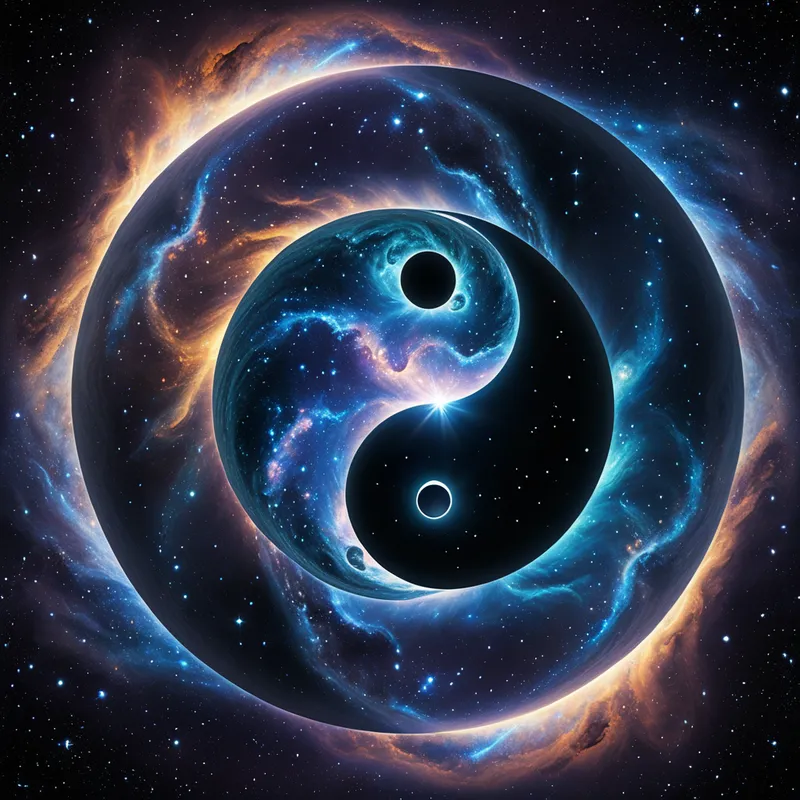
The Taijitu Myth Meaning & Symbolism
The myth of the primordial unity, its division into Yin and Yang, and their eternal, dynamic dance that births and sustains all of existence.
The Tale of The Taijitu
In the time before time, there was no east or west, no above or below, no sound or silence. There was only the Hundun, the Great Chaos—a perfect, silent, and boundless egg. It was not empty, but full beyond measure, a womb containing all potential, dreaming of all form. Within its seamless shell, everything that ever could be slept in a profound, motionless unity. There was no conflict, for there was no other. There was no life, for there was no death to give it meaning. It was a timeless, featureless ocean of pure being.
But within the heart of that perfect stillness, a tension began to stir. A longing. A question without words. The unity, in its very perfection, began to dream of relation. It dreamed of touch and separation, of knowing itself by seeing its own reflection. And so, from the very center of the Hundun, a vibration arose—a single, silent pulse that was both a sigh and a birth cry.
The pulse became a rhythm. The rhythm became a strain. And the seamless shell of the cosmic egg trembled. With a sound like the cracking of a mountain or the first note of a song, it split. Not into fragments, but into two great, flowing breaths.
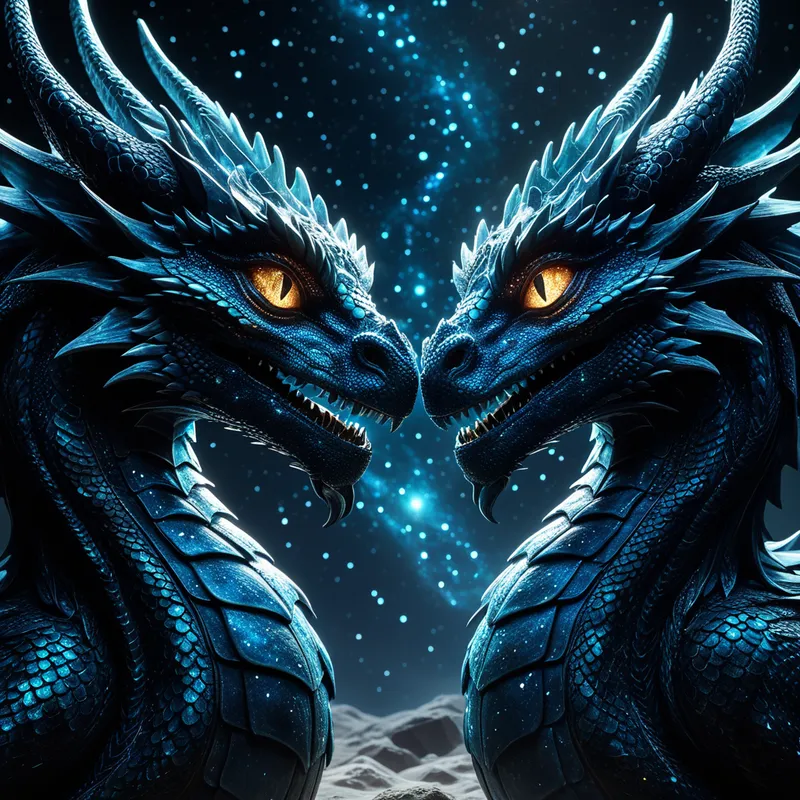
From one breath emerged a great, serpentine dragon of soft, yielding darkness. It was cool like deep water, receptive like the valley, still like the moonlit night. This was Yin. From the other breath surged a great, serpentine dragon of brilliant, active light. It was warm like the sun, creative like fire, moving like the mountain stream. This was Yang.
For a moment, they recoiled from each other, alien and complete. Then, they recognized. In the other, each saw the missing part of its own soul. Yin saw in Yang the motion its stillness craved. Yang saw in Yin the rest its motion required.
They did not battle; they began to dance. A slow, cosmic waltz. The dragon of light flowed into the spaces left by the dragon of dark, and the dragon of dark curled around the radiance of the light. They chased each other’s tails in an endless, graceful circle. Where Yang swelled to its fullest, a seed of Yin appeared at its heart, a dot of perfect night. Where Yin deepened to its most profound, a seed of Yang ignited, a dot of brilliant day.
Their dance was not a return to the old unity, but the creation of a new order—a dynamic, living harmony. From the friction of their movement came heat and vibration. From the interplay of their essences sprang the ten thousand things: the mountains and the rivers, the seasons and the stars, the breath of animals and the spirit of humans. The cosmos was not built, but born—from the eternal, loving embrace of two forces that were never truly separate, forever finding their completion in the other.
Cultural Origins & Context
The story of the Taiji and its symbol, the Taijitu, is not a myth with a single author or a canonical text like a Greek epic. It is a philosophical and cosmological narrative that coalesced over centuries, primarily during the Zhou dynasty and crystallized in texts like the I Ching and later in Daoist philosophy. It was passed down not by bards, but by sages, astronomers, and diviners who observed the patterns of the natural world.
Its societal function was profound and practical. It provided a template for understanding everything: from the governance of an empire (the balance between action and receptivity in a ruler) to medicine (the balance of hot and cold, active and passive energies in the body), to architecture (Feng Shui), and personal ethics. It was a myth that refused to be mere story; it insisted on being a living principle, a map of the dynamics of reality itself. It taught that conflict is not a problem to be eliminated, but a dynamic to be harmonized, and that true power lies not in the victory of one principle over the other, but in their skillful and fluid integration.
Symbolic Architecture
The Taijitu is perhaps the world’s most elegant diagram of a profound psychological truth. It symbolizes the fundamental architecture of consciousness and reality, built on relational opposites.
The dot of light in the dark, and the dot of dark in the light, whisper the ultimate secret: there is no purity, only relationship. Within the heart of your greatest strength sleeps your latent weakness; within the depth of your fear lies the seed of your courage.
Yin and Yang are not moral opposites like good and evil. They are complementary modes of being: contraction and expansion, rest and activity, intuition and logic, the unconscious and the conscious mind. The myth tells us that our psyche, like the primordial Hundun, begins in an undifferentiated state. Individuation—the process of becoming a whole self—requires a kind of sacred cracking. It requires the differentiation of these inner forces. We must allow our inner Yang (our striving, persona, conscious goals) and our inner Yin (our feelings, shadows, instincts, and receptive wisdom) to emerge from the chaos and recognize each other.
The flowing, non-linear boundary between them represents the liminal space where transformation occurs—the threshold where thought becomes feeling, where impulse becomes action, where the known meets the unknown.
The Dreamer’s Resonance
When the Taijitu appears in modern dreams, it is rarely as a static symbol. One may dream of a swirling vortex, a dance of two animals or people, a black and white room that slowly rotates, or the sensation of being simultaneously pulled in two directions yet feeling centered.
Such dreams often signal a somatic and psychological process of rebalancing. The psyche is attempting to correct an over-identification. Perhaps the dreamer has been excessively Yang: overworking, forcing, controlling. The dream presents the swirling dark to pull them toward necessary rest, introspection, and surrender. Conversely, a period of passivity, depression, or confusion (an excess of Yin) may provoke a dream of brilliant, activating light.
The dream is the psyche’s own attempt to perform the cosmic dance. It is creating the friction and flow needed to generate psychic energy and new life—new ideas, new feelings, a new attitude. It is a healing image, showing that the opposing forces within are not at war, but in a necessary, creative, and ultimately harmonious motion.

Alchemical Translation
The myth of the Taijitu models the alchemical process of individuation not as a linear journey to a goal, but as the cultivation of an inner dynamic. The goal is not to become all light or to resolve all darkness, but to become the vessel in which their eternal dance can occur with grace and consciousness.
The alchemical gold is not a state of static perfection, but the capacity to hold the tension of opposites without splitting, to be the circle that contains the swirl.
The first step is the acceptance of the primordial crack. We must acknowledge the end of psychic innocence (Hundun) and accept the birth of inner duality. This is the stage of recognizing our conflicts, our contradictions, our shadow.
The second step is the sacred chase. Instead of trying to eliminate the “negative” pole (the dark, the passive, the fearful), we learn to engage with it, to move with it, as the dragons do. This means actively listening to our fatigue when we want to push, or consciously engaging our will when we want to collapse. We chase our own tail, learning the contours of our whole being.
The final, ongoing process is the cultivation of the seed. This is the most profound alchemy: discovering the dot of Yin in our Yang and the dot of Yang in our Yin. It is finding rest within intense activity—a moment of breath in a speech. It is finding a point of fierce clarity within deep sadness—the insight that grief brings. In doing so, we transmute opposition into complement, conflict into creativity, and the self into a microcosm of the beautifully balanced, ever-turning world. We do not solve the mystery; we become its living expression.
Associated Symbols
Explore related symbols from the CaleaDream lexicon: