The Tabula Smaragdina Myth Meaning & Symbolism
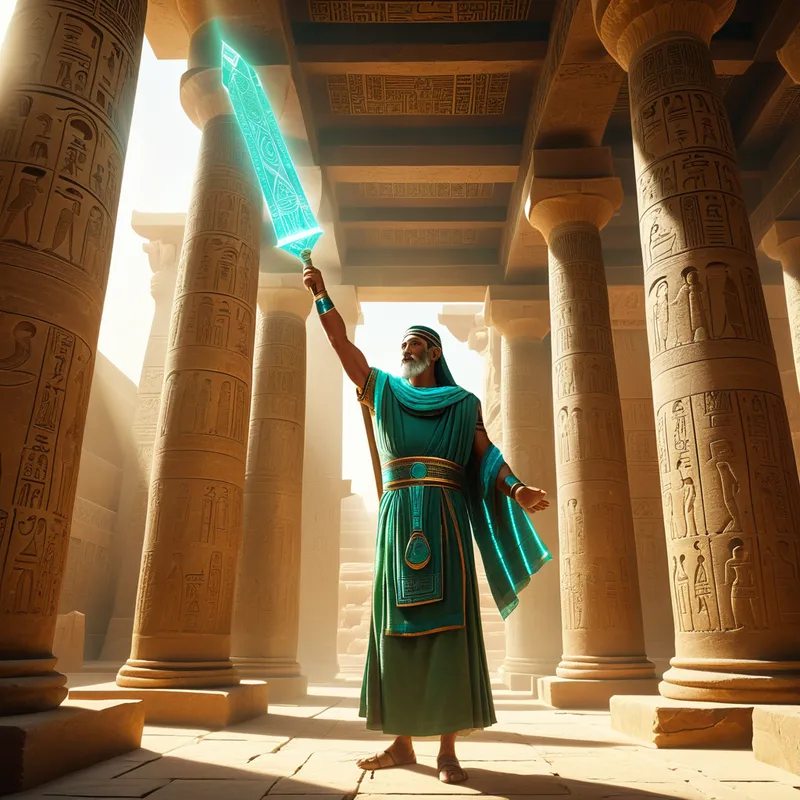
The myth of the Emerald Tablet, a divine text inscribed with the secret laws of the cosmos, gifted to humanity by the thrice-great sage Hermes Trismegistus.
The Tale of The Tabula Smaragdina
In the time when the boundaries between earth and heaven were thin as papyrus, in the land where the Nile whispers secrets to the sand, there walked a figure who was three in one. He was known as Hermes Trismegistus—Thrice-Great Hermes. His sandals had trodden the dust of markets and the marble of celestial halls. He was the messenger, but he carried no missives for kings. He bore a silence, a listening so profound it drew down the music of the spheres.
The air in his sanctuary was thick with the scent of kyphi incense and the electric tang of impending storm. Scrolls lined the walls, but their wisdom was a prelude. Hermes stood before a simple altar of black basalt, his gaze turned inward, his spirit ascending the ladder of the seven heavens. He did not plead or pray; he attuned. He became a hollow reed through which the breath of the One Thing might whistle its song.
And then, a sound—not of this world. A harmonic, a vibration that resonated in the marrow of the stone and the vault of his skull. Light, not of lamp or star, but of essence, coalesced in the center of the chamber. It was a condensation of understanding, a precipitation of cosmic law into form. From the heart of this luminous silence, it manifested. Not placed, not granted, but revealed, as if it had always been there, waiting for the eye that could see it.
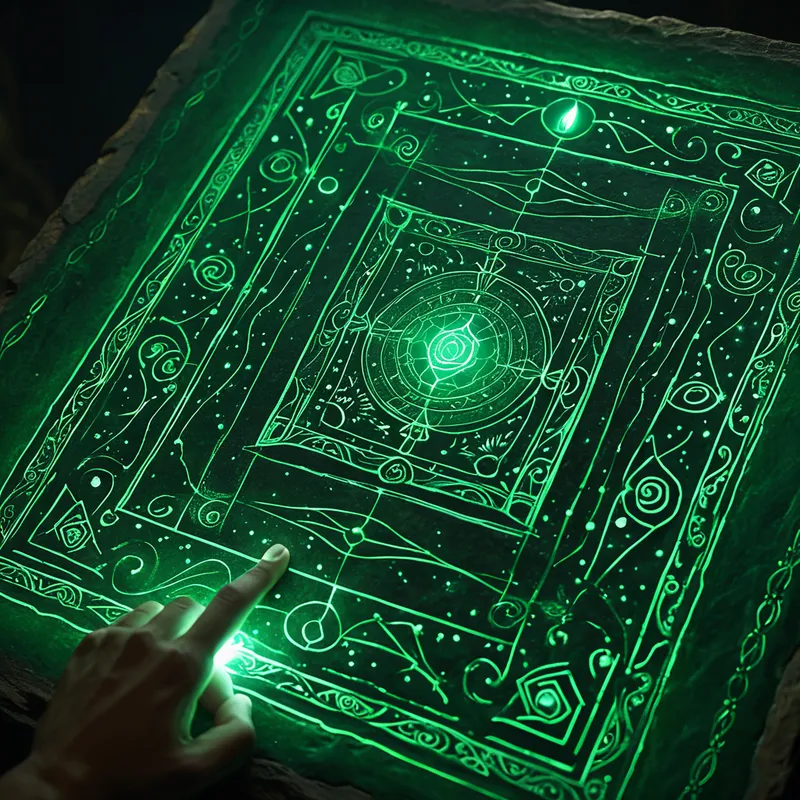
There it lay upon the altar: The Tabula Smaragdina. The Emerald Tablet. It was not carved, but inscribed—its letters not marks upon the surface, but channels of living light within the depths of the flawless green stone. It pulsed with a verdant fire, the green of life, of Venus, of the heart of the world. To look upon it was to feel the vertigo of infinity, to see the blueprint of the All.
Hermes reached out, not with greed, but with reverence, the gesture of a midwife. His fingers did not grasp the Tablet; they hovered, and the wisdom flowed into him. He heard the words without sound: “Verum, sine mendacio, certum et verissimum…” “True, without falsehood, certain and most true…” The law of correspondence, the secret of operation, the mystery of the threefold world—it was all there, a complete and perfect circle of knowledge. The conflict was not against a monster or a god, but against the inherent fragmentation of mortal understanding. The rising action was the dilation of his own mind to contain the universe. The resolution was the stillness of perfect knowing. The Tablet did not change him; it remembered him to what he, and all things, eternally were.
He knew then his task. He was to be the scribe not for pharaohs, but for humanity’s soul. The myth does not end with a vault or a hidden tomb. It ends with the Tablet held aloft, not to be worshipped, but to be read. The light from its surface bleeding into the twilight of the world, offering the key to the great prison of matter. The gift was given. The work, now, begins.
Cultural Origins & Context
The myth of the Emerald Tablet is the cornerstone of the Hermetic tradition, a syncretic current that flowed from the fertile delta of Hellenistic Egypt, blending Greek philosophical rigor with Egyptian sacerdotal mystery. It first appears in historical records in Arabic sources around the 8th century, but its legend claims an antiquity lost in time, purportedly discovered in the hands of Hermes himself in a hidden chamber.
This was not a myth for the populace, but for the initiate. It was passed down in whispers between master and disciple within the sealed circles of alchemists, astrologers, and philosophers. Its societal function was subversive and transformative: it provided a map for the liberation of the spirit from the confines of a deterministic cosmos. In a world perceived as fallen and chaotic, the Tablet asserted a profound, knowable order. It was the ultimate “proof text,” the divine authority that grounded the entire Hermetic pursuit of gnosis—direct experiential knowledge of the divine. The myth served as both a point of origin and a perpetual touchstone, a story that explained why the arduous work of spiritual alchemy was not mere fantasy, but a participation in the very architecture of reality.
Symbolic Architecture
The Tabula Smaragdina is not merely an object; it is the symbolic embodiment of the interconnectedness of all levels of existence. Its primary symbol is the principle of Correspondence, famously distilled in its opening axiom.
“That which is above is like to that which is below, and that which is below is like to that which is above, for the performance of the miracles of the One Thing.”
This establishes the macrocosm-microcosm relationship as the foundational law. The Tablet itself, a solid, earthly stone (below) containing the laws of the cosmos (above), is the perfect icon of this principle.
Psychologically, Hermes Trismegistus represents the integrated Self, the conscious ego that has made itself a vessel for the transpersonal wisdom of the unconscious (the One Thing). The “discovery” of the Tablet in a hidden chamber is the archetypal motif of finding the treasure hard to attain—the latent wholeness and innate knowledge buried within the psyche. The emerald green symbolizes the heart center, the mediating faculty between spirit and matter, intuition and intellect. The act of reading the inscribed light is the moment of insight, where abstract, unconscious content becomes conscious, formulated understanding.
The Dreamer’s Resonance
When this myth pattern stirs in the modern dreamer, it often signals a profound somatic and psychological process of synthesis. One may dream of finding a glowing stone, a book with incomprehensible yet deeply familiar symbols, or a simple formula that seems to explain everything.
Somatically, this can accompany a feeling of deep, resonant alignment—a “click” as if disparate parts of the body and mind suddenly synchronize. Psychologically, the dreamer is going through the process that Hermes modeled: a receptive attunement. The conflict felt is often the tension between a fragmented, chaotic life experience and a deep, intuitive sense of an underlying pattern. The dream presents the Tabula as the resolving symbol. Its appearance suggests the unconscious is ready to deliver a key insight, a core truth about the dreamer’s own nature and their place in their world that can unify previously opposing aspects of their life. It is the psyche’s own revelation of its foundational law.

Alchemical Translation
The myth of the Tabula Smaragdina is, in essence, a perfect model of the alchemical opus and the Jungian process of individuation. It maps the entire journey of psychic transmutation.
The initial state is one of separation: the ego (the seeker) feels apart from the wisdom of the Self (the One Thing). The “ascent” of Hermes represents the meditatio and imaginatio of active imagination, withdrawing from the outer world to engage the inner. The manifestation of the Tablet is the coniunctio, the sacred marriage where conscious and unconscious meet, and the transcendent function—the reconciling symbol—is born.
“And as all things proceed from the One, by the meditation of the One, so all things proceed from this One Thing, by adaptation.”
This line is the alchemical recipe for individuation. “The meditation of the One” is the sustained, focused attention on the central, unifying symbol of the Self (the Emerald Tablet within). “Adaptation” is the conscious, diligent work of integrating that insight into daily life—transmuting base, reactive patterns (lead) into conscious, purposeful action (gold). The myth teaches that the power to perform this “miracle” of self-transformation does not come from willful ego effort alone, but from first aligning with the pre-existing, divine pattern within. One does not create the gold; one discovers the innate law by which all matter, including the psyche, yearns to become it. The triumph is not conquest, but recognition; not making, but allowing the inherent unity to reveal itself through you.
Associated Symbols
Explore related symbols from the CaleaDream lexicon: