The Tablets of Moses Myth Meaning & Symbolism
A prophet ascends a mountain of fire to receive divine law, only to shatter it upon the idolatry of his people, forging a new covenant from the broken pieces.
The Tale of The Tablets of Moses
Hear now the tale of the mountain of smoke and [the law](/myths/the-law “Myth from Biblical culture.”/) of fire.
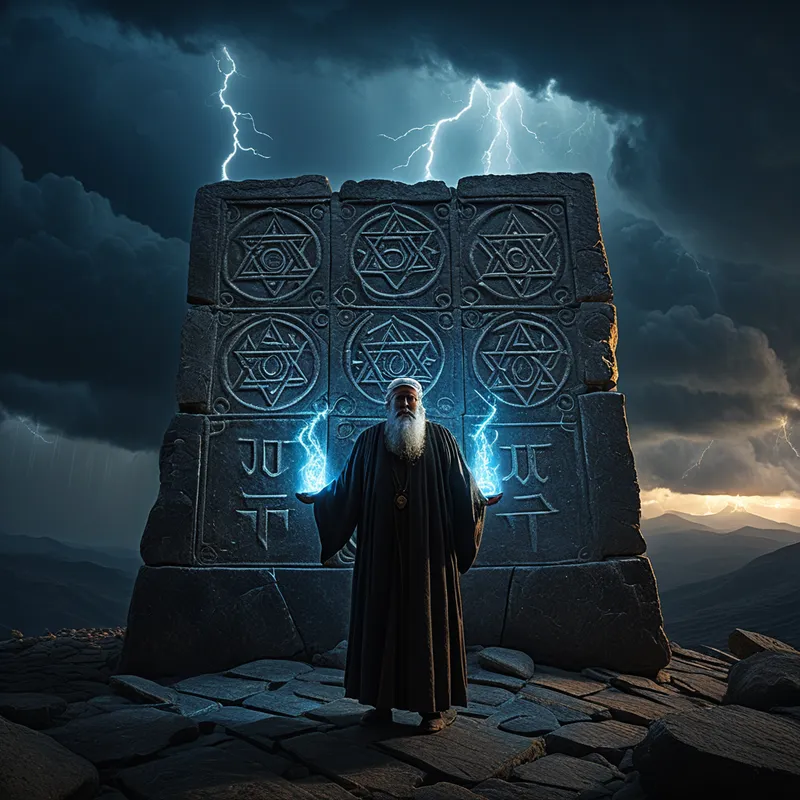
The people were a murmuring multitude in the vast, sun-scorched womb of [the desert](/myths/the-desert “Myth from Biblical culture.”/), freed from the brick and straw of Egypt but not yet from the pharaohs in their own hearts. Their leader, [Moses](/myths/moses “Myth from Biblical culture.”/), was called away, up the terrible slopes of [Mount Sinai](/myths/mount-sinai “Myth from Biblical culture.”/). The mountain itself was a terror—wrapped in a thick, churning cloud, trembling at its roots, its peak a crown of lightning and thunder. For forty days and forty nights, the mountain was a closed mouth, and the people below became a sea of fear.
In that absence, fear gave birth to a [golden calf](/myths/golden-calf “Myth from Biblical culture.”/). “Make us gods who will go before us!” they cried to Aaron. “As for this Moses, we do not know what has become of him.” From their earrings they forged a molten idol, and they reveled before it, their songs a poor substitute for the divine silence on the mountain.
But on the peak, in the eye of the storm, a communion was occurring. The Lord spoke to Moses face to face, as a man speaks to his friend. And there, from the very substance of the mountain, God fashioned two tablets of stone. Not with chisel or tool, but with the finger of God Himself, the covenant was inscribed—a architecture of words for a people without a home, a boundary of spirit for a tribe of slaves.
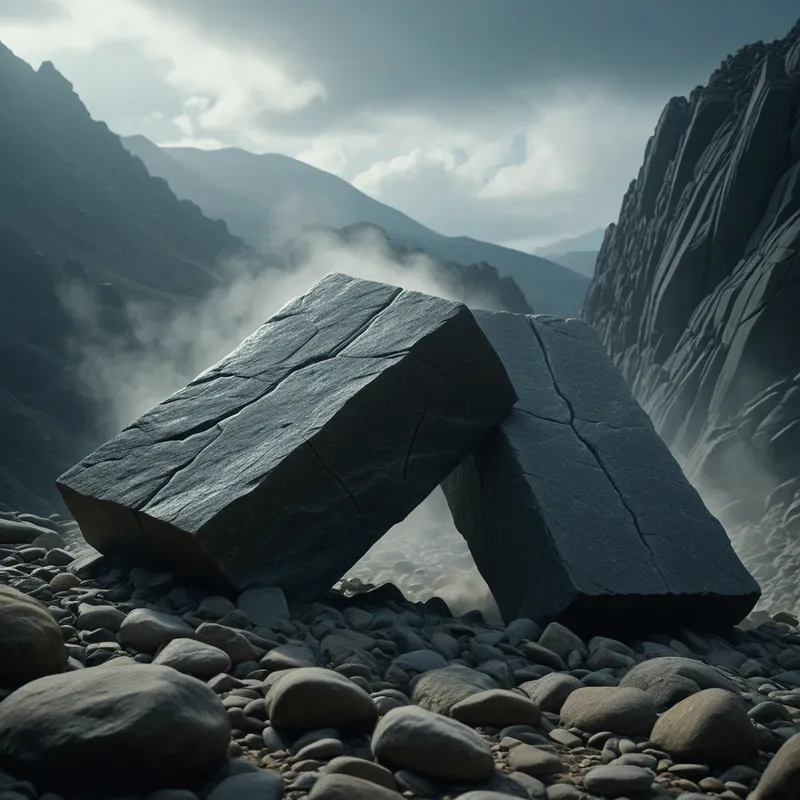
Moses descended, the weight of the tablets in his arms not merely stone, but the weight of a world made coherent. The law was in his hands. But as he drew near the camp, the sound of singing and the sight of the dancing before the golden idol struck him like a physical blow. The vision of order met the reality of chaos. In a fury of holy despair, his hands acted before his mind could counsel patience. He raised the tablets, the very breath of God made mineral, and dashed them against the base of the mountain. They shattered into a thousand fragments, the letters of fire scattering among the common rocks.
The breaking was not an end, but a terrible new beginning. The idol was ground to dust, the camp purified by strife. And then, the call came again. “Cut two tablets of stone like the first ones,” the Lord said. “And I will write on the tablets the words that were on the first tablets, which you broke.” Moses ascended again, alone, to receive the law a second time. This time, the covenant was written not on pristine stone delivered from above, but on stone hewn by human hands, offered up. The law remained divine, but its vessel was now indelibly marked by human failure and divine grace. He returned, his face shining with a light so terrifying he had to veil it, carrying the negotiated truth: a law born of rupture, a covenant forged in the aftermath of the broken [thing](/myths/thing “Myth from Norse culture.”/).
Cultural Origins & Context
This foundational narrative is recorded in the books of Exodus and Deuteronomy, core texts of [the Torah](/myths/the-torah “Myth from Jewish culture.”/) and the Christian Old Testament. It is not a mere historical anecdote but the constitutional myth of the Israelite nation, defining their identity as a people in covenant with a singular, transcendent God. The story was preserved and transmitted orally long before being codified, likely during the monarchy or exile periods, serving as an etiological explanation for the centrality of the Mosaic Law (Torah).
Its societal function was multifaceted: it established the divine authority of the law, explained the severe prohibitions against idolatry, and most profoundly, illustrated the tension between God’s perfect standard and humanity’s chronic failure. The telling of this myth around campfires and in temples reinforced social cohesion, defined ethical boundaries, and offered a narrative of second chances—the possibility of renewal even after catastrophic breach.
Symbolic Architecture
The tablets are the ultimate [symbol](/symbols/symbol “Symbol: A symbol can represent an idea, concept, or belief, serving as a powerful tool for communication and understanding.”/) of [Covenant](/symbols/covenant “Symbol: A binding agreement or sacred promise between parties, often carrying deep moral, spiritual, or social obligations and consequences.”/). They represent the structuring principle of [consciousness](/symbols/consciousness “Symbol: Consciousness represents the state of awareness and perception, encompassing thoughts, feelings, and experiences.”/) itself—the divine attempt to impose order, ethics, and meaning onto the chaotic, instinctual energies of the [human](/symbols/human “Symbol: The symbol of a human represents individuality, complexity of emotions, and social relationships.”/) [psyche](/myths/psyche “Myth from Greek culture.”/) (the “murmuring multitude” in the desert).
The first tablets are the ideal, descending pristine from the realm of pure archetype. Their shattering is the inevitable collision of the perfect idea with the flawed, living reality of human nature.
The act of breaking them is not merely an act of anger, but a crucial, alchemical [moment](/symbols/moment “Symbol: The symbol of a ‘moment’ embodies the significance of transient experiences that encapsulate emotional depth or pivotal transformations in life.”/) in the myth. It symbolizes the necessary [death](/symbols/death “Symbol: Symbolizes transformation, endings, and new beginnings; often associated with fear of the unknown.”/) of the naive, absolutist ideal. [The golden calf](/myths/the-golden-calf “Myth from Biblical culture.”/) represents the regressive pull of the unconscious, the desire for a tangible, instinctual god (a symbol of materialism, addiction, or unregulated desire) when the [tension](/symbols/tension “Symbol: A state of mental or emotional strain, often manifesting physically as tightness, pressure, or unease, signaling unresolved conflict or anticipation.”/) of waiting for the transcendent becomes too great. Moses’s [fury](/symbols/fury “Symbol: An intense, overwhelming rage that consumes the dreamer, often representing suppressed anger or a primal emotional eruption.”/) is [the ego](/myths/the-ego “Myth from Jungian culture.”/)’s righteous, yet devastating, confrontation with this [shadow](/symbols/shadow “Symbol: The ‘shadow’ embodies the unconscious, repressed aspects of the self and often represents fears or hidden emotions.”/).
The second tablets are the psychologically mature covenant. They are hewn by human [effort](/symbols/effort “Symbol: Effort signifies the physical, mental, and emotional energy invested toward achieving goals and personal growth.”/) (“cut two tablets of [stone](/symbols/stone “Symbol: In dreams, a stone often symbolizes strength, stability, and permanence, but it may also represent emotional burdens or obstacles that need to be acknowledged and processed.”/)”) and then inscribed by the divine. This is [the law](/symbols/the-law “Symbol: Represents external rules, societal order, moral boundaries, and the tension between personal freedom and collective structure.”/) internalized, the [structure](/symbols/structure “Symbol: Structure in dreams often symbolizes stability, organization, and the framework of one’s life, reflecting how one perceives their environment and personal life.”/) that is co-created. It is no longer an external imposition, but a negotiated [integration](/symbols/integration “Symbol: The process of unifying disparate parts of the self or experience into a cohesive whole, often representing psychological wholeness or resolution of internal conflict.”/). The shining face of Moses signifies the transformation of the individual who has borne this tension—carrying both the divine law and the [knowledge](/symbols/knowledge “Symbol: Knowledge symbolizes learning, understanding, and wisdom, embodying the acquisition of information and enlightenment.”/) of human frailty, they become a [vessel](/symbols/vessel “Symbol: A container or structure that holds, transports, or protects something essential, representing the self, emotions, or life journey.”/) of a terrifying, mediated [radiance](/symbols/radiance “Symbol: A powerful symbol of illumination, divine presence, and inner awakening, often representing clarity, truth, and spiritual energy.”/).
The Dreamer’s Resonance
To dream of receiving stone tablets is to dream of a moment of profound personal revelation or responsibility. The dreamer may be encountering a foundational truth about their life, a core ethic, or a “law” they feel compelled to follow. The weight of the tablets translates somatically as pressure in the chest or arms—the burden of conscience or a destined task.
Dreaming of shattering the tablets is a critical psyche event. It often accompanies a life crisis where one’s deepest principles, beliefs, or life-structure (a marriage, career, identity) have collided with an undeniable, perhaps shameful, reality of failure or desire. It is the psyche’s dramatic enactment of a broken covenant with oneself. The feeling upon waking is often one of guilt mixed with a strange, unburdened relief. The dream is not a condemnation, but a necessary stage in the death of an old, rigidified self-concept, making way for something more resilient.
Dreaming of the golden calf is a direct encounter with the personal or collective shadow—the seductive, “easier” idol that promises immediate gratification of the instincts, bypassing the difficult, lonely ascent to consciousness.
Alchemical Translation
The myth of the tablets is a perfect map of the individuation process. The [prima materia](/myths/prima-materia “Myth from Alchemical culture.”/) is the unformed, chaotic mass of the liberated but untransformed psyche ([the Israelites in the desert](/myths/the-israelites-in-the-desert “Myth from Abrahamic culture.”/)).
The first ascent (ascensus) is the ego’s (Moses’s) heroic quest for meaning, climbing to meet [the Self](/myths/the-self “Myth from Jungian culture.”/) (the God-image) to receive a guiding structure. The receiving of the first tablets is the conjunctio, [the sacred marriage](/myths/the-sacred-marriage “Myth from Various culture.”/) of human seeking and divine answer, producing the philosopher’s stone in its initial, volatile form.
The shattering is the essential nigredo, the blackening, the putrefaction. The perfect symbol must be broken so that its spirit can be freed from the literal stone and integrated into the soul’s lived experience.
The destruction of the calf is the painful but necessary [separatio](/myths/separatio “Myth from Alchemical culture.”/), the purging of identifying with the base, unconscious drives. The second ascent is undertaken with humility, carrying the raw material of one’s own experience (the self-cut stone). The inscribing of the second tablets is the albedo and [rubedo](/myths/rubedo “Myth from Alchemical culture.”/)—the whitening and reddening—where the law is no longer external command but internal wisdom, written on the heart. The shining face is the [lapis philosophorum](/myths/lapis-philosophorum “Myth from Alchemical culture.”/), the realized Self, which is both individual and transpersonal, carrying a light that is both one’s own and bestowed, requiring a veil for ordinary interaction with [the world](/myths/the-world “Myth from Tarot culture.”/).
For the modern individual, this myth teaches that our highest principles will inevitably be broken against the rocks of our own humanity. The path to wisdom lies not in clinging to the fragments of the first, perfect ideal in despair, nor in worshipping the easier idols of distraction, but in having the courage to ascend again, to offer our own hewn experience, and to receive a covenant that has passed through the fire of failure. Our true face begins to shine only after we have shattered the first stone.
Associated Symbols
Explore related symbols from the CaleaDream lexicon: