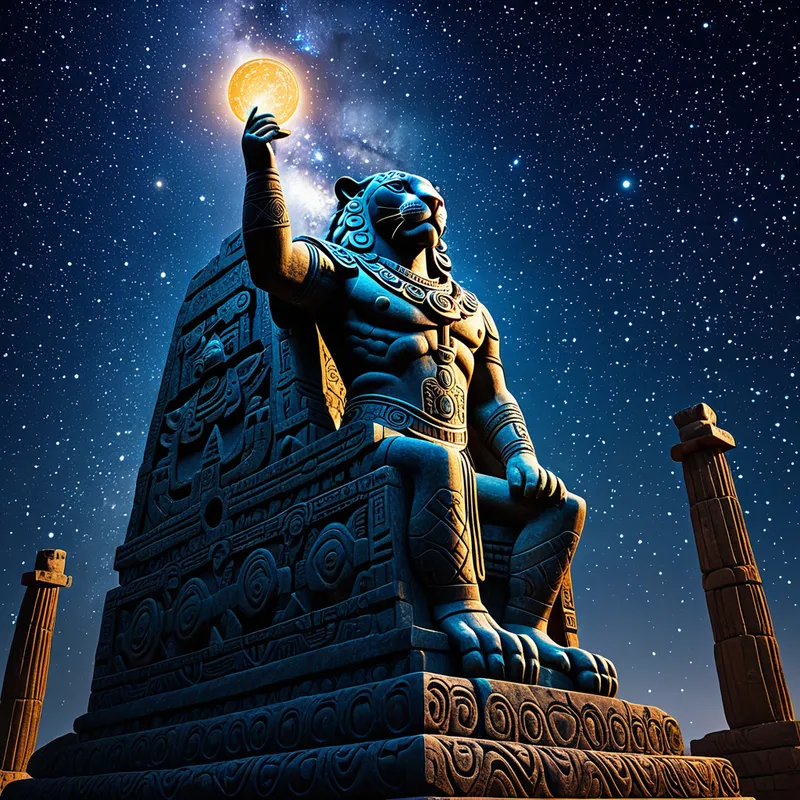
The Tablets of Destiny in Meso Myth Meaning & Symbolism
A cosmic battle for the tablets that govern fate, revealing the universal struggle between order and chaos, destiny and free will.
The Tale of The Tablets of Destiny in Meso
Listen. Before the first city, before the first name, the world was a song of potential, humming in the dark. It was the age of the Primordials. Among them ruled Quetzalcoatl, the Plumed Serpent, whose breath was the wind that stirred the void. And there was Tezcatlipoca, the Smoking Mirror, whose obsidian surface reflected not what was, but what could be, and what was hidden in the heart.
But the song was formless. Fate was a tangled thread, time a river with no banks. To bring order, the gods forged the Tablets of Destiny. Not of stone, but of solidified starlight and the breath of prophecy. Upon them were etched the patterns of days and nights, the destinies of rains and droughts, the rise and fall of kingdoms yet unborn. They were the loom upon which reality was woven.
The Tablets were placed in the heart of Coatepec, the Serpent Mountain, guarded by the Tzitzimime, the star-demons who dwelled between the worlds. For an age, the cosmos turned in measured rhythm.
But Tezcatlipoca, ever restless in his sovereignty, gazed into his mirror and saw a flaw. The order was too perfect, a cage of light. He desired the chaos that makes creation sing, the wild card in the deck of fate. He would not destroy the Tablets, but reshape them. He descended to Coatepec not as a conqueror, but as a whisper. He slipped past the Tzitzimime not by force, but by showing them their own fragmented reflections, confusing them with possibilities.
In the mountain’s luminous core, he found the Tablets pulsing like a second heart. He did not seize them. He breathed upon them. The smoke from his namesake mirror—a smoke that carries visions and lies—coalesced around the sacred glyphs. Where the etchings spoke of “harvest,” he added “and blight.” Where they decreed “peace,” he inscribed the footnote “born of struggle.” He introduced the variable, the shadow in the equation.
The cosmos shuddered. Quetzalcoatl, feeling the wind of change become a gale of discord, rushed to Coatepec. The two deities stood over the now-fluctuating Tablets. No thunderous battle ensued. Instead, a contest of essence. Quetzalcoatl wove the disordered energies back toward pattern, his feathers shedding light that sought to fix the glyphs. Tezcatlipoca unraveled them with a thought, his mirror showing infinite divergent paths. The Tablets themselves became the battlefield, their light flashing between harmony and entropy.
The conflict was not resolved by victory, but by transformation. Their struggle became the new inscription. The Tablets absorbed the tension itself. They now held not a single decree, but a dynamic balance: the law and the exception, the pattern and the anomaly. Exhausted, the gods stepped back. The Tablets glowed with a new, more complex light. They were no longer a simple decree, but a living dialogue between order and chaos, placed back in the mountain’s care, now governing a world that was both fated and free.

Cultural Origins & Context
The myth of the Tablets of Destiny, while not attached to a single historical codex, is a scholarly reconstruction of a profound archetype woven through the fabric of Mesoamerican thought. It synthesizes core concepts from the Mexica (Aztec), Maya, and other regional cosmologies. This was not a tale told verbatim in one sitting, but a philosophical undercurrent expressed in creation myths, calendrical systems, and ritual practices.
Priests and day-keepers (Ah Kin) were its primary custodians. They understood the cosmos as governed by sacred forces and cycles, recorded in almanacs and codices. The “tablets” are a metaphor for this cosmic law—the Tonalpohualli (the 260-day sacred calendar) and the movements of the heavens. Its societal function was paramount: it explained the nature of reality as a precarious, dynamic balance. It justified the role of ritual and sacrifice not as mere tribute, but as essential acts to maintain the cosmic equilibrium between opposing forces, to keep the “tablets” from tipping into chaos or stagnating into absolute order.
Symbolic Architecture
At its heart, this myth is not about theft, but about amendment. The Tablets represent the foundational laws of psyche and cosmos—the inherent structures of consciousness, the patterns of our personal destiny, and the collective unconscious itself.
The Tablets of Destiny are the psyche’s own constitution, written in the language of archetype. To encounter them is to confront the laws by which you have lived, often unknowingly.
Quetzalcoatl symbolizes the organizing, civilizing principle of the psyche—the ego’s drive for order, meaning, and conscious understanding. Tezcatlipoca is his shadow and complement: the trickster, the unconscious, the force that disrupts stagnation, reveals hidden truths (and deceptions), and insists on the sovereignty of the unknown. Their struggle over the Tablets is the eternal dialectic within the self: the conscious mind’s desire for control versus the unconscious’s demand for recognition and integration.
The Coatepec is the axis mundi, the center of the world and the Self. The Tzitzimime guardians represent the primal fears and archaic defenses that protect our core patterns from change. Tezcatlipoca’s method—confusing them with reflections—is classic shadow-work: we bypass resistance not by fighting it, but by making the unconscious conscious.
The Dreamer’s Resonance
When this myth stirs in modern dreams, it often surfaces during life transitions where one’s sense of fate or personal law is being challenged. Dreaming of finding or seeing sacred, inscribed objects (books, phones, stones with codes) points to an encounter with one’s own “tablets”—the internal scripts governing relationships, career, and self-worth.
A dream of a rigid, unchangeable tablet suggests a psyche trapped in a fate-complex, feeling powerless under internalized decrees (“I must always be the caregiver,” “I am doomed to fail”). The somatic sensation is often of weight, constriction, or paralysis.
Conversely, dreaming of tablets that are melting, rewriting themselves, or being argued over by contrasting figures signals the process Tezcatlipoca initiates: the deconstruction of an old, outgrown identity. This can feel terrifyingly chaotic in the dream—a “glitch in the matrix”—with somatic echoes of vertigo, feverish heat, or electric anxiety. The dream-ego is witnessing the painful, necessary alteration of its own foundational laws.
Alchemical Translation
The myth models the alchemical stage of solutio and coniunctio oppositorum. The initial, perfect Tablets represent the prima materia in a state of naive, unconscious order. Tezcatlipoca’s intervention is the necessary nigredo—the blackening, the introduction of doubt, shadow, and chaos that dissolves the old, rigid form.
Individuation is not about choosing between order and chaos, but about holding the tension between them until a third, more conscious order is born. This is the sacred amendment.
The modern individual undergoes this when a life crisis—a betrayal, a loss, a sudden insight—smokes the mirror of their self-perception. The old laws (“My worth is my productivity,” “My family’s expectations are my destiny”) are revealed as incomplete. The ensuing inner conflict (the Quetzalcoatl-Teztcatlipoca struggle) feels like a civil war. The goal is not to let one side “win,” but to endure the conflict until a psychic synthesis occurs.
The final, transformed Tablets represent the achievement of a more nuanced, personal sovereignty. One no longer lives by unquestioned internal or external decrees, but by a dynamic, self-authored code that acknowledges both structure and spontaneity, fate and free will. The individual becomes the sage-like guardian of their own Coatepec, capable of reading the complex glyphs of their soul, understanding that destiny is not a sentence to be served, but a dialogue to be lived.
Associated Symbols
Explore related symbols from the CaleaDream lexicon: