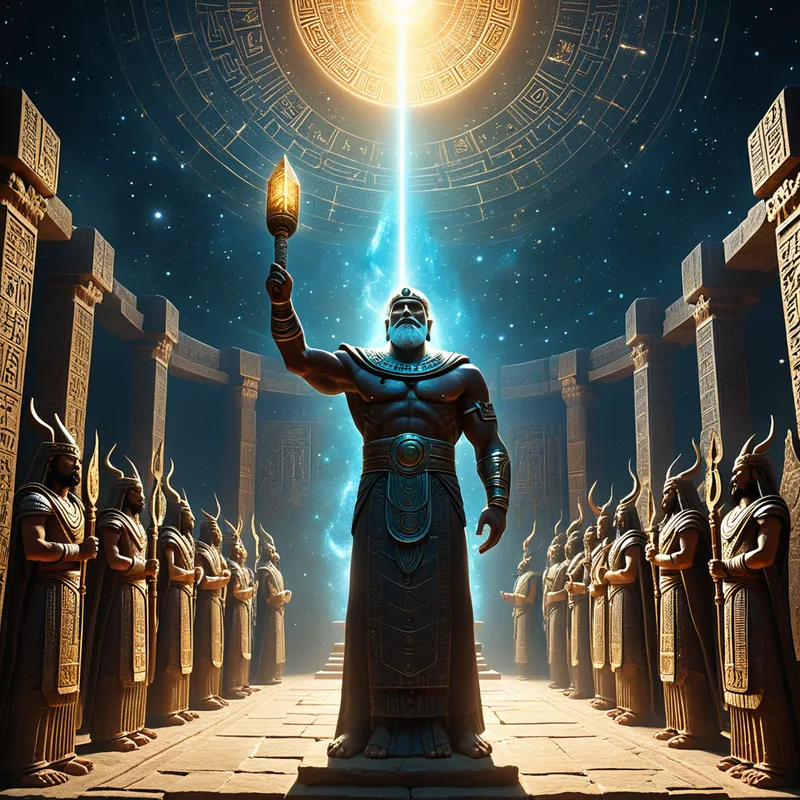
The Tablets of Destiny from Me Myth Meaning & Symbolism
A cosmic tale of stolen divine authority, where the fate of all things is inscribed on tablets, contested by gods, and reclaimed through primordial struggle.
The Tale of The Tablets of Destiny from Me
Before the names of things were fixed, in the time when the salt waters of Tiamat mingled with the sweet waters of Apsu, there was a silence that was not peace, but a seething potential. From this mingling, generations of gods were born, their clamor and light disturbing the primal deep. Apsu, weary of the noise, plotted their end. But the wise god Ea perceived the plot, cast a sleep upon Apsu, and from his remains fashioned a new order.
Yet a greater chaos stirred. Tiamat, enraged at the slaying of her consort, raised a monstrous host. To lead her army of serpents, storm-demons, and scorpion-men, she did not choose from among the elder gods. Instead, she took Kingu, once a lesser among them, and elevated him to a terrible kingship. She placed in his hands the ultimate prize: the Tablets of Destiny.
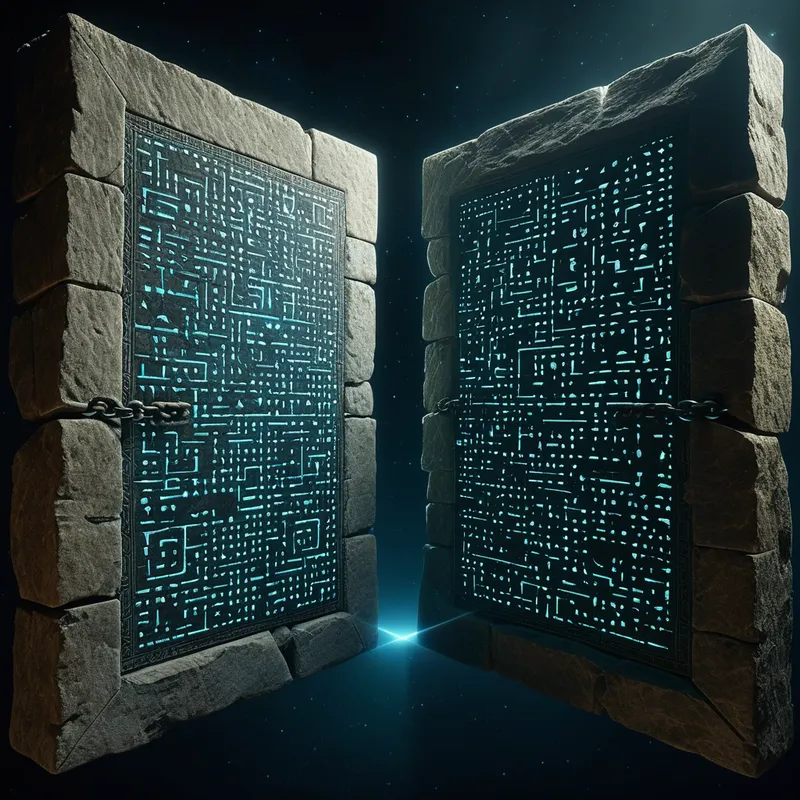
Feel the weight of them. They were not stone, but the solidified breath of the universe before time. Upon their surfaces glimmered the unalterable decrees—the laws of movement for stars, the path of rivers, the lifespan of kings, the function of every god. To hold them was to command the hidden architecture of all that is. With them bound to his chest, Kingu’s voice became the edict of fate itself. The rebel host marched, and the very fabric of the world quaked, threatening to unravel back into the formless void.
In the council of the threatened gods, fear was a cold wind. None could stand before Tiamat’s wrath and the authority of the Tablets. Until one, born of deep wisdom and fierce potential, stepped forward. Marduk, son of Ea, set his price: if he prevailed, supreme kingship over all the gods. Desperate, they agreed.
Armed with the four winds, a bow of lightning, and a net held by the seven storms, Marduk faced the Dragon of the Sea. Tiamat roared, opening her maw to consume him. But Marduk drove the evil winds into her, swelling her body. He loosed an arrow that split her heart. As her monstrous form fell, he stood over the chaos she embodied. Then, he turned to Kingu.
The usurper, clad in the stolen authority of the Tablets, faced the champion. The battle was not of brute force alone, but of contested decree. Marduk, embodying a new order, wrested the Tablets from Kingu’s grasp. In that moment, the hum of the cosmos shifted frequency. The right to command fate passed from the hand of chaos to the hand of the one who had imposed form upon it. From Tiamat’s carcass, Marduk fashioned the heavens and the earth. From the blood of the defeated Kingu, he fashioned humankind, to bear the labor of the gods. And the Tablets of Destiny found their rightful place upon Marduk’s own breast, no longer a tool of rebellion, but the foundation of a cosmos built upon slain chaos.
Cultural Origins & Context
This myth is the beating heart of the Enuma Elish, recited not as mere entertainment, but as a sacred, cosmological anchor during the Babylonian New Year (Akitu) festival. Its performance was a societal re-enchantment, a ritual reaffirmation of cosmic and political order. By chanting the tale of Marduk’s victory, the priesthood and the people participated in the ongoing maintenance of the world. The myth served a profound political function as well, legitimizing Babylon’s ascendancy and its king’s rule by mirroring Marduk’s divine kingship. It answered the fundamental human questions: Why is there something rather than nothing? Why is there order instead of chaos? And by whose authority does this order stand? The story was passed down through meticulously trained scribal schools, inscribed on clay tablets, ensuring that the blueprint of reality itself was preserved in cuneiform.
Symbolic Architecture
The Tablets are the ultimate symbol of Sovereignty. They represent not just power, but the right to wield power—the cosmic mandate. Their theft by Kingu under Tiamat’s sanction symbolizes a profound perversion: when the foundational laws (Destiny) are seized by a figure of undifferentiated, reactive impulse (Kingu) backed by primal, chaotic emotion (Tiamat), the result is not creation, but world-annihilating rebellion.
To hold the Tablets is to hold the responsibility for the functioning of the universe. Their theft is the ultimate act of psychic inflation; their recovery, the act of conscious integration.
Marduk’s journey is that of the conscious ego-complex emerging from the ancestral psychic matrix (Ea) to confront the devouring, possessive mother (Tiamat) and the inflated, illegitimate shadow (Kingu). He does not destroy the Tablets; he retrieves and re-contextualizes them. His subsequent creation of the world from Tiamat’s body signifies the alchemical act of building a structured psyche (cosmos) from the raw material of our own primal, chaotic nature.
The Dreamer’s Resonance
When this myth stirs in the modern unconscious, it often manifests in dreams of stolen credentials, hacked systems, or lost vital documents. You may dream of an impostor in your workplace wielding your own ideas with greater authority, or of a powerful, engulfing figure (a parent, a partner, an institution) who has given your personal “tablets”—your sense of purpose, your moral code, your voice—to someone unworthy, even to a weaker part of yourself. The somatic experience is one of profound disempowerment and rage coupled with inertia—a feeling that the very rules of your life are being used against you.
This is the psyche signaling a crisis of inner authority. The “Kingu” complex is active: a latent, often unconscious part of the personality has been handed the reins by an older, more overwhelming “Tiamat” pattern (like a legacy of family trauma, a cultural expectation, or a deep-seated fear). This complex now “runs the show,” dictating a destiny that feels alien and self-sabotaging. The dreamer feels fated, but by a false fate.

Alchemical Translation
The individuation process modeled here is the reclamation of psychic sovereignty. It is not about becoming a tyrannical “ruler” over oneself, but about retrieving the authentic, lawful authority from the usurping complexes.
The first step is the “Marduk” moment: the conscious ego must, with great courage, name the chaotic, engulfing force (Tiamat) that has empowered the impostor within. This often means facing deep, primitive anxiety and rage. The second step is the confrontation with “Kingu”—the specific pattern, perhaps a habit of people-pleasing, a chronic victim stance, or a defensive arrogance, that wears the crown it did not earn. This requires dis-identifying from that pattern and seeing it as an object within the psyche, not as the self.
The triumph is not the destruction of Tiamat or Kingu, but the differentiation from them. One slays the identification with the chaos and the impostor, thereby freeing their energy for world-building.
Finally, the recovered “Tablets” are integrated. This translates to living from one’s own deep law—the authentic values, talents, and purposes that are uniquely inscribed in one’s soul. The chaos (Tiamat) becomes the raw material for a new life structure. The usurper’s energy (Kingu’s blood) becomes the vital force that fuels daily labor and service. The individual is no longer subject to a fate dictated by unconscious complexes, but actively inscribing, from a place of hard-won authority, a destiny that is truly their own. The cosmos of the self is established, not by chance, but by decree.
Associated Symbols
Explore related symbols from the CaleaDream lexicon: