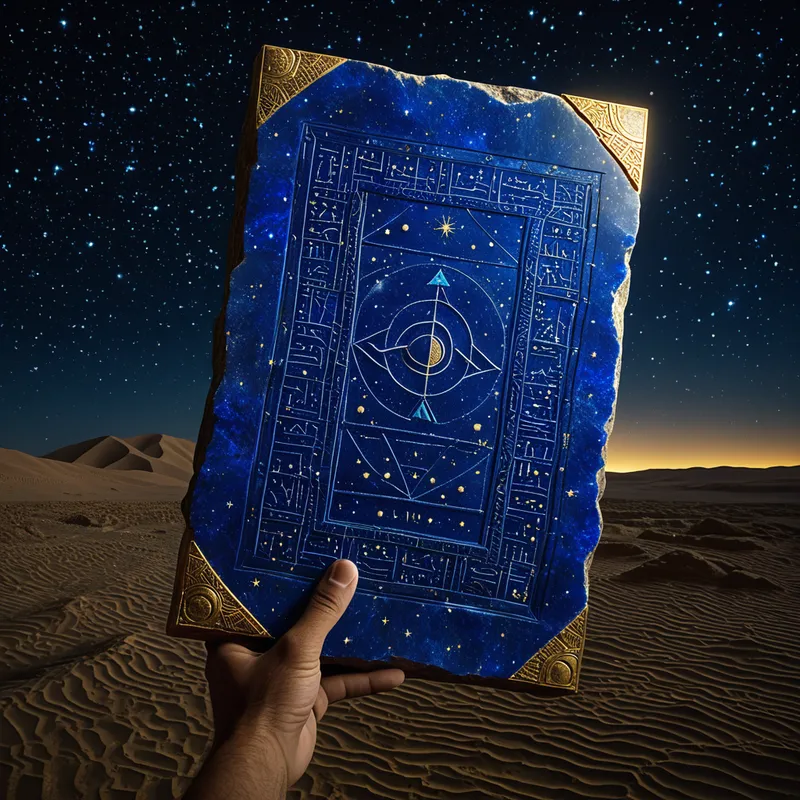
The Tablet of Destinies Myth Meaning & Symbolism
A cosmic artifact inscribed with the laws of reality, stolen by a primordial monster, triggering a divine war for the right to rule the universe.
The Tale of The Tablet of Destinies
In the time before time, when the heavens were not yet named and [the earth](/myths/the-earth “Myth from Hindu culture.”/) below was not yet called, the great gods had established their order. Anu ruled the high heavens. Enki, the cunning one, governed the sweet waters of the Apsu. And Enlil, the storm-lord, held the most potent instrument of all: the Tablet of Destinies.
It was not merely an object, but the very source-code of creation. Fashioned from celestial lapis lazuli, its surface was inscribed with the me—the fundamental decrees that set the boundaries of rivers, the paths of stars, the fate of kings, and the lifespan of all that lived. To hold it was to command the Me. To speak from it was to make law. Enlil, as the executive power, was its rightful guardian. He would remove his regalia—his crown, his robe, his scepter—to bathe in the sacred waters, and the Tablet would rest beside him, humming with silent power.
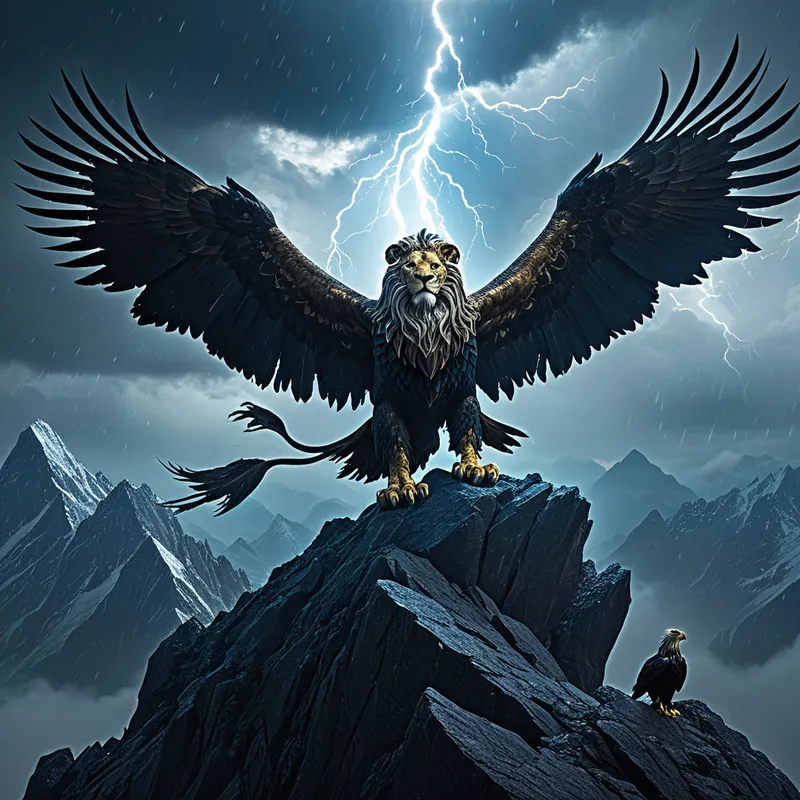
But a watcher coveted this power. Anzu, a creature born of the primordial deep, with the body of a lion and the head and wings of an eagle, served as a guardian in Enlil’s temple. Each day, Anzu watched the ritual. He saw the god lay aside his might. He felt the pull of the Tablet’s silent song. A terrible desire grew in his heart: “I will take the Tablet of Destinies for myself. I will seize the Enlil-power, the rites of the gods I will decree. I will establish my throne and rule over all the Igigi!”
And so, when the waters once again cradled the unsuspecting Enlil, Anzu struck. His talons, sharp as flint, closed around the glowing slab. The very air crackled. He took the Tablet and fled to his mountain, a remote peak where he could sit enthroned in stolen majesty. The moment he possessed it, the cosmic order shattered. The divine decrees fell silent. The gods’ words lost their power. The universe held its breath, paralyzed. The great assembly of gods fell into a panic, wailing like abandoned children. Who could fight a being who now controlled the fabric of fate itself?
One by one, the mightiest gods were called. Ninurta, Adad, even the fierce [Inanna](/myths/inanna “Myth from Sumerian culture.”/)—all refused. To challenge the holder of the Tablet was to challenge reality’s own rules. Their weapons would turn to dust, their words to empty wind. Despair thickened in the council hall.
Then, from the deep waters of wisdom, Ea spoke. He devised a plan not of brute force, but of cunning and destiny. He called upon a young god, Ningirsu (in some versions, this is Ninurta under another name), and armed him not just with terrible weapons, but with a strategy woven from the very nature of power. Ea whispered secrets of [the wind](/myths/the-wind “Myth from Various culture.”/) and the arrow’s flight. The young god ascended to the mountain, his heart a drum of war.
The battle was cataclysmic. Anzu, perched on his peak, roared and invoked the Tablet’s power. He commanded the winds to still Ningirsu’s arrows. He summoned storms to blind him. But Ningirsu, guided by Ea’s wisdom, unleashed the Seven Winds, the South Wind, the North Wind—winds that could slip between the decrees. He fired an arrow that rode the tempest, not fighting it. The shaft flew true, piercing Anzu’s heart. The monster’s roar became a gurgle of defeat. The Tablet of Destinies fell from his limp talons.
Ningirsu retrieved the sacred slab. The cosmic hum returned. Order flowed back into [the world](/myths/the-world “Myth from Tarot culture.”/) like a returning tide. The Tablet was returned to Enlil, and with it, the rightful authority to decree [the fates](/myths/the-fates “Myth from Greek culture.”/). The usurper was slain, the hierarchy restored. The universe could breathe again, its laws once more in the hands of the designated ruler.
Cultural Origins & Context
This myth, known from several versions including the Old Babylonian “Anzu” epic and Sumerian antecedents, was not mere entertainment. It was a foundational narrative of the Mesopotamian worldview, recited by temple priests and scribes in the great cult centers of Nippur (Enlil’s city) and Lagash (where Ningirsu/Ninurta was worshipped). Its function was deeply political and theological. It explained and justified the divine hierarchy: why Enlil, and not another, held executive power. It served as a mythic template for kingship, illustrating that legitimate authority (Nam-lugal) could be challenged by chaotic, self-aggrandizing force, but must and would be restored by a champion who combined martial prowess with divine wisdom (Ea’s counsel).
The story reinforced the idea that cosmic and social order (Me) is fragile, maintained through vigilance and rightful ritual. The king on earth was seen as an analogue to Ninurta/Ningirsu, the defender of Enlil’s order, tasked with upholding the “destinies” or decrees for his land. The myth was a powerful tool for socialization, teaching that usurpation leads to cosmic paralysis, and that true power is not merely taken, but bestowed and defended within a sacred framework.
Symbolic Architecture
At its core, the [Tablet](/symbols/tablet “Symbol: A tablet symbolizes personal connectivity, information access, and the blending of work and play in the digital age.”/) of Destinies symbolizes the principle of order itself. It is not personal will, but transpersonal law. It represents the immutable codes—cosmic, natural, moral, and psychological—that [structure](/symbols/structure “Symbol: Structure in dreams often symbolizes stability, organization, and the framework of one’s life, reflecting how one perceives their environment and personal life.”/) [reality](/symbols/reality “Symbol: Reality signifies the state of existence and perception, often reflecting one’s understanding of truth and life experiences.”/). To possess it is to hold [the authority](/symbols/the-authority “Symbol: A figure representing power, control, and societal structure, often embodying rules, leadership, or external judgment.”/) to interpret and execute these codes.
The Tablet is the script of the world, but the right to read it aloud belongs only to the one who has undergone the ritual of becoming its guardian, not its owner.
Anzu represents the [Shadow](/symbols/shadow “Symbol: The ‘shadow’ embodies the unconscious, repressed aspects of the self and often represents fears or hidden emotions.”/) of the Ruler—the raw, ambitious, envious [aspect](/symbols/aspect “Symbol: A distinct feature, quality, or perspective of something, often representing a partial view of a larger whole.”/) of power that seeks to bypass due process and sanctity to seize control for purely selfish ends. He is the intelligence that serves order but becomes intoxicated by it, the part of the [psyche](/myths/psyche “Myth from Greek culture.”/) that believes it can own [the law](/symbols/the-law “Symbol: Represents external rules, societal order, moral boundaries, and the tension between personal freedom and collective structure.”/) rather than serve it. His theft causes [paralysis](/symbols/paralysis “Symbol: A state of being unable to move or act, often representing feelings of powerlessness, fear, or being trapped in waking life.”/) because when the [Shadow](/symbols/shadow “Symbol: The ‘shadow’ embodies the unconscious, repressed aspects of the self and often represents fears or hidden emotions.”/) seizes [the ego](/myths/the-ego “Myth from Jungian culture.”/)’s guiding principles, the entire psychic [system](/symbols/system “Symbol: A system represents structure, organization, and interrelated components functioning together, often reflecting personal or social order.”/) freezes in conflict.
Ea represents the deep, intuitive wisdom of the unconscious that knows the loopholes in the ego’s own rigid rules. He is the counsel that comes not from fighting [the Shadow](/myths/the-shadow “Myth from Jungian culture.”/) with its own tools (brute force), but by understanding the larger patterns—the “winds” or forces of the psyche that can circumvent a tyrannical complex.
Ninurta/Ningirsu is the heroic ego-function that, when properly guided by wisdom (Ea), can reintegrate the usurped [authority](/symbols/authority “Symbol: A symbol representing power structures, rules, and control, often reflecting one’s relationship with societal or personal governance.”/). His victory is not the destruction of power, but the re-contextualization of it. He returns the Tablet to its rightful place, symbolizing the restoration of the ego’s legitimate, but not absolute, authority within the total psyche.

The Dreamer’s Resonance
When this myth stirs in the modern unconscious, it often manifests in dreams of stolen authority, paralyzed systems, and hidden rules. One might dream of a crucial document (a will, a contract, a diploma) being taken by a shadowy colleague or a bird-like creature, leading to a feeling of utter impotence at work or in a relationship. The dreamer may be in a meeting but unable to speak, their voice stolen. They may discover a control panel or a computer that governs their life, but it is in the hands of a menacing, unfamiliar figure.
Somatically, this can feel like a constriction in the throat (stolen voice), a heaviness in the chest (the weight of powerless responsibility), or a literal paralysis upon waking. Psychologically, this indicates a process where a complex—often a power complex rooted in envy or inferiority—has “stolen” the individual’s sense of agency and self-determination. The ego feels it has lost its right to decree its own life’s direction. The dream is signaling a state of inner coup d’état, where a neurotic pattern (the Anzu-complex) is holding the psyche hostage with its own rigid, self-serving “rules.”
Alchemical Translation
The myth models the alchemical process of reclaiming authentic authority—the stage of Albedo following the chaotic [Nigredo](/myths/nigredo “Myth from Alchemical culture.”/) of the theft. The individual’s journey begins with the realization that their inner “Tablet”—their core values, vocation, or sense of purpose—has been usurped. This usurper may be an internalized critical parent, a societal expectation, or a greedy, inflated aspect of the personality that seeks total control.
The struggle is not to destroy the power impulse, but to defeat its illegitimate claim, freeing the power to flow again in service to the whole self.
The “Ea” phase involves retreating from direct combat with the complex (which only strengthens it) and seeking counsel from a deeper wisdom. This is introspection, therapy, active imagination, or engaging with art—any practice that accesses the “fresh waters” of the unconscious for a new strategy. The insight gained is often that one cannot fight the complex head-on with willpower (the other gods’ failed weapons), but must use indirect means: understanding its nature, its fears, its vulnerabilities.
The “Ninurta” phase is the enacted integration. Armed with this new wisdom, the ego confronts the usurping complex. The battle is fierce—it is the hard work of changing lifelong patterns, facing shame, and asserting boundaries. The victory is achieved not by annihilating the ambitious, powerful part of oneself (Anzu), but by stripping it of its illegitimate, paralyzing control. The “Tablet” is reclaimed. This translates to the individual taking back their right to decree their own values, to set their own boundaries, and to execute their own life’s choices from a place of integrated, legitimate authority, no longer frozen by internal tyranny or external coercion. The restored order is not the old, naive hierarchy, but a more conscious, resilient sovereignty, tested and earned.
Associated Symbols
Explore related symbols from the CaleaDream lexicon: