The Symposium of Plato Myth Meaning & Symbolism
A philosophical banquet where guests give speeches on love, culminating in Socrates' revelation of love as a daimon guiding the soul toward absolute beauty.
The Tale of The Symposium of Plato
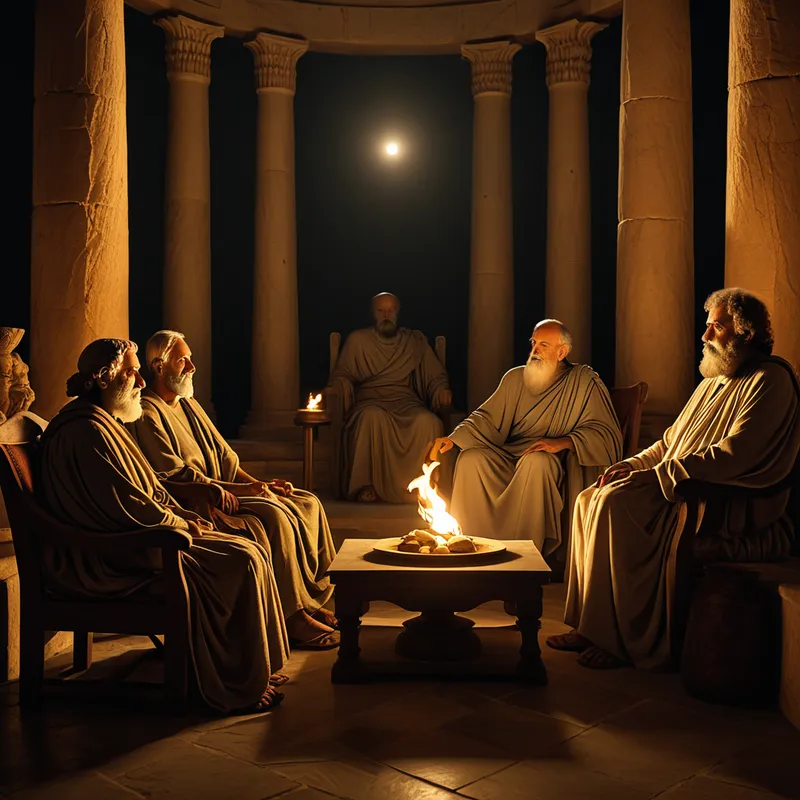
The night was not for sleeping. In the house of Agathon, the air was thick with the scent of crushed herbs, spilled wine, and the sweet, smoky breath of the oil lamps. The victory party had raged, but the true revelers, the ones whose thirst could not be quenched by wine alone, remained. Their bodies were weary, but their spirits, like restless birds, sought a higher perch.
They reclined on couches, a circle of minds in the dim light: Aristophanes, his belly full but his wit sharper; Agathon, radiant and delicate; Eryximachus; and others, each a world unto themselves. And then there was [Socrates](/myths/socrates “Myth from Greek culture.”/), who had come late, who had stood entranced on a neighbor’s porch, lost in some inner [symposium](/myths/symposium “Myth from Greek culture.”/) of his own.
To soothe their heads from the day’s excess, they made a pact: to drink moderately and to give speeches in praise of Eros. Not the battle-lust of Ares, nor the thunder of Zeus, but [the force](/myths/the-force “Myth from Science Fiction culture.”/) that stirs the blood, that knots the heart, that draws soul to soul.
Phaedrus began, speaking of Eros as the eldest god, the great inspirer of honor and noble deeds in lover and beloved. Pausanias followed, cleaving love in two: the common, grasping love of the body, and the heavenly love that seeks wisdom and virtue. Eryximachus, the physician, expanded love into a cosmic principle, the harmony that tunes the body and the seasons alike.
Then came Aristophanes, his voice a rumble of laughter and profound ache. He told a tale of original, spherical beings, mighty and whole, with two faces, four arms, four legs. For their pride, Zeus split them apart, condemning each half to wander [the earth](/myths/the-earth “Myth from Hindu culture.”/), longing for its missing piece. Love, he declared, is the name of this ancient yearning, the desperate search for the other half that will make us whole again. A sigh moved through the room, for who has not felt that cut?
Agathon, the beautiful host, then sang a poet’s hymn. Eros was young, tender, delicate, the source of all grace, dwelling not in the hearts of gods but of men, guiding them to all gentleness.
The speeches hung in the air like perfumed smoke. Then all eyes turned to Socrates. He did not sing. He questioned. With the humility of one who knows only that he knows nothing, he recounted the teachings of a wise woman, Diotima of Mantineia.
And through his voice, she spoke. Eros, she revealed, is not a god but a great daimon. He is [the child](/myths/the-child “Myth from Alchemy culture.”/) of Poverty and Resource, born on the day of Aphrodite’s birth. He is ever poor, rough, barefoot, sleeping under the stars. Yet he is also ever resourceful, a hunter, a philosopher, a magician. He is not beautiful, but he desires beauty. He is not wise, but he tirelessly seeks wisdom. He is the eternal in-between.
And the task of this daimonic force? To guide the soul on a ladder of love. One begins by loving a single beautiful body. But the true lover learns to see that the beauty in one body is kin to the beauty in another. He ascends to love beauty in all bodies, then to love the beauty in souls, in laws and institutions, in the vast meadows of knowledge. Until at last, in a sudden flash, he beholds it: Beauty itself, absolute, pure, unchanging, the source of all beautiful things. This, Diotima promised, is the life for which a human being should live—a life of begetting true virtue in the presence of the divine.
The silence that followed was not empty, but full. It was shattered by the clamor of the door, the riotous entrance of Alcibiades, crowned with ivy and violets, already drunk, supported by revelers. He demanded to join the praise, but his speech was not of Eros abstract, but of Eros incarnate: Socrates himself. He told of the philosopher’s terrifying self-control, his unbearable wisdom, his ugly exterior that hid a soul of divine beauty. He confessed his own failed attempts to seduce Socrates, to trade his youthful beauty for the man’s wisdom. “He makes me feel ashamed,” Alcibiades cried, a confession of love that was also a portrait of the soul’s torment on the first rungs of the ladder.
As dawn’s grey light began to seep into the room, [the symposium](/myths/the-symposium “Myth from Greek culture.”/) dissolved. All slept or departed. Only Socrates remained awake, rising to go about his day, having drunk all under the table not with wine, but with a truth that both intoxicated and sobered the soul.
Cultural Origins & Context
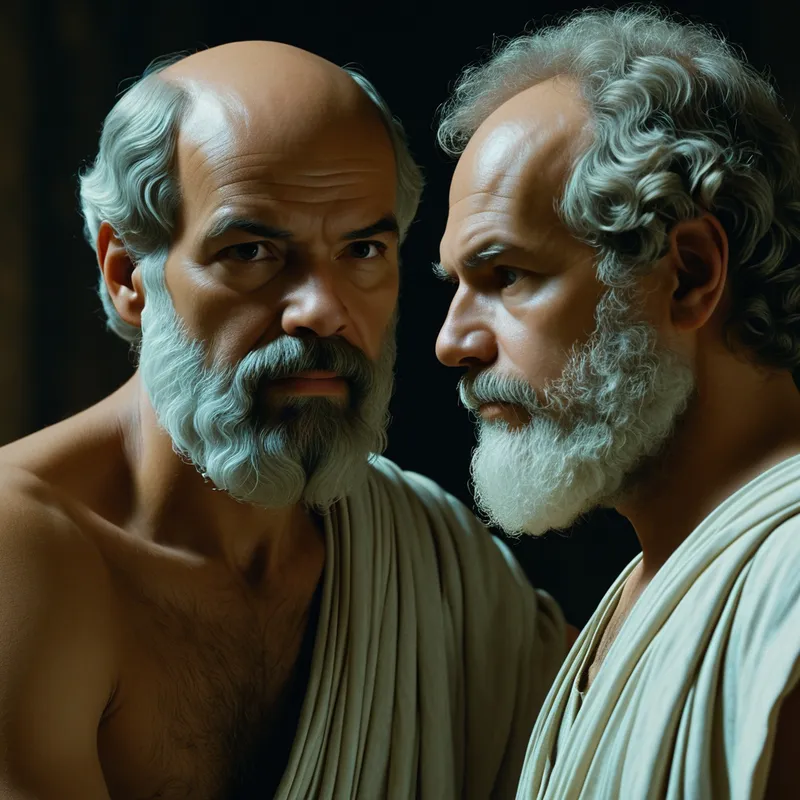
This is not a myth from the misty age of heroes, but a philosophical drama set in the heart of 5th-century BCE Athens. Written by Plato around 385-370 BCE, The Symposium is a literary fabrication—a reported account of a gathering that likely never happened in this exact form. Yet, its truth is of a different order. It is a foundational text of “Global/Universal” culture because it articulates, with unparalleled clarity, a perennial human intuition about the nature of love and aspiration.
It was passed down not by oral bards, but through the manuscript tradition of the Academy and later the libraries of the Hellenistic and Roman worlds. Its societal function was complex: it was a sophisticated piece of Athenian intellectual theater, justifying and spiritualizing the cultural practice of pederastic mentorship (paiderastia). More lastingly, it served as a pedagogical tool, a model of dialectical inquiry that moves from opinion to truth. It functioned as a myth for the emerging philosophical soul, providing a narrative map for the journey from [the cave](/myths/the-cave “Myth from Platonic culture.”/) of appearances to the light of [the forms](/myths/the-forms “Myth from Platonic culture.”/).
Symbolic Architecture
At its core, the Symposium is not about a [banquet](/symbols/banquet “Symbol: A banquet signifies celebration, abundance, and social connection, often symbolizing a reward for hard work or the joy of community gatherings.”/) of [food](/symbols/food “Symbol: Food in dreams often symbolizes nourishment, both physical and emotional, representing the fulfillment of basic needs as well as deeper desires for connection or growth.”/), but a feast of the [soul](/symbols/soul “Symbol: The soul represents the essence of a person, encompassing their spirit, identity, and connection to the universe.”/). Its symbolic [architecture](/symbols/architecture “Symbol: Architecture in dreams often signifies structure, stability, and the framing of personal identity or life’s journey.”/) is the Ladder of [Ascent](/symbols/ascent “Symbol: Symbolizes upward movement, progress, spiritual elevation, or striving toward higher goals, often representing personal growth or transcendence.”/).
Love is the daimon of the in-between, the psychic engine that drives us from fragmentation toward wholeness, from ignorance toward wisdom.
The Aristophanic halves symbolize the primal, psychological wound of [separation](/symbols/separation “Symbol: A spiritual or mythic division between realms, states of being, or consciousness, often marking a transition or loss of connection.”/)—from the divine, from [the Self](/myths/the-self “Myth from Jungian culture.”/), from the Other. This is the foundational [human](/symbols/human “Symbol: The symbol of a human represents individuality, complexity of emotions, and social relationships.”/) experience of lack, incompletion, and yearning. Eros, in this light, is the [symptom](/symbols/symptom “Symbol: A physical or emotional sign indicating an underlying imbalance, distress, or message from the unconscious mind.”/) of our [fragmentation](/symbols/fragmentation “Symbol: The experience of breaking apart, losing cohesion, or being separated into pieces. Often represents disintegration of self, relationships, or reality.”/) and the [impulse](/symbols/impulse “Symbol: A sudden, powerful urge or drive that arises without conscious deliberation, often linked to primal instincts or emotional surges.”/) toward healing.
Socrates-Diotima’s ladder provides the therapeutic [path](/symbols/path “Symbol: The ‘path’ symbolizes a journey, choices, and the direction one’s life is taking, often representing individual growth and exploration.”/). Each rung represents a stage of psychic [expansion](/symbols/expansion “Symbol: A symbol of growth, increase, or extension beyond current boundaries, often representing personal development, opportunity, or overwhelming change.”/):
- The Beautiful [Body](/symbols/body “Symbol: The body in dreams often symbolizes the dreamer’s self-identity, personal health, and the relationship they have with their physical existence.”/): The initial hook of desire, anchoring the soul in the sensory world.
- All Beautiful Bodies: The recognition of [pattern](/symbols/pattern “Symbol: A ‘Pattern’ in dreams often signifies the underlying structure of experiences and thoughts, representing both order and the repetitiveness of life’s situations.”/), moving from the particular to the universal.
- Beautiful Souls: The [interior](/symbols/interior “Symbol: The interior symbolizes one’s inner self, thoughts, and emotions, often reflecting personal growth, vulnerabilities, and secrets.”/) turn, where value shifts from the container to the content.
- Beautiful Laws & Institutions: The [projection](/symbols/projection “Symbol: The unconscious act of attributing one’s own internal qualities, emotions, or shadow aspects onto external entities, people, or situations.”/) of [beauty](/symbols/beauty “Symbol: This symbol embodies aesthetics, harmony, and the appreciation of life’s finer qualities.”/) onto the social and moral order, the [realm](/symbols/realm “Symbol: The symbol of ‘Realm’ often signifies the boundaries of one’s consciousness, experiences, or emotional states, suggesting aspects of reality that are either explored or ignored.”/) of meaning.
- The Vast Sea of [Knowledge](/symbols/knowledge “Symbol: Knowledge symbolizes learning, understanding, and wisdom, embodying the acquisition of information and enlightenment.”/): The embrace of the abstract and the conceptual.
- Beauty Itself: The unmediated encounter with the Form, the transcendent [source](/symbols/source “Symbol: The origin point of something, often representing beginnings, nourishment, or the fundamental cause behind phenomena.”/).
The figure of Eros the Daimon is perhaps the most profound [symbol](/symbols/symbol “Symbol: A symbol can represent an idea, concept, or belief, serving as a powerful tool for communication and understanding.”/). He represents the libido itself—not as mere sexual [energy](/symbols/energy “Symbol: Energy symbolizes vitality, motivation, and the drive that fuels actions and ambitions.”/), but as the total psychic [life](/symbols/life “Symbol: The symbol of ‘Life’ represents a journey of growth, interconnectedness, and existential meaning, encompassing both the joys and challenges that define human experience.”/)-force. He is the restless, creative, seeking function of [consciousness](/symbols/consciousness “Symbol: Consciousness represents the state of awareness and perception, encompassing thoughts, feelings, and experiences.”/) that is never satisfied with the given, always pushing toward greater complexity, [connection](/symbols/connection “Symbol: Connection symbolizes relationships, communication, and bonds among individuals.”/), and unity.

The Dreamer’s Resonance
When this myth stirs in the modern dreamer, it rarely appears as a Greek drinking party. It manifests as the dream of the unattainable beloved or the search for the missing piece.
You may dream of endlessly climbing a staircase in a vast library, seeking a specific book whose title you can never read. You may dream of a profoundly beautiful person who always remains just out of reach, or who transforms into a landscape or an idea as you approach. You may dream of a reunion with a twin or a soulmate that fills you with oceanic bliss, only to wake with a piercing sense of loss.
These are somatic echoes of the Aristophanic wound and the daimonic ascent. The psychological process is one of directed longing. The dream ego is experiencing the tension of Eros—the pain of incompletion and the pull toward something greater than the current confines of the self. It is the soul trying to orient its desire, to move it from a stagnant, object-bound state (lust, obsession, addiction) toward a dynamic, aim-oriented state (creativity, study, devotion). The frustration in the dream is the friction of the [psyche](/myths/psyche “Myth from Greek culture.”/) beginning its climb.

Alchemical Translation
The Symposium models the alchemical opus of individuation—the process of psychic transmutation where the base lead of instinctual, fragmented desire is turned into the gold of a unified, conscious Self.
The base material is our raw, often confused, longing. The [prima materia](/myths/prima-materia “Myth from Alchemical culture.”/) is the Aristophanic myth we tell ourselves: “I am incomplete until I find my other half” in a person, a job, a status. The alchemical vessel is the disciplined, questioning space of the Socratic dialogue—the inner symposium where our various sub-personalities (the Poet, the Doctor, the Comic, the Politician) give their speeches on what they think will fulfill us.
The goal is not to possess Beauty, but to give birth in its presence. The true creation is the integrated Self.
The furnace is the heat of Eros itself—the restless, daimonic discomfort that refuses to let us settle. The ladder is the series of sublimations: consciously redirecting that libidinal energy from one level of engagement to a higher, more complex one. Loving an art form instead of a crush. Serving a cause instead of a craving. Pursuing a truth instead of a trophy.
The final stage, the coniunctio or mystical marriage, is not a fusion with another person, but the soul’s recognition of its own inherent connection to the source of meaning. It is the moment when the seeker realizes that the beauty he pursued in [the world](/myths/the-world “Myth from Tarot culture.”/) was always a reflection of the beauty he is capable of perceiving and generating from within. The “ascent” culminates in a deepened “descent” into a fully embodied life, now informed by and aligned with the transcendent. The daimon Eros is not left behind but is revealed to be the very guide who was leading the soul home to itself, whole at last.
Associated Symbols
Explore related symbols from the CaleaDream lexicon: