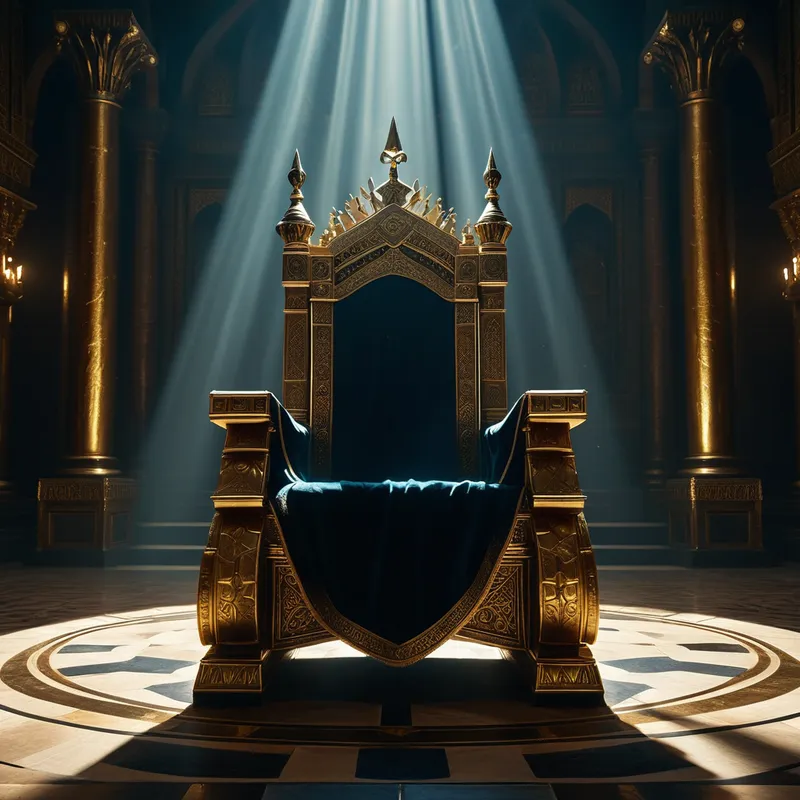
The Sword of Damocles Myth Meaning & Symbolism
A courtier learns that the splendor of a king's throne is overshadowed by a single, suspended sword, revealing the perpetual anxiety of supreme power.
The Tale of The Sword of Damocles
Hear now the tale of Damocles, a story whispered not in temples but in the courts of kings, a truth veiled in the guise of a fable. In the great city of Syracuse, under a sun that baked the marble white, there ruled a man named Dionysius II. His palace was a monument to earthly power: floors of polished porphyry, walls hung with tapestries depicting glorious conquests, and air perpetually sweet with the smoke of rare incense. At the center of this universe sat the throne, a mountain of ivory and gold.
Damocles, a courtier whose soul was woven from equal parts ambition and envy, beheld this splendor. His eyes drank in the jewelled cups, the obsequious bows of a hundred servants, the unchecked authority. One day, his flattery turned to a sigh of longing. “O Dionysius,” he exclaimed, “truly you are the most fortunate of men! What bliss it must be to live with such power, such wealth, free from the cares that plague lesser mortals!”
The Tyrant’s eyes, old and deep as still water, regarded the younger man. A silence fell, heavy as a cloak. Then, Dionysius spoke, his voice devoid of anger, filled instead with a terrible gravity. “You think so, Damocles? You believe this fortune is a garment one wears without weight? Very well. For a single day, you shall taste of it.”
A feast was commanded, more sumptuous than any before. Damocles was led to the throne, dressed in robes of purple and fine linen. He was seated upon the cool, hard gold. Before him, tables groaned under the weight of roasted peacocks, fruits from distant lands, and wine that shimmered like liquid ruby. Musicians played, and dancers moved like reeds in a gentle wind. Damocles smiled, lifting a golden goblet, feeling the intoxicating rush of power settle upon his shoulders.
Then Dionysius, from the shadows at the edge of the hall, gave a nearly imperceptible nod.
Damocles, reaching for a fig, happened to glance upward. His blood turned to ice. His breath caught in his throat. Directly above his head, suspended from the vaulted ceiling by the thinnest, most fragile of threads—a single hair from the tail of a horse—hung a massive, naked sword. Its point, honed to a cruel sharpness, aimed directly at the crown of his skull. The glitter of the feast dimmed. The taste of the wine turned to ash. The music became a distant, mocking hum. Every laugh, every clink of a dish, seemed to vibrate that deadly thread. He could not move. He dared not move. The bliss of kingship had vanished, replaced by a pure, animal terror, a knowledge that at any moment, the thread could snap, and glory would end in a final, silent plunge.
The feast stretched into an eternity of dread. Finally, trembling, his face pale, Damocles begged the Tyrant to release him from his “fortune.” He rose from the throne, a free man, and fled the hall, leaving the splendor and the suspended blade behind.

Cultural Origins & Context
This story is not a myth from the sacred canon of Judeo-Christian scripture, but a philosophical parable preserved within its cultural and intellectual lineage. It was recorded by the Roman statesman and philosopher Cicero in his work Tusculan Disputations (45 BCE). Cicero, a pivotal figure whose writings were meticulously studied by medieval Christian scholars, presented the tale as a Greek anecdote concerning Dionysius II, the tyrant of Syracuse.
Its function was didactic, a tool of moral philosophy. For Cicero’s Roman audience and later for the monastic scribes who copied his texts, the story served as a stark exemplum against envy and a profound meditation on the nature of power. It entered the stream of Western thought not as divine revelation, but as worldly wisdom, a classical insight that resonated deeply with Christian teachings on humility, the perils of earthly desire, and the anxiety inherent in temporal rule. It was a secular myth that addressed a sacred concern: the soul’s relationship to power and fear.
Symbolic Architecture
The myth constructs a perfect symbolic diorama of the psyche under the burden of ultimate authority. Every element is an archetypal truth.
The Throne is not merely a seat of power; it is the ego inflated to its zenith, the identified self that believes it has attained the pinnacle of existence. It is the illusion of having “arrived,” of being free from want or worry.
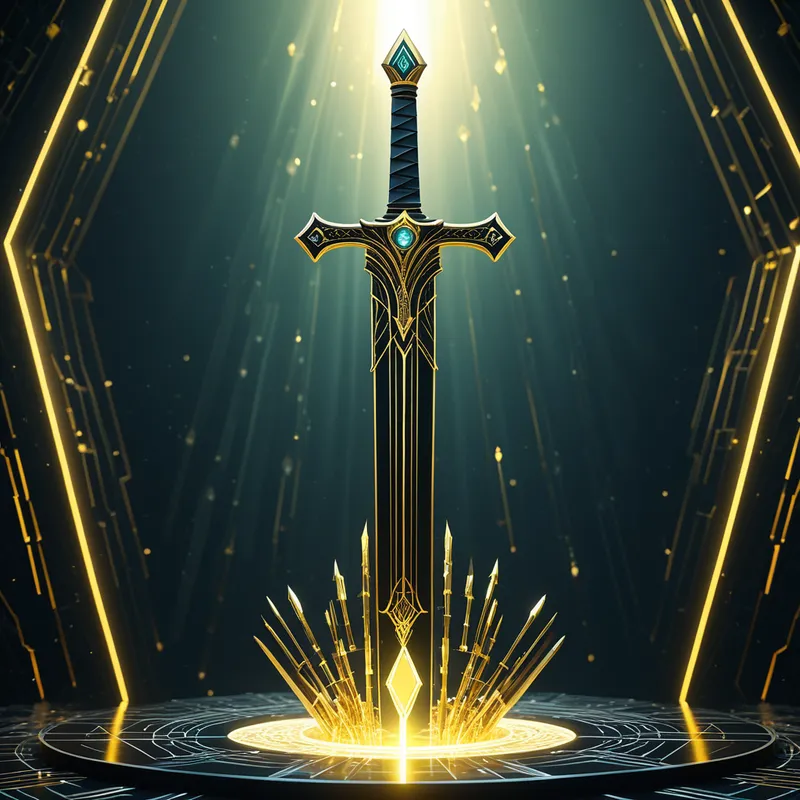
The Sword is the inevitable counterweight. It represents the unconscious tension, the latent catastrophe, the repressed knowledge upon which all such power is precariously balanced. It is the fear of assassination, the burden of decision, the guilt of tyranny, the anxiety of loss, the sheer weight of responsibility. It is the shadow of the throne.
The Sword of Damocles teaches that every crown has its hidden weight, and every point of absolute security is, in truth, a point of absolute vulnerability.
The Single Horsehair is the most exquisite symbol of all. It is the illusion of control, the fragile narrative of safety we construct. It is the belief that our wealth, our guards, our plans, or our divine right can hold the chaos of fate at bay. It is the thin thread of sanity stretched over the abyss of existential dread.
Damocles himself is the naive consciousness, the part of us that covets the glory without understanding the cost. His journey is one of instantaneous, brutal enlightenment. He does not earn the throne; he is granted a vision of its true nature—a seat beneath a blade.
The Dreamer’s Resonance
When this myth patterns a modern dream, the dreamer is not in a palace. They are in their office, their car, their home. The “throne” may be a promotion, a new house, a committed relationship, or any position of perceived security and success they have recently attained or desperately crave.
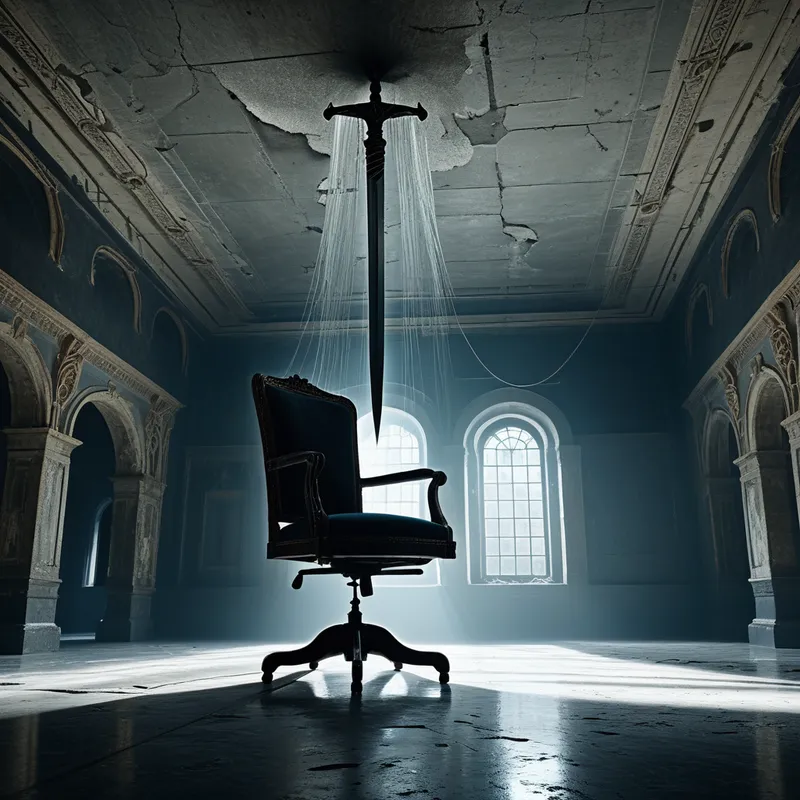
The somatic experience is one of frozen anxiety. The dreamer feels a profound, inescapable tension in the neck and shoulders—the body’s literal bearing of the weight from above. They may dream of looking up at a cracking ceiling, a loose heavy object on a high shelf, or a precarious chandelier. The feast—the rewards of their success—is present but tasteless, overshadowed by the looming, silent threat.
Psychologically, this dream signals a confrontation with the shadow aspect of ambition and achievement. The ego has claimed its prize, but the Self, the total psyche, knows the price. The dream is an urgent communication: the conscious attitude has become one-sided. The dreamer has identified wholly with the “ruler” archetype—control, responsibility, status—and is now being made acutely aware of the anxiety, isolation, and peril that are its innate companions. It is the psyche’s way of saying, “You wanted this power. Now feel its true gravity.”
Alchemical Translation
The alchemical process modeled here is not one of triumphant conquest, but of sobering disillusionment, which is the first, crucial stage of true psychic transmutation. The base metal of naive envy and ambition (Damocles’s desire) is placed in the athanor (the court) and subjected to the fire of direct experience.
The Nigredo, the blackening, occurs the moment Damocles sees the sword. His bright, golden fantasy is blackened by the shadow of terror. His inflation is punctured. This is a necessary death—the death of an illusion.
The alchemy of power begins not with seizing the throne, but with seeing the sword. The dissolution of the fantasy is the prima materia for genuine sovereignty.
From this blackened state, a new consciousness can be extracted. The true “treasure” is not the throne, but the knowledge the throne confers. The individual who integrates this myth does not necessarily abandon position or responsibility. Instead, they rule with conscious awareness of the sword. They transmute the paralyzing anxiety into a mindful, clear-eyed acknowledgment of risk and fragility. The power is no longer an intoxicant but a solemn duty. The thread is acknowledged as fragile, and therefore, every moment of stability is met not with arrogant assumption, but with a kind of humble gratitude and vigilant presence.
This is the shift from the tyrant (identified with power, denying the sword) to the wise sovereign (wielding power while respecting the blade above). The integrated Self holds both the throne and the sword in its awareness, achieving a grounded, unblinking form of authority that is rooted not in blind fortune, but in the profound, unshakeable knowledge of reality itself. The chain of ambition-envy-terror is broken, and in its place remains a conscious human, sitting upright, eyes open, bearing the weight of their world with clear sight.
Associated Symbols
Explore related symbols from the CaleaDream lexicon: