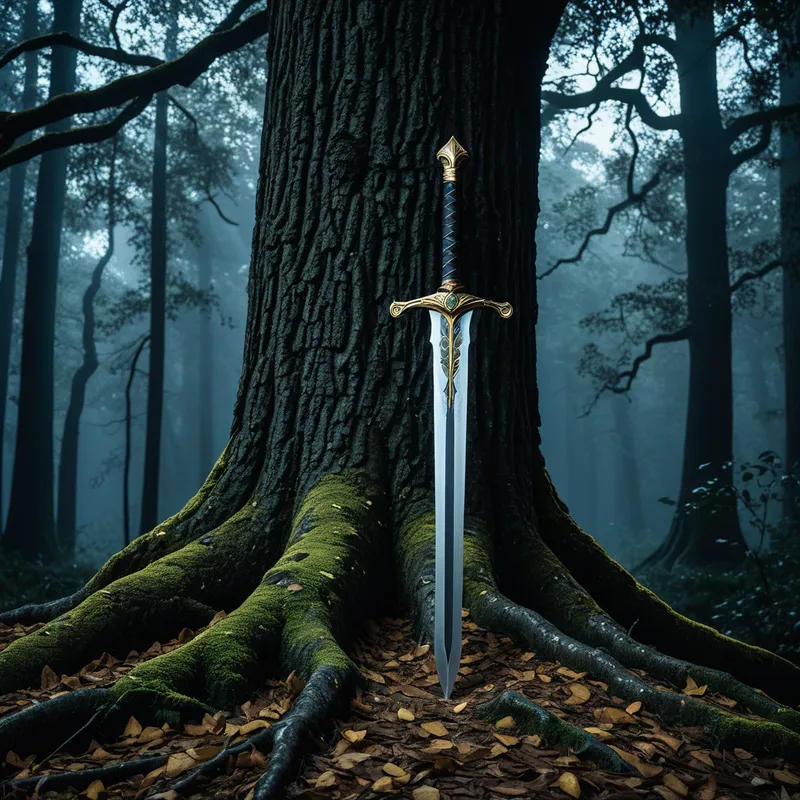
The Sword Gram Myth Meaning & Symbolism
A sword forged in betrayal, broken in a tree, and reforged for a hero's fateful quest, Gram embodies destiny's sharp edge and the price of vengeance.
The Tale of The Sword Gram
Hear now a tale of iron and oak, of a blade that sang with the voice of fate. In the halls of the Æsir, where the mead of poetry flows, the smith Reginn came to dwell. He was a master of the forge, brother to a dragon, and heart full of a slow, cold fire—the fire of vengeance.
For his brother, Fáfnir, wallowed on a glittering hoard, a worm coiled upon gold, his soul poisoned by greed. And their father was dead, slain by that same brother’s hand. Reginn’s vengeance was a seed that needed a tool to grow. He found it in a youth of royal blood but exiled fate: Sigurðr.
Reginn nurtured the boy, taught him the arts of war and counsel, and spoke ever of the glittering curse upon the heath. “A hero needs a hero’s blade,” Reginn whispered, his eyes like chips of flint. He brought forth the shattered pieces of a sword. “This was your father’s. It failed him. I will reforge it.”
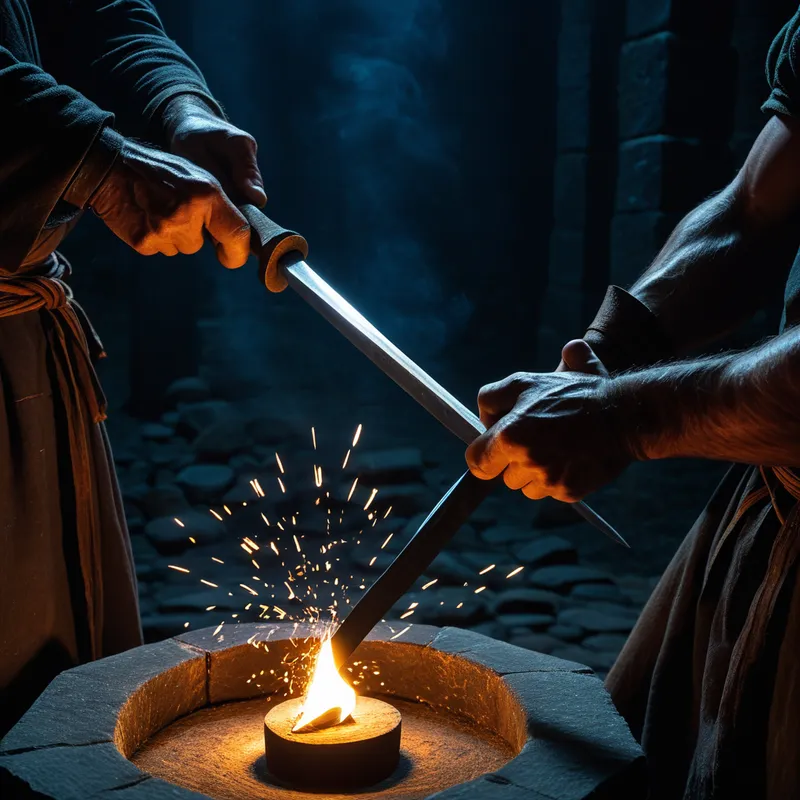
The bellows roared. The forge-fire, fed by Reginn’s cunning and Sigurðr’s destiny, burned hotter than the sun. The shards melted, wept iron tears, and were born anew. The sword that cooled on the anvil was named Gram. It was not beautiful; it was inevitable. Its edge was a line drawn by the Norns themselves.
“Test it,” said Reginn. Sigurðr took the sword, felt its balance—a perfect extension of his own will. He swung it at the anvil. The sound was not a clang, but a cleave. The great iron block sighed and parted in two, its severed faces smooth as still water.
But the true test lay in the forest. Reginn led Sigurðr to a mighty oak, its trunk gnarled with centuries. “Your father’s sword broke. Let us see if the son’s will hold.” Sigurðr raised Gram. The air hummed. With a shout that echoed in the roots of the world, he brought the blade down. It passed through bark, heartwood, and out the other side as if slicing mist. The great tree stood for a breath, then groaned and fell, split clean to its base. In that moment, the sword and the man were one. The path to the dragon was open.
The rest is written in fire and blood. With Gram, Sigurðr dug a pit in the dragon’s path. As the monstrous shape of Fáfnir oozed over the earth above him, Sigurðr thrust upward. Gram drank deep of the dragon’s life, a river of poison and gold. The deed was done. But as the dragon’s blood coated his hands, Sigurðr learned a terrible truth from the dying beast’s riddles: Reginn, his foster-father, intended to betray and slay him after the deed.
The seed of vengeance had borne a poisoned fruit. And so, with the same blade that slew the dragon, Sigurðr turned his fate upon the forger. As Reginn slept, dreaming of gold, Gram ended his plot and his life. The sword, forged for one vengeance, had completed another. It was then that Sigurðr, now lord of a cursed treasure and bearer of a blood-stained destiny, truly understood the weight of the blade in his hand.
Cultural Origins & Context
The saga of Sigurðr and the sword Gram is the pulsing heart of the Völsunga saga, a prose epic compiled in 13th-century Iceland from much older oral traditions. These stories were the lifeblood of the Germanic and Norse world, recited in smoky halls by skalds who were keepers of lineage, law, and cosmic order. The myth of Gram is not a simple adventure; it is a foundational narrative about the inescapable intertwining of kinship, obligation, and violence.
In a culture where fame (orðstír) was the only immortality, and where blood feud was a sacred, cyclical law, Sigurðr’s story provided a terrifying and magnificent template. It asked the hardest questions: What do you owe your family? What is the cost of fulfilling your destiny? The sword Gram is the physical manifestation of these questions—an instrument of heroic glory that also severs the very bonds of loyalty that set it in motion. Its passage from father to son, its breaking and reforging, mirrors the fragile yet unbreakable chain of fate (ørlög) that binds generations. To hear this tale was to be schooled in the paradox of power: the very tool that grants you victory also isolates you and demands further sacrifice.
Symbolic Architecture
Gram is not merely a weapon; it is an embodied paradox. It is a symbol of destiny actualized. Its initial state—broken, inherited—represents a fractured legacy, a duty unfulfilled. The reforging is the crucial act of psychological integration. The hero must take the broken pieces of his inheritance (his trauma, his expectations, his lineage) and, with the aid of a guiding yet flawed consciousness (Reginn, the mentor-shadow), subject them to the transformative fire of his own will. What emerges is not the old sword repaired, but a new, sharper entity, tempered in the conflict between past and potential.
The sword that can cleave an anvil is the will that can cut through the hardened patterns of the past.
Its most potent symbolic act is cleaving the oak. The oak, sacred to Thorr, represents stability, law, and the known world. Gram’s effortless cut is the violent, necessary rupture that must precede the hero’s journey. It is the moment the individual psyche severs its primary identification with the familial or tribal “tree” to embark on its own path. Yet, this autonomy is immediately directed toward a dragon—the hoarded, unconscious shadow of the very family system (here, fratricidal greed) it left behind. Gram thus becomes the instrument of confronting the familial unconscious, slaying the monstrous distortion of legacy (Fáfnir), only to then turn upon the manipulative, intellectual aspect of that same system (Reginn). It is a tool of cyclical purification that is itself never clean.
The Dreamer’s Resonance
To dream of such a sword is to feel the psyche grappling with the archetype of the empowered will. You may dream of finding a shattered blade and feeling compelled to repair it, or of being given a weapon of immense, almost frightening sharpness. The somatic sensation is often one of both power and dread—a heavy, electric grip in the hand, a knowledge that this tool must be used, and that its use will change everything.
This dream pattern signals a critical threshold in the dreamer’s life. The “sword” represents a nascent capacity for decisive action, for cutting through a tangled, oppressive situation (the “oak” or the “dragon”). It often appears when one is facing a duty inherited from family or culture that feels burdensome or toxic. The dream is the psyche’s forge, presenting the tool for your own liberation. Yet, the Gram myth warns the dreamer: this empowerment will demand a sacrifice. It may mean severing comfortable dependencies (the tree) or confronting a monstrous, hoarded truth (the dragon). The dream’s anxiety often centers on the fear of what—or whom—this newfound clarity and strength might inevitably have to turn against next.
Alchemical Translation
The journey of Gram is a perfect allegory for the alchemical and Jungian process of individuation. The prima materia is the broken paternal sword—the fragmented, ineffective aspects of the inherited Self. The nigredo, the blackening, is the death of the father and the fostering by the shadowy Reginn (the cunning, problem-solving but ultimately self-serving ego). The albedo, the whitening, is the reforging—the conscious, disciplined work of integrating these fragments into a cohesive, potent instrument of the will.
The cleaving of the oak is the separatio, the crucial separation of the individual consciousness from the collective. The slaying of Fáfnir is the mortificatio and putrefactio of the dragon—the confrontation and dissolution of the personal and familial shadow, the “poisonous” complexes of greed, resentment, or trauma that guard a seemingly golden but cursed treasure (the inflated ego or false Self).
To reforge the sword is to accept one’s fate; to wield it is to become responsible for the cuts it makes in the fabric of your world.
The final, tragic turn—using Gram to slay Reginn—represents the most difficult stage: the sacrificium intellectus. The very guiding intelligence, the clever plan that set you on this path, must now be seen in its full, manipulative light and relinquished. The hero must transcend the mentor’s limited design to fully own his destiny, even if it leaves him alone with a blood-stained treasure and a bittersweet wisdom. For the modern individual, this translates to the painful realization that the strategies, beliefs, and even the therapy that helped you break free from your past may themselves become limitations. The fully integrated Self must eventually wield its hard-won clarity to cut free from its own former methods of salvation, standing autonomous in a world of its own making, bearing the solemn weight of its power.
Associated Symbols
Explore related symbols from the CaleaDream lexicon: