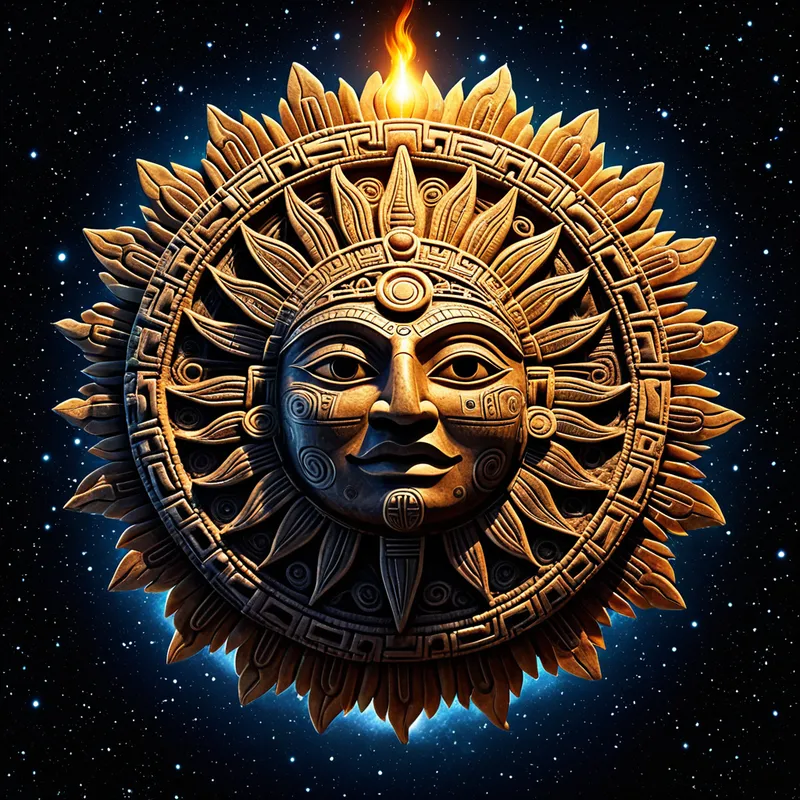
The Sun Stone Calendar Myth Meaning & Symbolism
The myth of the Fifth Sun, where a humble god's self-immolation creates the current world, demanding perpetual sacrifice to keep the cosmos in motion.
The Tale of The Sun Stone Calendar
Listen. Before time was counted, the world was dark and silent. Four suns had already perished, each destroyed by its own cataclysm—jaguar, wind, fire, rain. The bones of the gods lay scattered in the black waters of Tlalocan. The remaining deities gathered in the sacred darkness of Teotihuacan. A terrible question hung in the void: Who would leap into the divine furnace? Who would bear the unbearable burden of becoming the Fifth Sun, to set the cosmos in motion once more?
Two stepped forward. Tecciztecatl, lord of riches, adorned in glittering quetzal feathers and gold. Beside him stood Nanahuatzin, covered in sores, clad only in paper, humble and silent. For four nights they performed penance. Tecciztecatl offered magnificent sacrifices: quetzal plumes, gold spheres, coral branches, and rich copal incense. Nanahuatzin offered only the scabs from his own body, the green reeds he had pierced himself with, and his own humble blood.
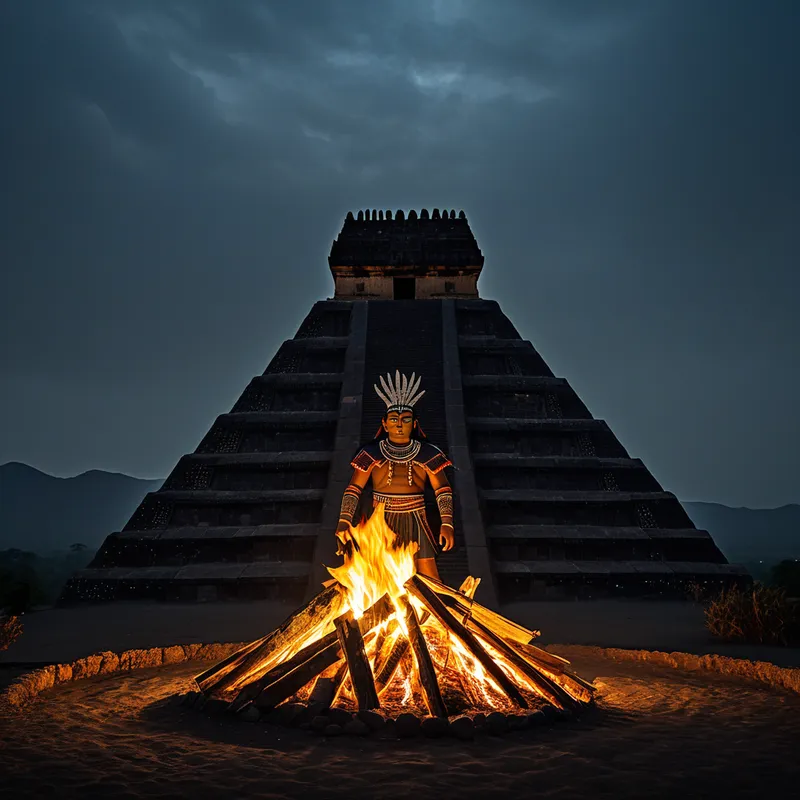
When the moment of ignition came, a vast pyre was built, its flames licking the starless sky. The gods called for Tecciztecatl to jump first. Four times he approached the terrible heat. Four times his courage failed him, and he retreated, his finery trembling. Then they called to Nanahuatzin. Without a moment’s hesitation, without a sound, the humble god closed his eyes, gathered his resolve, and ran. He leapt into the very heart of the blaze. His paper garments vanished in a flash. His flesh crackled and fused with the fire. There was a moment of profound silence.
Then—a blinding, searing light erupted from the ashes. A new sun, fierce and glorious, began to rise into the eastern sky. Shamed by Nanahuatzin’s courage, Tecciztecatl finally hurled himself into a second, lesser fire. He too rose, becoming a second sun, a moon. But the sky could not bear two equal lights. A god, swift as thought, took a rabbit and flung it into the face of Tecciztecatl, dimming his glory, leaving the mark of the rabbit upon the moon forever.
And so Tonatiuh, the Fifth Sun, began his journey. But he did not move. He hung, blazing, in the center of the sky, demanding payment. “Why do I not move?” his voice thundered. “You must feed me! You must give me your most precious substance!” And so the gods, to set the cosmos in motion, offered the ultimate sacrifice: they gave their own blood, their own lives. Only with this divine nourishment did the sun begin its first, faltering arc across the heavens, beginning the count of days, the era in which we now live—the Sun of Movement, Nahui Ollin.
Cultural Origins & Context
This is not merely a story of creation; it is the foundational charter of the Mexica (Aztec) world. Known from colonial-era texts like the Historia de los Mexicanos por sus pinturas and the Leyenda de los Soles, the myth was the sacred narrative behind the state’s most vital function: ensuring the sun’s continued journey. The massive Piedra del Sol, discovered in 1790, is its ultimate stone sermon. Carved in the late 15th century, it is not a practical calendar but a cosmic diagram, a sculpted version of this myth.
Told by priest-historians (tlamatinime) and illustrated in sacred codices, this narrative served a critical societal function. It justified the practice of ritual sacrifice (nextlahualli, “the paying of debt”) as a cosmological necessity. Every life offered was a replay of the gods’ original sacrifice, a tiny spark of energy to fuel the sun’s journey and stave off the final, eternal descent into darkness. The myth established a universe based on reciprocal debt (tequitl), where life itself was a loan from the gods, paid back through blood and sacred work.
Symbolic Architecture
At its core, the myth presents a [universe](/symbols/universe “Symbol: The universe symbolizes vastness, interconnectedness, and the mysteries of existence beyond the individual self.”/) where existence is not a given, but a precarious [achievement](/symbols/achievement “Symbol: Symbolizes success, mastery, or reaching a goal, often reflecting personal validation, social recognition, or overcoming challenges.”/), bought and maintained through willing surrender. The central conflict is not between good and evil, but between hollow pride and transformative humility, between selfish preservation and selfless expenditure.
The cosmos is not born from a word, but from a wound. Creation is not an act of will, but an act of surrender.
Nanahuatzin represents the rejected, the wounded, the “useless” part of the psyche that holds the key to renewal. His offerings are not grand but profoundly authentic: his own suffering, his own flawed [body](/symbols/body “Symbol: The body in dreams often symbolizes the dreamer’s self-identity, personal health, and the relationship they have with their physical existence.”/). His leap is the ultimate act of [faith](/symbols/faith “Symbol: A profound trust or belief in something beyond empirical proof, often tied to spiritual conviction or deep-seated confidence in people, ideas, or outcomes.”/)—the [dissolution](/symbols/dissolution “Symbol: The process of breaking down, dispersing, or losing form, often representing transformation, release, or the end of a state of being.”/) of the small, suffering ego into a greater, cosmic [purpose](/symbols/purpose “Symbol: Purpose signifies direction, meaning, and intention in life, often reflecting personal ambitions and core values.”/). Tecciztecatl is the ego in its splendid [armor](/symbols/armor “Symbol: Armor represents psychological protection, emotional defense, and the persona presented to the world. It symbolizes both safety and the barriers that separate us from vulnerability.”/), all [appearance](/symbols/appearance “Symbol: Appearance in dreams relates to self-image, perception, and how you present yourself to the world.”/) and no substance, incapable of the final, defining sacrifice. His transformation into the [moon](/symbols/moon “Symbol: The Moon symbolizes intuition, emotional depth, and the cyclical nature of life, often reflecting the inner self and subconscious desires.”/) signifies a secondary, reflective light—a [consciousness](/symbols/consciousness “Symbol: Consciousness represents the state of awareness and perception, encompassing thoughts, feelings, and experiences.”/) that illuminates but does not energize, forever marked by its hesitation.
The stationary sun, Tonatiuh, demanding [payment](/symbols/payment “Symbol: Symbolizes exchange, obligation, and value. Represents what one gives to receive something in return, often tied to fairness, debt, or spiritual balance.”/), symbolizes a brutal psychological [truth](/symbols/truth “Symbol: Truth represents authenticity, honesty, and the quest for knowledge beyond mere appearances.”/): [energy](/symbols/energy “Symbol: Energy symbolizes vitality, motivation, and the drive that fuels actions and ambitions.”/) (libido, will, [life](/symbols/life “Symbol: The symbol of ‘Life’ represents a journey of growth, interconnectedness, and existential meaning, encompassing both the joys and challenges that define human experience.”/)-force) does not flow freely. It becomes stuck, demanding a “payment” from the psyche—a conscious sacrifice of an old [attitude](/symbols/attitude “Symbol: Attitude symbolizes one’s mental state, perception, and posture towards life, influencing emotions and actions significantly.”/), a cherished illusion, a comfortable [pattern](/symbols/pattern “Symbol: A ‘Pattern’ in dreams often signifies the underlying structure of experiences and thoughts, representing both order and the repetitiveness of life’s situations.”/)—to get it moving again.
The Dreamer’s Resonance
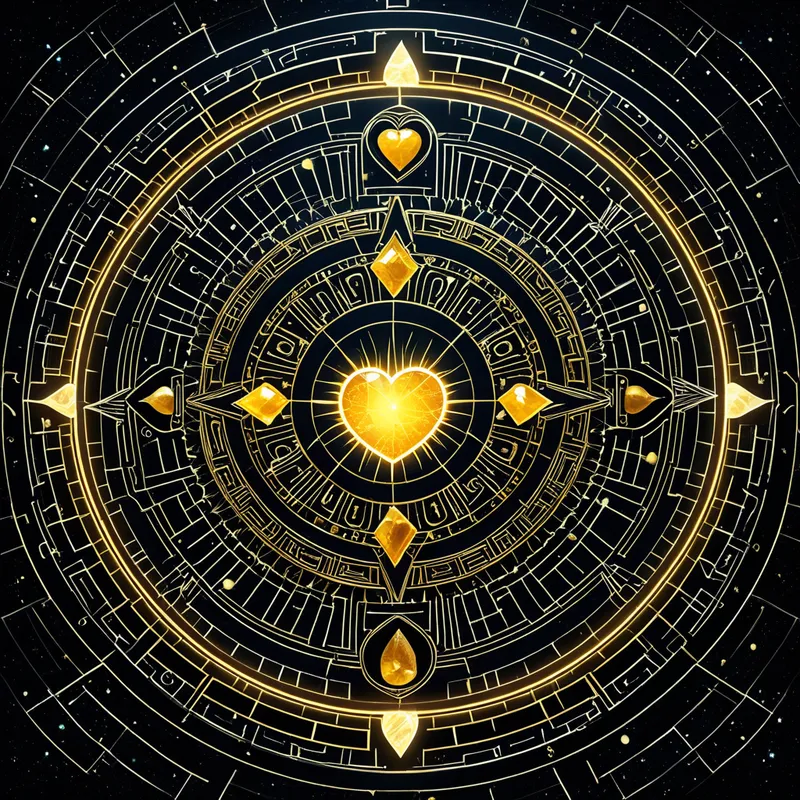
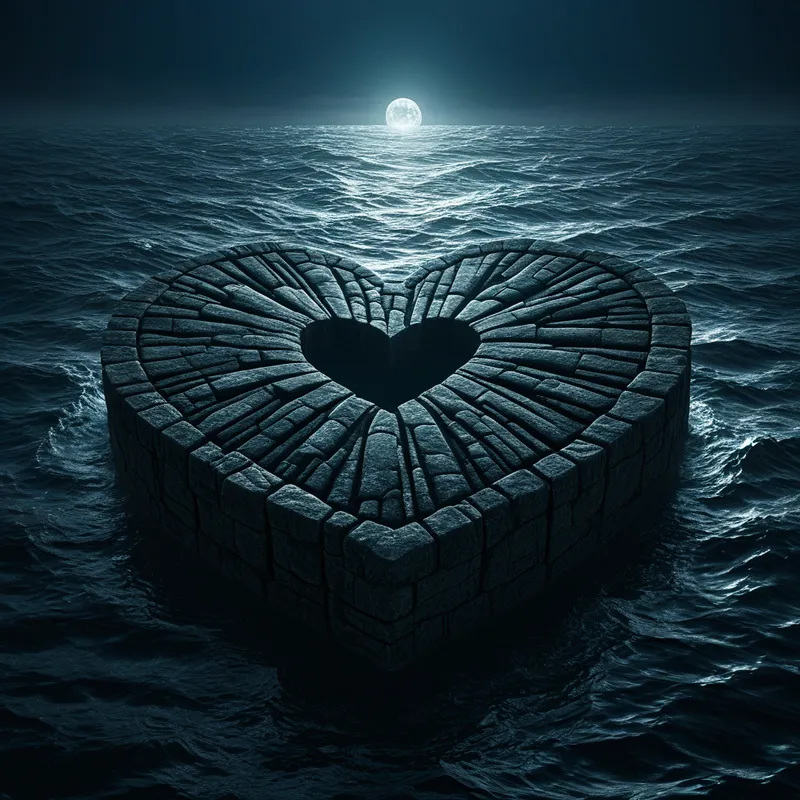
When this myth pattern stirs in the modern dreamer, it often manifests as dreams of immense, immobile wheels or gears; of a heart that is a stone, or a stone that must be warmed to life; of being called to leap into a fire or a void. The somatic sensation is one of profound stuckness, of cosmic inertia, coupled with a terrifying call to action.
Psychologically, this is the process of confronting a life that has become static, a career or relationship that no longer moves, a creative spirit that is frozen. The dreamer is at their own Teotihuacan. The “proud god” aspect (Tecciztecatl) may manifest as a dream figure who hesitates, makes excuses, or offers impressive but empty gifts. The “humble god” (Nanahuatzin) may appear as a sickly animal, a beggar, or a neglected part of the dreamer’s own body. The dream is presenting the critical choice: to remain in splendid, static safety, or to offer up something authentic, painful, and precious to break the deadlock and initiate a new cycle of movement.
Alchemical Translation
For the individual, the myth of the Fifth Sun is a map for psychic transmutation, the alchemical solve et coagula—dissolve and coagulate. The ego, identified with its treasures and status (Tecciztecatl), must be dissolved. This is not destruction, but a sacrificial offering of its current form.
Individuation begins not with claiming one’s crown, but with offering one’s wounds.
The “fire” is the heat of conscious engagement with the unconscious, the painful but transformative process of psychotherapy, artistic creation, or deep introspection. Leaping in is the act of total commitment to this process, trusting that from the dissolution of the known self, a new, more authentic consciousness (the Sun) will be born. But the work is not done. The newborn sun—the nascent, integrated Self—does not move on its own. It demands continual “payment.” This is the ongoing work of consciousness: to continually sacrifice the easy, automatic patterns (the “old gods” of habit and defense) to feed the new, demanding light of awareness. The Piedra del Sol thus becomes an internal mandala, a symbol of the psyche’s own central governing principle, which requires the constant, conscious offering of our attention, our honesty, and our lived experience to keep the inner universe in creative motion.
Associated Symbols
Explore related symbols from the CaleaDream lexicon:
- Sun — The central deity and goal of the myth, representing the demanding, life-giving consciousness born from total self-sacrifice.
- Sacrifice — The core action of the myth; the voluntary offering of what is most precious to generate cosmic and psychic motion.
- Fire — The transformative furnace of creation and destruction, the element through which the humble self is annihilated and reborn as a greater entity.
- Circle — The perfect, eternal form of the Sun Stone and the cosmic cycle it represents, symbolizing wholeness, completion, and the endless wheel of eras.
- Heart — The symbolic center of the sun god Tonatiuh, representing the life-force demanded as payment and the courage needed for the sacrificial leap.
- Blood — The sacred currency of the cosmos, the essential nourishment offered by the gods and later by humanity to fuel the sun’s journey.
- Moon — The transformed pride of Tecciztecatl, representing reflective light, hesitation, and the secondary, marked consciousness that follows the primary act of courage.
- Calendar — The physical and temporal manifestation of the myth, the structure imposed on chaos to measure and sustain the sun’s perilous journey.
- Stone — The enduring medium of the myth’s message; the Sun Stone itself is a permanent, weighty testament to the cosmic order bought with sacrifice.
- Rebirth — The ultimate promise of the myth; from the ashes of the old self and the old world, a new, moving era is perpetually born.
- Aztec Sun Stone — The ultimate symbol of the myth, a stone cosmos diagram that maps the divine struggle and the precarious balance of the current age.
- Order — The achieved state of the cosmos after the sacrifice, a fragile structure maintained through ritual and remembrance, constantly threatened by chaos.