
The Summit Myth Meaning & Symbolism
A seeker ascends a sacred mountain to find a master, only to discover the true summit is a descent into the valley of their own being.
The Tale of The Summit
Listen, and let the mists of time part. There was once a seeker, a soul whose spirit was a parched riverbed in a world of noise. He had read every scroll, mastered every form, yet a hollow wind whistled through the chambers of his heart. In the quiet desperation of his study, a whisper arrived, borne on the breath of an old traveler: “To find the answer, you must ask the question at The Summit.”
Without a second thought, he forsook his books. He walked. His journey was the world’s oldest story: the leaving behind. Villages became specks, forests thinned to stubborn shrubs, and the air grew thin and sharp. The mountain, whose name was forgotten because true names are felt, not spoken, loomed. It was not a friendly climb. It was a trial of silence. The wind on the high passes did not howl; it recited sutras of emptiness. The stones were not obstacles; they were the bones of the earth, asking to be acknowledged.
For forty-nine days he climbed, his mind a storm of anticipation. What wisdom awaits at the peak? What divine visage will grant the final secret? His body became a map of effort—aching muscle, cracked lips, breath like a ragged flag.
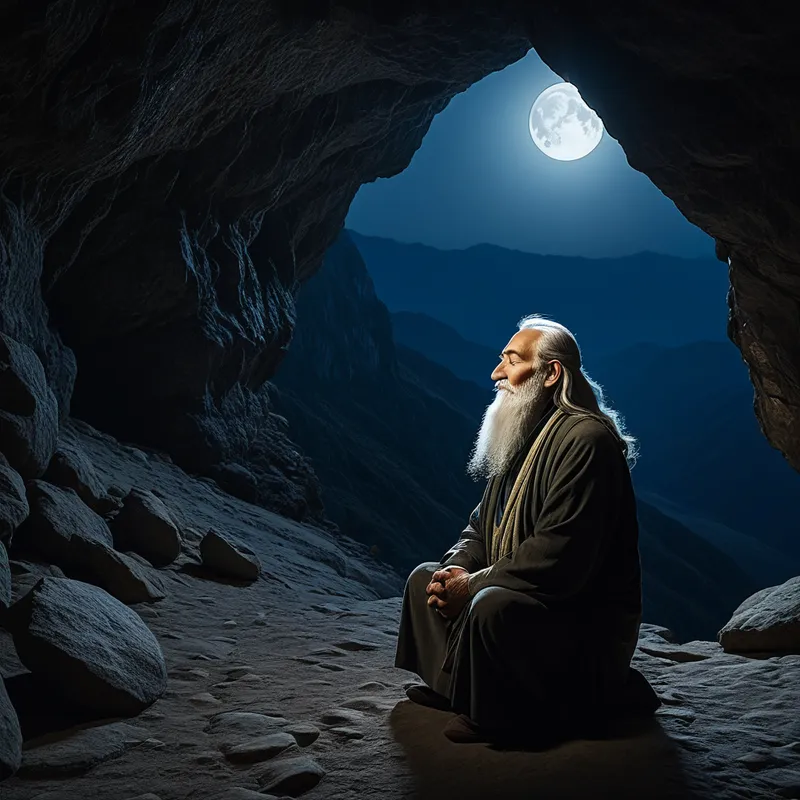
And then, the world flattened. The agonizing slope gave way to a vast, silent plateau, the true summit. In its center stood a single, ancient pine, its roots gripping the very sky. And beneath it, cross-legged on a worn stone, sat the Master. Not a deity of light, but a man so still he seemed carved from the mountain itself. His eyes were closed.
The seeker, heart pounding with triumph and reverence, fell to his knees. “Great Master!” he cried, his voice swallowed by the immense silence. “I have climbed the world! I have endured all hardships to reach you at The Summit! Please, impart to me the ultimate truth of the Tao!”
The Master did not move. A long moment passed, measured only by the seeker’s frantic heartbeat. Then, slowly, the ancient eyes opened. They held no spark of celestial fire, only a depth like a still mountain lake reflecting the infinite sky. He looked at the exhausted, expectant man before him. And he smiled, a gentle curve that held the patience of millennia.
He spoke a single sentence, his voice the soft rustle of pine needles.
“You have climbed the wrong mountain.”
And with that, he closed his eyes again, returning to his stillness. The seeker was cast into a void more terrifying than any precipice. All his striving, his sacrifice, his monumental effort—declared a mistake? A desperate anger rose in him, but it found no purchase in the serene emptiness of the plateau. He sat there for hours, days—time lost all meaning—as the Master’s words echoed in the hollow of his soul.
Then, a shift. Not in the world, but in his seeing. He looked out from The Summit, not up in triumph, but down. He saw the vast, green, mist-veiled valley from which he had come. He saw the winding, treacherous path of his ascent, now a delicate thread. He saw the villages, the rivers, the whole teeming, struggling, beautiful world cradled in the mountain’s embrace. The peak was not a destination above it all, but the vantage point that contained it all. The ultimate truth was not a secret to be grasped at the top, but the panoramic acceptance of the entire journey, including the humble valley he had been so desperate to escape.
He had not climbed the wrong mountain. He had climbed with the wrong gaze. The true summit was not a place of arrival, but a moment of inversion. Without a word, he bowed deeply to the motionless Master. Then he turned, and began his descent. But he was not the same man who had ascended. He walked down into the world, carrying the summit within him.
Cultural Origins & Context
This myth, in its myriad forms, is not found in a single canonical text like the Tao Te Ching or the Zhuangzi, but is woven into the oral and instructional traditions of Taoist hermit-sages and Xiu Dao practitioners. It functions as a gong’an (koan), a narrative puzzle designed to short-circuit logical striving and precipitate direct realization. Told from master to disciple, often at the moment the disciple’s spiritual ambition had hardened into a new kind of prison, its purpose was therapeutic: to shatter the seeker’s idolatry of the goal itself.
Societally, it served as a corrective to imperial and Confucian ideologies of hierarchical ascent. While the culture venerated mountains as sacred axes mundi, dwellings of immortals (Xian), this myth subtly subverts that. It suggests that the power of the sacred mountain is not to elevate one above humanity, but to re-contextualize one’s place within the ten thousand things of the natural world. The myth was passed down in whispers in monasteries and remote hermitages, a secret antidote to spiritual pride.
Symbolic Architecture
The myth’s power lies in its perfect symbolic geometry. The Mountain is the archetypal axis of the world, representing the arduous path of spiritual or psychological aspiration. The climber is the conscious ego, the part of us that believes progress is linear, ascendant, and goal-oriented.
The Summit is not the end of the climb, but the point where the vector of ambition curves back upon itself, revealing that the height of understanding is the depth of belonging.
The Master is the embodiment of the Self, the central archetype of wholeness in Jungian terms, or the perfected Yuanshen. His stillness represents the state of Wu Wei, and his devastating statement, “You have climbed the wrong mountain,” is the voice of the unconscious confronting the ego’s fundamental misapprehension. The ego seeks to acquire enlightenment as an object; the Self reveals that one must surrender to being part of the landscape.
The pivotal moment—looking down into the valley—is the symbolic death of the seeker-identity and the birth of integrated consciousness. The valley is the shadow, the rejected, mundane, “low” aspects of life and self. The summit’s final lesson is that wholeness is only achieved when the highest aspiration embraces the lowest origin.
The Dreamer’s Resonance
When this myth stirs in the modern dreamscape, it often manifests not as a literal mountain, but as any exhausting, obsessive pursuit toward a seemingly critical goal. The dreamer may be desperately climbing an endless staircase in a corporate tower, racing to finish a thesis that has no end, or striving to reach a brilliant light on a distant hill. The somatic feeling is one of frantic effort, breathlessness, and profound fatigue.
The psychological process is the unconscious working to dissolve a spiritual complex—a rigid, ego-inflated identification with one’s own journey of “self-improvement” or “achievement.” The dream is a compensatory message from the Self: “Your current direction, though filled with effort, is leading you away from your own nature.” The moment of reaching the “summit” in the dream and finding it empty, baffling, or containing a cryptic figure, mirrors the Master’s revelation. It is the psyche’s attempt to initiate a crisis of meaning, forcing a necessary inversion of perspective. The healing begins not upon waking with a new answer, but with the haunting question the dream implants: “What is the ‘mountain’ I am climbing, and what ‘valley’ have I left behind in my striving?”

Alchemical Translation
For the modern individual, the myth models the alchemical process of individuation, specifically the stage of Nigredo giving way to Albedo. The arduous climb is the conscious life of effort, discipline, and persona-building (the opus). Reaching the summit and facing the Master’s statement is the Nigredo—the crushing disillusionment, the dark night of the soul where all one’s efforts seem for naught. This is the essential dissolution of the ego’s project.
The alchemical gold is not mined at the peak, but is revealed when the peak becomes a mirror for the base metal of the valley below.
The “descent” is the Albedo, the washing clean. It is not a regression, but a return informed by the higher perspective. One reintegrates with ordinary life—the valley of relationships, mundane duties, and embodied existence—but now that life is informed by the summit. The psychic transmutation is complete when the individual no longer lives from a place of “climbing toward” an idealized self, but from a place of “being within” the cyclical, non-linear process of life itself. The conflict between high and low, spiritual and material, sacred and profane, is resolved into a harmonious circulation—the true image of the Yin-Yang. The struggle triumphs not in conquest, but in the profound, quiet peace of homecoming, having discovered that the entire mountain, from deepest valley to highest peak, was always home.
Associated Symbols
Explore related symbols from the CaleaDream lexicon: