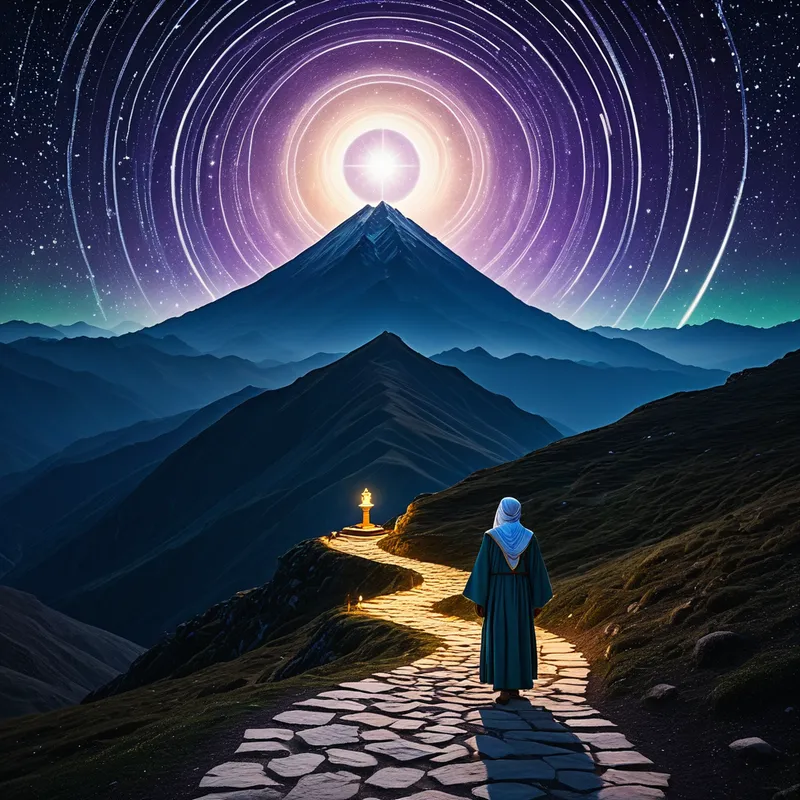
The Sufi Path of the Seven Stations Myth Meaning & Symbolism
A mystic's journey through seven stations of the soul, from repentance to annihilation, mapping the path from the ego's prison to the Beloved's presence.
The Tale of The Sufi Path of the Seven Stations
Listen, and let the silence between the words speak. There is a story not written on parchment, but etched on the heart. It begins not in a palace or a battlefield, but in a state of profound absence—a thirst so deep it cracks the earth of the soul.
Once, there was a seeker. Not a king, nor a warrior, but a soul who had tasted the dust of the world and found it bitter. He stood in the marketplace of life, hearing only the hollow clatter of coins and the drone of idle talk. A cry rose within him, a wordless ache. It was the first call. He turned his back on the noisy square and walked into the desert of his own longing.
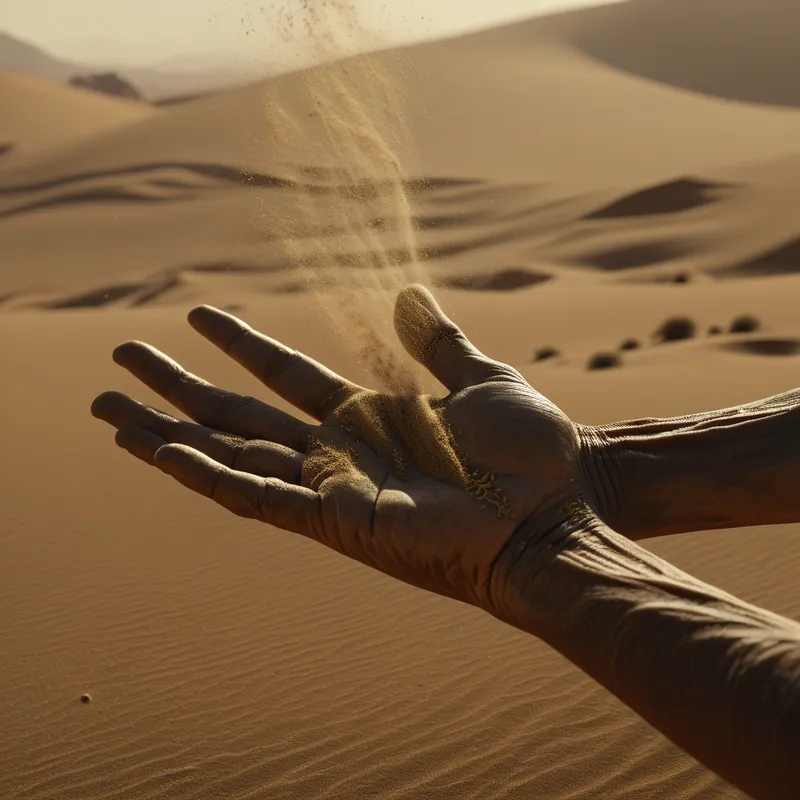
The first station rose before him like a mirage made solid: Tawbah, Repentance. Here, he did not merely regret errors; he emptied his hands of everything he had gathered—pride, certainty, even his past virtues. He scattered them to the four winds like dust, becoming a hollow reed.
The path then led to Wara, Abstinence. Every step became a choice. He learned to see the subtle snares in a glance, a morsel of food, a passing thought. The world, once a playground, became a sanctuary where every action was a whispered prayer.
Then came Zuhd, Renunciation. He did not hate the world, but saw through it. Gold and threadbare cloth became of equal weight. His hunger was not for bread, but for the nourishment that does not perish. He became a stranger in his own life, owned by nothing.
The fourth station was Sabr, Patience. Not the grim clenching of teeth, but a deep, flowing surrender. Here, the desert sun beat down, and the oasis remained unseen. Doubts assailed him like jackals. Yet he learned to stand in the fire of waiting, not as one burning, but as one being forged.
From that fire emerged Tawakkul, Trust. He let go of the tiller. The wind that filled his sail was not his own breath. He walked the cliff’s edge without fear of falling, knowing the ground beneath him was not stone, but promise. He became a leaf on the breath of the Beloved.
This trust blossomed into the sixth station: Rida, Satisfaction. Joy and sorrow lost their names; both were tasted as sweet wine from the same cup. The seeker no longer sought a change in circumstance, but saw the divine hand in all circumstance. The path itself became the destination.
And then… the path ended. It did not conclude, but dissolved. The seventh station, Fana, Annihilation, was not a place, but an un-becoming. The seeker, the path, the stations—all were consumed in a sun of such brilliance that it left no shadow. There was no “he” to arrive. Only the One who had been the journey all along. In that silence, which is not emptiness but fullness, the tale finds its true beginning.
Cultural Origins & Context
This map of the soul is not the invention of a single poet, but the crystallized wisdom of centuries of Islamic mysticism, known as Sufism. Emerging in the 8th and 9th centuries, Sufism sought the direct, experiential knowledge of the Divine (al-Haqq) beyond the confines of mere legalistic observance. The schema of the Seven Stations is a pedagogical and psychological framework developed by master teachers like Al-Ghazali and others to guide disciples (murid).
Transmitted orally in the intimate setting of the khanqah or dhikr circle, and later codified in poetic and prose manuals, this “path” (Tariqah) served a vital societal function. It provided a structured, interior counter-narrative to external political and social turmoil, offering a direct means of transformation. It was a living myth, not about gods on mountains, but about the divine spark within the human breast, charting its arduous return to its source.
Symbolic Architecture
The Stations are not a [linear](/symbols/linear “Symbol: Represents order, predictability, and a direct, step-by-step progression. It symbolizes a clear path from cause to effect.”/) checklist, but a spiraling [ascent](/symbols/ascent “Symbol: Symbolizes upward movement, progress, spiritual elevation, or striving toward higher goals, often representing personal growth or transcendence.”/) where each level contains and transcends the previous. They represent the systematic dismantling of the ego-self (nafs al-ammarah).
The journey begins not with an addition, but a subtraction. Tawbah is the first death, the necessary clearing of the ground so the new seed can be planted.
Wara and Zuhd represent the purification of [action](/symbols/action “Symbol: Action in dreams represents the drive for agency, motivation, and the ability to take control of situations in waking life.”/) and attachment, creating a [vessel](/symbols/vessel “Symbol: A container or structure that holds, transports, or protects something essential, representing the self, emotions, or life journey.”/) clean enough to hold sacred content. Sabr is the alchemical [vessel](/symbols/vessel “Symbol: A container or structure that holds, transports, or protects something essential, representing the self, emotions, or life journey.”/) itself, the sealed [crucible](/symbols/crucible “Symbol: A vessel for intense transformation through heat and pressure, symbolizing spiritual purification, testing, and alchemical change.”/) where the raw lead of the [soul](/symbols/soul “Symbol: The soul represents the essence of a person, encompassing their spirit, identity, and connection to the universe.”/) is held under the heat of trial. Tawakkul is the [moment](/symbols/moment “Symbol: The symbol of a ‘moment’ embodies the significance of transient experiences that encapsulate emotional depth or pivotal transformations in life.”/) the alchemist’s hand stops stirring, surrendering the process to the fire itself. Rida is the transformation witnessed—the lead now gleams with a different light. Finally, Fana is the [dissolution](/symbols/dissolution “Symbol: The process of breaking down, dispersing, or losing form, often representing transformation, release, or the end of a state of being.”/) of the [vessel](/symbols/vessel “Symbol: A container or structure that holds, transports, or protects something essential, representing the self, emotions, or life journey.”/), the [metal](/symbols/metal “Symbol: Metal in dreams often signifies strength, transformation, and the qualities of resilience or coldness.”/), and the alchemist into pure, undifferentiated light.
Psychologically, this is the process of individuation, where the [persona](/symbols/persona “Symbol: The social mask or outward identity one presents to the world, often concealing the true self.”/) is stripped away, the [shadow](/symbols/shadow “Symbol: The ‘shadow’ embodies the unconscious, repressed aspects of the self and often represents fears or hidden emotions.”/) is integrated through patience and abstinence, and the ego ultimately relinquishes its central [throne](/symbols/throne “Symbol: A seat of authority, power, and sovereignty, representing leadership, divine right, or social hierarchy.”/) to the Self.
The Dreamer’s Resonance
When this myth stirs in the modern dreamscape, it rarely appears as a robed mystic on a mountain. Instead, it manifests as the somatic feeling of being tested, of navigating a series of challenging, non-negotiable inner states.
One might dream of repeatedly packing and unpacking a suitcase (Tawbah), of being in a labyrinth where every turn requires excruciatingly careful choice (Wara), or of watching all one’s possessions float away on a river (Zuhd). The station of Sabr may appear as being stuck in traffic, in a waiting room, or under a heavy weight that must be endured. Tawakkul could be the profound dream of falling, only to be caught by an unseen force, or of sailing a boat with no rudder on a vast, trusting sea.
These dreams signal a profound psychic reorganization. The dream ego is undergoing a staged initiation, often precipitated by a life crisis—a loss, an illness, a profound disillusionment. The psyche is instinctively invoking this ancient architecture to process the death of an old identity and facilitate a rebirth into a more authentic, less self-centered mode of being.
Alchemical Translation
For the modern individual, the Seven Stations model the ultimate psychic transmutation: from identification with the personal ego to alignment with the transpersonal Self.
The goal is not to become spiritual, but to realize that you are, and always have been, a localized expression of the Spiritual, and to let that reality govern your life.
The initial stations (Tawbah, Wara, Zuhd) correspond to the essential, often painful, work of shadow integration. We must repent for the disowned parts of ourselves we have projected onto others, abstain from the compulsive behaviors that feed the petty ego, and renounce our attachment to a self-image built on achievement, status, or past trauma. This is the nigredo, the blackening, the descent into the base matter of our psyche.
The middle stations (Sabr, Tawakkul) are the albedo, the whitening. Here, in the fire of patience, we learn to hold the tension of opposites without collapsing into one side or the other. We develop the capacity to trust the process of life itself, to surrender our illusion of control. This builds the psychological container strong enough to withstand the final revelation.
The final stations (Rida, Fana) are the rubedo, the reddening, and the ultimate coniunctio, or union. Contentment is the embodied realization of wholeness; annihilation is the ego’s joyful capitulation to that wholeness. In psychological terms, this is the stable attainment of a Self-centered life, where the individual no longer lives from the fragile ego, but from the deep, guiding center of the total personality, connected to the collective and cosmic. The path ends where it began, but the traveler is no longer the same—because the traveler, in the deepest sense, is no more. Only the journey remains.
Associated Symbols
Explore related symbols from the CaleaDream lexicon:
- Path — The central image of the spiritual journey itself, representing the structured yet personal process of moving from a state of spiritual sleep to awakening and union.
- Station — Each of the seven stages represents a specific state of consciousness and being that must be fully inhabited and integrated before the next can be authentically reached.
- Fire — Symbolizes the transformative ordeal of the path, particularly in the stations of Patience and Annihilation, where the ego is purified and ultimately consumed.
- Desert — Represents the landscape of the seeker’s initial longing and the austerity required for the journey, a place of stripping away illusions to find the essential.
- Door — Each station is a threshold that must be passed through, requiring a specific sacrifice or realization to unlock and enter the next phase of the journey.
- Cup — The vessel of the heart that is gradually cleansed through the stations until it is pure enough to receive and reflect the divine wine of union.
- Shadow — The disowned parts of the self that must be faced and integrated, particularly in the early stations of Repentance and Abstinence, as the seeker takes responsibility for their whole being.
- Light — The ultimate goal and substance of the final station of Annihilation, where the individual self is dissolved into the radiant presence of the Divine.
- Journey — The overarching narrative of transformation, emphasizing that the path is a dynamic process of becoming, not a static set of beliefs.
- Death — The essential prerequisite for rebirth, symbolized most powerfully in the station of Annihilation, where the death of the ego is the birth of true life.
- Union — The unspoken eighth station, the state of abiding in the Divine (Baqa) that follows Annihilation, representing the integrated state of wholeness.
- Mountain — The arduous, ascending nature of the path, requiring sustained effort and perseverance to climb from the base camps of the lower stations to the summit of realization.