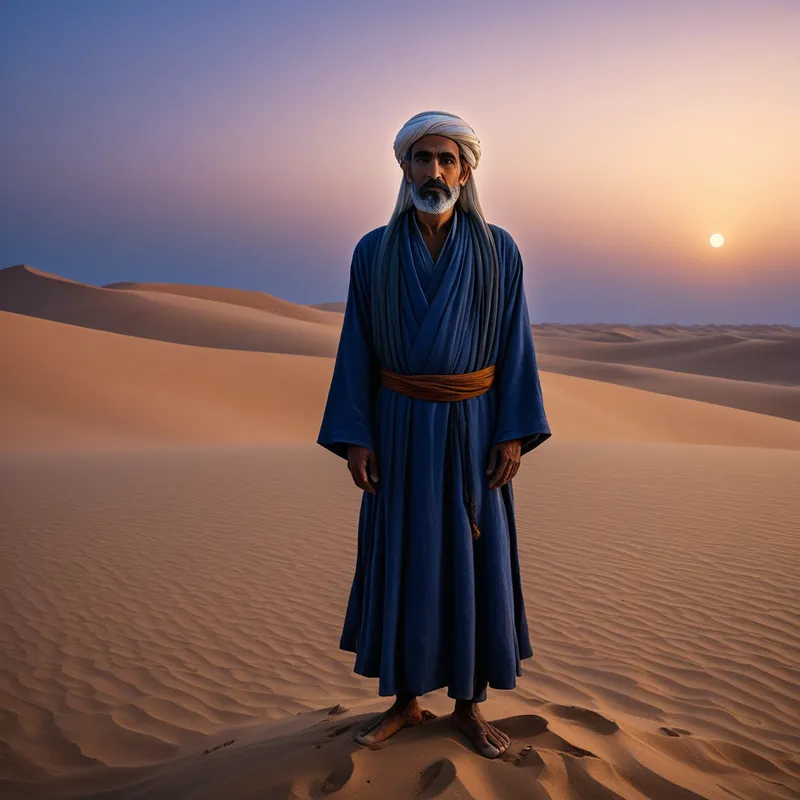
The Sufi Master Niffari Myth Meaning & Symbolism
A mystic's journey into the desert of the soul, where the only revelation is a silence that shatters the self to reveal the divine.
The Tale of The Sufi Master Niffari
Listen, and let the sands of time whisper a tale not of conquest, but of surrender. In an age when the world was loud with the clamor of scholars and the pride of saints, there walked a seeker named Niffari. His thirst was not for knowledge from scrolls, but for a draught from the Wellspring of Reality itself. He had studied under masters, recited until his tongue was weary, and prayed until his knees knew the shape of stone. Yet, a hollow echo remained in the chamber of his heart.
Driven by this divine discontent, he turned his back on the city of men and walked into the embrace of the desert—the great Faqr. The sun was a hammer of brass; the wind, a sculptor of dunes. He walked until his sandals frayed, until his water-skin hung light as a dried gourd, until his mind, stripped of its familiar landmarks, began to chatter and then to scream into the void. He cried out to the Beloved, not with polished prayers, but with the raw, ragged voice of his need: “Show me! Reveal yourself! Grant me a sign!”
The desert answered with silence. A silence so vast it had weight. A silence that was not an absence of sound, but the presence of something immense and listening.
Days bled into nights. His body became a skeleton draped in dust. His pleas turned to whispers, then to thoughts, and then… they stopped. In that absolute exhaustion, when the last notion of “I” as a seeker, a mystic, a man, had crumbled like a mud wall in the rain, it happened. It was not a vision of light. It was not a voice of thunder.
It was a Mukhāṭabah, a discourse from the Silence itself. The revelation did not come from the sky, but arose within the ruins of his own being. “You sought me in the forms of your longing,” the Silence said, without saying. “But I am not in your seeking. I am the ground upon which your seeking stands and falls. You called to me as a separate self. But where is that self now?”
In that moment, Niffari did not see God; he was seen. He did not find truth; he was unmade by it. The desert, the sky, his own breath—all distinctions melted. The seeker vanished into the Sought. He did not attain enlightenment; he was annihilated in it. What remained was not Niffari the man, but a clear mirror reflecting only the One. He had journeyed to the end of the world only to discover the journey was an illusion, and the destination had been his very starting point—now truly seen for the first time. He rose, not with an answer, but as an embodiment of the question’s end. The wind carried his empty robe, but the Master was gone, having finally arrived.

Cultural Origins & Context
The figure of Muhammad ibn ‘Abd al-Jabbar an-Niffari was a historical mystic of the 10th century CE, likely from the region of Niffar in Iraq. Unlike the more systematic theologians of his time, Niffari’s legacy is his two profound, cryptic texts: Al-Mawāqif and Al-Mukhāṭabāt. These are not doctrinal treatises but ecstatic records of his direct experiences, his “standings” before the Divine Presence.
The mythic tale of his desert journey is the oral and interpretive vessel built around these dense, poetic writings. It was passed down within ṭarīqahs, not as a historical biography, but as a teaching story—a map of the most extreme frontier of the Sufi path: Fanā. Its societal function was radical. In a culture valuing religious knowledge and law, the myth of Niffari served as a necessary corrective, a shocking reminder that all concepts of God are idols, and that true knowledge comes only through the utter dissolution of the knower.
Symbolic Architecture
The myth is a masterful depiction of the psyche’s [journey](/symbols/journey “Symbol: A journey in dreams typically signifies adventure, growth, or a significant life transition.”/) beyond itself. The Desert is the Barzakh—the liminal [space](/symbols/space “Symbol: Dreaming of ‘Space’ often symbolizes the vastness of potential, personal freedom, or feelings of isolation and exploration in one’s life.”/) where all egoic supports ([knowledge](/symbols/knowledge “Symbol: Knowledge symbolizes learning, understanding, and wisdom, embodying the acquisition of information and enlightenment.”/), [identity](/symbols/identity “Symbol: Identity represents the sense of self, encompassing personal beliefs, cultural background, and social roles.”/), [ritual](/symbols/ritual “Symbol: Rituals signify structured, meaningful actions carried out regularly, reflecting cultural beliefs and emotional needs.”/)) are stripped away. It is the alchemical nigredo. The Cries for a Sign represent the ego’s final, futile attempts to grasp the divine on its own terms, to fit the infinite into a finite form.
The ultimate revelation is that the revelation itself must be annihilated. The final veil is the belief that you are the one who lifts veils.
The pivotal [moment](/symbols/moment “Symbol: The symbol of a ‘moment’ embodies the significance of transient experiences that encapsulate emotional depth or pivotal transformations in life.”/) is not an acquisition but a subtraction. The Mukhāṭabah occurs only in the vacuum left by the exhausted self. Here, the Mirror of the [heart](/symbols/heart “Symbol: The heart symbolizes love, emotion, and the core of one’s existence, representing deep connections with others and self.”/), once clouded by the [breath](/symbols/breath “Symbol: Breath symbolizes life, vitality, and the connection between the physical and spiritual realms.”/) of “I” and “me,” is wiped clean. The Nafs is not perfected; it is seen through. The myth posits that al-Ḥaqq is not an object to be found, but the very subject of all finding.
The Dreamer’s Resonance
When this myth stirs in the modern Dream, it often manifests as dreams of profound isolation, of being lost in vast, empty spaces (airports, malls, deserts). The dreamer may search frantically for a Guide or a Door that never appears. There is a somatic quality of exhaustion, of a search that has hit a wall.
Psychologically, this signals the end of a paradigm. The ego’s strategies for meaning-making—through career, relationships, intellectual pursuits—have run dry. The dreamer is in the desert of Niffari, experiencing a spiritual or existential Dark Night. The longing is not for a new answer, but for the cessation of the exhausting question. The dream invites a surrender, not to failure, but to a deeper process: the allowing of the old, seeking self to die so that a more authentic consciousness, which was always present, can be revealed.

Alchemical Translation
For the modern individual, Niffari’s journey models the process of Individuation at its most profound level—the confrontation with the Self archetype. Our culture teaches us to build the ego-tower ever higher. Niffari’s path is one of deliberate deconstruction.
The first alchemical stage is Solutio: entering the desert (therapy, crisis, loss) where the solid structures of persona dissolve. The second is Coagulatio: the painful clinging and crying out, the ego’s last stand. The transformative third stage is Citrinitas: the exhaustion that leads to surrender. This is not passive defeat, but an active Tawakkul, a letting go into the unknown.
The alchemical gold is not a shiny new self. It is the realization that you are the crucible, the flame, and the transformation itself.
The final stage, Rubedo, is the “standing” (Wuqūf). It is living from the annihilated center. In modern terms, it is no longer identifying with your thoughts, emotions, or story, but abiding as the aware space in which they arise and pass. The struggle for self-improvement transmutes into a simple, abiding presence. The Journey ends where it began, but the traveler is forever changed because the illusion of being merely a traveler has been burned away.
Associated Symbols
Explore related symbols from the CaleaDream lexicon:
- Desert — The archetypal landscape of spiritual aridity and purification, where all egoic supports are stripped away to reveal the bare essence of the soul.
- Silence — Not an absence, but the profound presence of the divine reality that can only be heard when the mind’s chatter ceases.
- Mirror — The heart or consciousness that, when polished clean of the dust of self, perfectly reflects the divine essence without distortion.
- Journey — The soul’s movement away from the familiar and into the unknown, which ultimately reveals that the destination was the origin seen truly.
- Master — The annihilated self that remains after fanā; not a person who controls, but a presence that embodies the realized state.
- Water — The sought-after knowledge or divine grace that is ultimately found not as an external resource, but as the inherent nature of the ground of being.
- Door — The threshold between the world of seeking and the state of being; it opens not by force, but through the dissolution of the one who knocks.
- Fire — The transformative agony of the ego’s burning, the necessary suffering that consumes illusion to reveal what cannot be burned.
- Shadow — The entirety of the personal unconscious, including the ego itself, which must be fully encountered and integrated (annihilated as a separate entity) in the desert ordeal.
- Annihilation — The core process of the myth; the passing away of the limited self-identity into the boundless reality of the Divine.
- Vision — The ultimate mystical perception, which is not of a form or light, but of the formless ground of all seeing and being.
- Cup — The vessel of the heart or self, which must be emptied completely before it can be filled with the undrinkable wine of divine presence.