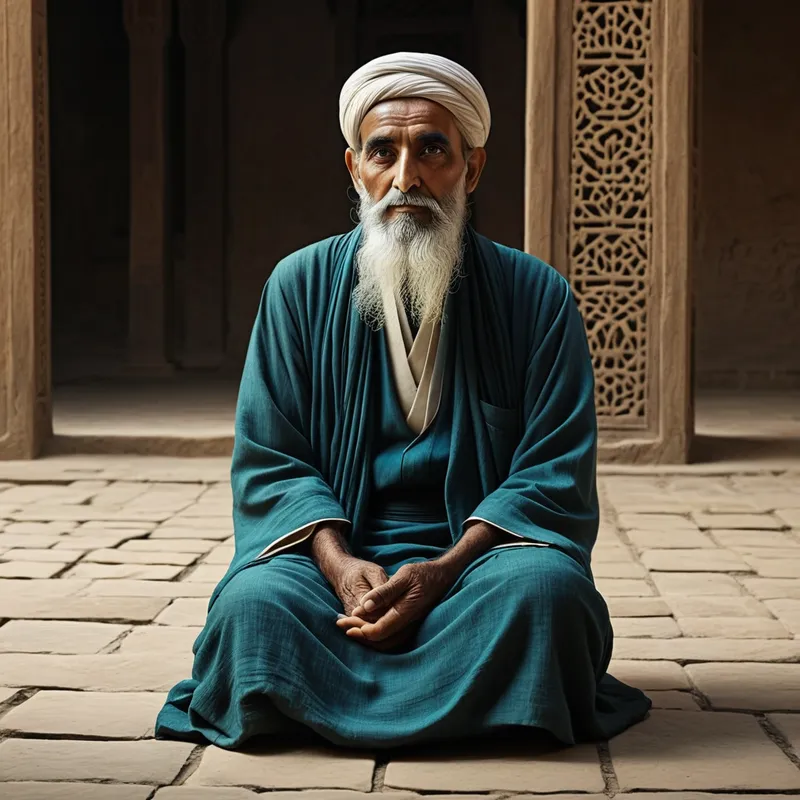
The Sufi Master and Student Myth Meaning & Symbolism
A student's quest for truth leads to a shocking lesson from his master, revealing that the divine is found not in seeking, but in the dissolution of the seeker.
The Tale of The Sufi Master and Student
Listen, and let the silence between the words speak.
There was once a student whose heart was a furnace of longing. He had traversed deserts of scripture and scaled mountains of philosophy, yet the Haqiqa remained a distant star, beautiful and cold. His soul thirsted, and he believed only one draught could quench it: the direct transmission from a true Murshid. After years of wandering, his search ended at a humble dwelling on the edge of a forgotten village.
The master was an old man who moved with the quiet certainty of a river finding its course. He wore poverty like a king wears a crown. The student, bursting with the zeal of his quest, poured out his heart. “Guide me to the Truth! Unveil the secret! Show me the path to Fana!”
The master listened, his eyes holding the patience of stone worn smooth by centuries. He said nothing for many days. The student, undeterred, served, cleaned, and meditated, waiting for the lightning bolt of wisdom.
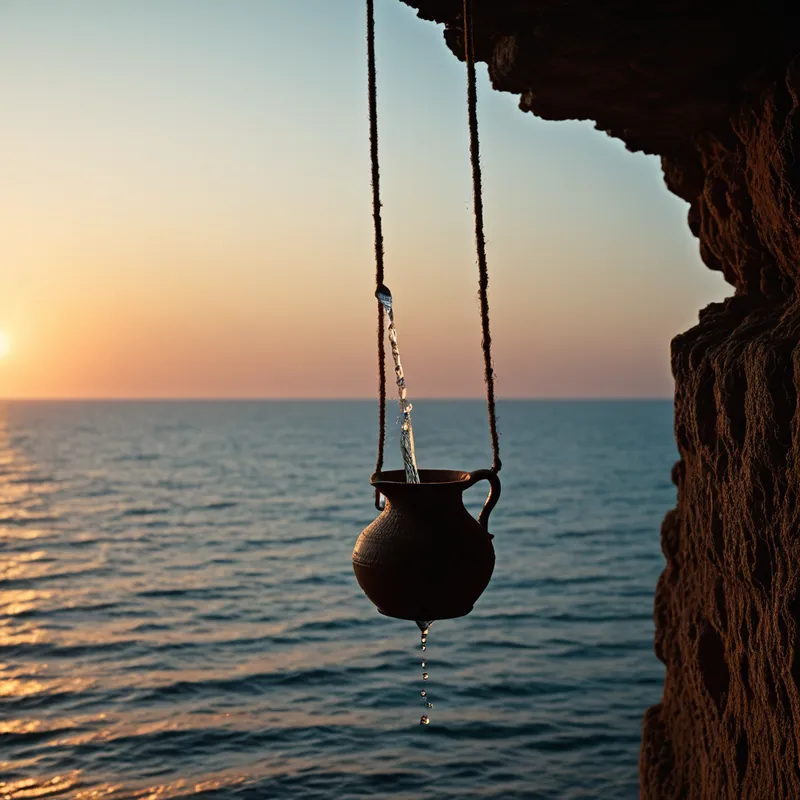
One evening, as the sun bled into the horizon, the master handed the student an old, empty clay jug. “Go to the well,” he instructed, his voice soft as dust. “Fill this and bring it to me.”
Eager to prove his devotion, the student rushed to the well, filled the jug to its brim, and hurried back. As he approached, the master simply said, “Empty it.” Puzzled, the student did so. “Again,” said the master. Fill. Empty. Fill. Empty. The cycle repeated for hours, then days. The student’s arms ached; confusion curdled into a silent, simmering frustration. Was this a test of obedience? A meaningless chore?
On the seventh day, as the student lowered the jug into the well’s dark mouth for the hundredth time, a wave of utter despair broke over him. His quest felt absurd, his efforts futile. In that moment of complete exhaustion, as he hauled the heavy, water-filled jug up, his grip slipped. The jug struck the stone rim of the well and shattered.
The sound was like the breaking of a world. Clay shards and water scattered at his feet. He stood there, empty-handed, breathless, staring at the wreckage of his labor. A profound stillness descended. He had nothing to bring, nothing to show, nothing to do.
It was then he heard the master’s voice behind him, softer than ever. “Good. Now, at last, you are ready. You came to me with a jug full of yourself—your knowledge, your seeking, your ‘I’. How could I fill what was already full? Only when the vessel is broken can the Ocean enter.”
The student looked down at the broken pieces, then at the master, and in that glance, he saw not an old man, but the reflection of the sky in a puddle on the ground. He did not find an answer. He dissolved into the question.
Cultural Origins & Context
This tale, in its myriad forms, is woven into the oral and written tapestry of Sufism. It is not a singular, canonical myth but a living teaching story, a hikayat, passed down through centuries within tariqas. It belongs to the tradition of adab, where behavior and submission are the first teachers. Told in khanaqahs (lodges) and whispered between teacher and disciple, its function was never mere entertainment. It was a surgical instrument, designed to puncture the disciple’s intellectual arrogance and prepare the heart for a reality beyond concepts.
The story operates within the core Sufi framework of fana and baqa. The master is not a god but a polished mirror, one who has undergone the breaking and can thus guide others to it. The story emphasizes that the path (tariqa) is not about accumulation, but subtraction; not about building up the self, but surrendering it.
Symbolic Architecture
The myth’s power lies in its stark, [alchemical symbols](/symbols/alchemical-symbols “Symbol: Alchemical symbols represent the transformative processes of purification and enlightenment, indicating a quest for inner change.”/). The [student](/symbols/student “Symbol: The student symbolizes learning, growth, and the pursuit of knowledge.”/) represents the conscious ego, the nafs al-ammara, which believes it can acquire divinity through [effort](/symbols/effort “Symbol: Effort signifies the physical, mental, and emotional energy invested toward achieving goals and personal growth.”/) and will. The master symbolizes the higher Self, the nafs al-mutma’inna, which exists in a state of surrendered unity.
The jug is the constructed self, the identity forged from memory, knowledge, and desire. It is designed to hold, to possess.
The [water](/symbols/water “Symbol: Water symbolizes the subconscious mind, emotions, and the flow of life, representing both cleansing and creation.”/) is the boundless divine [reality](/symbols/reality “Symbol: Reality signifies the state of existence and perception, often reflecting one’s understanding of truth and life experiences.”/) (al-Haqq), the essence of [life](/symbols/life “Symbol: The symbol of ‘Life’ represents a journey of growth, interconnectedness, and existential meaning, encompassing both the joys and challenges that define human experience.”/) and [consciousness](/symbols/consciousness “Symbol: Consciousness represents the state of awareness and perception, encompassing thoughts, feelings, and experiences.”/) that cannot be contained by any form. The well is the [depth](/symbols/depth “Symbol: Represents profound layers of consciousness, hidden truths, or the unknown aspects of existence, often symbolizing introspection and existential exploration.”/) of the unconscious, the [source](/symbols/source “Symbol: The origin point of something, often representing beginnings, nourishment, or the fundamental cause behind phenomena.”/). The relentless cycle of filling and emptying is the futile spiritual practice of the unawakened [seeker](/symbols/seeker “Symbol: A person actively searching for meaning, truth, or a higher purpose, often representing the dreamer’s own quest for identity or fulfillment.”/), who tries to “get” enlightenment without erasing the getter. The shattering is the critical [moment](/symbols/moment “Symbol: The symbol of a ‘moment’ embodies the significance of transient experiences that encapsulate emotional depth or pivotal transformations in life.”/) of qabd, the [contraction](/symbols/contraction “Symbol: A symbolic process of compression, reduction, or inward movement, often representing preparation, transition, or the tension between opposing forces.”/) that precedes [expansion](/symbols/expansion “Symbol: A symbol of growth, increase, or extension beyond current boundaries, often representing personal development, opportunity, or overwhelming change.”/). It is the [death](/symbols/death “Symbol: Symbolizes transformation, endings, and new beginnings; often associated with fear of the unknown.”/) of the [seeker](/symbols/seeker “Symbol: A person actively searching for meaning, truth, or a higher purpose, often representing the dreamer’s own quest for identity or fulfillment.”/), which is the [birth](/symbols/birth “Symbol: Birth symbolizes new beginnings, transformation, and the potential for growth and development.”/) of seeing.

The Dreamer’s Resonance
When this myth pattern stirs in modern dreams, it signals a profound psychological impasse. The dreamer may be tirelessly “filling jugs”—pursuing therapy modalities, spiritual practices, or self-help techniques—yet feeling an underlying emptiness, a sense of cyclical frustration. The dream landscape might feature repetitive, futile tasks, broken containers, or a wise but silent figure.
Somatically, this can feel like tension in the shoulders (carrying the burden), tightness in the jaw (holding on), or exhaustion. Psychologically, it is the process where the conscious attitude has reached its limit. The psyche is orchestrating a necessary breakdown of an outdated identity structure. The dream is not a warning, but an announcement: the ego’s project of self-improvement is ending. The soul is preparing for a rupture, a surrender where control is relinquished, and a deeper, more authentic Self can emerge from the wreckage.
Alchemical Translation
For the modern individual navigating individuation, this myth maps the transition from the ego-centric to the Self-centric psyche. We all begin as the student, constructing our jug—our persona, our achievements, our “spiritual resume.” Our initial forays into growth are about filling this jug: more knowledge, more healing, more experience.
The alchemical solve (dissolution) is not something you do. It is what happens when all your doing fails utterly.
The master’s command—“Empty it”—is the call of the Self to begin the nigredo, the dark night where all we’ve accumulated is seen as provisional. We resist, believing if we just fill the jug better, we will arrive. The breaking is the involuntary, often traumatic, moment when life itself shatters our most cherished self-concept: the healer is broken, the wise one is humiliated, the seeker loses the path.
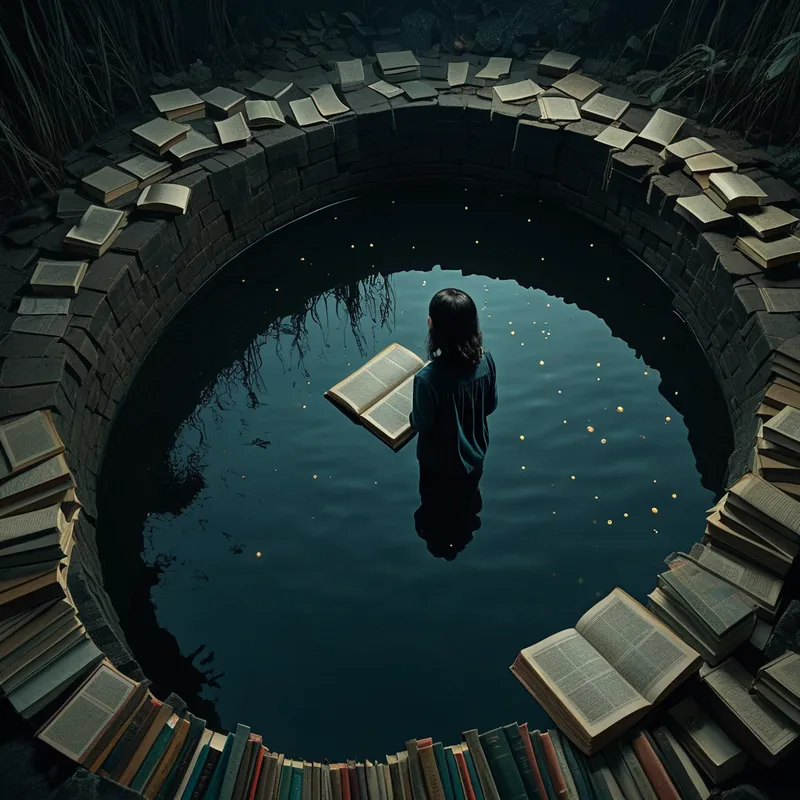
This is the alchemical mortificatio. It feels like failure, but it is the essential operation. Only when the illusion of a separate, seeking self (the jug) is broken can the unconscious (the ocean) flood the conscious field. The “master” is then recognized not as an external other, but as the inner archetype of wholeness that was always present, waiting for the noise of the seeker to cease. The goal is not to become the master, but to realize you were never not the ocean, momentarily dreaming it was a jug.
Associated Symbols
Explore related symbols from the CaleaDream lexicon:
- Water — The boundless, formless Divine Essence or the unconscious; that which the student’s jug tries and fails to contain, symbolizing the futility of possessing truth.
- Master — The archetype of the integrated Self or the guiding inner principle that orchestrates the breaking of the ego’s vessel to allow for true awakening.
- Student — The conscious ego or the seeking self, representing the initial stage of the journey where identity is rigid and focused on acquisition.
- Journey — The entire arc of the myth represents the spiritual journey, which is ultimately revealed to be an inward collapse of distance, not a linear traversal of space.
- Death — The shattering of the jug symbolizes the necessary death of the seeker-identity, a psychic death that precedes rebirth into a more authentic state of being.
- Ocean — The ultimate destination and source; the vast, unified reality into which the broken student dissolves, losing separateness.
- Vessel — The soul or the constructed self; its breaking is the critical moment of initiation, without which no true filling is possible.
- Shadow — The student’s frustration, pride, and intellectual certainty, which must be exhausted and brought to light through the master’s seemingly absurd task.
- Sacrifice — The voluntary and involuntary surrender of the ego’s plans, knowledge, and control, which is the only true offering on the path.
- Mirror — The master serves as a mirror, not to show the student who he is, but to reveal the illusion of who he thinks he is, until only the reflection of the divine remains.