
The Stranger/Visitor Myth Meaning & Symbolism
A mysterious figure arrives at the threshold, disrupting the ordinary world and demanding a choice that will change everything forever.
The Tale of The Stranger/Visitor
Listen, and let the fire’s crackle become the rustle of ancient leaves. Let the night outside become the deep, unmeasured dark from before the first hearth was lit. In a time when the world was closer to the bone, in a village where every face was known and every story told, the ordinary held its breath.
It began at the hinge of the day, that liminal hour when the sun bleeds into the horizon and shadows grow long and unfamiliar. The chores were done, the pots were set to simmer, and a comfortable weariness settled over the homes. Then, a sound. Not a bird, not a beast. The slow, deliberate crunch of a footfall on the path that led from the wild places. The dogs, who barked at squirrels and the wind, fell silent, their tails tucked, their eyes wide.
He appeared at the edge of the clearing—though to call it a “he” is to assume too much. It was a figure, wrapped in a cloak the color of dust and twilight. A wide-brimmed hat shadowed its face, and in its hand was a staff of gnarled wood, older than the oldest tree in the grove. It carried no pack, showed no sign of journey’s fatigue. It simply stood, a still point in the settling dusk, and waited.
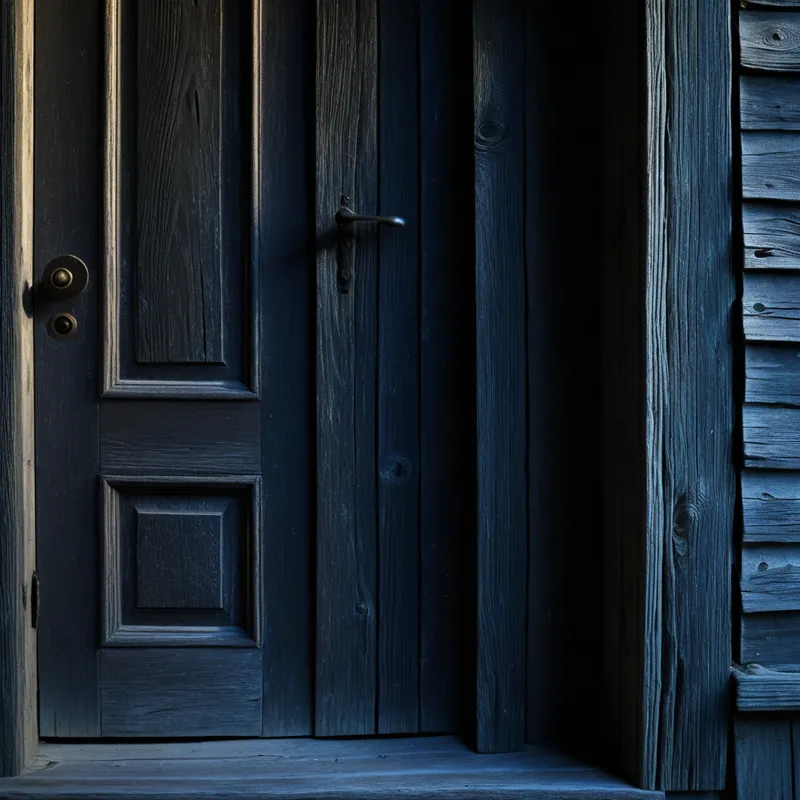
Doors, which had been open to the evening breeze, were quietly pulled shut. Bolts, rarely used, slid home with soft, final thuds. Eyes peered through cracks in shutters, hearts beating a frantic rhythm against ribs. The Stranger did not call out. It did not beg. It turned its hidden gaze upon each dwelling in turn, a silent question hanging in the air thicker than smoke.
In one house, at the village’s very heart, an old woman paused. Her hands, kneading dough for the morning bread, stilled. She listened to the fear whispering through the walls of her home, the fear of the unknown, the not-us. But she also heard something else—a deeper, older song. It was the song of the path itself, of hospitality that was not just custom but a sacred law between the world of the hearth and the world of the road.
While others hid, she moved. Her hand, wrinkled and strong, went to the bolt. It resisted, stiff with disuse. With a grunt, she pulled it back. The door creaked open on protesting hinges, spilling a rectangle of firelight and the smell of baking bread onto the path. There, framed in her light, stood the Visitor.
No words were exchanged. The figure stepped across her threshold, and the moment it did, the very air in the room changed. It grew charged, like before a storm. The fire flared, not with heat, but with a cool, silver light. The Stranger let the cloak fall. It revealed no monstrous visage, but a face of impossible age and profound peace, eyes that held galaxies of forgotten stars. It raised a hand, not in threat, but in blessing, and touched the loaf of bread on her table.
Where it touched, the simple bread transformed. It gleamed, not with gold, but with a nourishing light that spoke of harvests never failed and hunger never known. The Visitor then turned and, without a backward glance, walked out the way it came, melting into the forest night as silently as it had arrived. The woman stood at her open door, holding the luminous loaf, while behind the shuttered windows of her neighbors, a different kind of hunger—the hunger of regret—began to gnaw.
Cultural Origins & Context
The myth of the Stranger at the Threshold is not the property of a single culture, but a human universal, etched into our collective story-memory. We find it in the Philemon and Baucis story of Ovid, where Zeus and Hermes, disguised as beggars, reward an impoverished elderly couple for their kindness while drowning their selfish neighbors. It echoes in the Abrahamic tradition of hosting angels unawares. It resonates in countless Native American tales, Celtic fables of the Faery Folk testing household virtue, and in the strict codes of Xenia in ancient Greece.
This story was not mere entertainment. It was a vital social and spiritual technology, told by elders at communal gatherings, by parents at the hearthside. Its function was threefold: to codify the sacred duty of hospitality as a bulwark against chaos, to warn against the spiritual poverty of xenophobia and closed-heartedness, and to remind people that the divine, or fate, or profound insight, rarely announces itself with fanfare. It comes disguised, asking not for worship, but for a simple, human gesture: a shared meal, a cup of water, an open door.
Symbolic Architecture
Psychologically, the Stranger is the embodied Self approaching the conscious ego, which is represented by the village or the individual home. The village, with its known paths and familiar faces, is the realm of the persona—the adapted, social self that fears disruption.
The Visitor is the ultimate symbol of the unexpected insight, the disruptive grace, the call from the depths that arrives precisely when we feel most secure in our own small world.
The closed doors symbolize resistance, the ego’s defense mechanisms that seek to preserve the status quo by rejecting anything unfamiliar. The old woman who opens her door represents the courageous function of consciousness—the ego’s capacity, however frail, to entertain the unknown, to suspend judgment, and to make room for what the psyche urgently needs to deliver.
The transformed bread is the symbol of the reward. It is not material wealth, but psychic nourishment. It is the new perspective, the healed complex, the creative inspiration, or the profound peace that comes only when we have had the courage to host the disconcerting parts of our own soul. The neighbors who hid are the parts of ourselves that remain in shadow, clinging to old patterns and starving in their self-made prisons.
The Dreamer’s Resonance
When this myth stirs in the modern dreamscape, it often manifests as dreams of an unknown figure at the door of one’s house (the psyche), an unexpected guest at a party (the social self), or a mysterious passenger in one’s car (the journey of life). The somatic feeling is key: a palpable tension, a thrill of anxiety mixed with curiosity. The dream-ego is faced with a primal choice: to bolt the door or to turn the handle.
This dream pattern signals a critical moment of shadow-work. The Stranger is frequently a personification of a repressed quality, a forgotten talent, a denied trauma, or a nascent wisdom that is seeking entry into conscious life. The act of opening the door in the dream, despite fear, is a profound somatic rehearsal for psychological integration. The refusal to open it often coincides with feelings of stagnation, creative block, or a pervasive sense of meaninglessness in waking life—the psychic hunger of those who hid.

Alchemical Translation
The alchemical process mirrored here is the Nigredo, the blackening. The comfortable village is the prima materia—the leaden, unconscious state of ordinary life. The arrival of the Stranger is the introduction of the transformative agent, the Lapis, which first appears as a disturbing, dark, and foreign element.
The entire myth is an allegory for the ordeal of the threshold, where the base metal of a narrow consciousness is tested by the mercurial spirit of the unknown. The transformation occurs not in the wilds, but in the heart of the familiar, catalyzed by a single act of courageous reception.
The old woman’s house becomes the alchemical vessel. Her act of hospitality is the gentle heat of attention applied to the troubling content. The confrontation between the known (the home) and the unknown (the Stranger) within this sealed space creates the necessary tension for transmutation. The resulting “bread of light” is the Rubedo, the reddening—the creation of the philosophical gold, which is integrated consciousness. For the modern individual, the myth maps the path of individuation: security is disrupted (Stranger arrives), a moral-psychological choice is presented (open or close the door), and through the courageous integration of the “other” (hosting the Stranger), the psyche is fundamentally nourished and enlarged (transformed bread). We do not conquer the mystery; we invite it in for supper, and in doing so, we are the ones who are remade.
Associated Symbols
Explore related symbols from the CaleaDream lexicon: