
The Stranger at Emmaus Myth Meaning & Symbolism
Two grieving disciples walk home after a tragedy. A stranger joins them, explains ancient mysteries, and is revealed in the breaking of bread.
The Tale of The Stranger at Emmaus
The world had broken. The sky, which had turned to iron and wept blood three days prior, was now a hollow, indifferent blue. The air in Jerusalem was thick with the scent of fear, grief, and the bitter residue of crushed hope. Two men, Cleopas</ab” title=“One of the twelve disciples, also called Levi”>Cleopas and his companion, their shoulders slumped under an invisible weight, turned their backs on the city of tombs. Their feet found the familiar, dusty road to Emmaus, but their hearts were lost in a labyrinth of despair. They spoke in low, broken tones, replaying the horror: the betrayal, the trial, the nails, the final cry. Their teacher, their sun, was extinguished.
As they walked, arguing over rumors of an empty tomb and visions of angels—empty words to their shattered faith—a third presence joined them. A Stranger fell into step. He asked what they were discussing, and his voice was like a cool wind in the desert heat. They stopped, their faces etched with a sorrow so profound it was almost a physical mark. “Are you the only visitor to Jerusalem who does not know the things that have happened there in these days?” Cleopas asked, his voice cracking.
The Stranger listened, a silent vessel for their pain. Then, he began to speak. “Was it not necessary that the Messiah should suffer these things and then enter into his glory?” Starting with Moses and winding through all the Prophets, he interpreted the ancient scriptures. His words were not dry scholarship; they were a key turning in a long-locked door. A strange fire began to kindle in their chests. The road beneath their feet, the cypress trees, the very stones seemed to hum with a hidden meaning as he spoke. The story of their people—the exile, the suffering, the hope—was being rewritten before their ears, not as a tale of defeat, but as a divine pattern leading to this very moment of despair.
The sun bled into the horizon, painting the world in hues of violet and gold. As they approached Emmaus, the Stranger made as if to continue his journey into the gathering dark. But the two men, compelled by the unfamiliar warmth in their hearts, urged him strongly: “Stay with us, for it is nearly evening; the day is almost over.” He agreed.
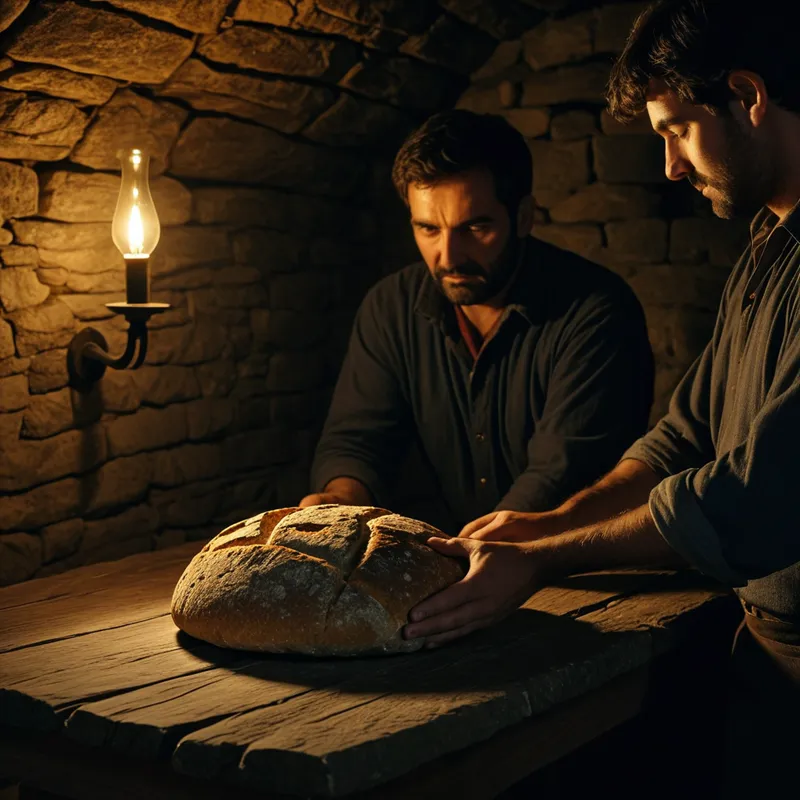
Inside the simple house, in the intimate circle of firelight and shadow, they reclined at table. The Stranger took the bread, gave thanks, broke it, and began to give it to them.
In that moment—the crisp sound of the crust fracturing, the offering of the pieces—the scales fell from their eyes. A shock of recognition, pure and electric, coursed through them. The familiar gesture, the sacred geometry of brokenness and sharing, was the final cipher. They knew him. And in that knowing, he vanished from their sight, leaving only the broken bread and the echoing silence of revelation.
They said to each other, their voices trembling with awe, “Were not our hearts burning within us while he talked with us on the road and opened the Scriptures to us?” They rose immediately, the fatigue of their seven-mile journey forgotten, and rushed back through the night to Jerusalem, not as mourners, but as messengers. The world had been remade not in the spectacular, but in the simple. The road was now a sanctuary; the stranger, the most familiar presence of all.
Cultural Origins & Context
This narrative is found within the Gospel of Luke, a text composed in the latter half of the first century CE. It emerges from the fertile, tumultuous soil of early Christian communities who were grappling with a profound cognitive dissonance: how could the promised Messiah have suffered the shameful, criminal death of crucifixion? The story functions as a masterful piece of pastoral and pedagogical literature.
It was a story told among communities for whom “the breaking of bread” was the central ritual act of fellowship and remembrance. The narrative served multiple vital functions: it provided a model for interpreting Hebrew scripture through the lens of the crucifixion and resurrection (a practice called typology); it validated the experience of doubt and slow-burning revelation over instantaneous, easy faith; and most importantly, it located the presence of the risen Christ not in a distant heaven, but on the common road and at the ordinary table. It democratized epiphany, suggesting that divine recognition happens in community, through teaching, and in the shared necessities of life.
Symbolic Architecture
At its core, the myth is a profound exploration of recognition through rupture. The Stranger represents the hidden aspect of the Self, the Self archetype, which walks alongside the conscious ego (the two disciples) in its hour of deepest despair and intellectual confusion. The ego is fixated on a literal, historical tragedy—the death of its hope. The Self, unrecognized, engages it not with a miraculous display, but through interpretation.
The road is the psyche in motion, and the stranger is the wisdom that meets us precisely where we are, disguised in our own grief.
The journey symbolizes the necessary process of working through (the via dolorosa of the psyche). The burning heart is the somatic signal of truth resonating at a level deeper than intellect—the feeling function awakening. The critical act, however, is the breaking of bread. Bread symbolizes sustenance, community, and the substance of life itself. To break it is to perform an act of vulnerability, sharing, and fragmentation. It is in the willing fragmentation of the whole (the loaf, the old understanding) that the hidden wholeness (the recognized Christ, the integrated Self) is revealed. He is known not in his intact, triumphal form, but in the gesture that signifies nourishment, sacrifice, and communion.

The Dreamer’s Resonance
When this mythic pattern stirs in the modern dreamer, it often manifests as a dream of a meaningful yet unrecognized companion on a journey—a guide whose face is obscured, a voice on a phone offering crucial advice from an unknown number, a fellow traveler in a train carriage who speaks unsettling truths. The somatic sensation of a “burning heart” may translate as a powerful, inexplicable feeling of significance or poignant longing upon waking.
Psychologically, this dream pattern signals that the dreamer is in a state of grief or disillusionment, having experienced the “death” of a cherished ideal, relationship, or self-image. The conscious mind is stuck in the narrative of loss. The dream introduces the healing, integrative function of the unconscious (the Stranger) which is already at work, re-contextualizing the dreamer’s personal history (“the scriptures”) to reveal a hidden pattern of meaning and growth. The dream is an invitation to “stay with” the discomfort, to invite the unknown aspect in for deeper communion, and to pay attention to the simple, repetitive gestures of daily life where revelation may crack open.

Alchemical Translation
The alchemical process mirrored here is the nigredo transforming into the albedo, not through a sudden blast of light, but through the slow, patient heat of conversation and the catalytic act of breaking.
The individuation journey begins with the mortificatio—the crushing of the ego’s central hope (the crucifixion). The disciples represent the psyche in this black, sunless state. The Stranger’s scriptural interpretation is the solutio, a dissolving of rigid, literal understandings in the solvent of a broader, symbolic narrative. This is the work of therapy, reflection, and art: re-telling our personal myth until it reveals its purpose.
The ultimate transmutation occurs not when the gold is found, but when the lead of our grief is recognized as the necessary vessel for a more profound presence.
The pressing invitation (“Stay with us…”) is the crucial, voluntary engagement with the unconscious. The final, transformative revelation occurs in the coniunctio, the sacred marriage, symbolized by the shared meal. The breaking of the bread is the separatio and coagulatio simultaneously—the old form is shattered so that a new, nourishing wholeness can be distributed and integrated. For the modern individual, this translates to the moment when, in the midst of our daily routines—making tea, speaking with a friend, performing our work—a gesture suddenly becomes transparent, and we recognize the sacred pattern weaving through our own ordinary life. The goal is not for the Stranger to stay, but for our eyes to be opened, so we may see that he was, is, and always will be, walking the road with us.
Associated Symbols
Explore related symbols from the CaleaDream lexicon: