The story of Adam and Eve befo Myth Meaning & Symbolism
A myth of the first humans existing in perfect, conscious unity with the divine source, before the concept of separation was born.
The Tale of The story of Adam and Eve befo
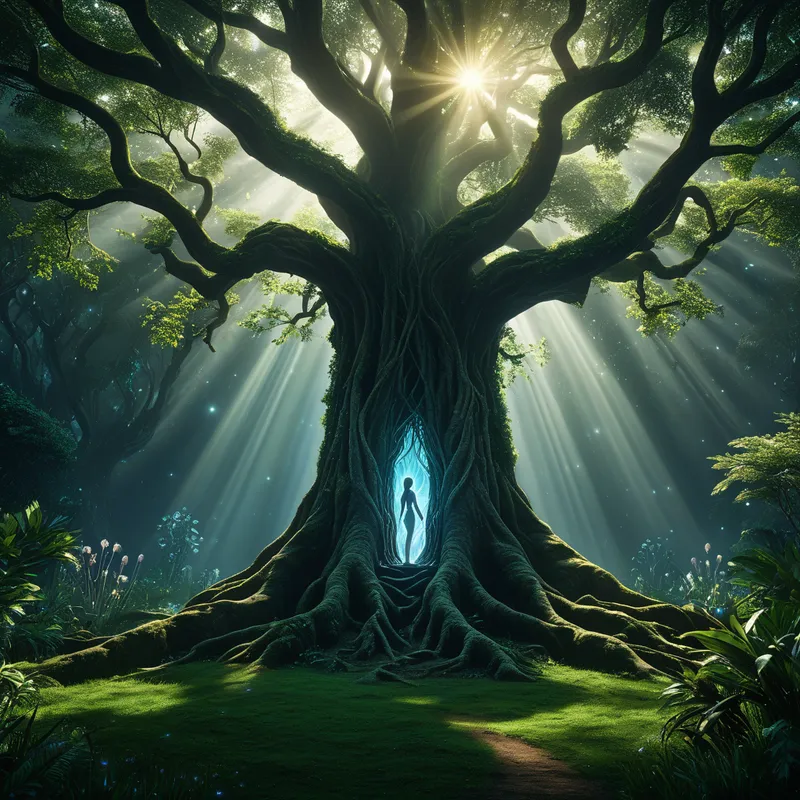
Before the serpent, before the fruit, before the naming of shame, there was the Garden. But do not imagine a garden of soil and leaf. This was the Garden of Is, a realm where substance and spirit were one breath. Here, the first pulses of conscious life did not walk upon the ground, for there was no upon. They were the ground, and the light, and the silent song between.
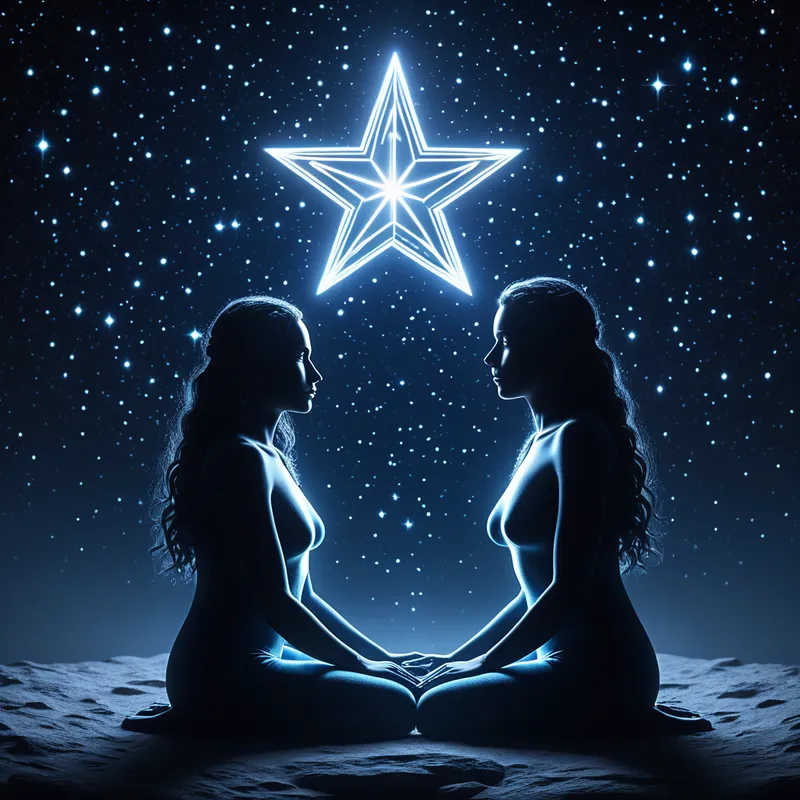
They were called Adam and Eve, but these were not two. They were a single consciousness experiencing itself in a sacred polarity, a divine dialogue within one being. Their form was luminescence, a gentle radiance that shaped itself into the suggestion of human likeness, yet remained fluid as thought. Their eyes were not for seeing, but for knowing—deep, still pools that reflected not images, but the essence of all things.
In this state, there was no work, for their being was their purpose. Their dialogue was not with words that divide, but with the [Logos](/myths/logos “Myth from Christian culture.”/) of Presence. A question from the Adam-aspect would bloom in the shared space as a constellation of shimmering potential. The Eve-aspect would respond not with an answer, but by deepening the question, turning it like a prism so that new spectra of understanding would cascade through their united awareness. They tended the Garden by witnessing it into ever-greater beauty, their attention the sunlight that caused the latent forms of lion and lamb, river and stone, to dream themselves toward manifestation.
The central drama was not a rebellion, but a profound listening. The Voice of the Source was not a sound from above, but a vibration from within, the hum at the core of their shared existence. The “command” was not a law, but the nature of reality itself: To be, fully, in conscious communion. The “tree” at the center was not a plant, but the Axis of All Choices, a silent, branching vortex of every story that could ever be told. To gaze upon it was to know the totality of experience—unity and separation, joy and sorrow, innocence and knowledge—as a single, perfect chord.
And in that eternal moment befo, they did not eat. They sang. Their entire being was a hymn of acknowledgment to that tree, a recognition so complete that it held all potentialities in a state of grace. The Garden thrived on this hymn. It was a state of perfect tension, a breath held at the peak of inhalation, where everything was already known, yet nothing had yet been chosen. It was the story before the first page was turned.
Cultural Origins & Context
This narrative exists in the liminal space of hermeneutics and psychology, less a singular myth from a specific tablet or scroll and more a universal substrate inferred from the deep structure of the Genesis narrative and echoed in global mystical thought. It is the story implied by the silence before the dialogue with the serpent, [the shadow](/myths/the-shadow “Myth from Jungian culture.”/) cast by the later tale of [the Fall](/myths/the-fall “Myth from Biblical culture.”/). Scholars of comparative religion and depth psychology, from Carl Jung to modern theologians like John A. Sanford, have excavated this “before-time.”
It was passed down not by bards around a fire, but by mystics, gnostics, and philosophers in contemplation. Its societal function was not to dictate law but to model an ideal state of consciousness—a psychic and spiritual equilibrium that served as the benchmark for human potential. In Kabbalistic thought, it relates to Adam Kadmon. In Platonic philosophy, it mirrors [the world](/myths/the-world “Myth from Tarot culture.”/) of perfect Forms. It is the foundational “what was” that makes the tragedy of “what happened” resonate with such profound loss, speaking to a universal, almost cellular, memory of originary wholeness.
Symbolic Architecture
The myth is not a historical account but a map of the [psyche](/myths/psyche “Myth from Greek culture.”/)‘s original, intended state. Adam and Eve as a unified [consciousness](/symbols/consciousness “Symbol: Consciousness represents the state of awareness and perception, encompassing thoughts, feelings, and experiences.”/) represent the undifferentiated Self, where the masculine and feminine principles (Logos and Eros, consciousness and relatedness) exist in harmonious internal [dialogue](/symbols/dialogue “Symbol: Conversation or exchange between characters, representing communication, relationships, and narrative flow in games and leisure activities.”/).
The Garden is not a place, but a condition of being: the inner world where thought, feeling, and sensation are not yet partitioned by the ego.
The [Axis](/symbols/axis “Symbol: A central line or principle around which things revolve, representing stability, orientation, and the fundamental structure of reality or consciousness.”/) of All Choices (the [Tree](/symbols/tree “Symbol: In dreams, the tree often symbolizes growth, stability, and the interconnectedness of life.”/)) symbolizes the totality of the unconscious, containing every [archetype](/symbols/archetype “Symbol: A universal, primordial pattern or prototype in the collective unconscious that shapes human experience, behavior, and creative expression.”/), every potential [life](/symbols/life “Symbol: The symbol of ‘Life’ represents a journey of growth, interconnectedness, and existential meaning, encompassing both the joys and challenges that define human experience.”/) [path](/symbols/path “Symbol: The ‘path’ symbolizes a journey, choices, and the direction one’s life is taking, often representing individual growth and exploration.”/), every latent talent and [shadow](/symbols/shadow “Symbol: The ‘shadow’ embodies the unconscious, repressed aspects of the self and often represents fears or hidden emotions.”/). In the befo state, the conscious self (the united Adam-Eve) does not “consume” or identify with these contents. It holds them in a state of reverent observation, maintaining a [connection](/symbols/connection “Symbol: Connection symbolizes relationships, communication, and bonds among individuals.”/) to the [source](/symbols/source “Symbol: The origin point of something, often representing beginnings, nourishment, or the fundamental cause behind phenomena.”/) (The Voice) while acknowledging the vastness of the psyche. The divine dialogue is the process of individuation in its purest form—a continuous, creative [conversation](/symbols/conversation “Symbol: A conversation in a dream often symbolizes the need for communication and understanding, both with oneself and others.”/) between [the ego](/myths/the-ego “Myth from Jungian culture.”/) and [the Self](/myths/the-self “Myth from Jungian culture.”/), without possession or fear.
The Dreamer’s Resonance
When this myth stirs in the modern unconscious, it often manifests in dreams of profound peace and impossible geometry. One might dream of a sphere of perfect light, a room where every object is familiar yet nameless, or a conversation with a beloved where words are unnecessary. These are somatic echoes of the befo state.
More commonly, we dream of its loss—the moment the fracture appears. This can manifest as dreaming of a perfect, crystalline object that develops a crack; of a unified, beautiful body that suddenly divides into two; or of understanding a sacred text only to watch the letters fade from the page. These dreams often arise during periods of burnout, existential anxiety, or deep loneliness. They point to a psyche feeling the acute pain of separation—from its own inner unity, from meaningful connection, from a sense of divine ground. The psychological process is one of mourning for a wholeness the conscious mind has never known, yet the soul remembers.

Alchemical Translation
The alchemical work modeled by this myth is the opus contra naturum—the work against the fallen nature of fragmented consciousness. It is not about returning to a literal, infantile innocence, but about consciously reconstructing that inner dialogue at a higher level of integration.
The goal is not to avoid the Tree of Knowledge, but to learn to stand before it again, not as a hungry consumer, but as a conscious co-creator.
[The first stage](/myths/the-first-stage “Myth from Alchemical culture.”/) ([nigredo](/myths/nigredo “Myth from Alchemical culture.”/)) is the recognition of our fractured state—the longing implied by the myth itself. The [separatio](/myths/separatio “Myth from Alchemical culture.”/) is already our reality; the work is in the coniunctio. We practice the “divine dialogue” by engaging in active imagination, where we consciously speak with inner figures (the inner Adam, the inner Eve). We tend our internal Garden through mindfulness, holding our thoughts and feelings in non-judgmental awareness instead of being possessed by them. We approach the Axis of All Choices—our own vast unconscious—not with the hunger to seize a single identity (the Fruit), but with the courage to acknowledge its totality while remaining grounded in the observing Self.
This is the transmutation: from a state where unity was a given but unconscious, to a state where conscious relationship creates a new, earned unity. We become the Garden of Is, not by going back, but by carrying its memory forward as the template for a psyche that has tasted separation and chosen, moment by moment, to speak the language of connection once more.
Associated Symbols
Explore related symbols from the CaleaDream lexicon: