The Stone Forest Myth Meaning & Symbolism
A myth of a great hunter who sacrifices his life to become a guardian forest of stone, teaching the balance between humanity and the sacred earth.
The Tale of The Stone Forest
Listen. [The wind](/myths/the-wind “Myth from Various culture.”/) that sighs through the canyons is not just wind. It is the breath of the stone, and it carries an old story.
In the time when [the world](/myths/the-world “Myth from Tarot culture.”/) was still soft, when the rivers were young and the mountains were still dreaming of their height, there lived a people who knew the language of the deer and the song of the corn. Among them was a hunter named Ahanu. His arrows flew true, but his heart was truer. He took only what was given, gave thanks for every life, and left offerings of tobacco and song. He was beloved by Wakan Tanka and respected by the animal spirits.
But a great dryness came. The rains forgot the land. The rivers shrank to silver threads. The grass turned to dust, and the buffalo grew thin and distant. The people grew weak, their prayers seeming to fall like stones into a silent sky. The elders fasted and danced, but [the sky](/myths/the-sky “Myth from Persian culture.”/) remained a hard, blue bowl.
One night, in a vision-dream, the spirit of the land came to Ahanu. It was not a man or a beast, but a voice like grinding rock and rustling leaves. “The heart of the world is parched,” it whispered. “The balance is broken. The [water](/myths/water “Myth from Chinese culture.”/) has retreated deep into the bones of [the earth](/myths/the-earth “Myth from Hindu culture.”/), and it will not return until a heart as steadfast as the mountain and as giving as the spring offers itself as a bridge.”
Ahanu awoke with the dawn’s cold light in his soul. He knew his path. He told no one, but took his pipe and walked away from the camp, toward the highest, driest plateau where nothing grew but thirst.
For four days and nights he walked, his own thirst a fire in his throat. On the fourth day, he reached the center of the barren plain. He built a small altar of the few stones he could find, lit his sacred pipe, and sent his prayer upward on the smoke. “[Great Spirit](/myths/great-spirit “Myth from Native American culture.”/),” he said, his voice cracking. “Let my life be [the vessel](/myths/the-vessel “Myth from Alchemical culture.”/). Let my body be the vessel for the water to return. Let me hold the space for life, forever.”
He laid down upon the dry earth, arms outstretched. The sun beat down. As his spirit began to loosen from his flesh, he felt not pain, but a profound rooting. His fingers dug into the soil, not by his will, but by the earth’s pull. A deep rumble rose from below. From his fingertips, a gray hardness spread. It traveled up his arms, down his legs, through his chest. He felt his body becoming dense, heavy, eternal. His last sight was of the sky, and his last breath did not vanish but sank into the ground.
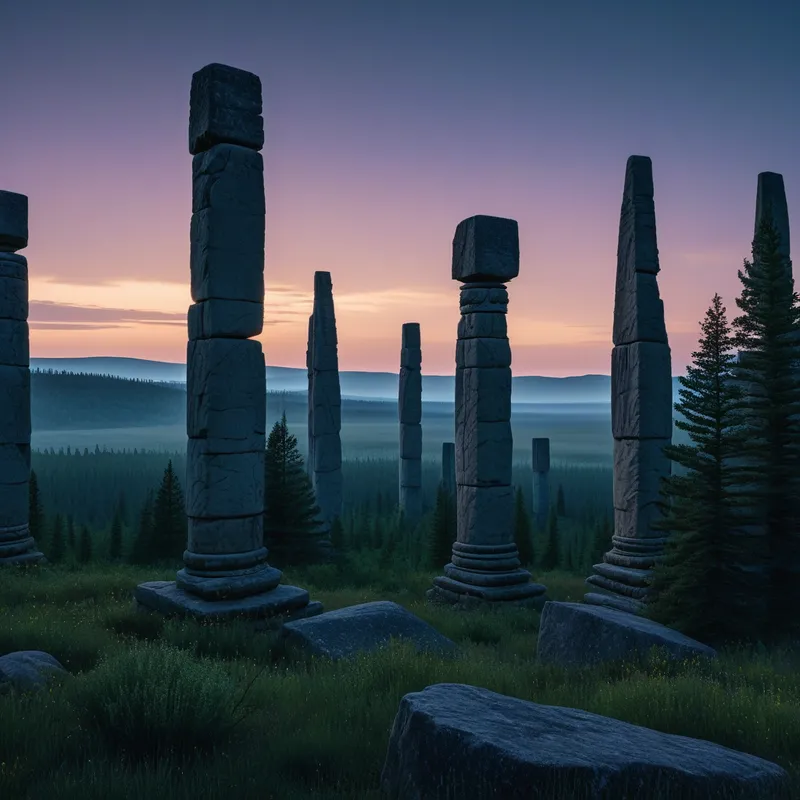
Where Ahanu lay, the earth trembled and cracked. Not in destruction, but in creation. From his body, a forest began to grow—but not of wood and leaf. Great pillars of living stone pushed skyward, groaning with the sound of continents dreaming. They formed trunks, branches, arches, and canyons. And from within this newborn forest of stone, from a thousand crevices and hidden basins, clear, cold water began to seep. It trickled, then streamed, then flowed out in rivulets down from the plateau, a life-giving web of silver returning to the world.
The people, following the new streams, found the Stone Forest. They felt the profound peace there, the silent, watchful presence. They understood. Ahanu had not died. He had transformed. He had become the guardian, the steadfast heart, the eternal bridge between the deep water of the earth and the thirsting life upon it. The wind through the stone pillars was his enduring breath, a constant, whispering reminder of the ultimate gift.
Cultural Origins & Context
The story of the Stone Forest belongs to the rich oral traditions of several Plains and Southwestern tribes, including the Lakota, Navajo (Diné), and Pueblo peoples. It is a classic etiological myth, explaining the creation of specific, awe-inspiring geological formations—often pointed to as real places like the Badlands, Monument Valley, or certain petrified forests. These landscapes, stark and majestic, naturally inspired narratives of profound transformation.
The myth was not mere entertainment; it was a foundational teaching. Told by elders and storytellers around winter fires or during communal gatherings, it served key societal functions. It encoded the ethic of sacrifice for the community, the sacred responsibility of stewardship, and the concept of reciprocal relationship with the land. The land was not a passive resource but a living, responsive relative. Ahanu’s transformation modeled the ideal: humans are not separate from nature but can become a permanent, nurturing part of its architecture. The story also functioned as a spiritual map, imbuing specific, formidable locations with meaning, making them not just landmarks but temples of remembrance.
Symbolic Architecture
At its core, the [Stone](/symbols/stone “Symbol: In dreams, a stone often symbolizes strength, stability, and permanence, but it may also represent emotional burdens or obstacles that need to be acknowledged and processed.”/) [Forest](/symbols/forest “Symbol: The forest symbolizes a complex domain of the unconscious mind, representing both mystery and potential for personal growth.”/) myth is a powerful [allegory](/symbols/allegory “Symbol: A narrative device where characters, events, or settings represent abstract ideas or moral qualities, conveying deeper meanings through symbolic storytelling.”/) of the ultimate act of nurturing—the sacrifice of the individual self for the eternal sustenance of the whole.
The most profound caregiving is not an action done, but a state of being become.
Ahanu, the archetypal [caregiver](/symbols/caregiver “Symbol: A spiritual or mythical figure representing nurturing, protection, and unconditional support, often embodying divine or archetypal parental energy.”/), represents the conscious ego that chooses to surrender its temporal form for a transpersonal [purpose](/symbols/purpose “Symbol: Purpose signifies direction, meaning, and intention in life, often reflecting personal ambitions and core values.”/). His hunting prowess symbolizes skilled engagement with [life](/symbols/life “Symbol: The symbol of ‘Life’ represents a journey of growth, interconnectedness, and existential meaning, encompassing both the joys and challenges that define human experience.”/), but the [drought](/symbols/drought “Symbol: Drought signifies a period of emotional scarcity, lack of resources, or feelings of deprivation leading to anxiety or intense longing.”/) represents a psychic or spiritual [crisis](/symbols/crisis “Symbol: A crisis symbolizes turmoil, urgent challenges, and the need for immediate resolution or change.”/) where old ways no longer nourish. The “[heart](/symbols/heart “Symbol: The heart symbolizes love, emotion, and the core of one’s existence, representing deep connections with others and self.”/) of the world” is the deep, often inaccessible Self—the underground [aquifer](/symbols/aquifer “Symbol: An underground layer of water-bearing rock or sediment, symbolizing hidden resources, emotional reserves, and life-sustaining potential beneath the surface.”/) of the [psyche](/myths/psyche “Myth from Greek culture.”/). The act of laying down and petrifying is the ultimate commitment: [the ego](/myths/the-ego “Myth from Jungian culture.”/) solidifying into a permanent [structure](/symbols/structure “Symbol: Structure in dreams often symbolizes stability, organization, and the framework of one’s life, reflecting how one perceives their environment and personal life.”/) (a complex, a talent, a moral stance) that serves as a [conduit](/symbols/conduit “Symbol: A passage or channel that transfers energy, information, or substance from one place to another, often hidden or structural.”/).
The Stone Forest itself is the central [symbol](/symbols/symbol “Symbol: A symbol can represent an idea, concept, or belief, serving as a powerful tool for communication and understanding.”/). It represents the paradoxical [synthesis](/symbols/synthesis “Symbol: The process of combining separate elements into a unified whole, representing integration, resolution, and the completion of a personal journey.”/) of opposites: life and [death](/symbols/death “Symbol: Symbolizes transformation, endings, and new beginnings; often associated with fear of the unknown.”/) (forest of stone), [movement](/symbols/movement “Symbol: Movement symbolizes change, progress, and the dynamics of personal growth, reflecting an individual’s desire or need to transform their circumstances.”/) and [stillness](/symbols/stillness “Symbol: A profound absence of motion or sound, often representing inner peace, creative potential, or existential pause in artistic contexts.”/) ([water](/symbols/water “Symbol: Water symbolizes the subconscious mind, emotions, and the flow of life, representing both cleansing and creation.”/) flowing from rock), the individual and the collective (one man becomes a [landscape](/symbols/landscape “Symbol: Landscapes in dreams are powerful symbols representing the dreamer’s emotional state, personal journey, and the broader context of life situations.”/) for all). It is the manifested result of sacred sacrifice—a psychic structure that endures and nourishes long after the personal will that created it has dissolved.

The Dreamer’s Resonance
When this myth stirs in the modern dreamscape, it often signals a profound process of psychic re-structuring. To dream of turning to stone, or of navigating a petrified forest, is not necessarily a dream of stagnation, but of foundational change.
The somatic experience in such dreams is key: a feeling of immense weight, of slowing down, of becoming incredibly dense or solid. Psychologically, this mirrors the process where a fleeting insight, a deep value, or a hard-won lesson is being “set.” It is moving from the fluid state of emotion or idea into the permanent architecture of character. You are building an inner Stone Forest. The anxiety in the dream often comes from the ego’s fear of losing its fluidity, its freedom. Yet, if the dream ends with a sense of peace or the discovery of water (clarity, emotion, life), it indicates the dreamer is undergoing a necessary alchemy—sacrificing personal flexibility to become a stable source of wisdom or strength for themselves and perhaps for others.
Alchemical Translation
The myth models the individuation process—the journey toward psychic wholeness—as an act of radical, self-directed transmutation. The “lead” of the personal ego is turned into the “gold” of a transpersonal, enduring vessel.
[The first stage](/myths/the-first-stage “Myth from Alchemical culture.”/) is the Drought ([Nigredo](/myths/nigredo “Myth from Alchemical culture.”/)): a period of aridity, depression, or meaninglessness where the conscious attitude has exhausted its resources. The ego feels futile. The call then is not to find a new external source, but to offer oneself to the source.
The second is the Sacrificial Vision (Albedo): the clarifying realization that one must become the vessel. This is the purification, the conscious decision to let an old identity die for the sake of a deeper truth. Ahanu’s resolve is the whitening, the lunar clarity of purpose.
The third is the Petrification ([Rubedo](/myths/rubedo “Myth from Alchemical culture.”/)): the reddening, the fiery ordeal of embodiment. This is where insight becomes structure. In our lives, this is when a principle becomes a non-negotiable part of our being—when “be kind” becomes ingrained kindness, when “speak truth” becomes unwavering integrity. It feels like a loss of freedom, but it is the creation of an inner landmark.
Individuation is not about remaining fluid, but about knowing what within you must become stone, so that everything else may flow.
Finally, the Emanation (Citrinitas) is the result: the water flowing from stone. This is the life that springs from your solidified core—the creativity, compassion, and stability that now nourish your world and the worlds of others. You have not vanished; you have become landscape. The Stone Forest stands, an eternal testament within the soul, whispering that the greatest gift one can give is to become, irrevocably, a bridge between the deep and the daily.
Associated Symbols
Explore related symbols from the CaleaDream lexicon: