The Stoa Poikile (Painted Porc Myth Meaning & Symbolism
A cosmic artisan paints the world's memory onto a living porch, creating a sanctuary where order emerges from chaos and history is preserved in color.
The Tale of The Stoa Poikile (Painted Porc
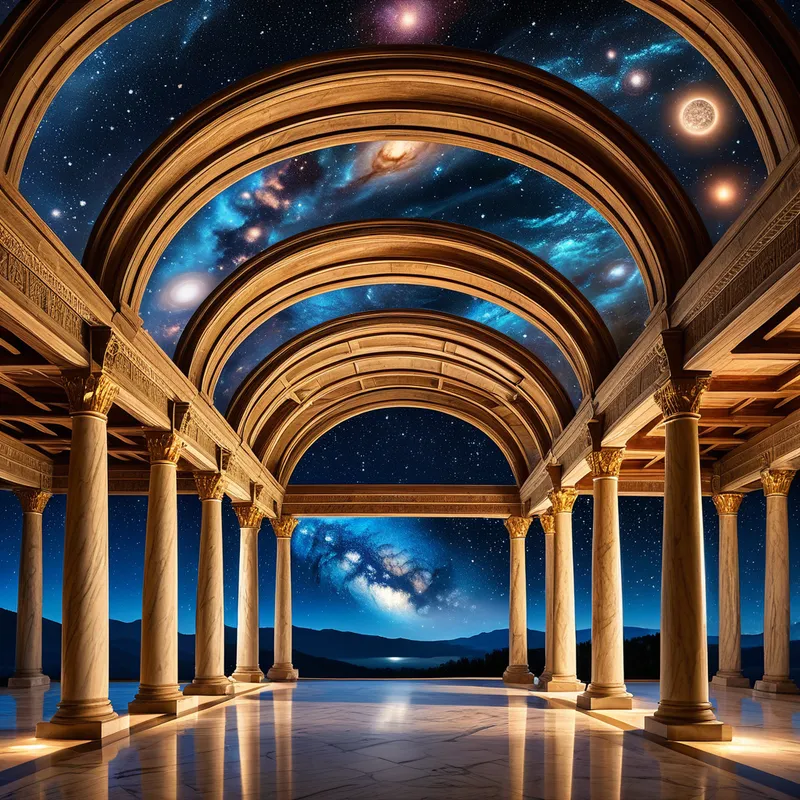
Listen. Before the names of cities were fixed, when [the world](/myths/the-world “Myth from Tarot culture.”/) was still wet clay awaiting a seal, there existed a place of becoming. It was not a temple, nor a palace, but a porch—a stoa of impossible length, fashioned from marble that held the warmth of the sun and cedar that whispered with the scent of forgotten forests. It stood open to the winds, a threshold between the wild earth and the inner sanctum of human understanding.
And it was blank.
Into this space of pure potential came the Poikilotés, the Variegated One. No one deity, but a spirit of synthesis, whose fingers were stained with the ground dust of stars, crushed lapis lazuli, ochre from the first blood of [the earth](/myths/the-earth “Myth from Hindu culture.”/), and the luminous green of deep-sea light. The Poikilotés did not speak, but sang in a language of color and line. With a breath that smelled of rain on hot stone, the work began.
Upon the vast, waiting plane of the porch’s inner wall, the story unfurled. First, chaos—a swirl of umber and black, formless and turbulent. Then, a single stroke of titanium white: the Dividing Line. From it, the cosmos spilled forth. Nebulae bloomed like flowers in [the void](/myths/the-void “Myth from Buddhist culture.”/). Planets coalesced, spheres of malachite and cinnabar. The artist painted the birth of mountains, the carving of rivers, the first pulse of green life. Then came the figures: the Ouraniones in their epic struggles, their triumphs and falls rendered in agonized, magnificent detail.
But the song did not stop with the gods. The brush dipped into new pigments—the muted brown of plowed earth, the red of baked brick, the silver glint of tools. Humanity emerged. Not as idealized statues, but in the midst of action: planting, building, debating, weeping, loving. Great battles were frozen at their moment of decisive clash; philosophers stood in circles of discourse; unknown mothers cradled children. Every panel was a heartbeat of history, a memory of the world made permanent.
The final act was not an end, but an opening. The Poikilotés painted, at the very center of the long narrative, an empty space—a single, pristine column. And before it, they depicted the porch itself, populated by ordinary people. They were shown pointing, discussing, arguing, and reflecting upon the very paintings that surrounded them. The artist painted the viewers into the story, completing the circle. With a final sigh that stirred the dust motes into a golden dance, the Poikilotés vanished. [The Stoa](/myths/the-stoa “Myth from Greek culture.”/) was no longer blank. It was Poikile. A living memory, a sheltering order against the formless winds of time.
Cultural Origins & Context
The myth of the Stoa Poikile transcends a single culture, finding echoes in the human impulse to create ordered narrative from the chaos of existence. It is a “Global/Universal” story because it speaks to the foundational moment when a community builds not just a physical shelter, but a psychic one. While its most famous namesake is the historical Stoa Poikile of Athens, where philosophers like Zeno taught, the mythic version is older and more profound.
It was a tale told by artisans to their apprentices, by elders at the founding of a new settlement, and by poets at festivals of renewal. Its function was threefold. First, it sanctified the act of building and decoration as a cosmic, ordering principle. Second, it served as a foundational myth for law, history, and civic identity; the porch represented the shared space (agora) where collective memory becomes the bedrock of society. Third, it was a metaphysical map: the world itself was understood as a kind of “painted porch,” a structured reality (cosmos) artfully arranged within the boundless void (chaos). The myth was passed down not as dogma, but as a reminder that the human task is to continually “paint the porch”—to create meaning, record truth, and build shelters of understanding.
Symbolic Architecture
At its core, the Stoa Poikile is a [symbol](/symbols/symbol “Symbol: A symbol can represent an idea, concept, or belief, serving as a powerful tool for communication and understanding.”/) of the cosmizing function of [consciousness](/symbols/consciousness “Symbol: Consciousness represents the state of awareness and perception, encompassing thoughts, feelings, and experiences.”/). The blank [porch](/symbols/porch “Symbol: A porch often signifies a transitional space in dreams, representing the area between the inside self and the outside world.”/) is the undifferentiated [psyche](/myths/psyche “Myth from Greek culture.”/), the potential self before it has engaged with experience. The Poikilotés represents the creative, ordering principle of the mind—[the Ego](/myths/the-ego “Myth from Jungian culture.”/) in its most positive, world-building [aspect](/symbols/aspect “Symbol: A distinct feature, quality, or perspective of something, often representing a partial view of a larger whole.”/).
The porch is the threshold of the self, where the raw data of existence is transformed into the narrative fresco of a life.
The paintings are not mere decoration; they are the structured contents of the personal and [collective unconscious](/symbols/collective-unconscious “Symbol: The Collective Unconscious refers to the part of the unconscious mind shared among beings of the same species, embodying universal experiences and archetypes.”/), made visible and sequential. The battles depict inner conflicts; the philosophical debates represent the [dialogue](/symbols/dialogue “Symbol: Conversation or exchange between characters, representing communication, relationships, and narrative flow in games and leisure activities.”/) between competing values; the scenes of daily [life](/symbols/life “Symbol: The symbol of ‘Life’ represents a journey of growth, interconnectedness, and existential meaning, encompassing both the joys and challenges that define human experience.”/) are the [assimilation](/symbols/assimilation “Symbol: The process of integrating new experiences, identities, or knowledge into one’s existing self, often involving adaptation and transformation.”/) of personal [history](/symbols/history “Symbol: History in dreams often represents the dreamer’s past experiences, lessons learned, or unresolved issues that continue to influence their present.”/). Crucially, the [inclusion](/symbols/inclusion “Symbol: The state of being accepted, welcomed, or integrated into a group, community, or society. It represents belonging and participation.”/) of humanity viewing the paintings symbolizes the act of self-[reflection](/symbols/reflection “Symbol: Reflection signifies self-examination, awareness, and the search for truth within oneself.”/). The myth tells us that consciousness turns back upon itself to understand its own composition. The empty [column](/symbols/column “Symbol: A vertical architectural support representing strength, stability, and connection between earth and sky. It symbolizes structure, tradition, and spiritual ascent.”/) at the center is the symbol of the transcendent function, the still point of [the self](/myths/the-self “Myth from Jungian culture.”/) (Self) around which the [whirl](/symbols/whirl “Symbol: A rapid, circular motion representing transition, chaos, or being swept up in forces beyond one’s control.”/) of personal [history](/symbols/history “Symbol: History in dreams often represents the dreamer’s past experiences, lessons learned, or unresolved issues that continue to influence their present.”/) revolves, the place from which one can observe the entire “painting” of one’s [life](/symbols/life “Symbol: The symbol of ‘Life’ represents a journey of growth, interconnectedness, and existential meaning, encompassing both the joys and challenges that define human experience.”/).
The Dreamer’s Resonance
When this myth stirs in the modern unconscious, it often manifests in dreams of architecture and art. To dream of a long, colonnaded hallway or porch, especially one where the walls begin to reveal hidden paintings or murals, signals a profound process of psychic integration and historical review.
The somatic sensation is often one of awe mixed with anxiety—the “awe-ful” realization that one’s psyche is vaster and more detailed than previously known. The dreamer might find themselves brushing dust off a wall to reveal a vivid scene from their childhood, or watching as colors bleed through bland modern wallpaper to depict a forgotten trauma or joy. This is the psyche’s own Poikilotés at work, actively painting the porch of the dreamer’s awareness. The process indicated is one of reclaiming personal and ancestral memory, of bringing order to internal chaos. If the dreamer is painting the walls themselves, it points to active engagement in this process of self-creation. If they are merely observing, it may indicate a readiness to witness and accept the full narrative of their being. The dream is an invitation to walk the length of one’s own inner stoa and behold the story thus far.
Alchemical Translation
The alchemical journey modeled by this myth is that of ablutio followed by pigmentatio. The initial state is the massa confusa—the blank, chaotic porch. The first work is the creation of the Dividing Line, which in psychological terms is the birth of discernment, the ability to separate “I” from “Not-I,” value from distraction.
Individuation is the artisanal act of painting one’s own porch with the pigments of lived experience, transforming event into essence.
The laborious painting of the cosmic and historical scenes represents the long, often tedious work of analysis, memory work, and shadow integration—gathering the scattered fragments of the self and giving them a coherent place in a larger narrative. The [triumph](/myths/triumph “Myth from Roman culture.”/) is not in finishing, for the porch is potentially infinite, but in the establishment of the central, empty column—the achievement of a stable observing consciousness. This is the [Lapis Philosophorum](/myths/lapis-philosophorum “Myth from Alchemical culture.”/). From this center, the individual can behold the entire panorama of their psyche—the glorious and the terrible, the divine and the human—without identifying with any single panel. They become both the artist and the wise one who strolls the porch, understanding that they are the creator, the creation, and the contemplative space that holds it all. The myth ultimately teaches that we are tasked not with finding a pre-existing meaning, but with the sacred, ongoing responsibility of painting it into being, thereby creating a shelter for our soul amidst the timeless winds.
Associated Symbols
Explore related symbols from the CaleaDream lexicon: