The Stoa Myth Meaning & Symbolism
The myth of the divine porch where Zeus dispensed justice, a liminal space between chaos and order, sheltering humanity under the gaze of fate.
The Tale of The Stoa
Hear now of the place that is not quite a temple, and not quite the wild earth. Hear of the Stoa.
Before the first city was built by mortal hands, the air on the heights of Olympus crackled with unbound power. Thunder was a constant rumble in the chest of the sky, and lightning scribbled its furious, fleeting laws across the clouds. Zeus, the All-Seeing, sat upon his throne amidst this splendid chaos, but a disquiet grew in his fathomless mind. Below, the children of clay huddled in caves or beneath sparse trees, exposed and trembling. Their prayers rose to him not as praise, but as a cacophony of fear—of storms, of beasts, of the vast, uncaring night.
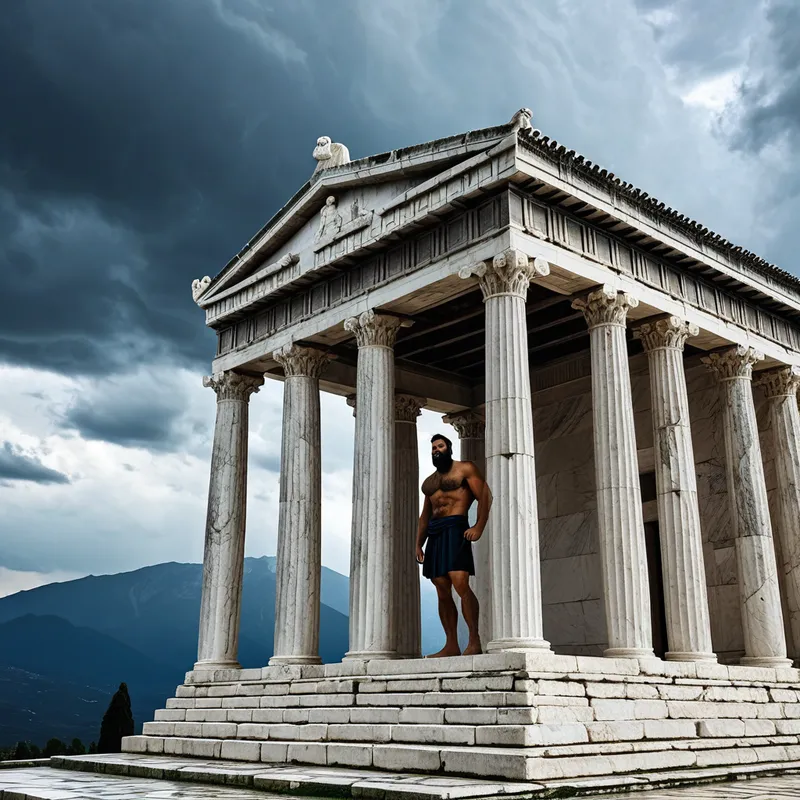
Their fear was a shadow on his sovereignty. To rule was not merely to command the tempest, but to give form to the formless. One evening, as the last light bled from the west, he rose. With a gesture that gathered the twilight, he summoned the very bones of the mountain. Marble, not from quarries, but from the dream of stone, rose in long, graceful lines. He did not raise walls to shut out the world. Instead, he commanded a roof to be born—a single, massive slab of grey stone, held aloft by a row of sturdy, fluted columns. It was open on one side to the winds and the view, and closed on the other by the solid mountain rock.
He called it the Stoa. A porch. A threshold.
Here, Zeus would descend from his secluded throne. He would stand beneath this roof, his feet on the patterned floor where sun and shadow lay in equal stripes. From this place, he listened. A farmer, his fields scorched, would come and stand in the shelter, not daring to enter the god’s full presence, but speaking his grievance into the space between them. Zeus, from the Stoa, would point a finger, and a single, fertilizing rain would fall upon that man’s plot alone. A widow, wronged by a powerful lord, would whisper her truth into the cool, still air beneath the roof. Zeus would hear, and his brow would darken the sky above the lord’s hall, a silent, looming judgment.
The Stoa became the place of measured justice. It was not the absolute, terrifying law of the thunderbolt, nor the soft, hidden mercy of the hearth. It was the law spoken. It was the space where chaos met order, where plea met decree, where the unprotected found a line drawn against the storm. It was the first civic space, a divine prototype for the meeting place of minds. Under its roof, one was neither fully in the wild nor fully in the sanctum. One was in the place of becoming, of decision, on the porch of fate itself.
Cultural Origins & Context
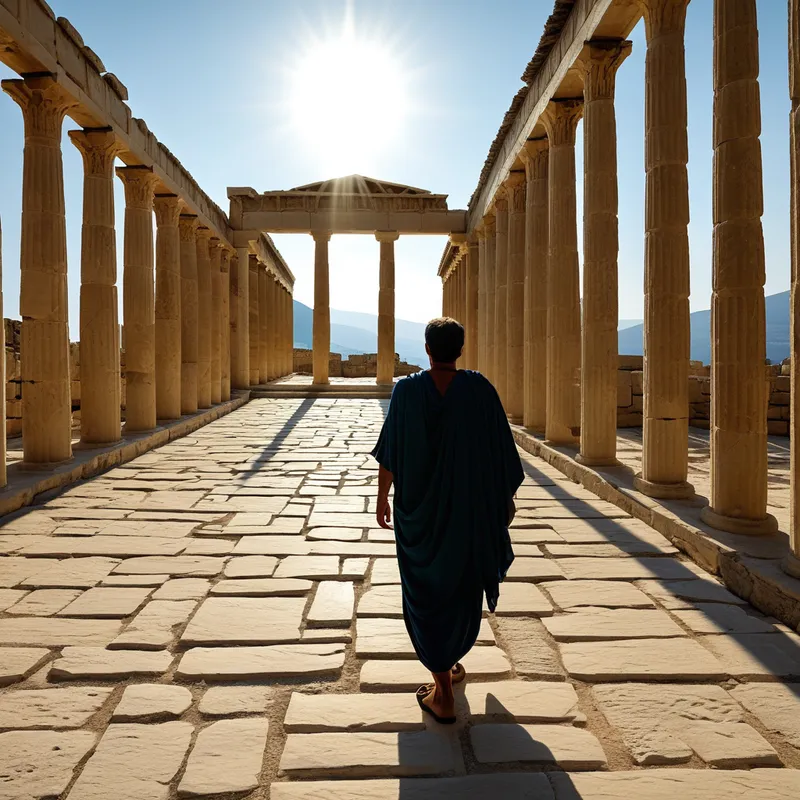
The myth of the Stoa is not a single, codified epic but a foundational idea woven into the fabric of Hellenic thought. It emerges from the architectural and social reality of the stoa—the long, colonnaded portico that framed the agora of every Greek city-state. These were not backdrops but active participants in civic life: places of philosophy (the Stoics taught in one), commerce, shelter, and conversation.
The mythic attribution to Zeus as its divine architect served a profound societal function. It sacralized the very concept of public, shaded space as a gift from the highest god. It framed law, debate, and even casual discourse as activities under divine patronage and scrutiny. The story was passed down not by bards in feasting halls, but by architects pointing to columns, by philosophers pacing in the shade, and by citizens feeling the relief of stepping out of a sudden downpour. It was a myth enacted daily, a reminder that civilization itself—the ordered space between men—was a holy shelter erected against the chaos of nature and human passion.
Symbolic Architecture
The Stoa is the archetype of the liminal—the threshold. Its symbolic power lies in its elegant duality.
It is the roof that does not enclose, the shelter that demands exposure. It is the firm line drawn against the storm, behind which one may safely watch the storm’s fury.
Psychologically, it represents the structured psyche. The columns are the principles, the virtues, the core beliefs that hold up the roof of consciousness, allowing us to function. The open side is our perception, our engagement with the chaotic, sensory, and often overwhelming external world. The solid back is the unconscious, the mountain from which we are hewn, the unknown depths that support us. To stand in the Stoa is to occupy the ego’s proper place: not identified with the raw chaos outside (the storm), nor lost in the dark interior (the mountain cave), but in the conscious, shaded space of observation and judgment.
The Stoa is also the symbol of discernment. Zeus does not deliver his judgments from the remote, clouded peak. He comes down to the porch. Justice requires engagement with the particulars, a listening ear turned toward the specific human story. The myth tells us that true order is not imposed from absolute, abstract height, but negotiated at the threshold where the absolute meets the relative.
The Dreamer’s Resonance
When the image of the Stoa colonnade appears in modern dreams, it signals a psyche working with the theme of containment and exposure. The dreamer may be feeling emotionally or psychologically “weather-beaten,” exposed to chaotic life circumstances, criticism, or internal storms of anxiety.
To dream of seeking shelter in a Stoa indicates a nascent desire for psychological structure—for principles, routines, or boundaries that can provide relief. The dream ego is moving toward a space of reflection, away from raw, immersive suffering. Conversely, to dream of being trapped in the Stoa, afraid to step back into the world, suggests a fear of re-engagement, where one’s protective structures have become a prison of isolation.
The most potent Stoa dream is one where the dreamer is neither entering nor leaving, but simply standing within it, looking out. This is the somatic signature of integration. The body feels the solid floor, the cool shade, while the eyes take in the brilliant, moving chaos beyond. It is the dream of the conscious witness, building the internal porch from which to observe the passions and tempests without being destroyed by them.
Alchemical Translation
The alchemical journey modeled by the Stoa is the transmutation of chaotic experience into conscious wisdom—the opus of building a soul that can withstand the elements.
The initial state is nigredo, the blackening: the exposed, storm-tossed mortal on the bare mountainside, identified with every lightning strike of fate and every gust of emotion. The call is for shelter, for a prima materia that is not escape, but definition.
The work begins not by building a fortress, but by erecting the first column. That column is a single, unwavering truth one can hold onto: “I am not the storm.”
This is the albedo, the whitening. Each column raised is a conscious choice, a value clarified, a boundary set. The roof is the synthesized worldview that slowly forms, allowing the rain of experience to run off, while providing shade for clear thought. The process is the descent of the inner Zeus—the sovereign self—from its remote, idealized throne into the practical, shaded space of the lived life.
The final stage, the rubedo or reddening, is not achieved by sealing off the open side. It is the golden, enduring ability to stand in one’s fully constructed Stoa, engaged with the world, dispensing justice to one’s own inner conflicts, and offering shelter to others. The individual has become a liminal being, a living threshold where chaos is met with order, suffering with understanding, and the raw stuff of fate is transformed, under a sheltering intelligence, into a life of dignified meaning. The porch has become the dwelling place of the soul.
Associated Symbols
Explore related symbols from the CaleaDream lexicon: