The Steel Pan Myth Meaning & Symbolism
A myth of alchemical creation where the discarded and oppressed are transformed, through fire and rhythm, into a vessel of transcendent beauty and collective voice.
The Tale of The Steel Pan
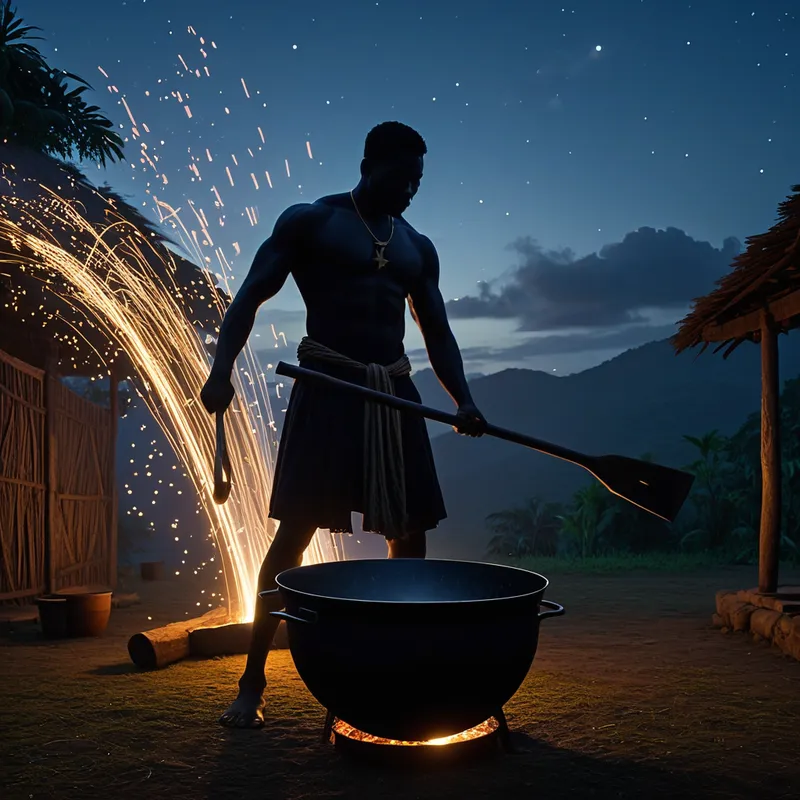
Listen. In the beginning, there was the silence of the yard. Not a peaceful quiet, but the heavy, humid silence of things discarded, of histories buried under rust and grime. It was the silence of the oil drum, a hollow king of scrap, born from the deep earth only to be emptied and cast aside on foreign soil. Its skin, once taut with black gold, was now slack, stained, and mute—a perfect echo of a people told they had no song of their own.
But in the shadows, where the firelight of kerosene lamps fought the night, the Tuner appeared. He was not a single man, but a spirit in many men, a collective ghost of hands that remembered the heartbeat of the djembe and the complex conversations of the gamelan. He saw [the drum](/myths/the-drum “Myth from West African / Diasporic culture.”/) not as refuse, but as a fallen god, a slumbering giant of potential.
The conflict was not against a dragon, but against the very nature of the material—against the stubborn steel, against the laws of physics, against the decree that beauty could not be forged from industrial waste. The Tuner’s tools were simple: a hammer, fire, his ear pressed against the metal as if listening for a soul trapped within. The rising action was the ping… ping… thud of the hammer. Each strike was a question. Each dent, a syllable of a new language being born from violence.
He heated the drum’s face in a great fire, tempering it, not to harden, but to make it malleable to his will. He sank the circle into a concave bowl, a celestial dish to catch the rain of sound. With meticulous, almost divine geometry, he mapped a constellation of notes onto the blackened steel. This was the alchemy: the fire of the forge, the [water](/myths/water “Myth from Chinese culture.”/) of the soul’s longing, the air of the melody seeking form, and [the earth](/myths/the-earth “Myth from Hindu culture.”/) of the discarded drum.
And then, the resolution. Not with a shout, but with a strike. The hammer fell on a precise point. What emerged was not a clang of scrap, but a clear, pure, resonant note. It hung in the humid air, a tear of sound, a drop of light in the yard’s silence. Then another note, and another, until a scale was born—a ladder of sound climbing out of [the pit](/myths/the-pit “Myth from Christian culture.”/). The oil drum was dead. Long live the Pan. Its voice was the sound of transformation itself: melancholic yet joyous, metallic yet liquid, utterly new yet ancient as the first rhythm. It was the silence, finally answering back.
Cultural Origins & Context
This is not a myth from a singular, ancient text, but a living, breathing epic born from the docks and yards of Laventille, Trinidad, in the 1930s and 1940s. Its “bards” were the descendants of the enslaved and the indentured, communities forged in [the crucible](/myths/the-crucible “Myth from Alchemical culture.”/) of colonialism and oil booms, who found themselves legally and socially suppressed. The British colonial government had banned traditional African drumming, fearing its power to organize and communicate.
The myth arose from a profound cultural necessity: the need for a voice. The discarded 55-gallon oil drum, ubiquitous waste of the island’s petroleum industry, became the unlikely protagonist. The story was passed down not in words, but in action—in the clandestine “bamboo tamboo” bands that evolved into the first pan yards, in the secretive tuning techniques guarded like mysteries, and in the fierce competitions of Panorama. Its societal function was, and remains, one of sublime resistance: to take the very symbol of economic exploitation and industrial refuse and alchemize it into the ultimate instrument of cultural pride, sophisticated artistry, and unifying joy.
Symbolic Architecture
At its core, the myth of the [Steel](/symbols/steel “Symbol: Steel symbolizes strength, resilience, and endurance, suggesting a solid foundation or a formidable presence in one’s life.”/) Pan is a masterclass in the [symbolism](/symbols/symbolism “Symbol: The use of symbols to represent ideas or qualities, often conveying deeper meanings beyond literal interpretation. In dreams, it’s the language of the unconscious.”/) of the [Magnum](/symbols/magnum “Symbol: A powerful spiritual symbol representing divine authority, ultimate truth, and transformative force that transcends ordinary reality.”/) [Opus](/symbols/opus “Symbol: A spiritual or alchemical term for a great work of creation, often representing the culmination of a life’s purpose or a transformative process.”/). The oil drum represents the [prima materia](/myths/prima-materia “Myth from Alchemical culture.”/)—the despised, rejected, and unconscious aspects of both personal and collective [history](/symbols/history “Symbol: History in dreams often represents the dreamer’s past experiences, lessons learned, or unresolved issues that continue to influence their present.”/). It is the [shadow](/symbols/shadow “Symbol: The ‘shadow’ embodies the unconscious, repressed aspects of the self and often represents fears or hidden emotions.”/): the [legacy](/symbols/legacy “Symbol: What one leaves behind for future generations, encompassing values, achievements, possessions, and memory.”/) of [trauma](/symbols/trauma “Symbol: A deeply distressing or disturbing experience that overwhelms the psyche, often manifesting in dreams as unresolved emotional wounds or psychological injury.”/), the feelings of worthlessness, the raw, unprocessed pain of displacement and oppression.
The true alchemist does not turn lead into gold; they turn the leaden weight of history into the golden sound of becoming.
The hammer and fire symbolize the necessary, often painful, process of confrontation and engagement. Individuation requires us to “beat” our complexes into new shapes, to apply the heat of conscious [attention](/symbols/attention “Symbol: Attention in dreams signifies focus, awareness, and the priorities in one’s life, often indicating where the dreamer’s energy is invested.”/) to the cold, hardened patterns of the [psyche](/myths/psyche “Myth from Greek culture.”/). The Tuner represents the conscious ego, guided by the deeper Self—that which remembers a more whole and harmonious [pattern](/symbols/pattern “Symbol: A ‘Pattern’ in dreams often signifies the underlying structure of experiences and thoughts, representing both order and the repetitiveness of life’s situations.”/) (the ancestral [memory](/symbols/memory “Symbol: Memory symbolizes the past, lessons learned, and the narratives we construct about our identities.”/) of [rhythm](/symbols/rhythm “Symbol: A fundamental pattern of movement or sound in time, representing life’s cycles, emotional flow, and universal order.”/)). The act of sinking the drumhead creates a [vessel](/symbols/vessel “Symbol: A container or structure that holds, transports, or protects something essential, representing the self, emotions, or life journey.”/), a vas, which in [alchemy](/symbols/alchemy “Symbol: A transformative process of purification and creation, often symbolizing personal or spiritual evolution through difficult stages.”/) is the container where transformation occurs. It is the [psyche](/myths/psyche “Myth from Greek culture.”/) making [space](/symbols/space “Symbol: Dreaming of ‘Space’ often symbolizes the vastness of potential, personal freedom, or feelings of isolation and exploration in one’s life.”/) to receive and hold new, more complex realities.
The resulting Pan is the [symbol](/symbols/symbol “Symbol: A symbol can represent an idea, concept, or belief, serving as a powerful tool for communication and understanding.”/) of the integrated Self. Its concave form is a receptive [bowl](/symbols/bowl “Symbol: A bowl often represents receptivity, nourishment, and emotional security, symbolizing the dreamer’s needs and desires.”/), a [skull](/symbols/skull “Symbol: The skull often symbolizes mortality, the afterlife, and the fragility of life.”/) that holds a [universe](/symbols/universe “Symbol: The universe symbolizes vastness, interconnectedness, and the mysteries of existence beyond the individual self.”/) of notes. No longer a monolithic, hollow echo of oppression, it is a differentiated, conscious entity where every part has a unique voice, yet all are necessary for the [harmony](/symbols/harmony “Symbol: A state of balance, agreement, and pleasing combination of elements, often associated with musical consonance and visual or social unity.”/) of the whole.
The Dreamer’s Resonance
When this myth stirs in the modern dreamer, it often manifests as dreams of finding profound value in what was discarded. One might dream of discovering a masterpiece in a dumpster, of polishing a rusted object until it shines with [inner light](/myths/inner-light “Myth from Buddhist culture.”/), or of hearing beautiful music emanating from a sewer grate or a broken machine.
Somatically, this can correlate with a process of reclaiming the body—perhaps after illness or trauma—listening to its signals (the “ping” of the hammer) and reshaping one’s relationship to it from one of disdain to one of instrumentality. Psychologically, it signals the active phase of integrating [the shadow](/myths/the-shadow “Myth from Jungian culture.”/). The dream ego is the Tuner, engaged in the arduous, precise work of confronting the “discarded” parts of the personality—the anger, the shame, the grief—and, through the focused application of consciousness (the hammer), discovering their latent, resonant value. The conflict in the dream is the resistance of the material, the fear that engaging with this pain will only produce more noise. The resolution is the shocking, clear note—the moment of insight where the pain reveals itself as a specific, understandable, and ultimately harmonious part of a larger composition.
Alchemical Translation
For the individual on the path of individuation, the myth of the Pan provides a potent model for psychic transmutation. It begins with the [Nigredo](/myths/nigredo “Myth from Alchemical culture.”/): the acknowledgment of the “black sun,” the depressive weight of one’s personal and inherited “refuse”—the dysfunctional family patterns, the societal conditioning, the core wounds. This is the oil drum in the yard, the feeling of being a hollow vessel for others’ purposes.
The Albedo is the cleansing fire and the hammer’s strike—the work of therapy, journaling, meditation, or any disciplined practice that applies conscious heat and pressure to these patterns. It is the often repetitive, frustrating work of “sinking” [the ego](/myths/the-ego “Myth from Jungian culture.”/), of creating a receptive space within. The mapping of the notes represents the Citrinatio—the beginning of differentiation, where one learns to identify distinct emotions, complexes, and drives, giving each a specific “place” in the psyche’s geography.
The symphony of the Self is not played on a perfect instrument, but on one forged in the fires of its own breaking.
Finally, the [Rubedo](/myths/rubedo “Myth from Alchemical culture.”/) is the emergence of the Pan’s voice—the fully realized expression of the individual. This is not the eradication of one’s history, but its sublime transmutation. The trauma is not gone; it has become the tensile strength of the steel, the depth of the resonance. The individual discovers that their unique “sound,” their authentic voice and purpose in [the world](/myths/the-world “Myth from Tarot culture.”/), is built entirely from the precise, loving reworking of what was once considered shameful, broken, or worthless. They become a vessel that does not hide its scars but uses their specific geometry to create a harmony impossible for any “perfect,” untouched surface. They become, in essence, a creator who has performed the ultimate act of creation: turning the story of their suffering into the song of their soul.
Associated Symbols
Explore related symbols from the CaleaDream lexicon: