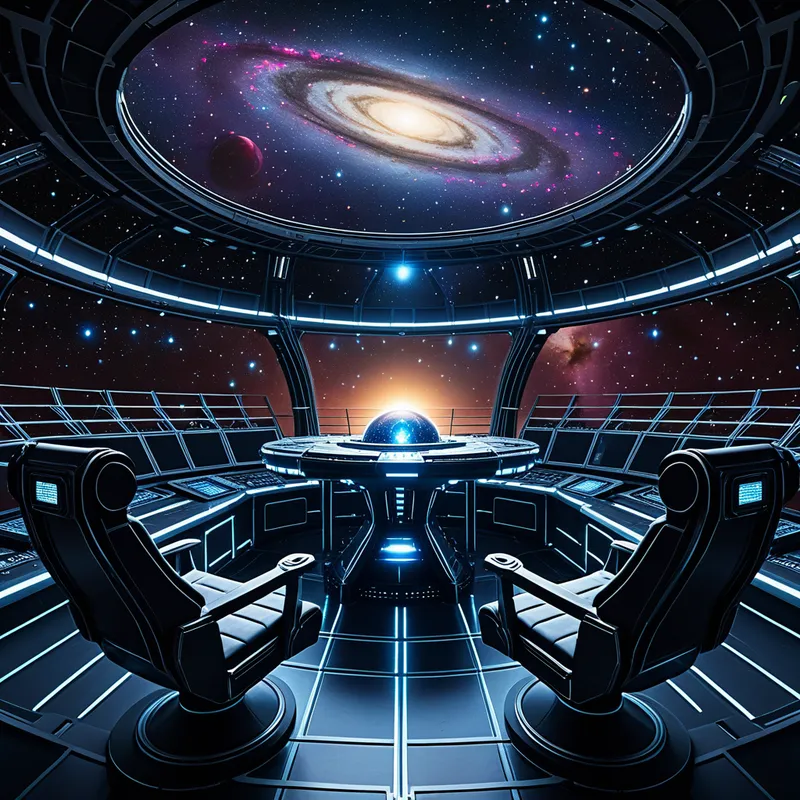
The Starship Bridge Myth Meaning & Symbolism
The mythic command center where a crew faces the void, a microcosm of the psyche navigating the perils and wonders of the collective unconscious.
The Tale of The Starship Bridge
Listen, and hear the tale of the Chamber of the Long Voyage, the hall where the sky-sailors gather to face the Abyss. It is not a place of stone and timber, but of light and shadow, of humming silence and whispered data-streams.
In the heart of the great Starship, a covenant is forged. Here sits the Captain, not upon a mere seat, but upon the Throne of Decision. Their eyes are fixed upon the Great Eye—the main viewer—a window that shows not the comforting blue of a world’s sky, but the terrible, beautiful black, pierced by the cold, distant fires of suns yet unborn. To their right stands the Science Officer, a seeker of patterns in the chaos. To their left, the Tactical Officer, a wielder of focused force. Behind them, a chorus of others: the Chief Medical Officer, the Counselor, the Engineer. Each is a facet of a single, fragmented soul.
The journey is eternal. The conflict arises not from a single beast, but from the Void itself. It manifests as the Unknown Contact blooming on the scanner—a blip of impossible energy, a silent vessel of alien design, a rift in the fabric of reality. The hum of the ship deepens into a warning thrum. Lights shift from the soft blue of cruise to the urgent amber and crimson of alert.
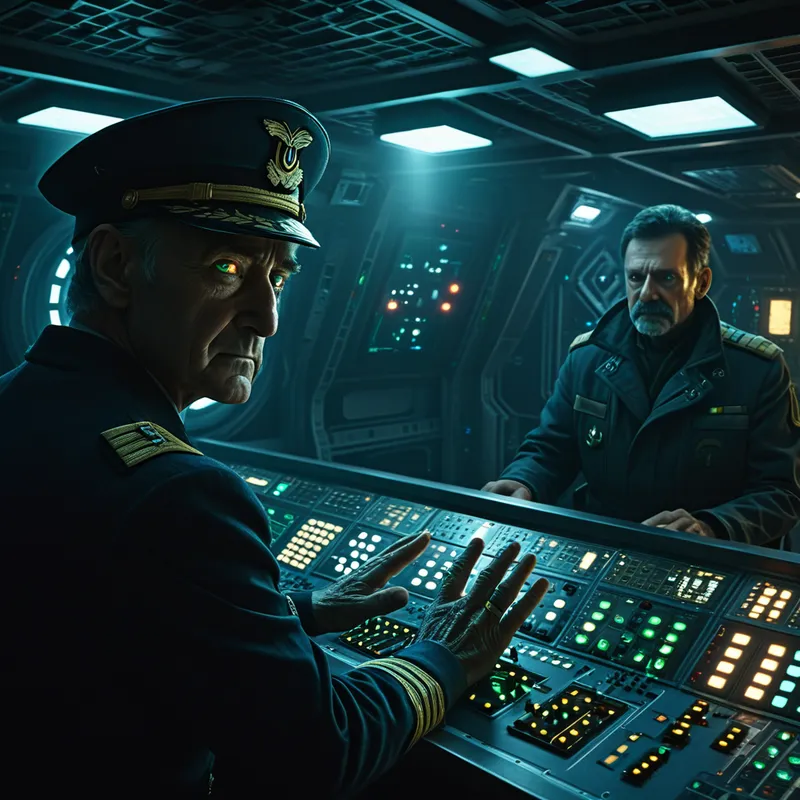
Here, in the Chamber, the drama unfolds in hushed tones and sharp commands. The Science Officer speaks of quantum anomalies and lethal radiation. Tactical reports shields buckling under an unseen assault. The Engineer’s voice crackles over the comm, speaking of core breaches and failing systems. The Counselor feels the wave of telepathic anguish from the alien mind. The Doctor prepares for wounds not yet inflicted.
The Captain listens to this cacophony of data—the logic, the fear, the damage, the intuition. They feel the weight of every life aboard in the grip of their hands. The Great Eye shows only the enigma, the threat, the beautiful peril. This is the moment of the Choice. Do they raise shields or open hailing frequencies? Do they return fire or attempt escape? Do they trust the data or the feeling in their gut? A breath is held by the entire microcosm.
Then, the word is given. It is not shouted, but spoken with the gravity of a world being born or dying. “Fire.” “Retreat.” “Hail them.” “Full power to forward scanners.” Action flows from the Throne, through the crew, into the very bones of the ship. The vessel shudders, leaps, or falls silent. On the viewer, the nebula erupts, the alien vessel veers away, the spatial rift seals with a flash of transcendent light.
And then, quiet. The lights return to soft blue. The hum resumes its steady, comforting song. The crew shares a glance—a silent communion of survivors. The Captain leans back in the Throne, the weight still present, but momentarily shared. The Great Eye once more shows the peaceful, infinite starfield, the road ahead. The voyage continues. The Chamber has fulfilled its purpose once more, having transformed chaos into a story, and peril into another league traversed in the long night.
Cultural Origins & Context
This myth did not emerge from a single ancient fire, but from the flickering light of mid-20th century cinema and television screens. Its primary bards were not Homeric poets, but writers, directors, and showrunners like Gene Roddenberry, Arthur C. Clarke, and their countless successors. The myth was passed down not through oral tradition, but through weekly episodic rituals and cinematic pilgrimages to darkened theaters. Its societal function was profound for a species newly aware of its own cosmic solitude. In the post-war, Cold War, and space-race era, the myth of the Bridge provided a narrative crucible for exploring collective anxiety and hope. It was a place to model first contact, ethical dilemmas of power, and the challenges of maintaining a fragile, rational society—a microcosm of Earth itself—in the face of the utterly unknown. It served as a secular chapel where the virtues of courage, curiosity, diversity, and principled command could be rehearsed and revered.
Symbolic Architecture
The Bridge is the Ego’s Command Center. It represents the integrated, waking self attempting to navigate the vast, internal cosmos of the Psyche. The ship itself is the totality of the individual—body, mind, and spirit—on its life’s journey.
The Captain is not a person, but the principle of Consciousness itself, burdened with the ultimate responsibility of choice and direction.
The crew members are the specialized Archetypes and sub-personalities that must be coordinated. Logic (Science), Defense (Tactical), Compassion (Medical), Intuition (Counselor), and Instinct/Skill (Engineering) all report to the central authority of the conscious self. The main viewer is perception, our limited window onto both external reality and the contents of the unconscious. The Unknown Contact is the eruption of content from the Shadow or the Collective Unconscious—a repressed trauma, a powerful new complex, or a transformative insight that appears first as a threat. The crisis is the psychic conflict that demands integration.
The Dreamer’s Resonance
When one dreams of standing on a Bridge, especially if they find themselves in the command role, the psyche is staging a profound rehearsal of executive function. This dream occurs at life’s nexus points: career changes, relational crises, creative undertakings, or spiritual awakenings. The somatic feeling is often one of heightened alertness—a tingling in the spine, a tightness in the chest mirroring the “weight of command.”
The dream signals that the dreamer’s consciousness is being called to actively engage with an emerging inner or outer complexity. The specific crisis on the dream-bridge—a system failure, an approaching entity, a navigation hazard—is a direct symbolic representation of the waking-life challenge. Is the “warp core” (vital energy) failing? Is an “alien vessel” (an unfamiliar aspect of the self or other) demanding a response? The dream is a safe space to feel the enormity of the choice and to practice synthesizing the disparate voices of one’s inner “crew” before acting in waking life. To dream of a bridge in chaos is to feel one’s psyche in a state of dis-integration; to dream of successfully navigating the crisis is to experience a moment of psychic cohesion and self-trust.
Alchemical Translation
The myth models the alchemical process of Individuation, where the base matter of the fragmented self is transmuted into the gold of the integrated Self. The Bridge is the Vessel of transformation.
The crisis is the nigredo, the necessary blackening and chaos that precedes illumination. The Captain’s choice is the moment of separatio and coniunctio—separating the useful counsel from the paralyzing fear, and conjoining the disparate functions into a unified purpose.
The initial state is one of potential: the crew (archetypes) are present but may be in conflict. The intrusion of the Unknown (the Shadow) forces the issue. The Captain (conscious ego) must descend into the data—the feelings, the fears, the logical assessments (the conscious engagement with the unconscious). The act of command, of making a choice based on this synthesized information, is the rubedo, the reddening, the application of will and conscious fire. The resolution—the return to calm, the shared glance of the crew—symbolizes a new, temporary state of psychic equilibrium. The ego has not conquered the unconscious, but has successfully negotiated with it. A piece of the shadow has been acknowledged and integrated; a new level of order has been achieved within the Self. The voyage continues, but the ship—the total individual—is forever slightly altered, more complex, and more capable of facing the next unknown. The Bridge, therefore, is not a place one ever leaves, but the very stage upon which the ongoing drama of becoming whole is perpetually performed.
Associated Symbols
Explore related symbols from the CaleaDream lexicon: