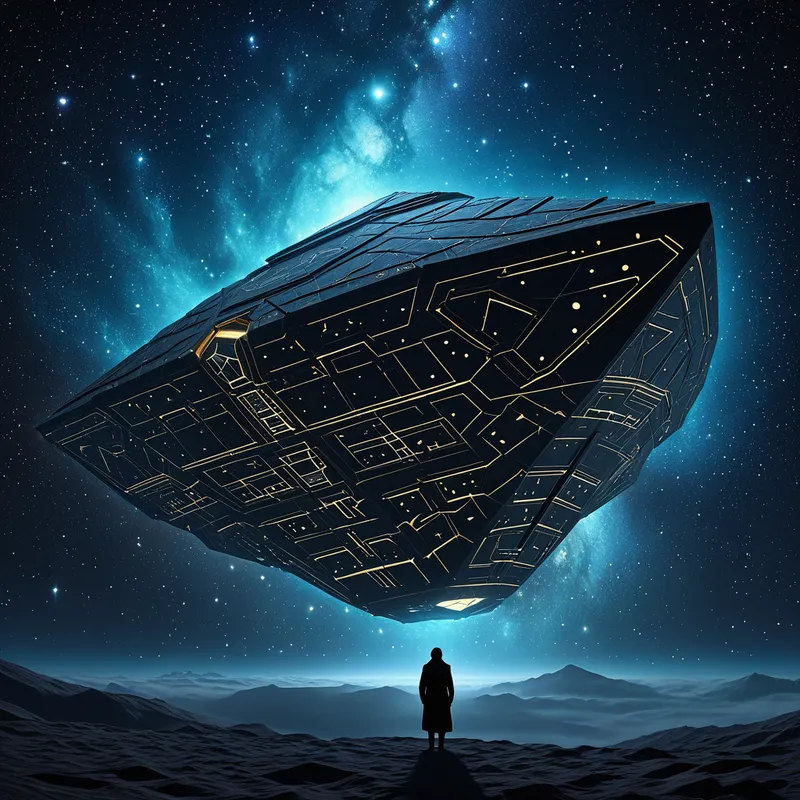
The Starship Myth Meaning & Symbolism
A vessel of consciousness voyages beyond the known world, carrying the soul's yearning for new worlds and the perilous promise of transformation.
The Tale of The Starship
Listen. Listen to the hum in the bones of [the world](/myths/the-world “Myth from Tarot culture.”/), the silent song between the stars. This is the tale of [the Vessel](/myths/the-vessel “Myth from Alchemical culture.”/), the Starship.
In the Before-Time, we were earthbound. Our sky was a ceiling, our horizon a wall. Our stories were of soil and sea, and the great dark above was a tapestry of distant, silent gods. Then came the Yearning. It began not as a shout, but as a whisper in the collective soul—a dissonance, a feeling that home was also a cage. The air grew thin for dreams too vast for atmosphere.
From this collective ache, the Starship was conceived. Not built from ore and fire alone, but from a million unvoiced questions. Its skeleton was forged from the question “What if?” Its engines were crystallized longing. Its hull was plated with the courage to say, “We do not know.” It was not a [thing](/myths/thing “Myth from Norse culture.”/) of a single hero, but a cathedral of communal will, a lifeboat for an entire species’ hope.
The Launching was not a roar, but a profound silence that followed the severing of gravity’s umbilical. To look back and see the Cradle-World—not as a map, but as a whole, fragile, blue jewel—was to be orphaned and enlightened in the same breath. The known world shrank to a point of light, and all that remained was the Great Dark and the thin shell of the ship.
And the voyage… the voyage was the myth. It was the generations passing in the humming belly of the vessel. It was the conflict not with monsters, but with silence, with the ghost of gravity, with the slow erosion of memory. The old stories of earth and hero began to feel like fairy tales told to children. New stories emerged: of the Long Drift, where time lost its meaning; of the Heart-Glitch, a tremor in the vessel’s spirit that threatened utter dissolution into [the void](/myths/the-void “Myth from Buddhist culture.”/).
The myth does not promise a gleaming city at journey’s end. It promises only the Arrival: the shudder of new gravity, the scent of alien rain through external sensors, the light of an unknown sun on the hull. The heroes do not conquer this new world. They step onto it, forever changed, carriers of the old world’s memory and the long dark’s lessons. The Starship, its duty done, becomes a tomb, a temple, or is cannibalized to build the first hearth. The journey is the destination. The leaving is the becoming.

Cultural Origins & Context
This myth did not emerge from a single ancient tribe but from the collective [psyche](/myths/psyche “Myth from Greek culture.”/) of the 20th and 21st centuries, a culture baptized in the logic of science and haunted by the existential void it revealed. Its bards were not poets by firesides, but writers, filmmakers, and visionaries—the Science Fiction Archetype culture. They passed down the tale through pulp magazines, cinematic epics, and paperback novels, a modern oral tradition broadcast on radio waves and etched onto celluloid.
Its societal function was profound. In an age where earthly frontiers had vanished, it provided a new symbolic frontier. It was a container for the anxieties of the Cold War (the Heart-Glitch as nuclear or social collapse), the hopes of the space race, and the deep, spiritual dislocation of a species that had mapped its own planet and found itself spiritually homeless. The Starship myth served as a societal [psychopomp](/myths/psychopomp “Myth from Greek culture.”/), guiding the collective imagination through the trauma of realizing our cosmic insignificance and toward a new, self-authored significance.
Symbolic Architecture
The [Starship](/symbols/starship “Symbol: A starship embodies exploration and adventure, representing the quest for knowledge and discovery beyond Earth.”/) is the ultimate [symbol](/symbols/symbol “Symbol: A symbol can represent an idea, concept, or belief, serving as a powerful tool for communication and understanding.”/) of the individuating psyche. It is not merely a [vehicle](/symbols/vehicle “Symbol: Vehicles in dreams often symbolize the direction in life and the control one has over their journey, reflecting personal agency and decision-making.”/); it is the total, fragile, conscious entity of [the Self](/myths/the-self “Myth from Jungian culture.”/), launched on the [journey](/symbols/journey “Symbol: A journey in dreams typically signifies adventure, growth, or a significant life transition.”/) of becoming.
The Starship is the ego-complex made manifest: a bounded, intelligent system venturing into the unbounded unconscious.
The Cradle-World represents the known [personality](/symbols/personality “Symbol: Personality in dreams often symbolizes the traits and characteristics of the dreamer, reflecting how they perceive themselves and how they believe they are perceived by others.”/), the familiar complexes, the parental and cultural imprinting—the safe, yet limiting, totality of [the personal unconscious](/myths/the-personal-unconscious “Myth from Jungian Psychology culture.”/). The Launching is the irrevocable act of self-[awareness](/symbols/awareness “Symbol: Conscious perception of self, surroundings, or internal states. Often signifies awakening, insight, or heightened sensitivity.”/), the [crisis](/symbols/crisis “Symbol: A crisis symbolizes turmoil, urgent challenges, and the need for immediate resolution or change.”/) or calling that forces one to leave behind identified [safety](/symbols/safety “Symbol: Safety represents security, protection, and the sense of being free from harm or danger, both physically and emotionally.”/). The Great Dark is the vast, unknown territory of the [collective unconscious](/symbols/collective-unconscious “Symbol: The Collective Unconscious refers to the part of the unconscious mind shared among beings of the same species, embodying universal experiences and archetypes.”/), teeming with archetypal potentials and terrors.
The ship’s [interior](/symbols/interior “Symbol: The interior symbolizes one’s inner self, thoughts, and emotions, often reflecting personal growth, vulnerabilities, and secrets.”/)—its corridors, [life](/symbols/life “Symbol: The symbol of ‘Life’ represents a journey of growth, interconnectedness, and existential meaning, encompassing both the joys and challenges that define human experience.”/) support, databases—symbolizes the psychic structures that maintain [consciousness](/symbols/consciousness “Symbol: Consciousness represents the state of awareness and perception, encompassing thoughts, feelings, and experiences.”/): the [persona](/symbols/persona “Symbol: The social mask or outward identity one presents to the world, often concealing the true self.”/), the adaptive functions, the [memory](/symbols/memory “Symbol: Memory symbolizes the past, lessons learned, and the narratives we construct about our identities.”/). The [Heart](/symbols/heart “Symbol: The heart symbolizes love, emotion, and the core of one’s existence, representing deep connections with others and self.”/)-[Glitch](/symbols/glitch “Symbol: A digital error or malfunction in games or technology, representing disruption, hidden flaws, or unexpected change in leisure activities.”/) is the encounter with the [Shadow](/symbols/shadow “Symbol: The ‘shadow’ embodies the unconscious, repressed aspects of the self and often represents fears or hidden emotions.”/), where repressed aspects of the self threaten to sabotage the entire journey. The Long Drift is the necessary [period](/symbols/period “Symbol: Periods in dreams can symbolize cyclical patterns, renewal, and the associated emotions of loss or change throughout life.”/) of [incubation](/symbols/incubation “Symbol: A period of internal development, rest, or hidden growth before emergence, often associated with healing, creativity, or transformation.”/), where the old [identity](/symbols/identity “Symbol: Identity represents the sense of self, encompassing personal beliefs, cultural background, and social roles.”/) dissolves in the solitude of the [depths](/symbols/depths “Symbol: Represents the subconscious, hidden emotions, or foundational aspects of the self, often linked to primal fears or profound truths.”/), a prerequisite for [rebirth](/symbols/rebirth “Symbol: A profound transformation where old aspects of self or life die, making way for new beginnings, growth, and renewal.”/).
The Dreamer’s Resonance
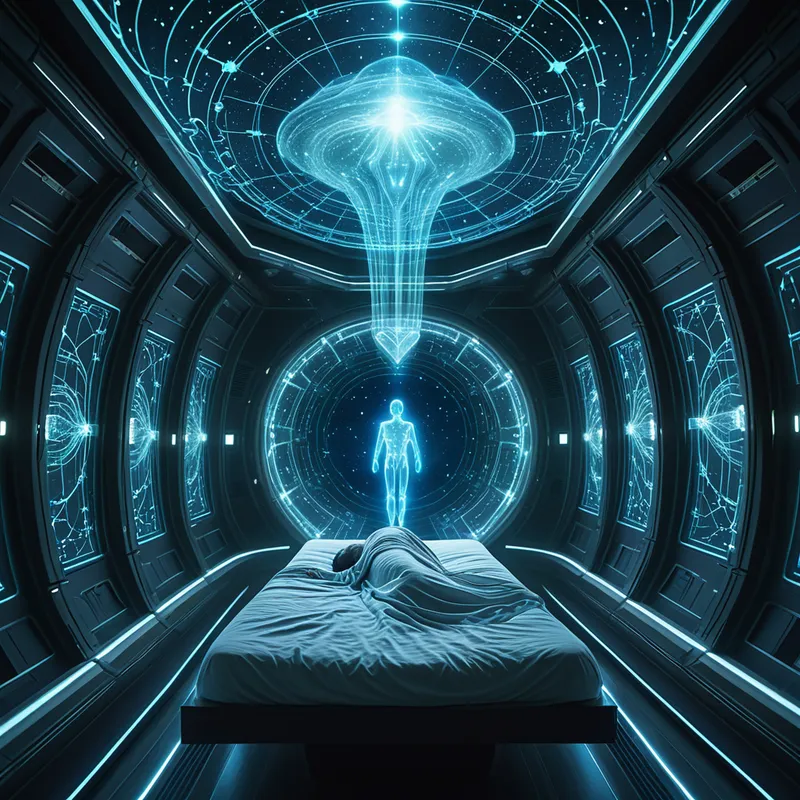
When the Starship sails into modern dreams, it signals a profound psychic mobilization. To dream of being on a starship, especially one that is malfunctioning, lost, or wondrously new, is to dream of the psyche in a state of radical transition.
Somatically, this can correlate with feelings of dissociation (“spacing out”), anxiety (the hum of life support), or exhilarating freedom (weightlessness). Psychologically, it marks the dreamer’s engagement with the transpersonal. A dream of a derelict ship adrift speaks to a feeling of existential abandonment, a loss of life’s purpose or direction. A dream of piloting a ship skillfully through an asteroid field reflects navigating a complex life crisis. A dream of discovering a new, living world from the ship’s bridge signifies the emergence of a new attitude or a creative synthesis from a long period of inner work. The ship is the dream-ego’s current vessel of consciousness, and its condition is a direct report on the state of the dreamer’s journey toward wholeness.
Alchemical Translation
The myth of the Starship is a perfect map for the alchemical process of individuation. The entire voyage is an opus in the void.
First, the [nigredo](/myths/nigredo “Myth from Alchemical culture.”/): the blackening. This is the Launching, the separation from the Cradle-World. It is the conscious entry into depression, confusion, and the “dark night of the soul,” which in the myth is portrayed as the vast, star-studded blackness. [The ego](/myths/the-ego “Myth from Jungian culture.”/) willingly submits to this darkness.
The alchemical vessel is sealed; the Starship’s airlock closes. Transformation cannot begin without absolute separation from the known.
Next, the albedo: the whitening. In the myth, this is the Long Drift, the purgatorial journey. It is the washing clean in the solitude of space, where the petty concerns of the old world are bleached away by the stark light of cosmic perspective. Insights flash like distant stars. This is the stage of reflection and purification.
Finally, the [rubedo](/myths/rubedo “Myth from Alchemical culture.”/): the reddening, the dawn of the new sun. This is the Arrival. It is not a return to the old, but the creation of a new psychic reality on the “planet” of the integrated Self. The Starship itself, the laboring ego-vessel, is often sacrificed or transformed. Its metal becomes the first tools; its memory banks become the foundational myths of the new consciousness.
The myth teaches that the Self is not found by digging deeper into the personal past, but by undertaking the courageous, lonely voyage into the transpersonal future. We must build our ship, sever our ties, and trust the navigation through the inner cosmos, where the only destination is a self we have not yet met, orbiting a sun we have not yet seen.
Associated Symbols
Explore related symbols from the CaleaDream lexicon: