The Starfish in Creation Myths Myth Meaning & Symbolism
A cosmic being sacrifices its form, scattering its five-pointed essence across the seafloor to become the first starfish, a map for the soul's journey.
The Tale of The Starfish in Creation Myths
In the time before time, when [the world](/myths/the-world “Myth from Tarot culture.”/) was only a thought in the dark womb of Po, there was the Great Ocean, Moana. It was not [the sea](/myths/the-sea “Myth from Greek culture.”/) we know, but a boundless, dreaming expanse—a soup of potential, silent and deep. No sun pierced its ceiling; no creature stirred in its depths. It was a waiting.
From the silence of Po, a consciousness stirred. It was not a god as we imagine, with a face and a name, but a presence—a will to become. We may call it [Tangaroa](/myths/tangaroa “Myth from Polynesian culture.”/), for he is the lord of oceans, but in this first moment, he was more a longing than a lord. He gazed into the featureless deep of Moana and felt a profound loneliness. The ocean was perfect, but it was empty. It had no song, no pattern, no way to be known.
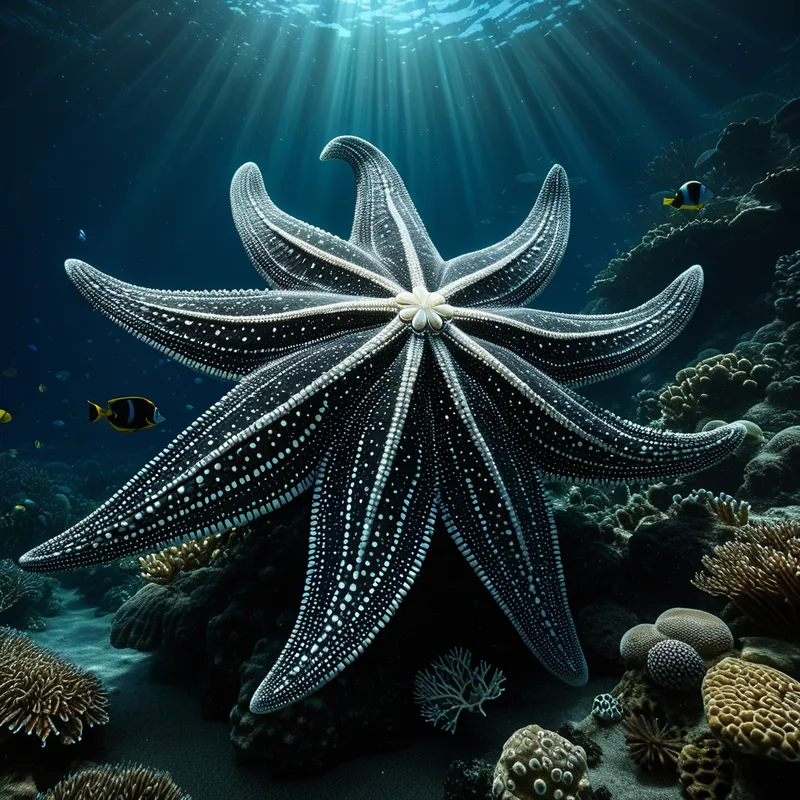
This longing took form as a sigh that rippled through the waters, and from that ripple, the presence gathered itself. It manifested not as a man or a fish, but as a great, radiant being of five points—a living constellation submerged in [the abyss](/myths/the-abyss “Myth from Kabbalistic culture.”/). It glowed with a soft, internal light, the first light that ever was, illuminating the eternal night of the primal sea. This was the Star-Being.
Yet, its light only made the emptiness more apparent. It could see, but there was nothing to see. It could be, but there was nothing to witness its being. [The Star](/myths/the-star “Myth from Tarot culture.”/)-Being understood then the great paradox of creation: to make a world, one must become part of it. To give the ocean a memory, a map, a meaning, it would have to shatter its own perfect unity.
With a resolve that shook the foundations of Po, the Star-Being began to let go. It did not fight; it surrendered. Its luminous essence began to soften, to dissolve at the edges. Its five great points, those arms of cosmic intention, started to fragment. Piece by brilliant piece, it shed itself. Its central heart of light dimmed, not extinguishing, but distributing.
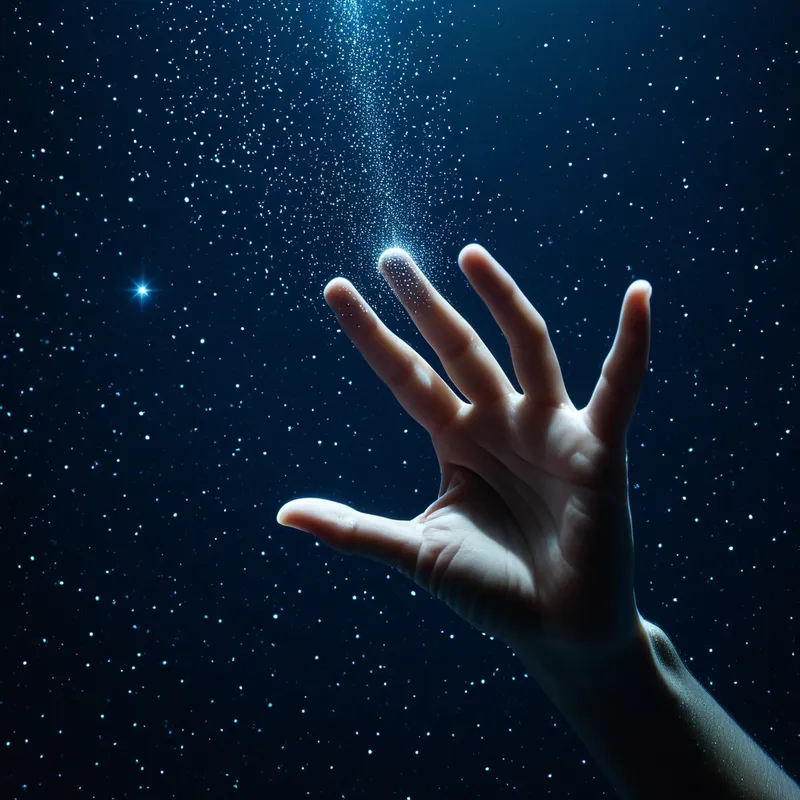
The particles of its being drifted down like slow, heavy stars through the black [water](/myths/water “Myth from Chinese culture.”/). They settled upon the soft, unseen floor of Moana. And where they landed, they did not die. They transformed. Each fragment, each spark of that original will, grew. It rooted itself in the deep, and from it, a new shape arose: a body with five arms, a echo of the original form, but smaller, grounded, earthly. It was the first starfish.
One became ten, then a hundred, then a number as vast as the stars in [the sky](/myths/the-sky “Myth from Persian culture.”/) above that did not yet exist. The seafloor, once a blank slate, was now inscribed with a living pattern. The Star-Being was gone, but in its place was a multitude. Its single light was now reflected in a million humble, crawling stars. The ocean was no longer empty. It had a design, a silent, spreading testament to the sacrifice that made the world knowable. The first act of creation was not a command, but a fragmentation—a scattering of self to seed the deep with meaning.
Cultural Origins & Context
This narrative pattern, of a cosmic entity sacrificing its form to create the tangible world, is a foundational thread in the vast tapestry of Polynesian cosmology. While no single, standardized “Starfish Myth” exists in a singular text, the symbolic motifs are deeply embedded in oral traditions across the Pacific. The story draws from the pervasive creation theme where the world is born from the body of a primordial being—be it the Ranginui (Sky Father) and Papatūānuku (Earth Mother) whose separation creates space for life, or the deity Maui drawing land from the sea.
The starfish, or pātangatanga in some dialects, was a familiar sight to Polynesian voyagers and coastal dwellers. Its radial symmetry, its connection to the seafloor, and its regenerative abilities made it a potent natural symbol. Stories like this were not mere fables but functional cosmologies, recited by priests (tohunga) and elders to explain the nature of reality, the origin of natural phenomena, and humanity’s place within it. They were told during rituals, navigational teachings, and rites of passage, serving to connect the community to the mana of the ocean and the sacrificial creativity that underpins existence.
Symbolic Architecture
At its core, this myth is a profound [allegory](/symbols/allegory “Symbol: A narrative device where characters, events, or settings represent abstract ideas or moral qualities, conveying deeper meanings through symbolic storytelling.”/) for the [movement](/symbols/movement “Symbol: Movement symbolizes change, progress, and the dynamics of personal growth, reflecting an individual’s desire or need to transform their circumstances.”/) from potential to actuality, from the unified Self to the diversified world. The Star-Being represents undifferentiated [consciousness](/symbols/consciousness “Symbol: Consciousness represents the state of awareness and perception, encompassing thoughts, feelings, and experiences.”/)—the [psyche](/myths/psyche “Myth from Greek culture.”/) in its pre-individual, cosmic state. The featureless Moana is the unconscious, vast and fertile, but without [structure](/symbols/structure “Symbol: Structure in dreams often symbolizes stability, organization, and the framework of one’s life, reflecting how one perceives their environment and personal life.”/).
The first creative act is always a sacrifice of wholeness. The One must become Many so that the Many might someday seek to understand the One.
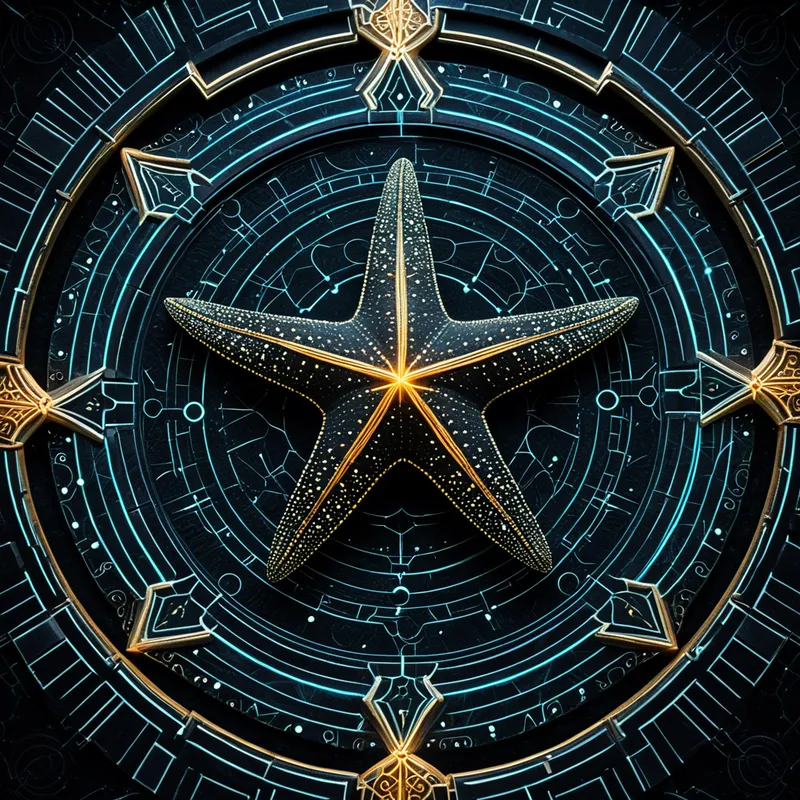
The five points are rich with [symbolism](/symbols/symbolism “Symbol: The use of symbols to represent ideas or qualities, often conveying deeper meanings beyond literal interpretation. In dreams, it’s the language of the unconscious.”/). They mirror the [human](/symbols/human “Symbol: The symbol of a human represents individuality, complexity of emotions, and social relationships.”/) form (head, arms, [legs](/symbols/legs “Symbol: Legs in dreams often symbolize movement, freedom, and the ability to progress in life, representing both physical and emotional support.”/)), suggesting the anthropomorphic [nature](/symbols/nature “Symbol: Nature symbolizes growth, connectivity, and the primal forces of existence.”/) of creation—the [universe](/symbols/universe “Symbol: The universe symbolizes vastness, interconnectedness, and the mysteries of existence beyond the individual self.”/) patterned in our [image](/symbols/image “Symbol: An image represents perception, memories, and the visual narratives we create in our minds.”/). They represent the five senses, the means by which we experience and map the world born from the sacrifice. In many traditions, five signifies balance, mediation (between the four cardinal directions and the center), and the tangible manifestation of [spirit](/symbols/spirit “Symbol: Spirit symbolizes the essence of life, vitality, and the spiritual journey of the individual.”/).
The [starfish](/symbols/starfish “Symbol: The starfish symbolizes regeneration, healing, and the ability to navigate through difficult situations.”/), then, is the archetypal map. It is the physical imprint of a cosmic [idea](/symbols/idea “Symbol: An ‘Idea’ represents a spark of creativity, innovation, or realization, often emerging as a solution to a problem or a new outlook on life.”/), a guidepost left on the seafloor of the unconscious. Each starfish is a fragment of the original [blueprint](/symbols/blueprint “Symbol: A blueprint represents the foundational plan or design for something, often symbolizing potential, structure, and the mapping of one’s inner self or future.”/), a reminder that every part of creation contains the [pattern](/symbols/pattern “Symbol: A ‘Pattern’ in dreams often signifies the underlying structure of experiences and thoughts, representing both order and the repetitiveness of life’s situations.”/) of the whole. Its [ability](/symbols/ability “Symbol: In dreams, ‘ability’ often denotes a recognition of skills or potential that one possesses, whether acknowledged or suppressed.”/) to regenerate lost arms echoes the myth’s [theme](/symbols/theme “Symbol: Themes in dreams often represent the overarching ideas or emotions the dreamer is grappling with.”/): from apparent [loss](/symbols/loss “Symbol: Loss often symbolizes change, grief, and transformation in dreams, representing the emotional or psychological detachment from something or someone significant.”/) and [fragmentation](/symbols/fragmentation “Symbol: The experience of breaking apart, losing cohesion, or being separated into pieces. Often represents disintegration of self, relationships, or reality.”/) comes renewal and [multiplication](/symbols/multiplication “Symbol: Represents exponential growth, spiritual expansion, and the amplification of energy or consciousness beyond linear progression.”/).
The Dreamer’s Resonance
When this myth stirs in the modern dreamer, it often surfaces during periods of profound personal dissolution or creative birthing. To dream of a starfish, especially in a deep, dark sea or in a context of transformation, can signal a somatic process of necessary fragmentation.
The psyche is preparing to sacrifice a old, perhaps outgrown, sense of unified identity (the “Star-Being” self) to create something new and more complex in the world. This can feel like a crisis—a fear of falling apart, of losing one’s light or central purpose. The dream may carry sensations of sinking, dissolving, or scattering. Yet, the starfish symbol insists this is not annihilation, but a sacred dispersal. The dreamer is undergoing a process where a singular talent, a monolithic self-concept, or a long-held ideal must be broken down and distributed into multiple, smaller, more adaptable forms—new projects, new roles, new connections.
Alchemical Translation
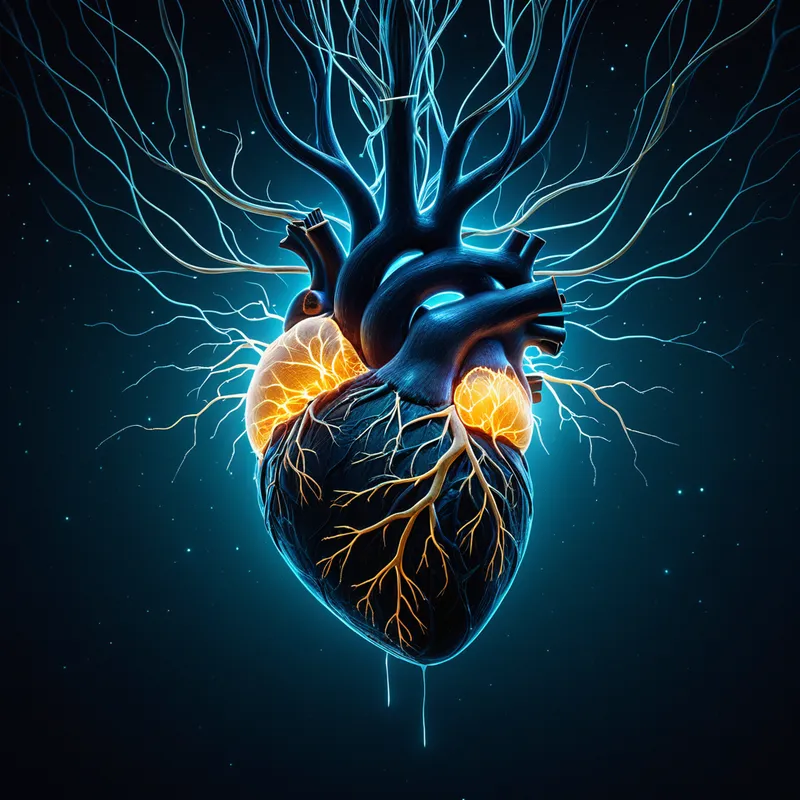
The alchemical journey modeled here is the opus of Individuation, specifically the stage of [solutio](/myths/solutio “Myth from Alchemical culture.”/) (dissolution) followed by multiplicatio. The modern individual often clings to a monolithic, ego-centric Self, a “Star-Being” that wishes to shine alone in [the void](/myths/the-void “Myth from Buddhist culture.”/). The path to wholeness, however, requires the courage of the Star-Being.
Individuation is not about becoming a more perfect, isolated star. It is about consenting to be scattered, so that your essence may become a constellation within the world.
The “Great Ocean” is the totality of one’s life—relationships, work, community, the unconscious. The alchemical work is to willingly let the centralized ego-structure dissolve, to allow its energies to be distributed into these waters. This might mean sharing authority, delegating a life’s work, embracing vulnerability, or allowing one’s identity to be shaped by others. The “starfish” that result are the integrated complexes, the lived contributions, the tangible legacies that now carry your pattern.
The [triumph](/myths/triumph “Myth from Roman culture.”/) is not in remaining an untouched, luminous singularity, but in becoming a generative pattern repeated across the landscape of your existence. The original light is not lost; it is translated. The goal is to look upon the seafloor of your life and see it teeming with the living, guiding forms born from your sacred surrender. You become not a lone creator, but the very principle of creation itself, multiplied and enduring.
Associated Symbols
Explore related symbols from the CaleaDream lexicon: