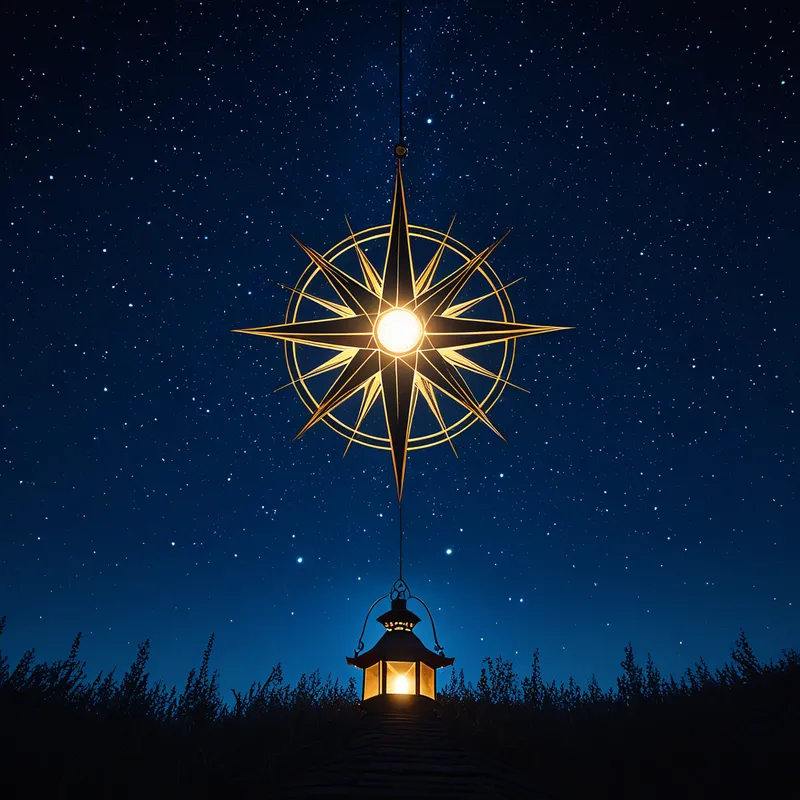
The Star of Bethlehem Myth Meaning & Symbolism
A celestial herald pierces the cosmic dark, guiding seekers to the birthplace of a new consciousness, a light born within the deepest human night.
The Tale of The Star of Bethlehem
Listen. There is a silence that comes before [the word](/myths/the-word “Myth from Biblical culture.”/), a darkness that cradles the first light. In that ancient dark, when empires were heavy stones upon the soul and hope was a memory thinner than a whisper, [the sky](/myths/the-sky “Myth from Persian culture.”/) began to dream.
It began not with a sound, but with a subtraction. The familiar constellations, those old stories pinned to the vault, seemed to hold their breath. Then, in the east, where the sun is born, a new point of fire kindled. It was not like other stars. It did not twinkle with cold, distant curiosity. It burned. It was a liquid, pooling light, a silent trumpet blast written in radiance. To the shepherds on the hills, it was a strange, beautiful terror, bleaching the wool of their flocks to silver. To the sleepless scholars in their towers of clay and vellum, it was a screaming anomaly in their perfect charts—a verb where only nouns should be.
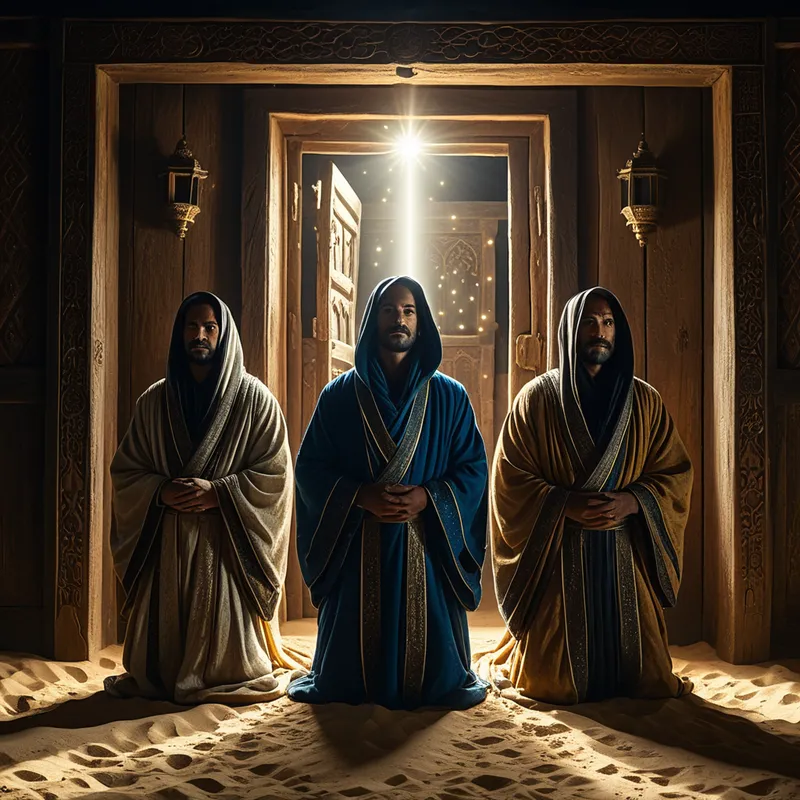
These scholars, Magi, were readers of the sky-text. They knew the grammar of planets and the poetry of conjunctions. This star was a new sentence, one that spoke of a king not of land and legion, but of spirit and substance. It was a summons written in light. And so they went, leaving the certainty of their scrolls for the uncertainty of the road, drawn by a celestial hook in their hearts. They followed a beacon that moved not with the stately wheel of the firmament, but with the intent of a guide.
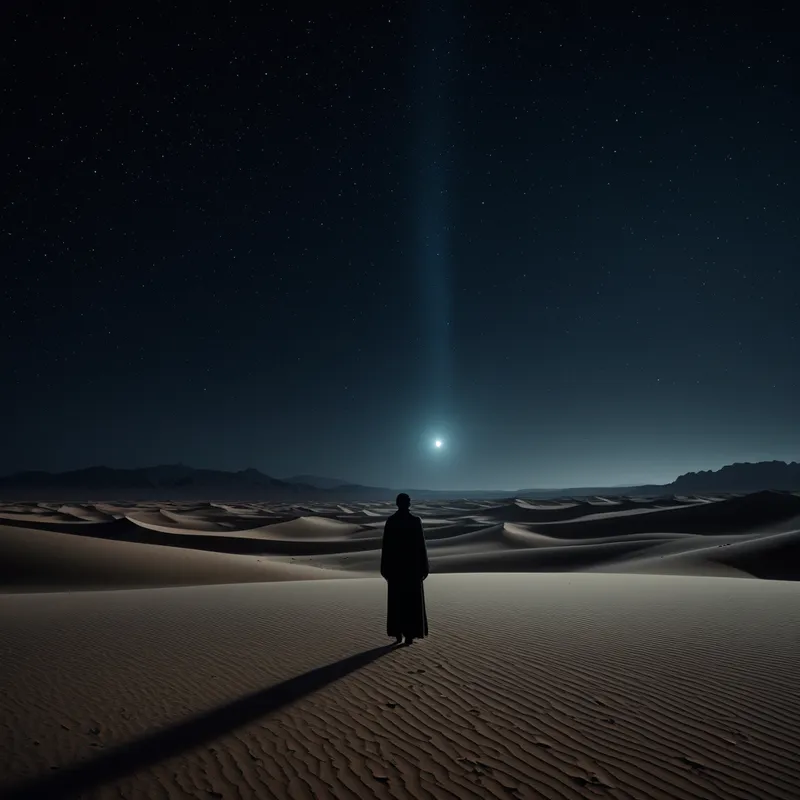
Their journey was [the world](/myths/the-world “Myth from Tarot culture.”/) in miniature: scorching deserts where [the star](/myths/the-star “Myth from Tarot culture.”/) was a cool promise on the brow, treacherous mountains where its light was the only path, and the cynical courts of men like Herod, where power, smelling a threat, smiled with a mouth full of knives. [The star](/myths/the-star “Myth from Tarot culture.”/) led them through all of it. And then it stopped. Not faded, not set—stopped. It hung, a silent, blazing pendant, over a place of profound ordinary: a dwelling in the little town of Bethlehem.
There was no palace guard, no fanfare of gold. The light from the sky fell upon a scene of humble human warmth. And in that confluence—the cosmic light from above meeting the vulnerable, newborn light in [the manger](/myths/the-manger “Myth from Christian culture.”/)—the journey ended. The seekers had found what was sought. They offered their gifts, not to a throne, but to a child. The star, its purpose fulfilled, faded back into the story of the night, leaving behind a changed world and a trail of light etched forever in the memory of humanity.
Cultural Origins & Context
The myth is rooted in the Second Temple Judaic and early Hellenistic world, a time of profound apocalyptic expectation and cultural syncretism. It appears solely in the Gospel of Matthew, a text composed for a Jewish audience intimately familiar with Tanakh prophecies, such as Balaam’s oracle of a star rising from [Jacob](/myths/jacob “Myth from Biblical culture.”/) (Numbers 24:17).
The tellers were early Christian communities, weaving a narrative that served multiple crucial functions. Societally, it was a polemic of legitimacy, asserting the Messiah’s cosmic, universal kingship over and above the political authority of Rome or Herod. It was a myth for the marginalized, showing that the ultimate revelation bypassed [Jerusalem](/myths/jerusalem “Myth from Biblical culture.”/)’s elite and was instead granted to foreign Gentile astrologers and humble shepherds. Its transmission was oral and communal before being codified, functioning as a foundational story that explained the nature of their faith: a divine light entering history, perceptible to those who had the eyes—and the courage—to follow.
Symbolic Architecture
At its core, the Star is not an astronomical object but a theophany—a manifestation of the divine in cosmic [language](/symbols/language “Symbol: Language symbolizes communication, understanding, and the complexities of expressing thoughts and emotions.”/). It represents the numinosum, the arresting, compelling force of the sacred that disrupts the ordinary.
The true guide appears not as a map, but as a disruption of the familiar sky.
The Star symbolizes the call to individuation. It is the sudden, inexplicable [intuition](/symbols/intuition “Symbol: The immediate, non-rational understanding of truth or insight, often described as a ‘gut feeling’ or inner knowing that bypasses conscious reasoning.”/), the [synchronicity](/symbols/synchronicity “Symbol: Meaningful coincidences that suggest an underlying connection between events, often interpreted as guidance or confirmation from the universe.”/), the dream [image](/symbols/image “Symbol: An image represents perception, memories, and the visual narratives we create in our minds.”/), or the psychological [symptom](/symbols/symptom “Symbol: A physical or emotional sign indicating an underlying imbalance, distress, or message from the unconscious mind.”/) so vivid it cannot be ignored. It is [the Self](/myths/the-self “Myth from Jungian culture.”/), the central [archetype](/symbols/archetype “Symbol: A universal, primordial pattern or prototype in the collective unconscious that shapes human experience, behavior, and creative expression.”/) of wholeness, announcing its nascent [presence](/symbols/presence “Symbol: Presence in dreams often signifies awareness or acknowledgment of something significant in one’s life.”/) in the [psyche](/myths/psyche “Myth from Greek culture.”/). The [journey](/symbols/journey “Symbol: A journey in dreams typically signifies adventure, growth, or a significant life transition.”/) of [the Magi](/myths/the-magi “Myth from Christian culture.”/) is [the ego](/myths/the-ego “Myth from Jungian culture.”/)’s arduous [pilgrimage](/symbols/pilgrimage “Symbol: A spiritual or transformative journey toward a sacred destination, representing personal growth, devotion, and the search for meaning.”/) toward that nascent Self. Herod represents the hostile, paranoid, and [status](/symbols/status “Symbol: Represents one’s social position, rank, or standing within a group, often tied to achievement, power, or recognition.”/)-quo-driven complex within the [psyche](/myths/psyche “Myth from Greek culture.”/) that seeks to destroy new [consciousness](/symbols/consciousness “Symbol: Consciousness represents the state of awareness and perception, encompassing thoughts, feelings, and experiences.”/). The gifts—gold, [frankincense](/symbols/frankincense “Symbol: A sacred resin used historically in religious rituals and healing, symbolizing purification, spiritual connection, and divine offering.”/), and [myrrh](/symbols/myrrh “Symbol: A fragrant resin historically used in incense, perfumes, and embalming, symbolizing purification, sacrifice, and the sacred.”/)—signify the total offering of one’s entire being: our worldly value, our spiritual devotion, and our mortal suffering, all laid at the [feet](/symbols/feet “Symbol: Feet symbolize our foundation, stability, and the way we connect with the world around us, often reflecting our sense of direction and purpose.”/) of the emerging new center.
The Dreamer’s Resonance
When this myth stirs in the modern dreamer, it signals a profound orientation process. To dream of a uniquely brilliant star, a guiding light, or a journey toward a radiant destination is to experience the psyche’s own announcement of a potential transformation.
Somatically, this may manifest as a feeling of being “pulled,” a restlessness, or a deep, magnetic yearning toward an unknown goal. Psychologically, the dreamer is in the stage of being called. The conscious mind (the Magi) has perceived a signal from the deeper Self (the Star) and must now undertake the often-disorienting work of following it. Resistance (Herod) will appear in dreams as figures of authority forbidding the journey, dead ends, or losing the light. The dreamer is navigating the conflict between the comfort of the known world and the compelling, terrifying attraction of the numinous. The culmination—finding a child, a light, a simple home—marks the dreamer’s nascent connection to the vulnerable, new, and utterly real core of their own being.
Alchemical Translation
The myth is a perfect allegory for the individuation process. The [prima materia](/myths/prima-materia “Myth from Alchemical culture.”/), the leaden state of unconscious suffering and spiritual longing, is “impregnated” by the celestial light—the irruption of the Self.
The birth of the divine child is always preceded by the long, star-led night of the soul.
The alchemical operation is one of conjunctio—[the sacred marriage](/myths/the-sacred-marriage “Myth from Various culture.”/) of opposites. The star (transcendent, cosmic, spiritual) descends to meet [the child](/myths/the-child “Myth from Alchemy culture.”/) in Bethlehem (immanent, earthly, human). In the psyche, this is the integration of the spiritual archetype into the fabric of human life, the grounding of inspiration into incarnation. The Magi’s journey is the mortificatio and [separatio](/myths/separatio “Myth from Alchemical culture.”/)—the dying to old identities and the separation from collective norms. Their arrival and offering are the sublimatio—the lifting of base matter (their gifts, their old selves) into service of the new. The modern individual lives this by heeding their unique “star”—a calling, a creative impulse, a path to healing—through the deserts of doubt and the courts of internal criticism, to arrive at the humble, authentic birthplace of their own true nature, where the greatest light is found not in the distant sky, but shining, quietly and fiercely, from within the most human of conditions.
Associated Symbols
Explore related symbols from the CaleaDream lexicon: