The Star Myth Meaning & Symbolism
A celestial goddess pours the waters of life onto earth and into the unconscious, guiding the soul from ruin to revelation under a canopy of stars.
The Tale of The Star
Listen. Listen to the silence that comes after the crash.
The dust of the shattered tower has settled. The screams have faded into echoes, and the echoes into memory. All that remains is a vast, open plain beneath a sky bruised purple with twilight. The air is cool, and it carries the scent of damp earth and distant rain. In this profound quiet, a figure moves.
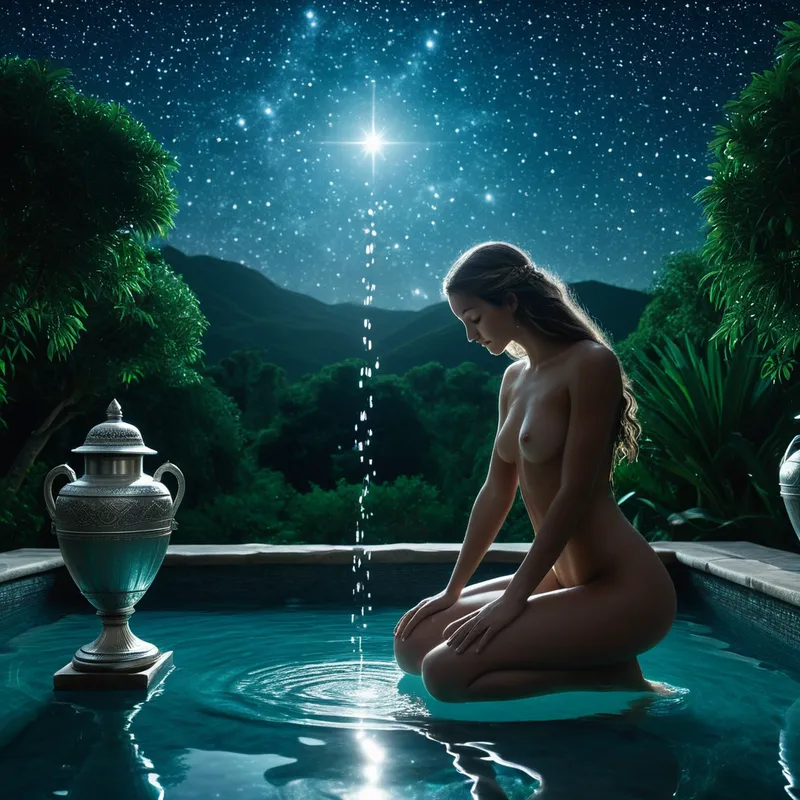
She is not of this earth, yet she kneels upon it. Her skin holds the pallor of moonlight, and her hair flows like a river of night. She is naked, unashamed, a primal form of grace. One knee rests upon the solid ground; the other dips into the mirrored surface of a still, dark pool. In her hands, she holds two urns.
With infinite care, she tilts the urn in her right hand. From it pours a stream of silvery water onto the rich, waiting soil. Where it falls, small green shoots unfurl in the gloaming, a promise of life returning. Then, she tilts the urn in her left hand. This stream falls back into the pool from which she draws, a perpetual cycle, a gift returned to the source.
Above her, the sky deepens. One by one, then in cascading multitudes, the stars emerge. They are not the cold, distant points of the astronomer’s chart, but living jewels, each pulsing with a secret song. Seven are larger, brighter—the Seven Sisters of ancient lore, the guardians of fate. One star, larger than all others, burns directly above her head, its light a column connecting heaven to the crown of her being.
A single, large bird—a ibis perhaps, or a heron—watches from a bare branch on the far shore of the pool. It does not stir. It is a witness. The goddess does not speak. Her work is her liturgy. She pours, and in the pouring, the world is remade not by force, but by blessing. The conflict was the fall; the resolution is this: the quiet, ceaseless act of pouring hope back into the broken vessel of the world, and of the soul. The night is not an end, but a womb.
Cultural Origins & Context
The image of The Star is one of the 22 Major Arcana in the Tarot, with its earliest recognizable form appearing in 15th-century Italian decks like the Visconti-Sforza. Unlike the structured narratives of classical mythology, Tarot “myths” are visual and symbolic, passed down not through epic poetry but through the hands of card painters, fortune-tellers, and occult scholars.
Its societal function was dual. In the parlors of the Renaissance nobility, it was part of a card game. In the secret studies of hermeticists and mystics, it became a map of the soul’s journey. By the 18th and 19th centuries, with the rise of orders like the Hermetic Order of the Golden Dawn, the card was systematized into a complex symbolic language. It was linked to the zodiacal sign of Aquarius, the planet Uranus (as a modern ruler), and the Hebrew letter Heh, meaning “window.” Thus, The Star became a window into the celestial influences, a card of divine inspiration channeled into the material and subconscious realms. It was a myth for the individual seeker, a private symbol of the hope that persists after personal catastrophe.
Symbolic Architecture
The myth of The Star is an allegory of psychic restoration. The naked goddess represents the soul stripped bare, vulnerable, yet authentic after the ego’s defenses (the Tower) have been demolished. Her nudity is not exposure, but truth.
The cosmos does not shout its truths; it whispers them in the flow of water and the silent language of light.
The two urns signify a dual flow. The water poured onto earth (the conscious) is inspiration made manifest—creativity, healing, tangible hope. The water returned to the pool (the subconscious) represents the nourishing of the soul’s own depths, a recursive act of self-care and introspection. The large star is the Self in Jungian terms, the inner guiding light. The seven smaller stars often correspond to the chakras or planets, suggesting the alignment of the entire being with cosmic order. The pool is the unconscious, now calm and reflective after the storm. The bird, a creature of air, symbolizes the mind at peace, witnessing the reconciliation of above and below.
The Dreamer’s Resonance
When this myth stirs in the modern dreamer, it often follows a period of rupture—a loss, a failure, a shocking revelation. The dream landscape may feature serene bodies of water under starlight, finding a hidden spring, or simply the overwhelming, peaceful presence of a star-filled sky.
Somatically, this can feel like a deep, releasing breath held for too long, or a cool balm on fevered skin. Psychologically, it marks the shift from traumatic reaction to integrative processing. The psyche is no longer fighting the fall or rummaging in the rubble; it has moved to a quiet place of acceptance and is beginning the slow, instinctive work of self-replenishment. To dream of The Star is to experience the unconscious itself offering a vision of hope that is not naïve, but earned. It is the soul’s innate healing intelligence activating, pouring the waters of memory, insight, and potential back into the parched landscapes of the dreamer’s inner world.
Alchemical Translation
In the alchemical process of individuation—becoming who one truly is—The Star represents the stage of Ablutio or Albedo. Following the fiery death and blackening (Nigredo) symbolized by the Tower, the soul’s matter is washed clean.
The greatest alchemy is not turning lead to gold, but turning despair into a vessel for starlight.
The modern individual engages in this transmutation by engaging in practices that “pour the water”: creative expression that channels inner vision outward (the right-hand urn), and contemplative practices like meditation, journaling, or therapy that nourish the inner depths (the left-hand urn). It is the conscious cultivation of hope as a discipline, not as a feeling. It is finding one’s guiding “star”—a core value, a sense of purpose, a connection to something transcendent—and aligning daily actions with its light. The triumph of The Star is not a victory over an enemy, but the quiet, persistent triumph of nature over ruin. It models how we, too, can kneel at the pool of our own being, and begin, again and again, the gentle work of pouring life back into ourselves, becoming both the goddess and the blessed earth.
Associated Symbols
Explore related symbols from the CaleaDream lexicon: