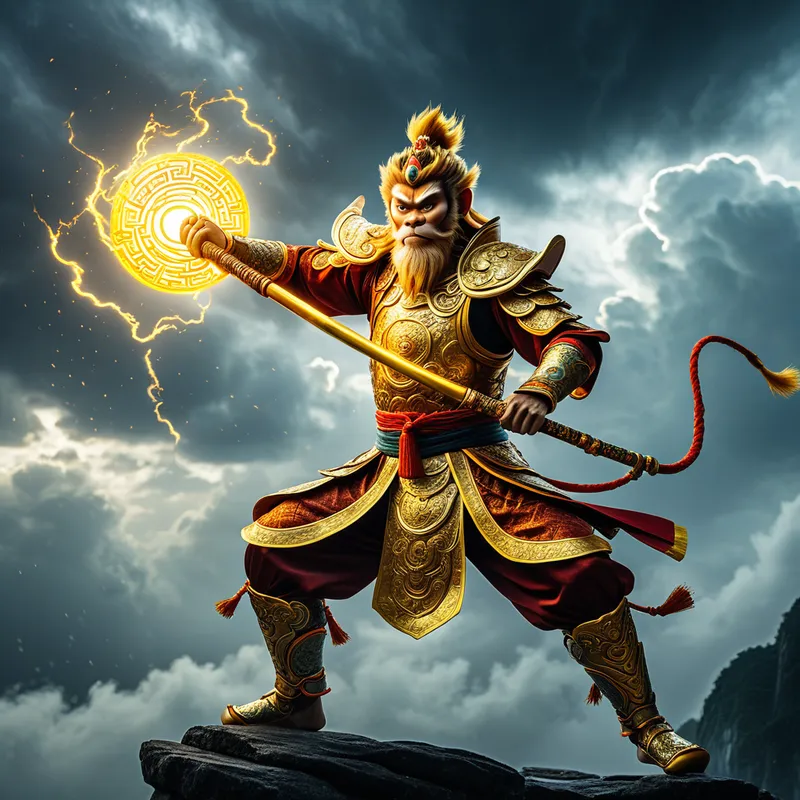
The Staff of Sun Wukong Myth Meaning & Symbolism
The tale of the Monkey King's magical staff, a cosmic pillar he wields on his epic journey from rebellious chaos to enlightened mastery.
The Tale of The Staff of Sun Wukong
Listen, and hear the tale of the iron that danced.
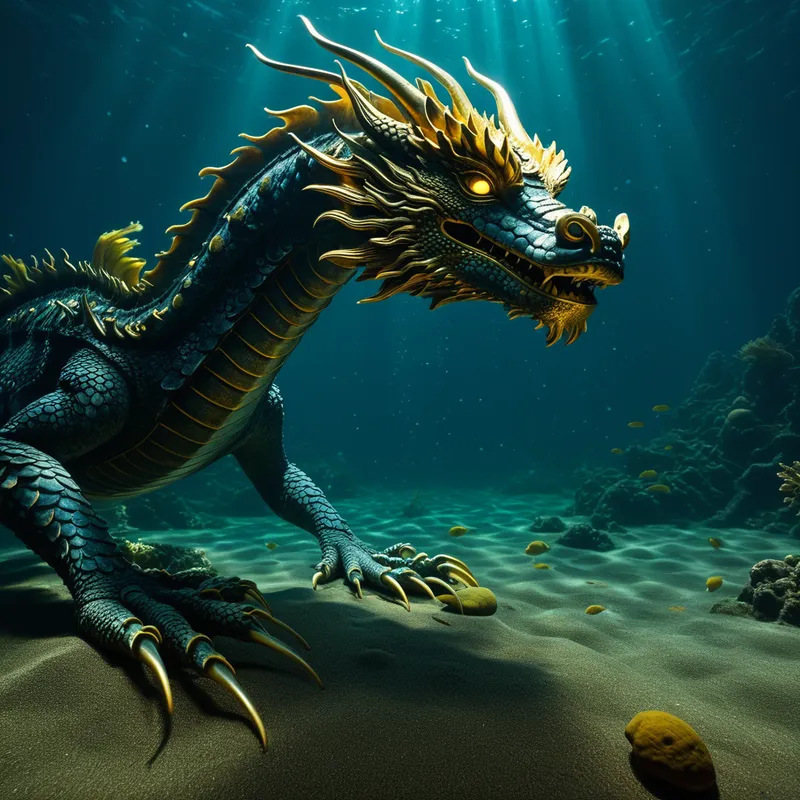
In the depths of the East Sea Dragon Palace, where light fell in watery pillars and jewels glowed like captive stars, there lay a treasure forgotten by time. It was not a jewel, nor a [pearl](/myths/pearl “Myth from Chinese culture.”/), but a pillar of black iron, thick as a barrel and towering into the gloom. The Dragon Kings called it the Ruyi Jingu Bang, the “As-You-Will Gold-Banded Cudgel,” a relic from the days when the [Jade Emperor](/myths/jade-emperor “Myth from Chinese culture.”/) set the measure of the heavens. It was the Pillar that Pacifies the Seas, holding the cosmic waters in check. To them, it was a monument, immovable, a dead [thing](/myths/thing “Myth from Norse culture.”/) of stone and metal.
Then he came. Not with reverence, but with the crackling, insolent energy of a force unchained. He was [Sun Wukong](/myths/sun-wukong “Myth from Chinese culture.”/), the Heaven-born stone monkey, king of the Huaguo Mountain. He had come seeking a weapon worthy of his might, and [the Dragon](/myths/the-dragon “Myth from Chinese culture.”/) King’s glittering armories had offered only toys. His gaze, sharp as a diamond, fell upon the dark pillar. “Too thick,” he muttered, and as the thought formed, the pillar shrank. “Too long,” he mused, and it shortened. A gasp rippled through the watery court. The iron was listening.
He reached out, and his fingers closed around a staff now perfectly sized—a rod of black iron, tipped with golden bands. He lifted it, and the very foundations of the ocean trembled. The Pacifying Pillar was pacified no more; it was awake. It became an extension of his will, shrinking to the size of a needle tucked behind his ear, or expanding to a colossal beam that could part mountains. With it, he challenged the heavens themselves, a single rebellious streak against the celestial order, writing his name in chaos across the stars. The staff was no longer a tool of stability, but the instrument of a revolution, dancing to the tune of a monkey’s boundless, defiant heart.
Cultural Origins & Context
This myth is the fiery core of the 16th-century Ming dynasty novel [Journey to the West](/myths/journey-to-the-west “Myth from Chinese culture.”/), attributed to Wu Cheng’en. While the novel synthesized earlier folk tales and religious allegory, the episode of the staff crystallizes a quintessential Chinese narrative archetype: the brilliant, disruptive force that must be integrated. The story was not confined to literati; it was performed by storytellers in teahouses, enacted in operas on village stages, and painted on temple walls. It functioned as both thrilling entertainment and a profound cultural container. It spoke to the peasant dreaming of overthrowing injustice, the scholar-official chafing against rigid hierarchy, and the Buddhist or Taoist adept understanding the allegory of the unbridled mind (the monkey) seeking the discipline of the path (the staff as a tool, later a symbol of pilgrimage). The staff’s theft is not a crime in the folk imagination, but a reclamation—a cosmic resource being rightfully claimed by an emergent, dynamic consciousness.
Symbolic Architecture
The Ruyi Jingu Bang is arguably one of the most potent symbolic objects in world mythology. It is the [axis](/symbols/axis “Symbol: A central line or principle around which things revolve, representing stability, orientation, and the fundamental structure of reality or consciousness.”/) mundi made personal, [the world](/myths/the-world “Myth from Tarot culture.”/)-pillar that an individual can wield.
The staff is the paradox of the disciplined rebel: a tool of order that enables chaos, and a weapon of chaos that must learn order.
Psychologically, it represents the innate, potent core of [the Self](/myths/the-self “Myth from Jungian culture.”/) before socialization—the raw will and genius that is often submerged, “pacifying the seas” of our unconscious. Sun Wukong’s act of claiming it is [the ego](/myths/the-ego “Myth from Jungian culture.”/)’s first, triumphant contact with this immense inner resource. Its [ability](/symbols/ability “Symbol: In dreams, ‘ability’ often denotes a recognition of skills or potential that one possesses, whether acknowledged or suppressed.”/) to change size symbolizes the adaptability of true power, which can be as subtle as a thought ([needle](/symbols/needle “Symbol: The needle is a powerful symbol of connection, precision, and the intricate threads of life that bind experiences and emotions.”/)-sized) or as world-altering as a conviction ([mountain](/symbols/mountain “Symbol: Mountains often symbolize challenges, aspirations, and the journey toward self-discovery and enlightenment.”/)-sized). The golden bands that cap it hint at the necessary constraints, the [ritual](/symbols/ritual “Symbol: Rituals signify structured, meaningful actions carried out regularly, reflecting cultural beliefs and emotional needs.”/) and [purpose](/symbols/purpose “Symbol: Purpose signifies direction, meaning, and intention in life, often reflecting personal ambitions and core values.”/) that eventually channel its wild [energy](/symbols/energy “Symbol: Energy symbolizes vitality, motivation, and the drive that fuels actions and ambitions.”/). In its dormant state, it was a measure of cosmic [stability](/symbols/stability “Symbol: A state of firmness, balance, and resistance to change, often represented by solid objects, foundations, or steady tools.”/); in Sun Wukong’s hands, it becomes the measure of his own evolving [destiny](/symbols/destiny “Symbol: A predetermined course of events or ultimate purpose, often linked to spiritual forces or cosmic order, representing life’s inherent direction.”/).
The Dreamer’s Resonance
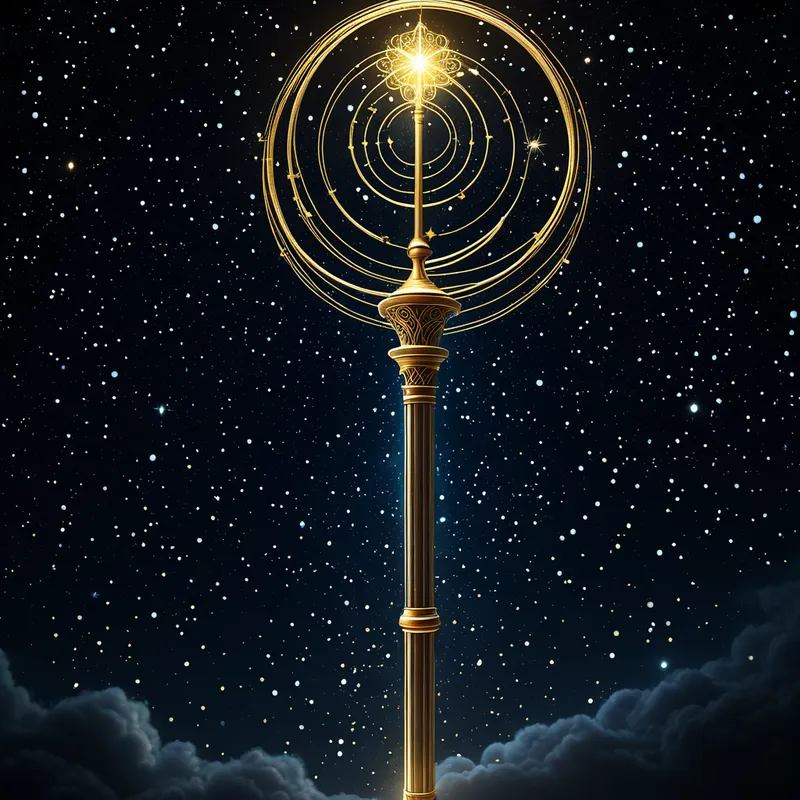
To dream of such a staff is to dream of latent potency. The dreamer may find a simple rod of wood or metal that responds to their thought, growing heavy or light, large or small. There is often a somatic component—a feeling of surging power in the arms and chest, a thrilling sense of agency. This dream emerges at a psychological crossroads where the individual is confronting a rigid, external structure (a “Dragon Palace” of societal expectation, corporate hierarchy, or familial duty) and feels an instinct to claim a tool of their own authority.
The conflict in the dream mirrors the myth: the initial exhilaration of wielding such power is often followed by chaos. The dreamer might accidentally break things, cause tremors, or attract the wrath of shadowy, authoritative figures. This signifies the [psyche](/myths/psyche “Myth from Greek culture.”/)’s warning. The awakening of the inner Sun Wukong—the rebellious, ingenious spirit—is not the end of the journey, but the tumultuous beginning. The dream is an invitation to acknowledge this formidable inner resource, not to let it gather dust in the depths, nor to let it run amok unchecked.
Alchemical Translation
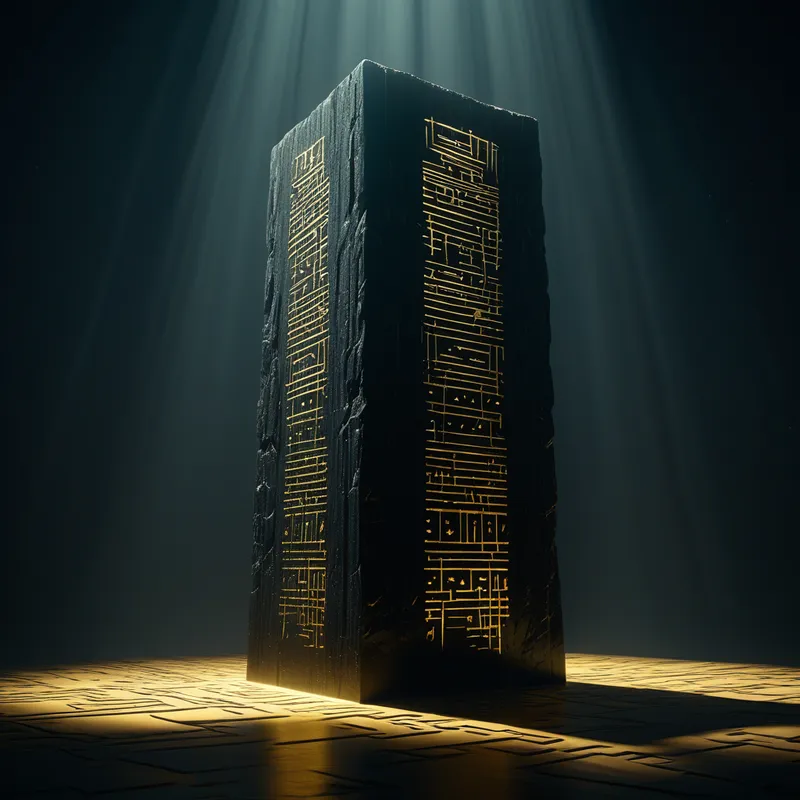
The myth models the early, fiery stages of individuation. The alchemical process begins with the [prima materia](/myths/prima-materia “Myth from Alchemical culture.”/)—the chaotic, base substance. Here, that substance is the unclaimed, unconscious potency (the staff at the ocean floor). Sun Wukong’s act is the [separatio](/myths/separatio “Myth from Alchemical culture.”/) and sublimatio: he separates this power from the realm of the undifferentiated deep ([the collective unconscious](/myths/the-collective-unconscious “Myth from Jungian culture.”/), represented by [the sea](/myths/the-sea “Myth from Greek culture.”/)) and raises it into the light of conscious possession.
The ultimate alchemy is not the possession of the magical object, but the transformation of the one who wields it.
The subsequent havoc Sun Wukong wreaks upon heaven is the necessary [nigredo](/myths/nigredo “Myth from Alchemical culture.”/), the blackening, the chaotic dissolution of the old celestial order (the old, rigid personality structure). He must be “defeated” and contained under the [Five Elements](/myths/five-elements “Myth from Chinese culture.”/) Mountain—a period of enforced introspection and containment. This is the albedo, the whitening, where the raw power is tempered by reflection. His eventual release to escort the monk Xuanzang on the pilgrimage is the [rubedo](/myths/rubedo “Myth from Alchemical culture.”/), the reddening. The staff is no longer just a weapon of rebellion; it becomes a tool for clearing the path on a sacred journey, protecting a higher purpose. The power that once measured the heavens is now used to measure the steps toward enlightenment. The rebel integrates into [the pilgrim](/myths/the-pilgrim “Myth from Christian culture.”/), and the staff of chaos becomes the rod of the guide. For the modern individual, this translates to the difficult process of taking one’s raw talent, rebellious energy, or unconventional genius—first using it to break free from oppressive constraints, then learning to discipline it, and finally directing it in service of a meaningful life journey.
Associated Symbols
Explore related symbols from the CaleaDream lexicon: