The Squire Myth Meaning & Symbolism
A young squire's journey from page to knight, defined by silent service, a pivotal sacrifice, and the alchemy of character forged in humility.
The Tale of The Squire
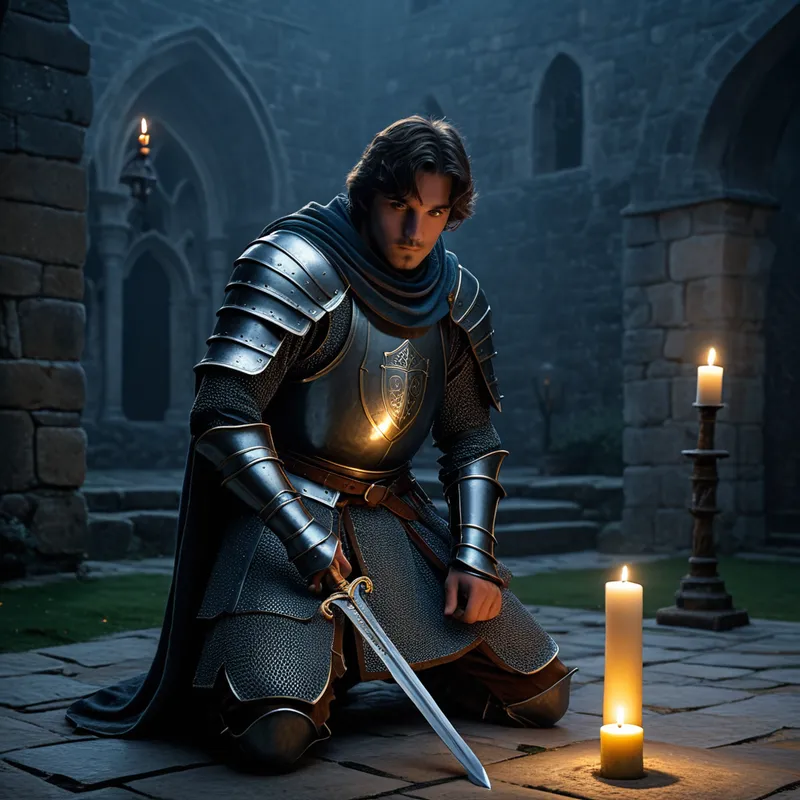
Listen. Before the trumpets, before the glory, before the name is sung in the hall, there is the silence of the yard. In that grey hour before the sun claims the land, when dew hangs like forgotten tears on the grass, he is already awake. He is [the shadow](/myths/the-shadow “Myth from Jungian culture.”/) that moves before the light.
They call him a squire. His world is not of parchment and prophecy, but of leather and steel, of sweat and service. His cathedral is the armory, his liturgy the meticulous rituals of care: the oiling of a hauberk to keep rust at bay, the sharpening of a blade until it sings a thin, dangerous note, the tending of a great, restless destrier who knows battle better than he ever will. He knows the weight of his lord’s shield, the exact fit of his gauntlets, [the way](/myths/the-way “Myth from Taoist culture.”/) the dawn light catches the dents in the helm—each one a story he was not there to witness.
The journey is dust, and rain, and fear. He rides at the rear, a train of packhorses and responsibility behind him. He feels the tension in the camp the night before a joust or a skirmish. He hears the older knights speak in low tones of honor and death, while his own heart hammers a frantic, unnamed rhythm against his ribs. His battle is not with lance or sword, but with buckling straps under trembling fingers, with fetching [water](/myths/water “Myth from Chinese culture.”/) that tastes of iron, with holding a torch steady so the surgeon can work.
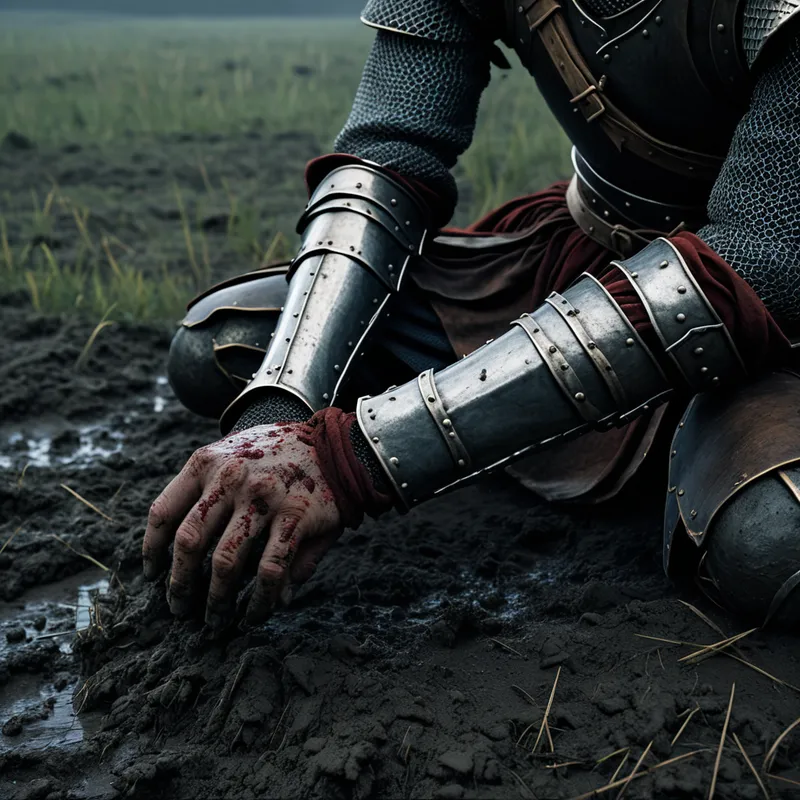
Then comes the day [the world](/myths/the-world “Myth from Tarot culture.”/) breaks. It is not in the glorious charge, but in the choked aftermath. The field is a tapestry of mud and anguish. His knight, the sun around which his entire world has orbited, lies fallen, his bright armor dimmed, his life seeping into [the earth](/myths/the-earth “Myth from Hindu culture.”/). The great quest, the noble cause, shrinks to this: one body, one breath fading.
And here, in the reek of blood and churned soil, the squire’s true mettle is tested. No one sings of this moment. He does not raise a sword. He crawls. He drags his lord from the fray, using his own body as a shield. He fumbles with a misericorde not to deal a death-blow, but to cut away ruined mail. He uses his own cloak to stanch the wound, his own voice—cracking, unheroic—to whisper assurances he does not feel. He forges his first act of true knighthood not in the smithy’s fire, but in the cold forge of desperation, with the tools of humility and sacrifice.
When the knight lives, and the king asks what boon the squire desires, the boy, now something else entirely, does not ask for land or title. He asks only to continue his service, or perhaps for a sword of his own—not as a reward, but as a responsibility. The accolade, the dubbing, is a formality. The transformation happened in the mud. The squire is gone. In his place stands a man who knows the weight of armor because he has carried it, and the weight of life because he has held it in his hands.
Cultural Origins & Context
The figure of the squire is the bedrock of the Arthurian world, a necessary hinge between the ideal and the real. While tales of [Lancelot](/myths/lancelot “Myth from Arthurian culture.”/) and [Merlin](/myths/merlin “Myth from Arthurian culture.”/) soared in the high medieval romances of Chrétien de Troyes and later Sir [Thomas](/myths/thomas “Myth from Christian culture.”/) Malory, the squire was [the anchor](/myths/the-anchor “Myth from Christian culture.”/). These stories were told in halls not only to inspire knights, but to instruct the boys who would become them.
The squire’s journey was a mirror of the feudal system itself—a pyramid of service, loyalty, and earned advancement. His myth was lived daily in castles across Europe. The stories codified this lived experience into a spiritual roadmap. Bards and storytellers used the squire’s trials to illustrate a profound cultural truth: that authority and honor are not inherent, but are forged through submission to a higher purpose and mastery of the mundane. The squire myth served as the essential prologue to every knight’s tale, grounding the dazzling concepts of chivalry in the dirt of daily, difficult practice.
Symbolic Architecture
Psychologically, the Squire represents the ego in service to [the Self](/myths/the-self “Myth from Jungian culture.”/). He is the conscious [personality](/symbols/personality “Symbol: Personality in dreams often symbolizes the traits and characteristics of the dreamer, reflecting how they perceive themselves and how they believe they are perceived by others.”/) that has not yet realized its own centrality, but which is being meticulously prepared for that [destiny](/symbols/destiny “Symbol: A predetermined course of events or ultimate purpose, often linked to spiritual forces or cosmic order, representing life’s inherent direction.”/) through menial, often frustrating, tasks.
The sword is not forged in the strike, but in the endless, patient folding of the metal in the fire.
His duties—polishing, carrying, observing—are not pointless chores. They are the alchemical processes of [attention](/symbols/attention “Symbol: Attention in dreams signifies focus, awareness, and the priorities in one’s life, often indicating where the dreamer’s energy is invested.”/) and containment. By focusing wholly on the care of another (the [knight](/symbols/knight “Symbol: The knight symbolizes honor, chivalry, and the pursuit of noble causes, reflecting the ideal of the noble warrior.”/), who symbolizes a nascent, superior [aspect](/symbols/aspect “Symbol: A distinct feature, quality, or perspective of something, often representing a partial view of a larger whole.”/) of the [psyche](/myths/psyche “Myth from Greek culture.”/) or a guiding ideal), the squire’s own base [metal](/symbols/metal “Symbol: Metal in dreams often signifies strength, transformation, and the qualities of resilience or coldness.”/) is tempered. The knight’s [armor](/symbols/armor “Symbol: Armor represents psychological protection, emotional defense, and the persona presented to the world. It symbolizes both safety and the barriers that separate us from vulnerability.”/) is a [symbol](/symbols/symbol “Symbol: A symbol can represent an idea, concept, or belief, serving as a powerful tool for communication and understanding.”/) of the squire’s own developing psychological defenses and [persona](/symbols/persona “Symbol: The social mask or outward identity one presents to the world, often concealing the true self.”/), which he must learn intimately from the outside in before he can inhabit them.
The pivotal act of saving his wounded [lord](/symbols/lord “Symbol: The symbol of ‘Lord’ represents authority, mastery, and control, along with associated power dynamics in relationships.”/) is the ultimate symbolic test. It represents the [moment](/symbols/moment “Symbol: The symbol of a ‘moment’ embodies the significance of transient experiences that encapsulate emotional depth or pivotal transformations in life.”/) [the ego](/myths/the-ego “Myth from Jungian culture.”/)’s self-interest is utterly sacrificed for the preservation of a deeper, guiding value or psychic [structure](/symbols/structure “Symbol: Structure in dreams often symbolizes stability, organization, and the framework of one’s life, reflecting how one perceives their environment and personal life.”/). The squire does not become a [hero](/symbols/hero “Symbol: A hero embodies strength, courage, and the ability to overcome significant challenges.”/) by slaying a [dragon](/symbols/dragon “Symbol: Dragons are potent symbols of power, wisdom, and transformation, often embodying the duality of creation and destruction.”/); he becomes one by preserving the inner dragon-slayer. This is the archetypal shift from serving an external master to recognizing that the master was always an internal principle, which he now must embody.
The Dreamer’s Resonance
When the pattern of the Squire appears in modern dreams, it often signals a profound phase of psychological initiation. The dreamer may find themselves in endless, repetitive tasks: cleaning a vast hall, organizing countless tools, or preparing for an event where they are not the guest of honor. There is a somatic feeling of burden, of being an apprentice to one’s own life.
This dream-state signifies that the psyche is in a necessary but arduous phase of groundwork. The conscious mind (the dream-ego) is being schooled by the unconscious. The “knight” in the dream—who may be an authority figure, a mentor, or even an abstract ideal like “success” or “wholeness”—is the symbol of the emerging Self. The frustration felt in the dream is the ego’s resistance to this essential, humble service. The dream is a reassurance: this tedious preparation is not a waste of time, but the very process by which the capacity for a greater life is built. The moment of “saving the knight” in a dream might manifest as finally standing up for a core value at work, or persisting in a therapeutic breakthrough despite the pain.
Alchemical Translation
The Squire’s myth is a perfect map for the individuation process. It models the transmutation of the lead of humble service into the gold of authentic selfhood.
The first alchemical stage, [nigredo](/myths/nigredo “Myth from Alchemical culture.”/) (the blackening), is his initial state: the dirty, thankless, shadowy work. He is immersed in the [prima materia](/myths/prima-materia “Myth from Alchemical culture.”/) of experience. The albedo (whitening) occurs through his meticulous, purifying routines—the polishing, the ordering. This is the development of consciousness and discipline.
The true vessel is not the chalice on the altar, but the soul that has been hollowed out by service, making it capable of holding something sacred.
The crucial act on the battlefield is the [rubedo](/myths/rubedo “Myth from Alchemical culture.”/) (reddening), the final stage. Here, the philosopher’s stone is revealed not as a physical object, but as an act of selfless love—caritas. By spilling his own life-force (his energy, his safety, his cloak) to save his guiding principle, he performs the ultimate alchemy. The ego’s leaden desire for recognition is dissolved, and in its place arises the golden, autonomous Self. He is no longer the one who tends the armor; he has become the armor, the sword, and the knight, all integrated into a single, responsible being. For the modern individual, this translates to the realization that our greatest power is not seized from the world, but forged in the faithful, often unseen, stewardship of our own deepest values and potentials.
Associated Symbols
Explore related symbols from the CaleaDream lexicon: