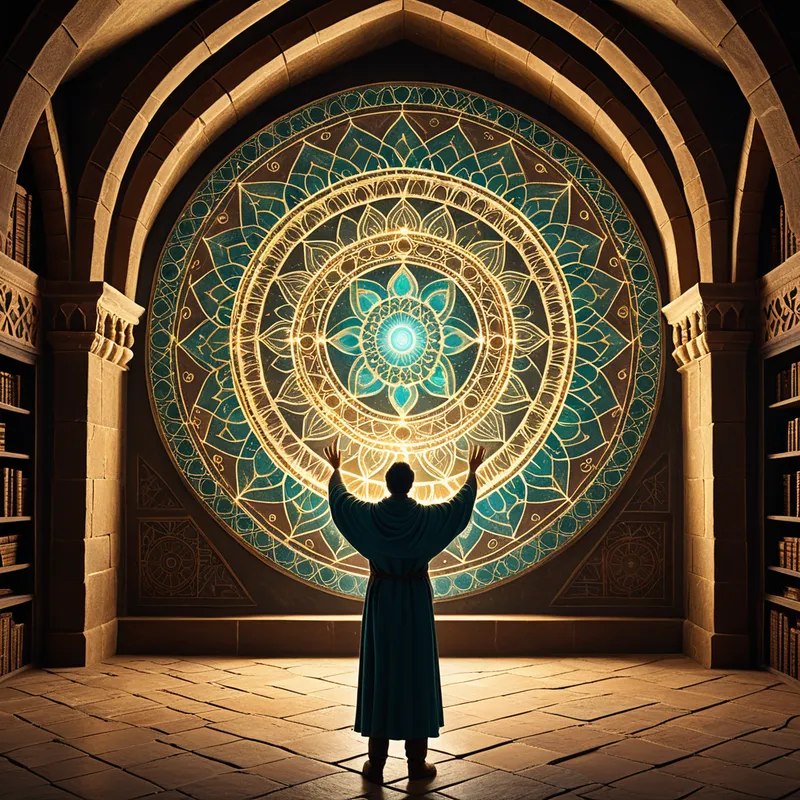
The Squaring of the Circle Myth Meaning & Symbolism
The impossible quest to unite the infinite circle of spirit with the finite square of matter, representing the ultimate alchemical goal of psychic wholeness.
The Tale of The Squaring of the Circle
Listen, and hear the tale not of a hero, but of a quest. A quest not for a golden fleece or a holy grail, but for a shape. A perfect, impossible shape.
In the perpetual twilight of the Laboratorium, where the scent of sulphur wrestled with the perfume of roses, the Adept toiled. Their world was one of paradox: the volatile and the fixed, the above and the below, the Sulphur and the Mercury. But above all, it was a world divided between the Circle and the Square.
The Circle was the breath of The One. It was the unbroken line, having no beginning and no end. It was the vault of the heavens, the orbit of the stars, the soul’s own eternity. To draw it was to invoke perfection, infinity, spirit. Its nature was to expand, to encompass, to breathe.
The Square was the law of the Earth. It was fourfold: the seasons, the elements, the corners of the material world. It was the foundation stone, the city wall, the confines of the body and of mortal time. Its nature was to define, to stabilize, to hold fast. It was order, but it was also prison.
The Adept’s task, whispered from master to apprentice since time out of mind, was the Squaring of the Circle. Not as a mathematician’s puzzle, but as a divine operation. The instruction was simple in its madness: Take the essence of the Circle—its infinite, boundless spirit—and contain it within the essence of the Square—its finite, manifest matter. Let them become one shape, without compromise, without loss.
For years that bled into decades, the Adept labored. With compasses of brass and rules of iron, they sought the geometric key. They drew circles within squares, squares within circles. The parchments piled high, a cemetery of failed attempts. The Circle would not be bounded without breaking its nature; the Square would not become infinite without dissolving its form. The conflict was absolute. Despair, a heavy Salt, settled in the Adept’s bones. The Laboratory grew cold, the fires dim.
Then, in the deepest hour of the Nigredo, as the Adept stared not at a drawing but into the dying embers of their furnace, a revelation struck not the mind, but the heart. It was not a problem of the hand, but of the eye. Not of construction, but of perception.
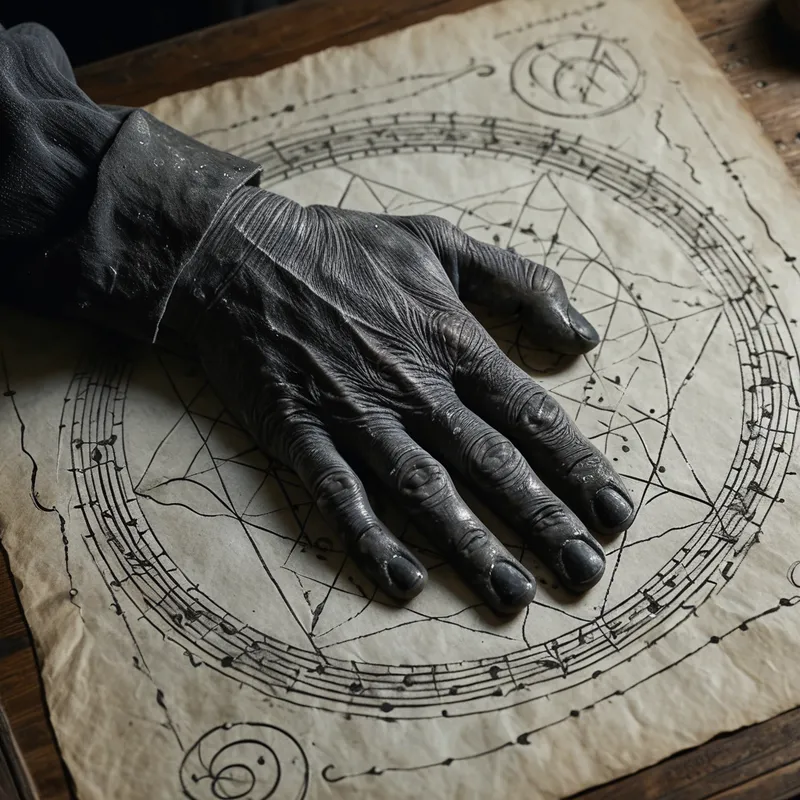
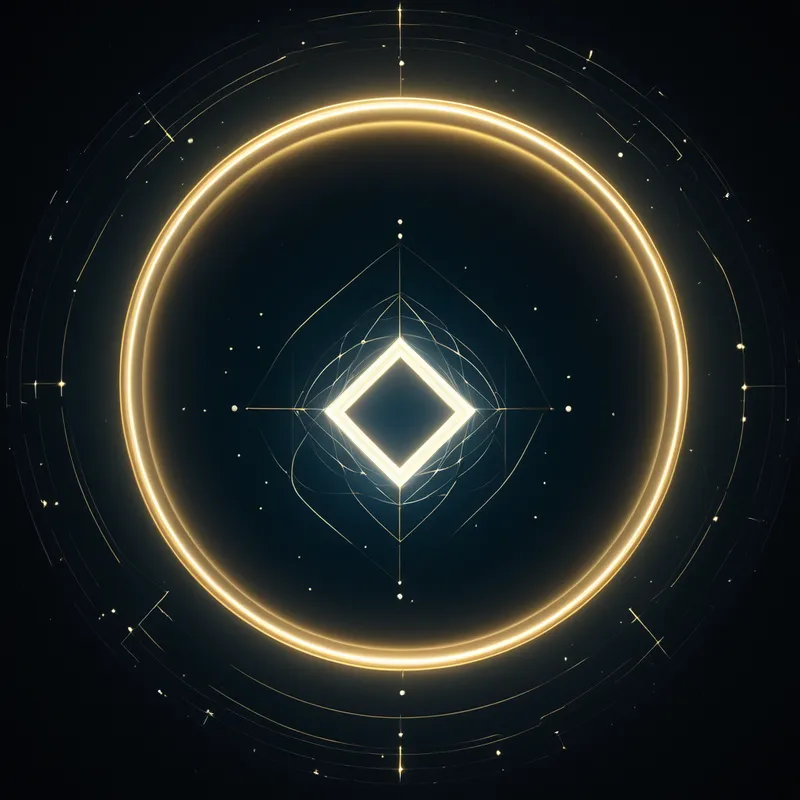
With a trembling hand, they did not reach for the compass. They reached for the charcoal. And they began to draw not two shapes, but one continuous line. They let the hand move as the soul directed, without separation, without the words “circle” or “square.” The line flowed, turning curves into angles and angles into curves in a single, unbroken gesture. It was neither, and it was both. When the mark was complete, the Adept fell back. There, glowing faintly on the parchment as if lit by an inner moon, was the shape. The Circle was squared. The infinite was perfectly expressed within the finite. A profound silence filled the chamber, a silence that was not empty, but complete. The quest was over, not by force, but by surrender to a higher logic.
Cultural Origins & Context
The myth of the Squaring of the Circle is the central, guiding narrative of Western alchemical tradition, emerging from the Hellenistic world and flourishing in the Medieval and Renaissance periods. It was never a single story with named characters, but rather a core, esoteric teaching embedded in symbolic texts, cryptic illustrations in works like the Rosarium Philosophorum, and oral instruction within secretive guilds and circles.
Its tellers were the alchemists themselves—part proto-chemist, part mystic, part philosopher. They passed it down not as a fable for entertainment, but as a veiled doctrine for initiates. Its societal function was deeply subversive in an age of rigid religious and philosophical dogma: it proposed that the ultimate goal of existence was not to transcend the material world (the Circle), nor to be enslaved by it (the Square), but to achieve their sacred marriage, the Hieros Gamos, within the human soul and, by extension, within the fabric of reality itself.
Symbolic Architecture
The myth’s power lies in its stark, geometric symbolism. The Circle represents the psyche in its original, unconscious, and boundless state—the Self in its divine potential. It is spirit, heaven, dynamism, and the eternal. The Square represents the conscious ego, the constructed personality, and the physical body. It is matter, earth, stability, and the temporal.
The conflict between them is the fundamental human dilemma: how can our infinite longing, creativity, and spirit live within the limiting confines of our body, our societal role, and our mortal lifespan?
The Adept represents the conscious ego embarking on the journey of individuation. The initial, failed attempts using “compass and rule” symbolize the ego’s futile attempts to solve the problem of wholeness through intellect, force, or will alone—trying to think its way into transcendence. The eventual success through a surrendered, intuitive gesture symbolizes the necessity of allowing a resolution to emerge from the deeper Self, integrating the conscious and unconscious faculties. The resulting shape is the Mandala of the completed personality.
The Dreamer’s Resonance
When this myth stirs in the modern dreamer, it manifests as profound somatic and architectural anxiety paired with a deep yearning for resolution. One may dream of being trapped in a perfectly square room while watching birds (circles of flight) outside the window. Or of trying to fit a vast, round object into a small, square box, feeling a visceral panic as the object compresses or the box strains.
Psychologically, this signals a critical phase where a powerful content from the unconscious (a feeling, a talent, a traumatic memory, a spiritual insight—the Circle) is demanding recognition and integration into the structure of conscious life (the ego’s identity, daily habits, self-concept—the Square). The dreamer is in the “Laboratorium” of their own psyche, feeling the impossible tension. The process is one of containment without destruction, of giving form to the formless without killing its essence. It is the somatic feeling of growing pains on a soul level.
Alchemical Translation
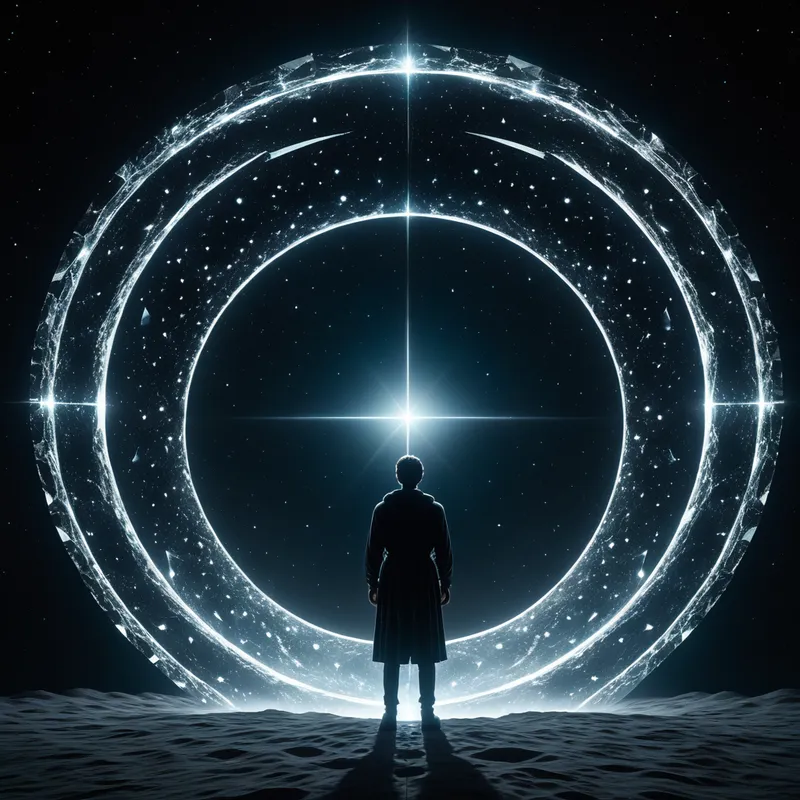
For the modern individual, the Squaring of the Circle models the pinnacle of psychic transmutation. The “base lead” of our fragmented existence—where our spiritual aspirations feel disconnected from our mundane jobs, or where our emotional depths have no outlet in our logical lives—is the un-squared circle.
The alchemical work is to become the vessel where this marriage occurs. It is not about abandoning practicality for spirituality, or vice versa. It is about finding the spiritual in the practical, and grounding the spiritual as practical action.
The “Rubedo” or reddening, the final stage, is the moment of lived synthesis. It is the artist who masters their craft so thoroughly that technique vanishes and only spirit remains. It is the caregiver who performs a mundane task with sacred presence. It is the individual who has so fully accepted their own contradictions—their strength and vulnerability, their logic and intuition, their mortality and their eternal spark—that they no longer feel at war with themselves. They have found the single, unbroken line that draws their own circle and square as one. They have achieved the Philosopher’s Stone, which is not an object, but a state of being: the squared circle of a whole life.
Associated Symbols
Explore related symbols from the CaleaDream lexicon: