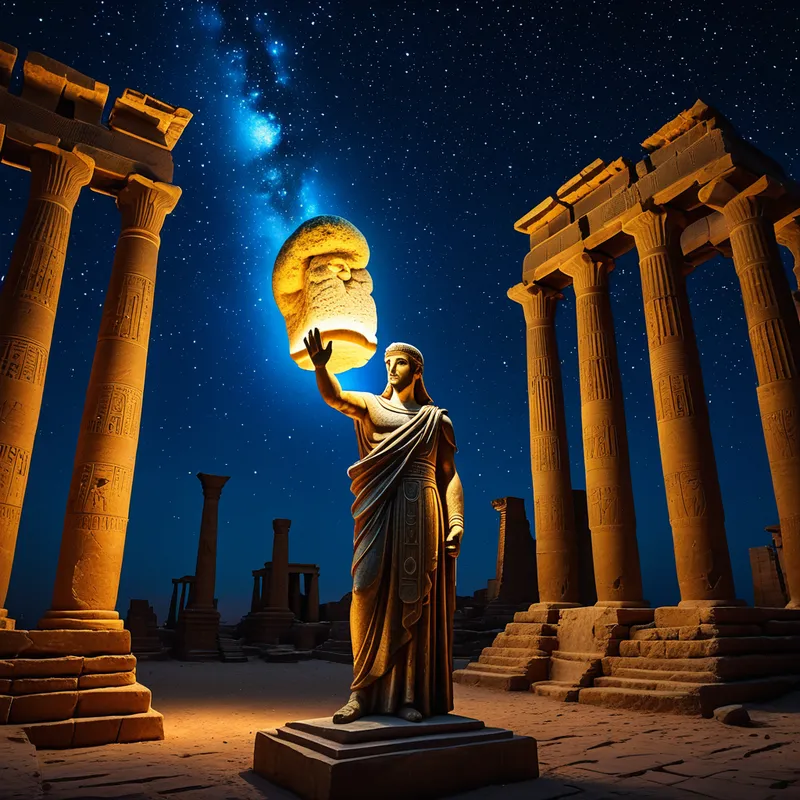
The Sponge of Hermes Myth Meaning & Symbolism
A myth of the alchemical Mercury, a divine sponge that absorbs the world's poisons to be wrung out in the crucible of the self, purifying all.
The Tale of The Sponge of Hermes
Listen, and hear the whisper from the furnace, the story breathed onto papyrus in the smoke of the athanor. It begins not with a bang, but with a sigh—the sigh of the world, heavy with its own bitterness.
In the time when the gods walked with the elements and the sky was a crucible for stars, there was a great sickness. It was not a plague of the body, but of the soul-stuff of creation itself. The prima materia, the first matter from which all things were spun, had grown thick and turbid. The waters of life carried not just sweetness, but the dregs of experience: the leaden weight of hatred, the corrosive acid of envy, the cloying residue of unchecked desire. The world was drowning in its own psychic effluent, and even the divine breath of pneuma struggled to move through the mire.
The celestial artisans saw this. Hermes Trismegistus, the thrice-great, he who knows what is hidden, walked the liminal shore between the fixed and the volatile. His heart, a nexus of mercury and wisdom, felt the world’s distress as a physical pain. He did not summon lightning or command armies. Instead, he went to the silent, receptive place at the center of his being, the place where the prima materia sleeps.
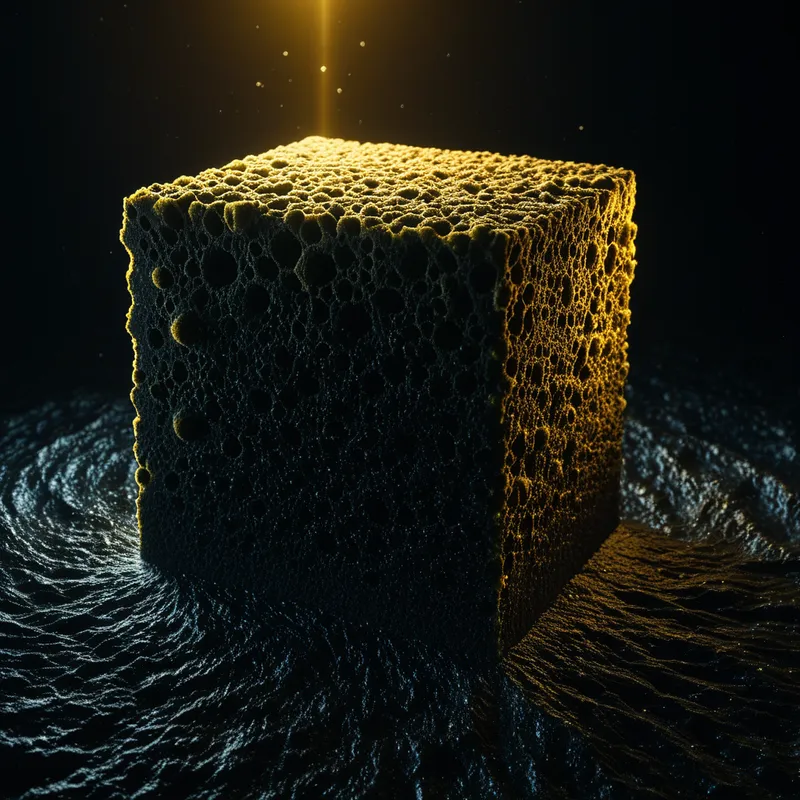
From his own essence, from the quick-silver of his divine mind, he fashioned a vessel. But it was not a cup or a bowl. It was a Sponge. A humble, porous thing, yet infinitely complex in its labyrinthine channels. It was not solid, nor was it empty. It was potential made form. He imbued it with a single, profound instruction: Absorb.
He cast the Sponge into the murky waters of the world-soul. And it drank. It did not discriminate. It drew in the shining streams of nascent love and the black, viscous rivers of spite. It soaked up the golden light of joy and the green, phosphorescent glow of decay. The Sponge swelled, becoming a world in miniature, a microcosm saturated with the macrocosm’s agony and ecstasy. It grew heavy, so terribly heavy, a dark star of concentrated experience.
When it could hold no more, when it was saturated to the point of bursting, Hermes retrieved it. Not with triumph, but with solemnity. The Sponge wept dark tears. This was the crisis, the nigredo. In his celestial workshop, above the realm of fixed stars, Hermes placed the burdened Sponge into the crucible of his own will—the sacred fire that does not consume but transforms.
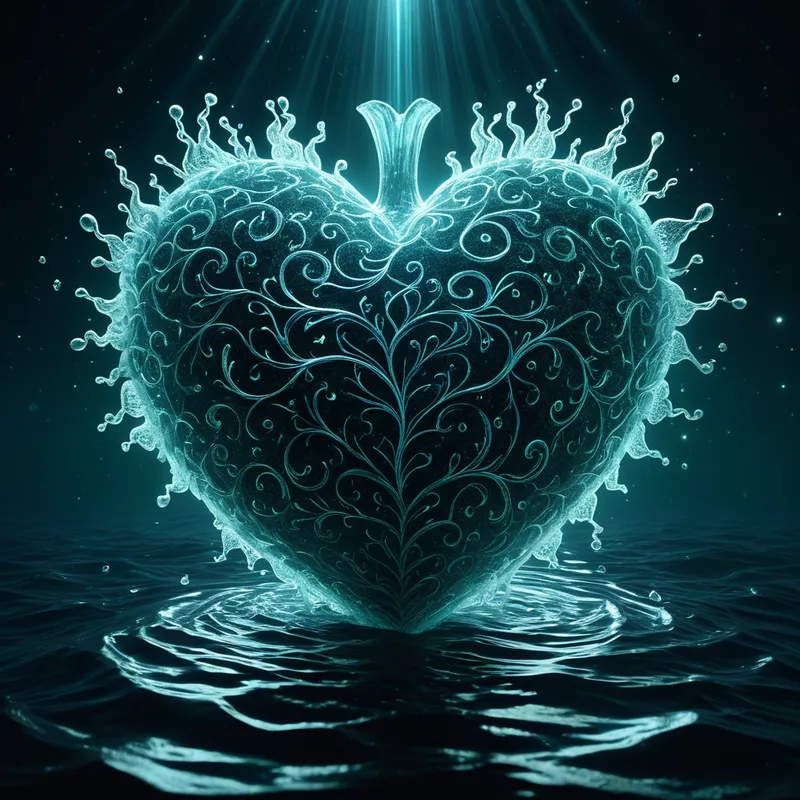
Then came the action not of adding, but of releasing. With a pressure born of infinite compassion, he wrung the Sponge. From its pores flowed not the poisons it had ingested, but a pure, crystalline water. The hatred, pressed by the fire of intention, had become a solvent for clarity. The envy had distilled into keen discernment. The desire had transmuted into the pure will-to-be. The first drops were black, then grey, then pearlescent, and finally, they ran clear as diamond. The dross remained as a dry, inert ash at the bottom of the crucible, and the Sponge itself was left luminous, light, and empty once more, ready to begin again.
And so the great respiration of the cosmos was restored: inhalation, absorption, compression, purification, release. The Sponge of Hermes hangs in the psychic firmament still, a silent testament that to hold the poison is the first step to discovering the cure within it.
Cultural Origins & Context
The myth of the Sponge of Hermes is not a narrative of popular folklore, but a speculum of esoteric alchemy. It emerges from the Hellenistic and later medieval alchemical corpus, attributed to the legendary figure of Hermes Trismegistus, a syncretic fusion of the Greek god Hermes and the Egyptian god Thoth. This myth was passed down not by bards in halls, but by adepts in scriptoriums and laboratories, encoded in cryptic texts like the Tabula Smaragdina (The Emerald Tablet) and the various works of the Corpus Hermeticum.
Its societal function was entirely inward and vertical. It served as an operative diagram for the alchemist’s opus, their great work. The story was a map, guiding the practitioner through the internal stages of transformation. It was told through symbols—the sponge, the wrung cloth, the purified water—in manuscripts illuminated with enigmatic drawings, meant to be meditated upon, not merely read. The culture that nurtured this myth was one of correspondences, where every external process (solution, filtration, distillation) mirrored an internal, psychological one. The myth’s purpose was to initiate, to provide a symbolic container for the terrifying and sublime process of psychic death and rebirth.
Symbolic Architecture
At its core, the Sponge represents the psychic ego in its ideal, yet passive, state: the receptive vessel. It is not the active hero who slays dragons, but the humble, porous medium that must first be filled with the totality of experience, both luminous and shadowed.
The soul must first become a perfect vessel of the world’s bitterness before it can become a fountain of the world’s cure.
The Absorption symbolizes the unavoidable process of life—taking in impressions, traumas, joys, and projections. The alchemist does not flee from the “poisons” of the world (criticism, failure, grief, envy); they are to be consciously ingested. The Saturation represents the crisis of the nigredo, the dark night of the soul, where the ego feels overwhelmed, burdened, and lost under the weight of unlived life and unprocessed emotion.
The Wringing in the Crucible is the pivotal act of transformation. This is the application of conscious suffering and disciplined introspection—the fire of attention. It is not enough to merely collect experience; one must submit it to the pressure of reflection and the heat of the will. The poison is not discarded; it is compressed until its hidden, antithetical nature is revealed. The Pure Water that results is the aqua vitae, the water of life—symbolizing insight, emotional clarity, and redeemed psychic energy. The Ash is the liberated ego, stripped of its identificatory toxins, now a neutral base for new growth.

The Dreamer’s Resonance
When this myth stirs in the modern dreamer, it often manifests as dreams of overwhelming absorption or miraculous purification. You may dream of being a room that fills with water or dark substance, yet you can breathe within it. You may dream of wringing out a cloth or a sponge, and watching in awe as black ink turns to clear water. You may find yourself in a landscape where you are compelled to drink from a polluted well, only to discover the act cleanses the source.
Somatically, this points to a psychological process of integration. The psyche is signaling that it is in a phase of intense intake—perhaps you are in a demanding job, a caregiving role, or simply a period of life where you are exposed to high levels of emotional or cognitive complexity. The dream is the psyche’s way of validating that burden, but also hinting at the mechanism for processing it. The “wringing” in the dream corresponds to a necessary, often difficult, period of introspection, therapy, or artistic expression—the active, pressurizing work of making meaning from chaos. It is the body-mind’s deep knowing that you are not just a passive collector of experience, but a potential alchemist of it.
Alchemical Translation
For the modern individual seeking individuation, the myth of the Sponge models the non-heroic, yet utterly essential, path of the caregiver archetype turned inward. The triumph is not conquest, but compassionate processing.
The first step is to consciously adopt the sponge-consciousness: to allow oneself to feel the full spectrum of reality without immediate defense or negation. This means accepting one’s envy, resentment, pettiness, and fear as part of the data set of the self, not as enemies to be expelled. The ego becomes the vessel.
The second, and most critical, stage is the creation of the inner crucible—a disciplined practice of reflection. This could be journaling, active imagination, meditation, or dialogue in analysis. This is the “fire” where the saturated experiences are placed. Here, through the pressure of questioning (“Why does this affect me so? What ancient echo does this touch?”), the transmutation begins.
The goal is not to emerge dry and untouched, but to have digested the world so completely that you can offer back only clarity.
The final stage is the release—the “wringing out.” This is the embodied expression of the gained insight: setting a boundary from a place of calm, not rage; offering forgiveness having understood the projection; creating a work of art born from processed pain. The purified “water” is the liberated energy now available for authentic life, and the “sponge” of the self is left lighter, more resilient, and empty in the best sense—ready to engage the world again, not as a brittle wall, but as a living, breathing, transforming membrane between spirit and matter. The myth teaches that our greatest service to ourselves and the world is to become adept at this sacred, ongoing respiration of the soul.
Associated Symbols
Explore related symbols from the CaleaDream lexicon: