The Spirit World of the Shipibo Myth Meaning & Symbolism
A mythic voyage into the Shipibo cosmos where healers navigate a luminous spirit realm to restore balance through visionary art and sacred song.
The Tale of The Spirit World of the Shipibo
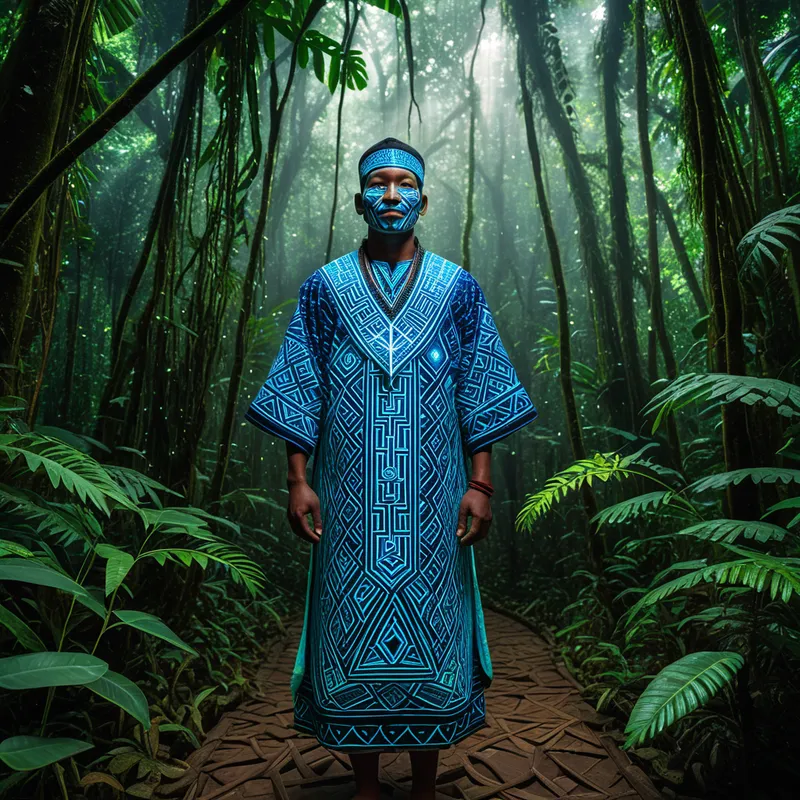
Listen. The world you see is a veil, thin as a dragonfly’s wing. Behind it, in the deep green breath of the Forest, lies the true world—a world of light and song. This is the world the Onanya know. They are the ones who remember the path.
In the beginning, there was only the great, dark water. From its depths, the cosmic Ronin arose, her immense body coiling the void into shape. As she moved, the intricate, beautiful scales of her skin sloughed off, not as dead matter, but as living light. These scales became the first kené—the luminous designs that are the blueprint of all life, the very language of the spirits. She sang, and her song was the first icaros, a vibration that gave the designs their power and purpose. From this song and light, the rivers curved, the trees reached, and the animals took form, each carrying a fragment of the original pattern within them.
But the patterns are fragile. When a person falls ill—when their soul is heavy with grief, fear, or the poison of disharmony—it is because their inner kené has been torn, muddied, or forgotten. The design within them is in disarray. The Onanya, having drunk the bitter tea of the Ayahuasca, steps through the Door. The familiar world dissolves into a torrent of vibrating, geometric light. Here, the Spirit World is not a place of ghosts, but a living library of design.
Guided by the spirits of healing plants—the Jaguar Spirit, the wise Serpent, the grandmotherly Spirit of the Forest—the Onanya navigates this luminous chaos. They seek the sick person’s essence, which appears as a dim or tangled knot of light amidst the brilliant, singing patterns. The healing is a act of re-weaving. The Onanya sings their icaros, their voice a shuttle. With each note, they draw threads of pure, coherent design from the spirit world and begin to stitch the patient’s fractured pattern back into harmony with the great design of the Ronin.
The struggle is fierce. Sometimes, the sickness manifests as dark, clinging spirits—the crystallized forms of Rage or Shame. The Onanya must confront these, not with violence, but with the overwhelming beauty and order of their song, dissolving the darkness back into potential light. The journey is a Journey to the very root of being. When the work is done, the patient’s inner light shines clear, its pattern realigned. The Onanya returns, bearing not just healing, but a new fragment of design—a new icaro, a new kené to paint—a gift from the spirits to adorn the physical world, making the invisible harmony visible.
Cultural Origins & Context
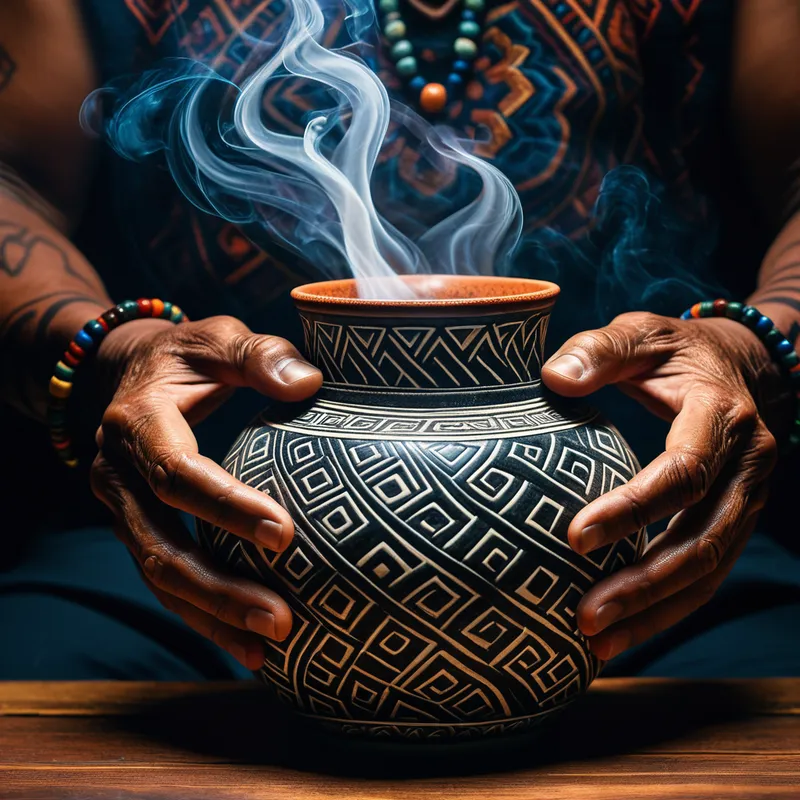
This is not a single story with a fixed plot, but the living cosmological framework of the Shipibo-Conibo people of the Peruvian Amazon. The “myth” is embedded in their entire worldview, transmitted not merely through spoken narrative, but through the immersive practices of ceremony, art, and song. The primary storytellers are the Onanya (healers) themselves, who learn directly from the spirits of the plants, primarily the Ayahuasca vine, during prolonged dieta retreats deep in the forest.
The societal function is profoundly practical: it is a manual for navigating reality. The myth explains the origin of illness (disorder in the spirit-pattern) and provides the technology for its cure (the re-application of ordered design through icaros). It legitimizes the healer’s authority as one who can travel between worlds. Furthermore, it elevates everyday art—the beautiful kené patterns painted on pottery, textiles, and the body—to a sacred act. Each painted line is a remembrance and an invocation of the original, perfect design of the cosmos, a way of bringing spiritual order and protection into the community.
Symbolic Architecture
At its core, this cosmology presents [reality](/symbols/reality “Symbol: Reality signifies the state of existence and perception, often reflecting one’s understanding of truth and life experiences.”/) as a vast, intelligent [pattern](/symbols/pattern “Symbol: A ‘Pattern’ in dreams often signifies the underlying structure of experiences and thoughts, representing both order and the repetitiveness of life’s situations.”/)—a cosmic fabric where mind, matter, and [spirit](/symbols/spirit “Symbol: Spirit symbolizes the essence of life, vitality, and the spiritual journey of the individual.”/) are woven from the same luminous threads. Illness and wellness are states of pattern integrity.
To heal is not to fight a foreign invader, but to remember a forgotten song and reweave a torn tapestry. The disease is the tangle; the cure is the restoration of elegant, flowing connection.
The Ayahuasca is the ultimate Key, a chemical [Door](/symbols/door “Symbol: A door symbolizes transition, opportunity, and choices, representing thresholds between different states of being or experiences.”/) that dissolves the ego’s rigid boundaries. The Onanya is the [Spirit Guide](/symbols/spirit-guide “Symbol: A spirit guide is an ethereal being believed to provide wisdom, guidance, and support along one’s life journey.”/) and the master artisan of the [soul](/symbols/soul “Symbol: The soul represents the essence of a person, encompassing their spirit, identity, and connection to the universe.”/). The kené represent the fundamental code of the psyche and the [universe](/symbols/universe “Symbol: The universe symbolizes vastness, interconnectedness, and the mysteries of existence beyond the individual self.”/)—the archetypal blueprints that exist prior to form. The icaros are the active, creative force that manipulates this code; they are the software that reprograms disordered existence.
Psychologically, the Ronin represents the unconscious itself in its creative, ordering, and potentially overwhelming totality. The healing spirits—[Jaguar](/symbols/jaguar “Symbol: The jaguar symbolizes strength, power, and stealth, often associated with transformation and the spiritual journey.”/), [Serpent](/symbols/serpent “Symbol: A powerful symbol of transformation, wisdom, and primal energy, often representing hidden knowledge, healing, or temptation.”/), Plant Grandmothers—are personified aspects of the unconscious’s innate drive toward wholeness and [integration](/symbols/integration “Symbol: The process of unifying disparate parts of the self or experience into a cohesive whole, often representing psychological wholeness or resolution of internal conflict.”/).
The Dreamer’s Resonance
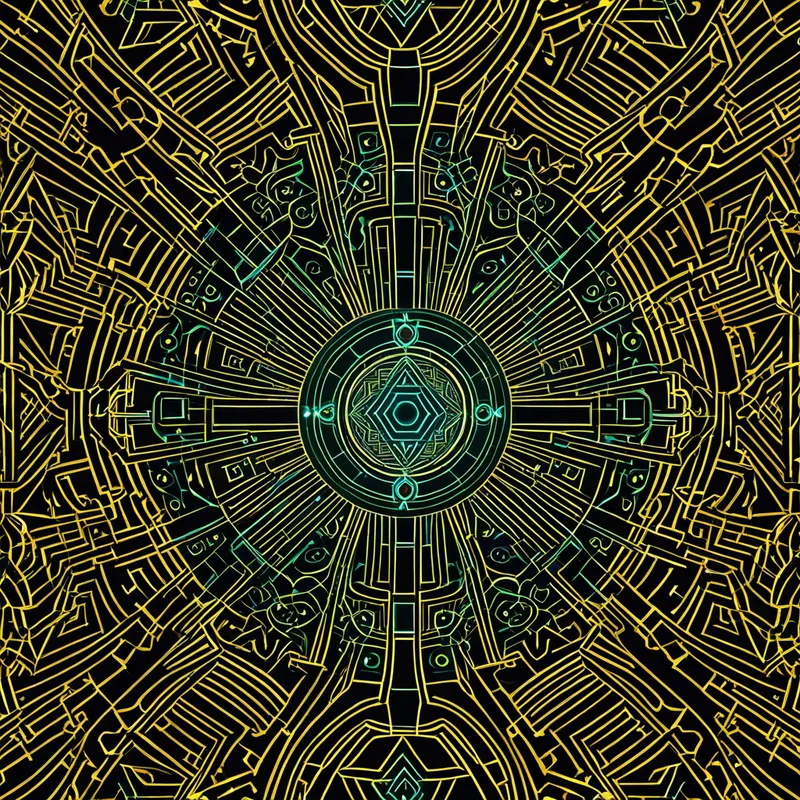
When a modern dreamer encounters motifs from this myth, they are likely in a profound process of psychic reorganization. Dreaming of being lost in a labyrinth of overwhelming, complex patterns may reflect a feeling of being trapped by the complexities of one’s own mind or life circumstances—a psychic “tangle.” Dreaming of a guiding voice (an icaro) or a helpful animal spirit emerging from such chaos signals the unconscious beginning to provide its own ordering intelligence.
Somatically, this can feel like a pressure in the head or chest, a sense of being “woven into” or “constricted by” one’s own thoughts, followed by a sudden release and flow. To dream of singing a song that changes the environment is a powerful indicator of accessing one’s own creative, healing agency. The core process is the move from chaotic, fragmented self-experience (sickness) toward a sensed, inner coherence and beauty (healing). The dream-ego is being initiated into the role of its own Onanya.
Alchemical Translation
The Shipibo myth is a precise map of the individuation process. The individual begins in a state of “dis-ease”—neurosis, depression, meaninglessness—which is the felt experience of the psyche’s patterns being out of sync with the Self (the Ronin). The conscious ego is the patient, suffering from its own fragmented design.
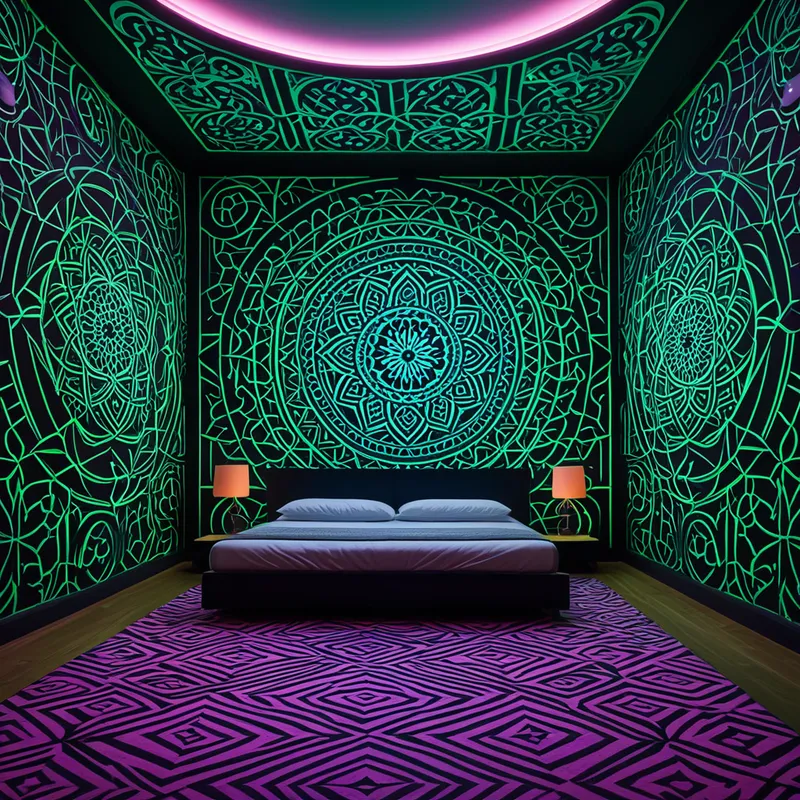
The alchemical vessel is not a flask, but the darkened maloca of the ceremony; the prima materia is the chaotic content of one’s own life; the transforming agent is the conscious, suffering attention itself, catalyzed by the “vine of the soul.”
Drinking the Ayahuasca is the voluntary descent into the nigredo—the chaotic, often terrifying encounter with the shadow, the repressed, the tangled knots of trauma (the dark spirits of Rage or Shame). The guiding icaro of the healer represents the transcendent function—the new, reconciling perspective that emerges from the unconscious. The modern individual must learn to “sing their own icaro”: to find the unique, authentic expression—through art, journaling, dialogue, or creative work—that can begin to reorder their inner chaos.
The final stage is not just the absence of illness, but the active creation of personal “kené.” This is the rubedo, the red dawn of consciousness that has integrated the unconscious material. The individual becomes an artist of their own life, able to perceive and manifest the beautiful, coherent pattern of their unique existence within the greater cosmic design. They move from being a passive patient to an active participant in the ongoing creation of the world, transforming personal wound into visionary gift.
Associated Symbols
Explore related symbols from the CaleaDream lexicon:
- Spirit World — The luminous, geometric dimension of intelligent energy and pattern that underlies physical reality, accessed for healing and knowledge.
- Serpent — Represents the cosmic creator Ronin, the source of all sacred design, and the healing, transformative power of shedding old patterns.
- Forest — The literal and metaphysical jungle, a place of immense complexity, danger, and teacher-spirits, representing the untamed unconscious mind.
- Door — The threshold crossed by the Onanya via ritual and plant medicine, symbolizing the passage from ordinary consciousness into non-ordinary, visionary reality.
- Healing — The core action of the myth, defined not as curing symptoms but as restoring the fundamental, harmonious pattern of the soul.
- Journey — The perilous voyage into the Spirit World, mapping the internal process of confronting the unconscious to retrieve wholeness.
- Spirit Guide — Embodied by the plant spirits (Jaguar, Grandmother Ayahuasca) and the Onanya, representing the guiding intelligence of the deeper Self.
- Vision — The perceptual state granted by the mythic framework, where reality is seen as a tapestry of living, singing light and pattern.
- Pattern — The essential concept of kené, the cosmic code and blueprint that structures all existence, from galaxies to thoughts.
- Song — The icaros, the active, vibrational force that manipulates reality’s pattern; the creative word that heals and reorders.
- Jaguar Spirit — A powerful guardian and teacher spirit from the rainforest, representing fierce protection, stealth, and the penetrating vision of the shaman.
- Shadow — The dark, clinging spirits of illness, representing unintegrated psychic material like rage and shame that must be faced and dissolved with light.