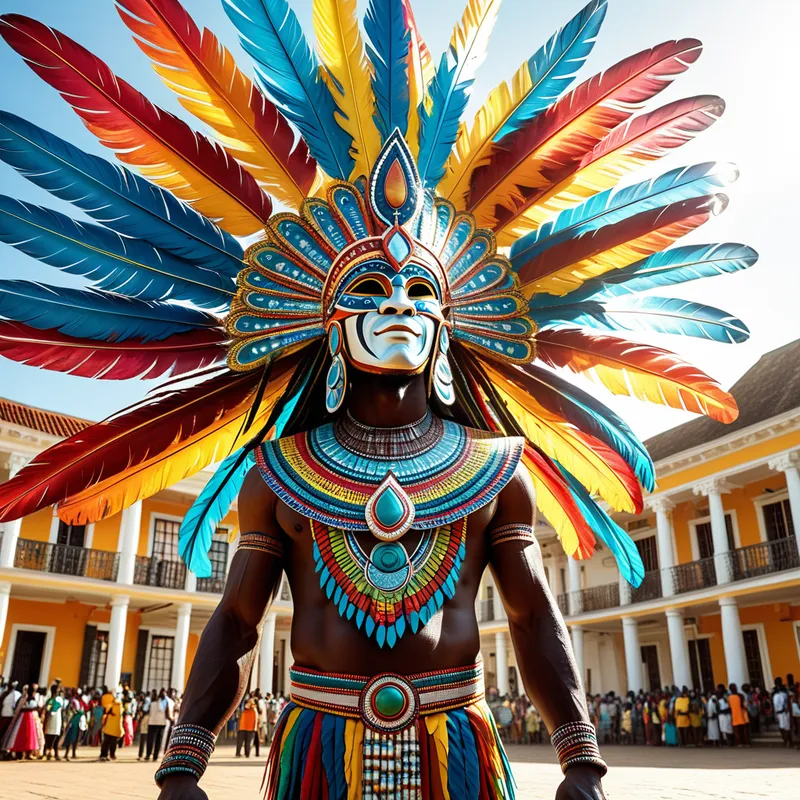
The Spirit of Carnival Myth Meaning & Symbolism
A mythic entity born from collective resistance, who descends annually to dissolve social order, embodying the soul's necessary, chaotic liberation.
The Tale of The Spirit of Carnival
Listen. There is a truth that lives in the space between the drumbeat and the silence, in the crack between the world as it is commanded and the world as it is dreamed. This is the tale of that truth.
Before the parades, before the sequins caught the sun, there was the weight. The weight of the sun on cane fields, the weight of iron on wrist and soul, the weight of a gaze that sought to make a person into a thing. The air was thick with the silence of swallowed songs. The nights were long with remembered constellations whose names were fading on the tongue.
But in the deepest dark, when even the overseer’s dogs slept, a different kind of seed was stirring. It was not planted by hand, but by spirit. It was a collective sigh, a shared memory of freedom that had no single owner, and thus could not be taken. This sigh gathered in the hidden groves, the bohíos, the hulls of ships made of memory. It fermented in the heat of collective longing until it could no longer be contained.
And from this pressurized dream, it was born—not with a cry, but with the first, defiant tap of a finger on a hollow gourd. It was the Ashe of resistance given form. They called it the Spirit of Carnival. No one saw its face, for its face was every face that dared to imagine itself free. Some say it wore a mask of midnight studded with stars stolen from the old gods. Others say it had no mask at all, but was a being of pure, shimmering potential, a human-shaped void waiting to be filled by the will of the people.
It did not arrive with an army, but with a rhythm. A rhythm that started in the chest, a counter-beat to the monotonous clock of oppression. It whispered through the canefields, a syncopated rustle. It echoed in the hammer of the blacksmith, finding a melody in the strike. The Spirit walked among the people, and where its shadow fell, backs straightened. Where its breath passed, a hum began in the throat—a fragment of a song from across the water.
Its first act was not battle, but inversion. On the day the masters celebrated their piety, the Spirit poured its essence into the dust of the street. And the people, moving as one body guided by this unseen force, took that dust and painted their skin. They took rags and turned them into regal finery. They took the chains and wore them as clanking, rhythmic jewelry. The servant played the king. The king was mocked as a fool. For a few, fleeting hours, the world was turned upside down. Laughter became a weapon sharper than any cane knife, and the dance was a map to a territory no colonizer could ever chart.
The masters, in their houses of stone, felt the foundations tremble. Not from earthquake, but from the seismic pulse of thousands of feet moving in unison, a stomp that said, “We are here. We are whole. We remember.” They saw the chaos in the streets and called it revelry, missing the sacred geometry within it. The Spirit, its work of psychic ignition complete, would not overstay. As dawn threatened the edge of the sky, it would begin to dissolve, its essence flowing back into the people, into the very soil, a promise buried like a seed: I am not gone. I am waiting in the rhythm. I am the space you carve for yourselves. I will return.
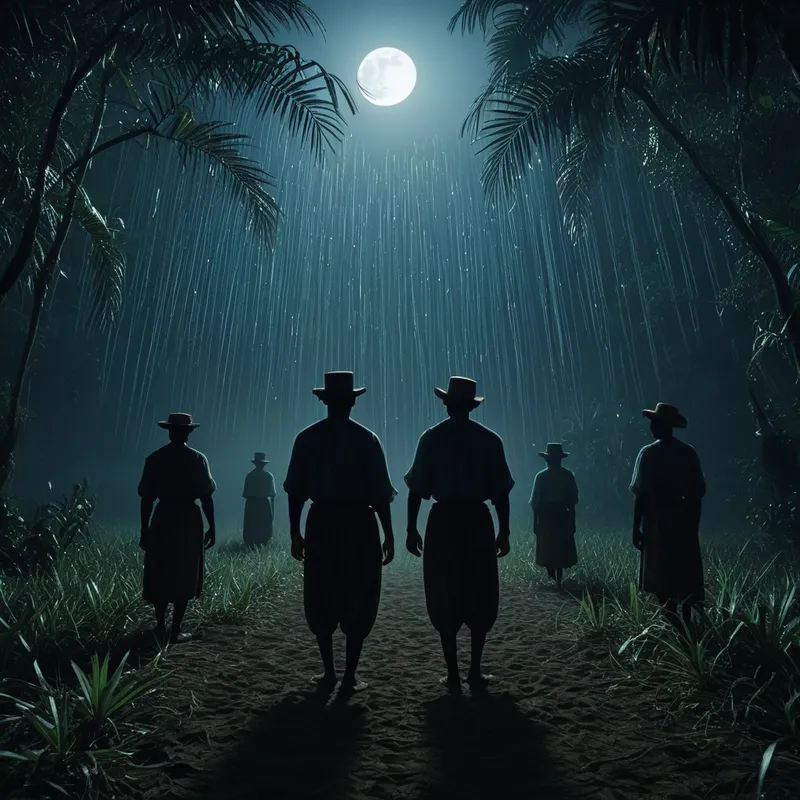
Cultural Origins & Context
The myth of the Spirit of Carnival is not etched on ancient tablets but is woven into the very fabric of post-colonial Caribbean reality. It is a living myth, born from the crucible of the transatlantic encounter: the brutal system of the plantation, the forced marriage of African, Indigenous, and European cultures. Its storytellers were the enslaved and the indentured, its parchment was the oral tradition, and its first stages were the provision grounds and the hidden clearings in the bush.
This myth served a profound societal function far beyond entertainment. In societies where official power structures were designed to dehumanize and control, Carnival—and the Spirit that animated it—became a sanctioned, yet deeply subversive, pressure valve. It was a temporal liminal zone, a period where the normal rules were suspended by collective agreement. The myth provided a divine mandate for this suspension. It wasn’t merely people deciding to party; it was a sacred possession by a Spirit of Liberation. This spiritual framing protected the participants and gave cosmic weight to their act of cultural reclamation. Through mas’ characters like the Dame Lorraine or the fierce, ancestral Moko Jumbie, the Spirit of Carnival fragmented into a thousand avatars, each mocking a different facet of oppression or honoring a forgotten lineage.
Symbolic Architecture
At its core, the Spirit of Carnival represents the indomitable human psyche’s refusal to be defined solely by its circumstances. It is the archetypal force of sacred chaos that must periodically erupt to shatter the tyranny of order—especially an order built on injustice.
The mask is not a disguise, but a revelation. It does not hide the self; it liberates the selves that the mundane world forbids.
The Spirit embodies the ultimate inversion, a psychological and social “world turned upside down.” This is not nihilistic destruction, but a necessary dissolution for re-creation. The king becomes the beggar, the slave becomes the monarch. In symbolic terms, the ego (the internalized “master,” the persona shaped by societal demands) is temporarily dethroned by the shadow and the Self (the collective, ancestral, and instinctual forces). The glittering costumes and exaggerated features are a deliberate caricature of power, exposing its inherent performativity and fragility.
The Spirit’s transient nature is key. It arrives, ignites the transformative fire, and retreats. This mirrors the essential rhythm of life: structure must be periodically dissolved by chaos (creativity, passion, rebellion) to prevent stagnation and psychic death. The Spirit is the embodiment of the vas Hermeticum—the ritual space where opposites clash and mingle to produce a new, more conscious substance.
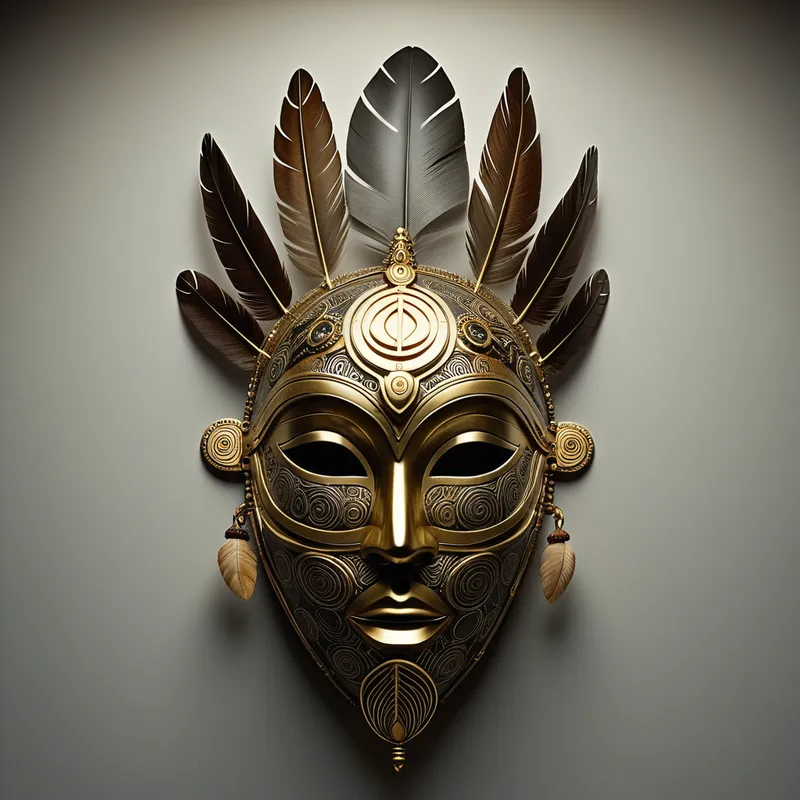
The Dreamer’s Resonance
When the Spirit of Carnival visits a modern dream, it rarely appears as a literal parade. Its presence is felt as an atmosphere, a pressing invitation from the unconscious. You may dream of being in a rigid, grey, bureaucratic building that suddenly fills with uncontrollable, vibrant vines or rhythmic pounding from the walls. You may find yourself at a solemn event where you are compelled to stand and sing a loud, joyful song entirely out of place. Or you may be desperately trying to glue a formal mask to your face, while your own skin beneath it dances and shifts of its own accord.
These dreams signal a somatic and psychological process of compensatory eruption. The conscious life has become too ordered, too repressed, too tightly bound by a “should” that has cut off access to vitality, spontaneity, and authentic passion. The psyche, in its wisdom, sends the Spirit to stage a coup. The somatic feeling is often one of pressure followed by release—a tightness in the chest giving way to an involuntary, deep breath or a tremor in the limbs that wants to move. The dream is an alarm: the soul’s need for sacred chaos is being starved. The rigid persona is cracking, and the riotous colors of the denied self are seeping through.
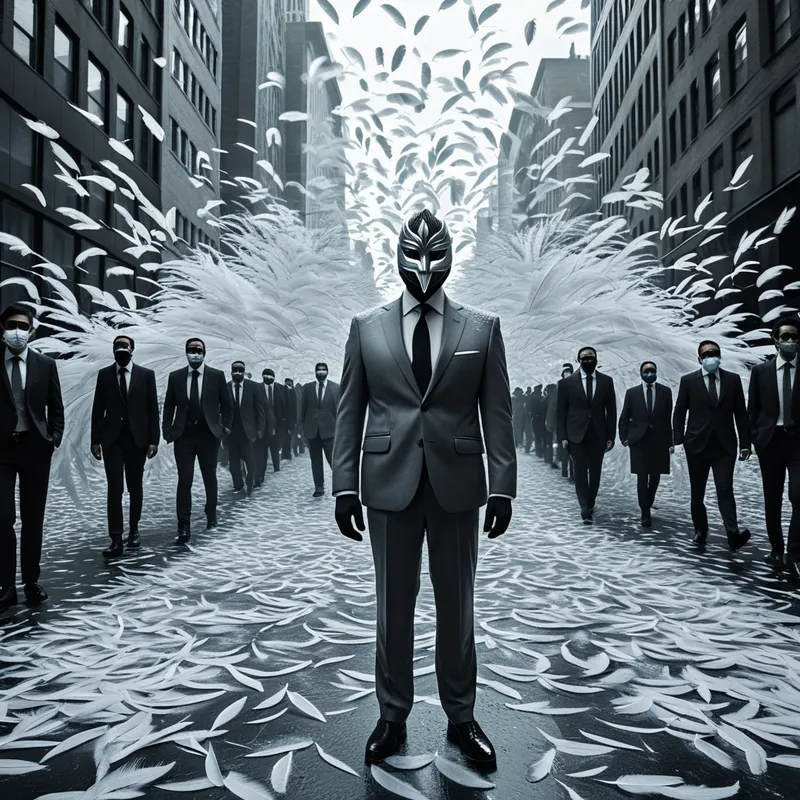
Alchemical Translation
For the modern individual pursuing individuation, the myth of the Spirit of Carnival models the essential, terrifying, and glorious process of psychic transmutation through temporary self-annihilation. Our modern identities are often plantations of the mind—carefully curated, productive, socially acceptable, and deeply confined.
The journey to wholeness requires not just building a better ego, but the courage to let the ego be ritually dismantled by the inner rebel.
The Alchemical Stage mirrored here is Nigredo, not as a depressive collapse, but as a chosen, ritualized deconstruction. One must consciously create the liminal space—through therapy, art, meditation, or radical honesty—and invite the inner Spirit of Carnival to enter. This means allowing the shadow its day in the sun: letting the repressed anger dance, letting the hidden flamboyance dress up, letting the mocked inner child play the ruler. It is a controlled, sacred rebellion against the internalized overseer.
The triumph is not in the permanent state of chaos, but in the successful return from it. The Spirit departs, leaving behind not ruins, but a transformed perspective. The individual reintegrates, but they can no longer fully believe in the absolute authority of the old order. They have seen the world inverted and found it more true. They have worn the mask and discovered it was their own face, freed. The final gold produced is authentic fluidity—the ability to move between structure and spontaneity, between the persona required by the world and the profound, multi-colored truth of the Self, having learned that true power lies not in rigid control, but in the courageous capacity for sacred, renewing release.
Associated Symbols
Explore related symbols from the CaleaDream lexicon: