The Spiral of Life Myth Meaning & Symbolism
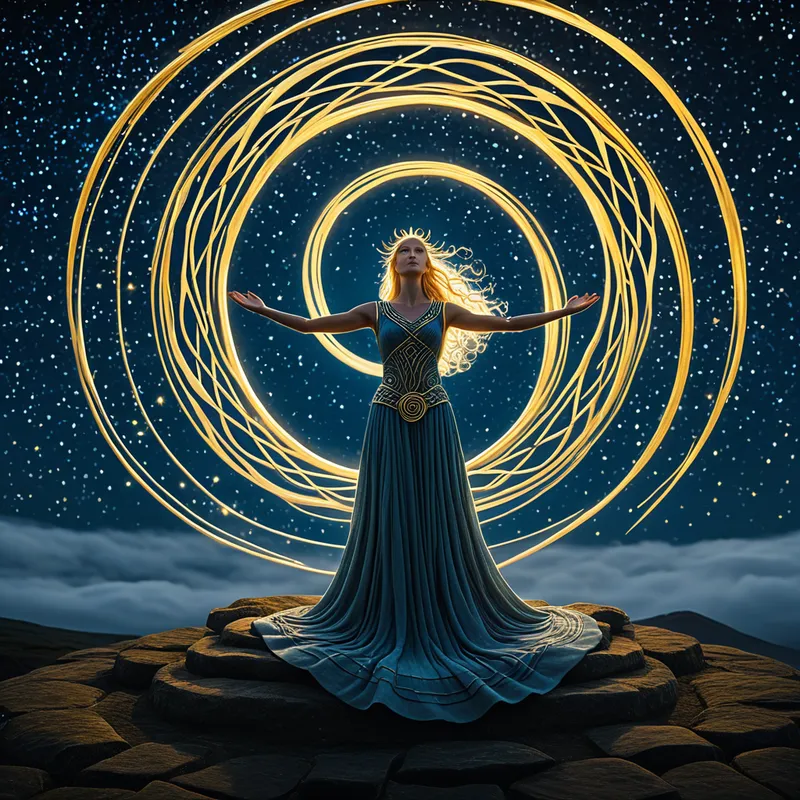
A primordial goddess weaves the cosmos from her own being, creating the eternal spiral that binds life, death, and rebirth into one sacred pattern.
The Tale of The Spiral of Life
Listen. Before the first oak took root, before the first salmon leaped in the silver river, there was only the Deep. A silence so vast it was a sound, a darkness so complete it was a womb. And within it, she stirred. She who had no name, for names are for things that are separate, and she was all that was. The Cailleach of the Before-Time, the bone-mother of potential.
She felt a longing, a pull in the hollow where a heart might be. Not for company, but for expression. For a song to be sung from the silence. She reached into the substance of her own being, into the endless dark that was her body, and she pulled. It was not matter she drew forth, but meaning. A thread of shimmering, painful light. It was the first sensation: the agony and ecstasy of separation from self.
With a breath that became the first wind, she began to weave. She anchored the thread to the center of her being—a point that would become the [Omphalos](/myths/omphalos “Myth from Greek culture.”/)—and she moved. Not in a line, not in a circle, but in a turning, returning arc. A spiral. Each outward coil cost her. The thread was her vitality, her unformed thought, her silent song given form. Stars sparked where the thread twisted. The murmur of future forests hummed in its curve. The cry of the first bird and the sigh of the last leaf were woven into its path.
She spiraled outward, and [the world](/myths/the-world “Myth from Tarot culture.”/) unfurled: mountains rose like frozen waves, seas poured into the basins of her footsteps. But as she wove the farthest reach of the cosmos, the thread grew thin. The light dimmed. She had poured herself into the pattern, and the center—her own core—felt like a void. The creation was complete, magnificent, and utterly separate from her. She stood at the outer edge of her own making, cold and spent, gazing back at the distant, dim anchor point.
This was the first death. Not an end, but a necessity woven into the pattern itself. For [the spiral](/myths/the-spiral “Myth from Celtic culture.”/) demanded return. Having given all away, she had no choice but to follow the path she had made. She turned and began the journey back along the gleaming track. And as she walked the inward coil, a miracle occurred. From everything she had created—the starlight on [water](/myths/water “Myth from Chinese culture.”/), the resilience of stone, the fleeting joy of a running fox—a new essence flowed back into her. Not the raw potential she had spent, but something richer: experience, memory, story. She drank it in, and by the time she reached the center again, she was remade. Not the silent goddess of the Deep, but the Sovereign of the Realized World.
And without pause, filled with this new, complex life, she pulled a second thread from her renewed heart and began to spiral out again. Not to repeat, but to deepen. To add a layer of complexity, of relationship, of love and loss. Thus the pattern was set: Outward in sacrifice of self to create the world. Inward in receipt of the world to recreate [the self](/myths/the-self “Myth from Jungian culture.”/). The eternal, three-fold [Spiral of Life](/myths/spiral-of-life “Myth from Celtic culture.”/).
Cultural Origins & Context
This myth, in its essence, is not a single story inscribed in a tome, but a pattern whispered by the landscape itself. The “Celtic” cultures of Iron Age Europe and the Insular world were profoundly oral and immanent. Their sacred texts were the groves, the rivers, and the [standing stones](/myths/standing-stones “Myth from Celtic culture.”/). The myth of the Spiral of Life was likely never told as a linear narrative in [the way](/myths/the-way “Myth from Taoist culture.”/) we have framed it. Instead, it was encoded.
It was passed down by the Druids and Bards not as a simple tale, but as a philosophical principle explaining the nature of reality. It was etched onto stones at sacred sites like Newgrange, where the triple spiral guards the inner chamber, aligning with the rebirth of the sun at winter solstice. It was implied in the seasonal rituals of [Samhain](/myths/samhain “Myth from Celtic culture.”/) and Beltane, which marked the points of symbolic death and rebirth in the yearly cycle. Its societal function was foundational: it taught that life, death, and renewal were not a linear progression but a continuous, integrated process. To live was to participate consciously in this sacred spiral.
Symbolic Architecture
The myth’s power lies in its non-dualistic [architecture](/symbols/architecture “Symbol: Architecture in dreams often signifies structure, stability, and the framing of personal identity or life’s journey.”/). It resolves the great [human](/symbols/human “Symbol: The symbol of a human represents individuality, complexity of emotions, and social relationships.”/) [tension](/symbols/tension “Symbol: A state of mental or emotional strain, often manifesting physically as tightness, pressure, or unease, signaling unresolved conflict or anticipation.”/) between being and becoming, between the self and the world.
The spiral is the shape of a breath: the exhale that gifts essence to the world, the inhale that receives the world back as wisdom.
The [Goddess](/symbols/goddess “Symbol: The goddess symbolizes feminine power, divinity, and the nurturing aspects of life, embodying creation and wisdom.”/) represents the undifferentiated [psyche](/myths/psyche “Myth from Greek culture.”/), the primal Self that contains all potential. Her initial state is wholeness, but it is a [static](/symbols/static “Symbol: Static represents interference, disruption, and the breakdown of clear communication or signal, often evoking feelings of frustration and disconnection.”/), unconscious wholeness. The Act of Weaving is the act of [consciousness](/symbols/consciousness “Symbol: Consciousness represents the state of awareness and perception, encompassing thoughts, feelings, and experiences.”/) itself—the painful, glorious process of ego-formation and world-making. We must expend our innate, unconscious [energy](/symbols/energy “Symbol: Energy symbolizes vitality, motivation, and the drive that fuels actions and ambitions.”/) to create a [life](/symbols/life “Symbol: The symbol of ‘Life’ represents a journey of growth, interconnectedness, and existential meaning, encompassing both the joys and challenges that define human experience.”/), a [personality](/symbols/personality “Symbol: Personality in dreams often symbolizes the traits and characteristics of the dreamer, reflecting how they perceive themselves and how they believe they are perceived by others.”/), a “world” out there.
The [Outward](/symbols/outward “Symbol: Movement or orientation away from the self or center; expansion, expression, or externalization of inner states into the world.”/) [Journey](/symbols/journey “Symbol: A journey in dreams typically signifies adventure, growth, or a significant life transition.”/) symbolizes incarnation, [effort](/symbols/effort “Symbol: Effort signifies the physical, mental, and emotional energy invested toward achieving goals and personal growth.”/), [expression](/symbols/expression “Symbol: Expression represents the act of conveying thoughts, emotions, and individuality, emphasizing personal communication and creativity.”/), and ultimately, sacrifice. It is giving our gifts until we feel empty. The [Inward](/symbols/inward “Symbol: A journey toward self-awareness, introspection, and the exploration of one’s inner world, thoughts, and unconscious mind.”/) [Journey](/symbols/journey “Symbol: A journey in dreams typically signifies adventure, growth, or a significant life transition.”/) symbolizes introspection, [integration](/symbols/integration “Symbol: The process of unifying disparate parts of the self or experience into a cohesive whole, often representing psychological wholeness or resolution of internal conflict.”/), healing, and [receipt](/symbols/receipt “Symbol: A receipt symbolizes proof of transaction, accountability, and the tangible record of choices made, often representing validation or the burden of past decisions.”/). It is the necessary return to the core to assimilate what our efforts have taught us. The Threefold [Nature](/symbols/nature “Symbol: Nature symbolizes growth, connectivity, and the primal forces of existence.”/) of the complete spiral mirrors the Celtic reverence for triplicities: Land, Sea, and Sky; Past, Present, and Future; and the psychological stages of Life, [Death](/symbols/death “Symbol: Symbolizes transformation, endings, and new beginnings; often associated with fear of the unknown.”/), and [Rebirth](/symbols/rebirth “Symbol: A profound transformation where old aspects of self or life die, making way for new beginnings, growth, and renewal.”/) as a single, revolving process.
The Dreamer’s Resonance
When the Spiral of Life appears in modern dreams, it is rarely as a neat carving. It manifests as a somatic or situational pattern. You may dream of walking an endless labyrinthine path that turns in on itself, of climbing a staircase that spirals into a starry void, or of watching the seasons cycle with impossible speed outside your window.
Such dreams often surface at existential crossroads: after a great creative outpouring that leaves you feeling depleted (the end of the outward coil), or during a period of deep depression or withdrawal that feels like a death (the painful inward turn). The dream is the psyche’s reassurance. It signals that you are not lost or broken, but in phase with a primordial pattern. The feeling of emptiness is not a flaw, but the precondition for being refilled with new substance. The dream asks: What have you given to the world that has left you hollow? And what is the world, in its quiet way, now offering back to you that you must slow down to receive?
Alchemical Translation
For the modern individual seeking individuation—the conscious realization of the Self—this myth is a master guide to psychic transmutation. Our culture prizes only the outward spiral: production, expansion, achievement. We see the inward turn as failure, as stagnation. The Celtic spiral teaches that this is a fatal error.
Individuation is not a straight path to a summit, but the courage to complete the circuit: to pour oneself out, and then to have the humility to turn and gather the fragments.
The alchemical process is mirrored perfectly. The initial [Nigredo](/myths/nigredo “Myth from Alchemical culture.”/) (blackening) is the goddess’s spent emptiness at the outer edge—[the dark night of the soul](/myths/the-dark-night-of-the-soul “Myth from Christian Mysticism culture.”/) after burnout. The turn inward is the Albedo (whitening), a purification not by fire, but by receptivity, where we wash our perceptions in the lunar light of reflection. The nourishment we receive from the integrated experiences is the Citrinitas (yellowing), the dawning of a new, less ego-driven understanding. The return to the center, remade, is the [Rubedo](/myths/rubedo “Myth from Alchemical culture.”/) (reddening), the achievement of a more conscious, embodied, and generous Self, ready to begin the work again from a higher order of complexity.
To live the spiral is to reject the tyranny of linear “progress.” It is to understand that your periods of retreat are as sacred as your periods of expression. That your endings are woven into your beginnings. It is to see your life not as a line from birth to death, but as a luminous, ever-deepening coil where every death—of a relationship, a career, an identity—is simply the turning point where you gather the wisdom to be reborn.
Associated Symbols
Explore related symbols from the CaleaDream lexicon: