The Spiral Myth Meaning & Symbolism
A tale of a hero who must navigate a living labyrinth to restore the sacred pattern of the world, facing the chaos within.
The Tale of The Spiral
Listen. [The wind](/myths/the-wind “Myth from Various culture.”/) does not just blow across the green hills; it sings the old pattern. The rivers do not just run to [the sea](/myths/the-sea “Myth from Greek culture.”/); they trace the sacred path. But there was a time when the song faltered and the path was lost. [The world](/myths/the-world “Myth from Tarot culture.”/) grew still and cold, the seasons stuck in a dying gasp of autumn, the sun a pale coin in a leaden sky. The people whispered that the Anam was sleeping, and the great Bithshníomh—[the World](/myths/the-world “Myth from Tarot culture.”/)-Spiral—was unraveling from its center.
A warrior, named Cú na Machaire, stood at the edge of the known world, where the forest gave way to the high, bare moor. He was not the strongest, nor the most cunning, but in his chest beat a rhythm out of sync with the stagnant world—a restless, turning pulse. The Filí came to him, her eyes like pools of dark [water](/myths/water “Myth from Chinese culture.”/). “The center cannot hold,” she said, her voice the rustle of dead leaves. “The Guardian of [the Threshold](/myths/the-threshold “Myth from Folklore culture.”/) has turned in upon itself. You must walk the Lúbra not to conquer, but to remember. You must reach the heart where the pattern is born.”
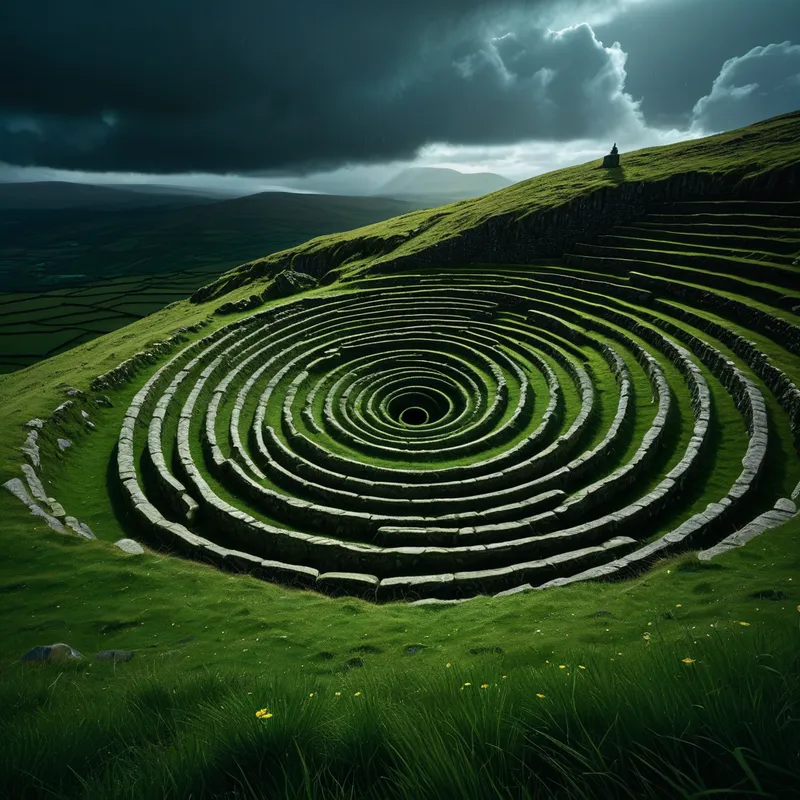
Cú took no sword, no shield. His only tool was a staff of [hawthorn](/myths/hawthorn “Myth from Celtic culture.”/), cut in the dead of winter. He approached the great spiral, not carved in stone but sunk into the very flesh of the land—a vast, grassy furrow leading inward. With his first step onto the path, the world shifted. [The sky](/myths/the-sky “Myth from Persian culture.”/) above was no longer grey but a swirling vault of stars moving too fast. The air thickened, carrying the scent of turned earth and ozone. He walked for what felt like days, the path curving ever inward, but the center seemed to recede, a teasing glimpse of a standing stone shrouded in mist.
Then came the whispers, not from without, but from within the turning path itself. They were his own doubts, given voice: You are lost. You are nothing. The pattern is broken because you are broken. The grass beneath his feet began to writhe like serpents. Shadows peeled from the banks of the spiral, taking forms of beasts he had slain, of friends he had failed. This was the Guardian—not a monster to fight, but the chaos of un-faced memory, the knotted dindshenchas of his own life, reflected back at him.
Cú did not raise his staff to strike. Instead, he stopped. He sank to his knees in the treacherous grass and did the one [thing](/myths/thing “Myth from Norse culture.”/) a warrior is never taught: he let go. He stopped pushing against the curve of the path and listened to its turn. He spoke his regrets to the shadows, named his fears to the whispering wind. And as he did, the writhing grass stilled. The hostile shadows, once sharp, softened and began to flow with the spiral, not against it. The path itself seemed to breathe.
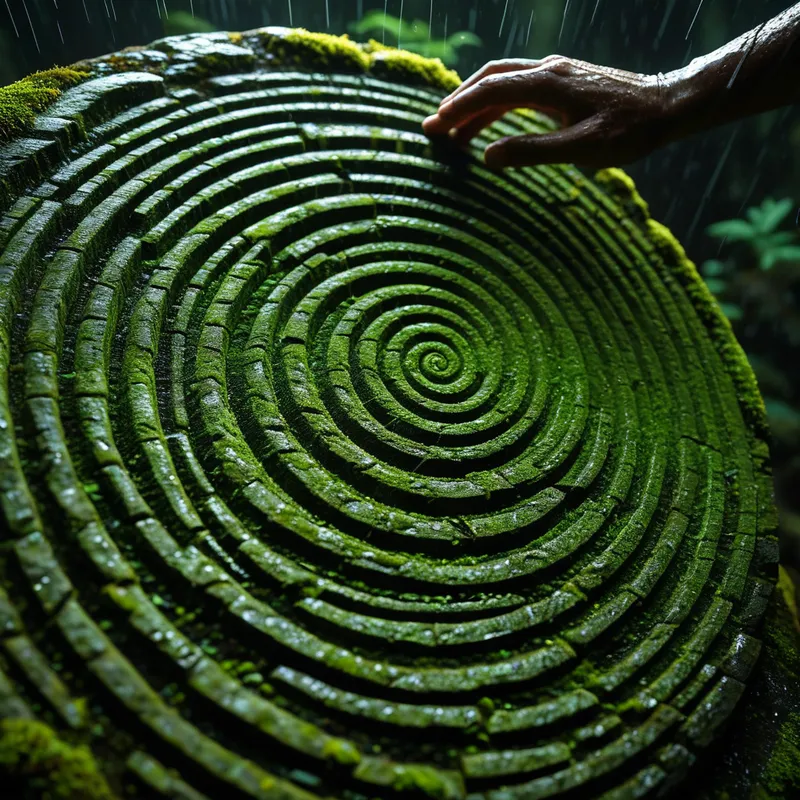
His journey inward became not a struggle, but a surrender to the direction of the curve. Finally, the banks fell away. He stood in the center, before a simple standing stone, its surface worn smooth by countless ages. At its base, the true pattern was revealed: a triple spiral, carved deep, pulsing with a gentle, gold light. It was not a symbol of endless toil, but of eternal motion—in, through, and out. Birth, life, death. Past, present, future. Without thought, Cú placed his palm upon the central nexus.
A shock, silent and profound, rang out through the land. On the hills, the people felt a great sigh move through [the earth](/myths/the-earth “Myth from Hindu culture.”/). The frozen streams groaned and began to flow. In the sky, the sun broke through, and the wind returned with the scent of spring rain. Cú emerged from the spiral not as a conqueror, but as a man who had met the center of himself. The Bithshníomh was not repaired by force, but remembered through a journey walked in full awareness. The pattern held, because he had learned to follow its turn.
Cultural Origins & Context
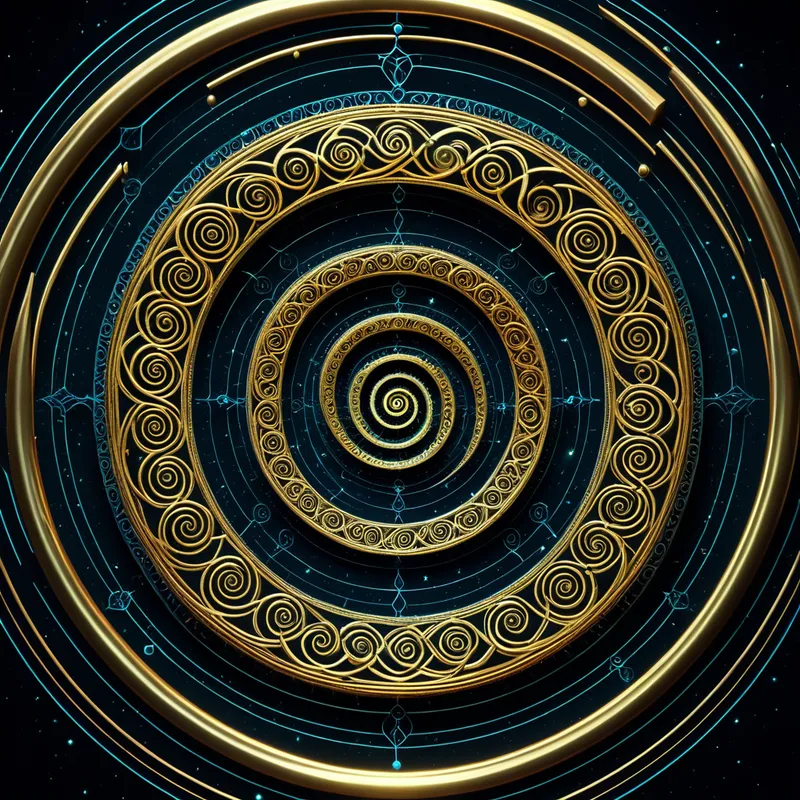
The spiral is one of the most ancient and persistent motifs in Celtic art, found incised on Neolithic passage tombs like Newgrange millennia before the historical Celtic cultures arose, and later adorning everything from stone crosses to illuminated manuscripts like the Book of Kells. This longevity suggests the symbol was not merely decorative but fundamentally ontological—a core concept about the nature of reality.
The myth of the hero and the living spiral exists not as a single, standardized narrative from a primary text (the ancient Celts left few written records of their myths), but as a deep, recurring pattern inferred from archaeology, later Irish and Welsh mythological cycles, and folk tradition. It was a story told not to record history, but to map cosmology. [The druids](/myths/the-druids “Myth from Celtic culture.”/) and filí were the keepers of this symbolic language, using such tales to teach about the structure of the universe ([Tír na nÓg](/myths/tr-na-ng “Myth from Celtic culture.”/) intersecting with our own), the journey of the soul, and the proper way to navigate a world perceived as inherently alive and patterned.
Societally, this myth functioned as a guide for navigating life’s transitions. The spiral path modeled [the hero’s journey](/myths/the-heros-journey “Myth from Global culture.”/) to [the otherworld](/myths/the-otherworld “Myth from Celtic culture.”/), the seasonal cycles of death and rebirth, and the individual’s passage through life’s stages. It taught that progress was not linear, but cyclical and inward-turning, that [the way](/myths/the-way “Myth from Taoist culture.”/) to the center (of a problem, a conflict, one’s destiny) required engaging with the turns, not resisting them.
Symbolic Architecture
At its [heart](/symbols/heart “Symbol: The heart symbolizes love, emotion, and the core of one’s existence, representing deep connections with others and self.”/), the spiral myth is about the [relationship](/symbols/relationship “Symbol: A representation of connections we have with others in our lives, often reflecting our emotional state.”/) between [chaos](/symbols/chaos “Symbol: In Arts & Music, chaos represents raw creative potential, uncontrolled expression, and the breakdown of order to forge new artistic forms.”/) and order, and the sacred [journey](/symbols/journey “Symbol: A journey in dreams typically signifies adventure, growth, or a significant life transition.”/) that connects them. The unraveling world represents a state of psychic [entropy](/symbols/entropy “Symbol: In arts and music, entropy represents the inevitable decay of order into chaos, often symbolizing creative destruction, impermanence, and the natural progression toward disorder.”/), where meaning has dissolved. The spiral itself is the archetypal [pattern](/symbols/pattern “Symbol: A ‘Pattern’ in dreams often signifies the underlying structure of experiences and thoughts, representing both order and the repetitiveness of life’s situations.”/) that contains both the journey and the [destination](/symbols/destination “Symbol: Signifies goals, aspirations, and the journey one is on in life.”/).
The spiral is the universe in motion; it is the breath of the world, the coil of time, and the labyrinth of the soul—all at once.
The [hero](/symbols/hero “Symbol: A hero embodies strength, courage, and the ability to overcome significant challenges.”/), Cú na Machaire, represents the conscious ego setting out with [intention](/symbols/intention “Symbol: Intention represents the clarity of purpose and direction in one’s life and can symbolize motivation and commitment within a dream context.”/). His initial goal—to “fix” the broken pattern—is [the ego](/myths/the-ego “Myth from Jungian culture.”/)‘s desire for control. The living [labyrinth](/symbols/labyrinth “Symbol: The labyrinth represents a complex journey, symbolizing the intricate path toward self-discovery and understanding one’s life’s direction.”/), the Lúbra, is the unconscious itself, with all its twists, repetitions, and hidden [depths](/symbols/depths “Symbol: Represents the subconscious, hidden emotions, or foundational aspects of the self, often linked to primal fears or profound truths.”/). The [Guardian](/symbols/guardian “Symbol: A protector figure representing safety, authority, and guidance, often embodying parental, societal, or spiritual oversight.”/)—the manifested shadows and whispers—is the personal [shadow](/symbols/shadow “Symbol: The ‘shadow’ embodies the unconscious, repressed aspects of the self and often represents fears or hidden emotions.”/), the repressed contents of the [psyche](/myths/psyche “Myth from Greek culture.”/) that rise up to meet anyone who dares to delve [inward](/symbols/inward “Symbol: A journey toward self-awareness, introspection, and the exploration of one’s inner world, thoughts, and unconscious mind.”/) without self-[awareness](/symbols/awareness “Symbol: Conscious perception of self, surroundings, or internal states. Often signifies awakening, insight, or heightened sensitivity.”/).
The critical turning point is not an act of battle, but of surrender and acknowledgment. This is the myth’s profound psychological [insight](/symbols/insight “Symbol: A sudden, deep understanding of a complex situation or truth, often arriving unexpectedly and illuminating hidden connections.”/): we do not integrate the unconscious by defeating it, but by recognizing it as part of our own pattern. The center, with its triple spiral, symbolizes the transcendent function—the point where opposites (conscious/unconscious, order/chaos, self/other) are held in a dynamic, generative [tension](/symbols/tension “Symbol: A state of mental or emotional strain, often manifesting physically as tightness, pressure, or unease, signaling unresolved conflict or anticipation.”/). It is the Self, in Jungian terms, the central organizing principle of the psyche that was there all along, waiting to be remembered.
The Dreamer’s Resonance
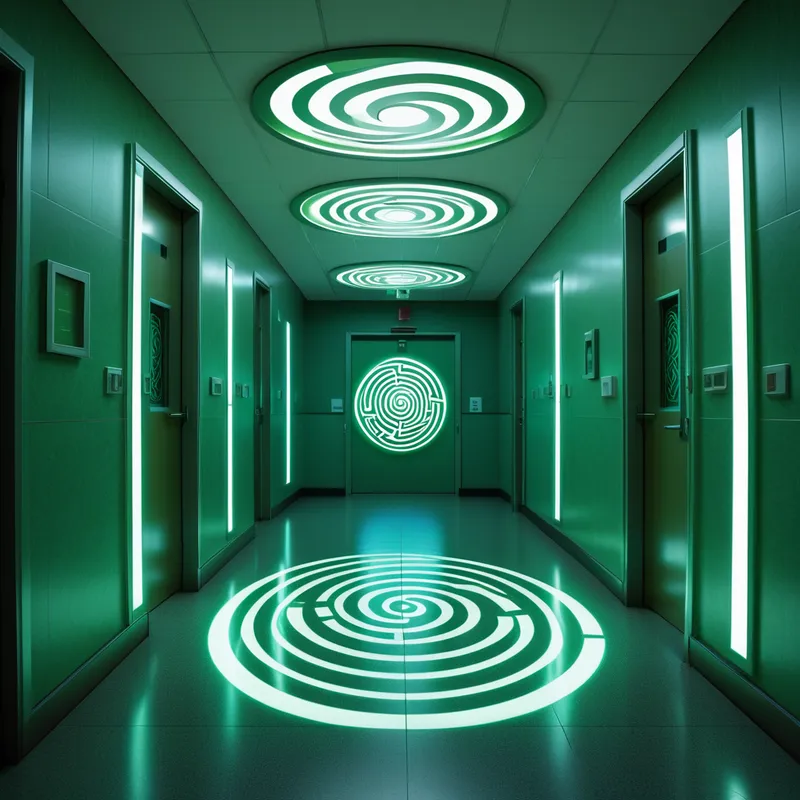
When the spiral appears in modern dreams, it is rarely a passive symbol. It is an active, somatic experience. You may dream of walking a spiral staircase that goes on forever, of driving on a looping highway, or of being caught in a whirlpool. The feeling is key: anxiety suggests you are resisting a necessary inward turn in your life, fighting a natural process of introspection or change. A sense of awe or calm suggests you are moving with the flow of a deep, psychic process.
These dreams often surface during life transitions—career shifts, the end of a relationship, a period of grief or creative blockage. The spiral is the psyche’s way of modeling the non-linear path of integration. You are not going in circles; you are navigating layers. Each loop of the dream spiral may bring you past a similar emotional “landscape” but at a deeper level, asking you to engage with it anew. The dream may present a “center”—a room, a person, a light—that feels both terrifying and magnetic. This is the call to confront the core complex, the central knot of the issue, which is often a foundational belief or memory. The dream spiral is the architecture of the soul’s own healing, insisting that the way out is through, and the way through is by turning inward.
Alchemical Translation
The myth of the spiral is a perfect allegory for the alchemical and Jungian process of individuation—the psychic transmutation of the base lead of the fragmented personality into the gold of the integrated Self. The process is not one of glorious, linear ascent, but of a disciplined, often disorienting, circulatio.
[The first stage](/myths/the-first-stage “Myth from Alchemical culture.”/), the [nigredo](/myths/nigredo “Myth from Alchemical culture.”/), is represented by the stagnant, dying world—the depression, confusion, or sense of meaninglessness that often initiates the individuation journey. The hero’s decision to enter the spiral is the [separatio](/myths/separatio “Myth from Alchemical culture.”/), the conscious decision to separate from collective norms and embark on a solitary quest for self-knowledge.
The long walk, with its confronting shadows, is the albedo and citrinitas—the washing and burning away of illusions. Here, the ego’s projections are withdrawn. The “monsters” are seen for what they are: parts of oneself. This is the painful, iterative work of shadow integration.
The alchemical vessel is the spiral path itself; its heated, rotating walls force the contents of the psyche to confront themselves until they transform.
The surrender in the center is the crucial coniunctio oppositorum—[the conjunction](/myths/the-conjunction “Myth from Alchemical culture.”/) of opposites. The ego surrenders its tyranny, not to be destroyed, but to be realigned with the greater Self. This is the moment of illumination, the [rubedo](/myths/rubedo “Myth from Alchemical culture.”/). The triple spiral that is “remembered” is the nascent, transcendent symbol born from this union—a new, guiding principle for the psyche that acknowledges life’s triple nature.
Emerging from the spiral, the hero returns to the world, but the world is changed because he is changed. This is the final stage: the multiplicatio. The integrated pattern within now informs his actions without. He lives from the center. The myth teaches that our personal healing is never just personal; by re-knitting our own fragmented pattern, we contribute to the coherence of the world around us. We restore the Bithshrníomh, one conscious turn at a time.
Associated Symbols
Explore related symbols from the CaleaDream lexicon: