The Spindle of Necessity Myth Meaning & Symbolism
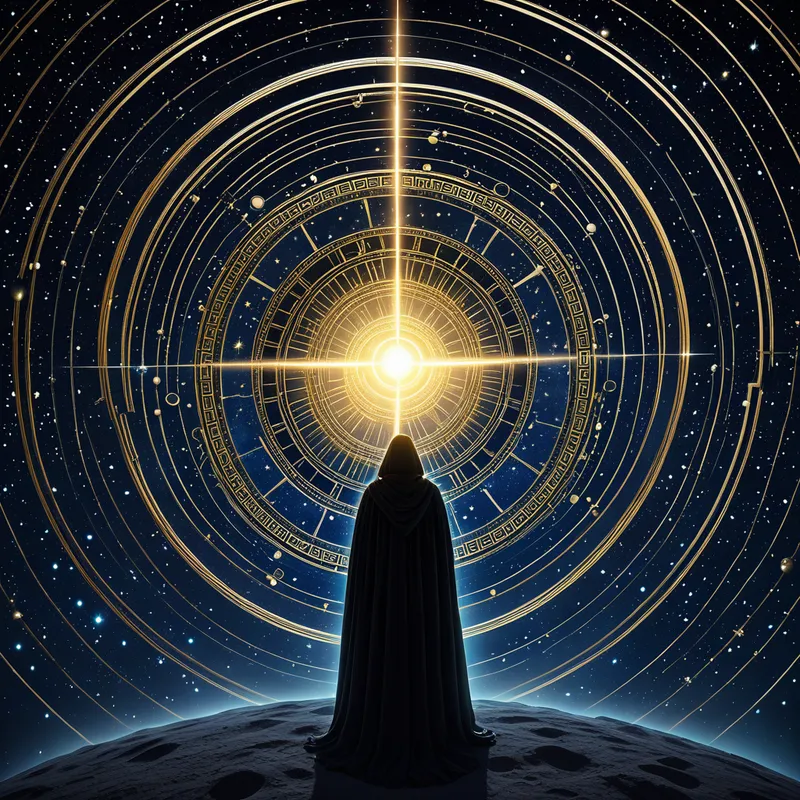
A vision of the cosmos as a divine spindle, turned by the Fates, dictating the immutable laws of destiny and the soul's cyclical journey.
The Tale of The Spindle of Necessity
Let me tell you of a vision not seen with mortal eyes, but beheld by a soul between lives. It is a tale told by a warrior named Er, who fell in battle and returned to tell of what lies beyond the veil of death.
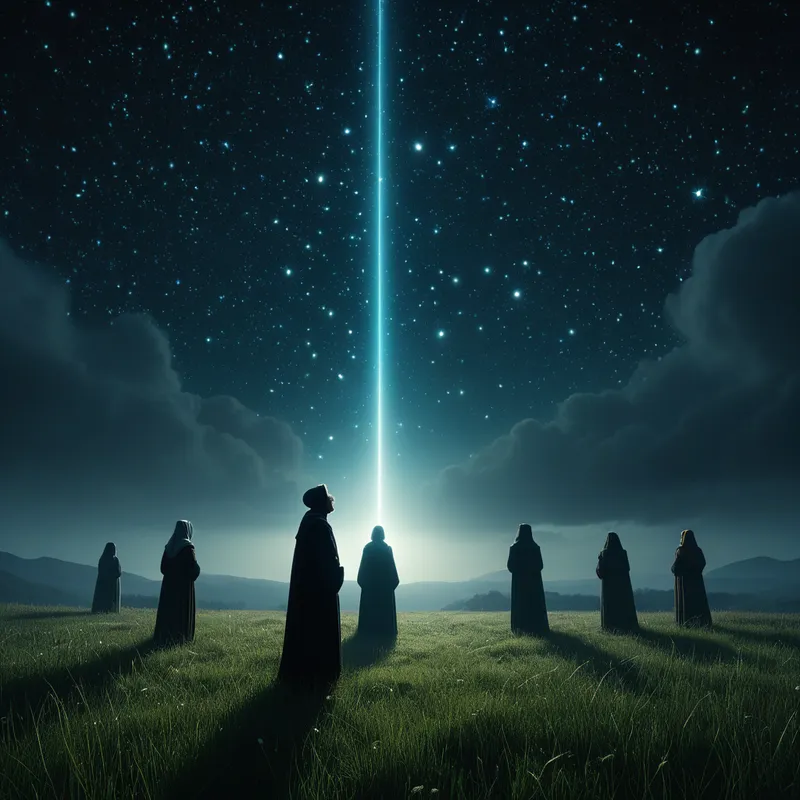
His soul, unmoored from his body, journeyed with a great company of spirits to a place of judgment—a meadow where four chasms opened into the earth and four into the sky. From these, souls ascended, radiant with the joy of a thousand years in paradise, or descended, weary and dust-stained from a millennium of atonement. Here, in this liminal field, the air hummed with the whispers of countless lives past and the murmur of lives yet to be.
From this place, the souls were led on a pilgrimage, a march of spirits that lasted four days, until they came to a sight that stole the breath from even the breathless. A pillar of light, straight as a plumb line, stretched from the heavens through the earth and all the cosmos. It was the Column of Light, the bond that holds the universe together.
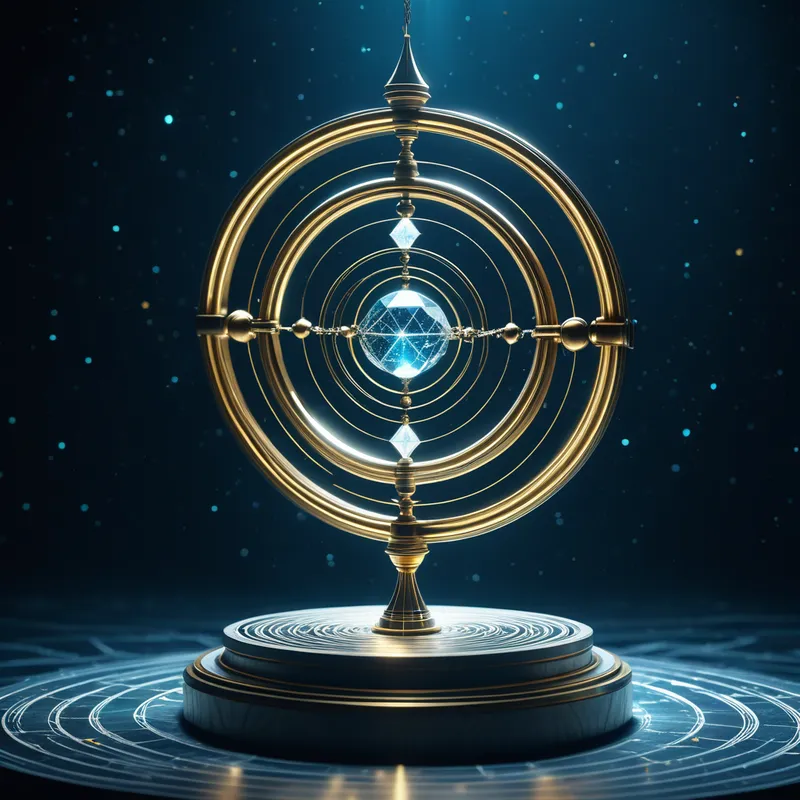
And wrapped around this column, like the heart of all creation, was a great Spindle of Necessity. Its shaft was of adamantine, unbreakable and eternal. Upon it turned eight concentric whorls, like bowls nested one within another, each a heavenly sphere: the fixed stars, the seven wandering planets. Each whorl was a different hue, singing a different note, a harmony that was the very music of the spheres.
Upon a circular throne sat Ananke, Necessity herself, robed and immutable. And around her, her daughters, the three Moirai, sang in time to the harmony. Clotho, with a touch of her right hand, turned the outer rim of the spindle. Lachesis, with alternating hands, touched the threads of destiny. And Atropos, with her left hand, touched what was spun, her shears at the ready.
Then came the moment of choosing. The souls were brought before Lachesis. A prophet scattered lots before them—the order in which they would choose their next life. And then, the prophet laid out before them a vast tapestry of lives: lives of tyrants and beggars, of animals and quiet citizens, of fame and obscurity. “Virtue knows no master,” the prophet declared. “You will choose, and your daimon will then enact the life you have chosen.”
In a frenzy of hope and fear, the souls chose. The greedy snatched at tyranny, only to later weep at their fate. The wise, having learned from past journeys, chose the life of a quiet seeker. Once chosen, each soul was led before the three Fates. Lachesis confirmed the destiny chosen. Clotho spun the thread of that life onto the spindle. And Atropos made the thread’s end inflexible.
Then, under a terrible, starless sky, the souls drank from the River of Unmindfulness, forgetting all they had seen. As they drank, they were swept upward like shooting stars to be born again, to live the lives they had chosen, bound to the turning of the great Spindle whose song they could no longer hear.
Cultural Origins & Context
This profound vision is not from a lost epic, but from the heart of Plato’s philosophical masterpiece, The Republic (Book X). It is the culminating myth of the dialogue, known as the “Myth of Er.” Plato, the master mythmaker, uses this story not as religious dogma, but as a philosophical allegory to cap his exploration of justice, the soul, and the ideal state.
Its function was pedagogical and psychological. In a culture rich with mystery cults and orphic traditions concerning the afterlife, Plato crafted a myth that served his philosophical aims: to illustrate the consequences of a life lived justly or unjustly, and to propose a model of cosmic order that was rational and mathematical. The Spindle, with its harmonious, geometrically precise whorls, reflects the Platonic ideal of a cosmos ordered by number and reason (kosmos). It was passed down not by bards at a feast, but by students in the Academy, a tool for contemplating the deepest questions of choice, fate, and the soul’s eternal nature.
Symbolic Architecture
The Spindle of Necessity is the ultimate symbol of cosmic determinism and soulful agency locked in a divine dance. It represents the immutable framework of reality—the physical laws, the cycles of time, the consequences of action—within which the drama of free will plays out.
The Spindle is the axis of the world, the still point around which the chaos of potential becomes the order of lived experience.
- The Adamantine Shaft: The unbreakable, central pillar is the law of cause and effect itself. It is reality’s backbone, the principle that actions have inescapable consequences, that every choice spins a thread that will be woven into the fabric of a life.
- The Eight Whorls: These are the celestial spheres, a model of the universe. They symbolize the totality of existence, all levels of being from the divine (fixed stars) to the planetary influences that shape mortal fate. Their harmony is the music of the spheres, the perfect, rational order underlying apparent chaos.
- Ananke & The Moirai: Ananke is impersonal, blind force—the “must-be” of the universe. The Fates personify the application of this force to individual life: the spinning (beginning), measuring (duration), and cutting (end) of each destiny. They are not cruel, but implacable administrators of a law-based cosmos.
- The Choice of Lives: This is the myth’s brilliant psychological core. The soul is ultimately responsible. The “lot” is chance, the circumstances one is born into. But the choice of life pattern is the soul’s own, guided—or misled—by its previous experiences and character. We are bound by the consequences of our own deepest choices.
The Dreamer’s Resonance
When this myth stirs in the modern unconscious, it often manifests not as a literal spindle, but as a profound feeling of being caught in a vast, impersonal system. One might dream of intricate clockwork, bureaucratic labyrinths with immutable rules, or being a cog in a giant, turning machine. The somatic sensation is often one of weight, pressure, or a humming vibration—the feeling of being subject to forces beyond one’s control.
Psychologically, this dream-pattern emerges when the individual confronts a “crossroads of necessity.” It could be a major life decision (career, relationship) that feels fated, a reckoning with the consequences of past actions, or a deep meditation on life’s purpose. The dream is the psyche wrestling with the tension between fate and free will. The oppressive machinery represents the perceived constraints (societal, familial, karmic), while the dreamer’s role within it—whether passive victim or active agent trying to understand the controls—reveals their attitude toward their own destiny. It is the soul’s own “meadow of judgment,” reviewing the life it has spun.
Alchemical Translation
The individuation process, the alchemy of becoming whole, is mirrored perfectly in the journey of Er. It is the movement from being a passive thread on the Spindle to becoming a conscious co-creator of its turning.
First, one must have the “vision of Er”—a psychological death and descent. This is the dissolution of the ego’s certainties, a dark night of the soul where one’s personal myth collapses. In this space, we see the “Column of Light,” the Self, the central, ordering principle of the psyche that has been there all along, holding the chaos together.
Individuation is the process of drinking less from the River of Unmindfulness, of remembering the choice you made before the Fates and consciously re-spinning its thread.
Confronting the Moirai within means acknowledging the inner Ananke: the neurotic patterns, the family destinies, the core wounds that feel like fate. Lachesis is the voice that says, “This is how long you have suffered this pattern.” Clotho is the creative impulse that can begin to spin a new narrative. Atropos is the ruthless courage needed to cut what no longer serves life.
The final alchemy is in the “choice of lives.” In our daily existence, we are constantly choosing the pattern of our next “life”—not in a literal rebirth, but in the rebirth of attitudes, relationships, and projects. The wise soul, having learned from past sufferings (the “thousand-year journeys” of our inner history), does not snatch at the glittering lot of tyranny (ego-inflation) or the miserable lot of victimhood. It chooses the life of integrated responsibility, the pattern that allows for growth, connection, and justice. We bind ourselves to the Spindle not as slaves, but as those who, in understanding its immutable revolutions, find within them the freedom to sing our own note in the cosmic harmony.
Associated Symbols
Explore related symbols from the CaleaDream lexicon: